

GDPR has set the global standard for data privacy, but it's far from the only regulation businesses need to worry about. In fact, a growing number of regions have their own strict regional privacy laws that can catch companies off guard. If your business handles data from California, Brazil, or other jurisdictions, you're likely dealing with a maze of overlapping requirements. This article breaks down the key regional privacy laws beyond GDPR, including CCPA and LGPD, and explains what you need to know to stay compliant.
California Consumer Privacy Act (CCPA)
California Consumer Privacy Act (CCPA)A California state law that gives residents control over their personal data, including the right to know what data is collected, delete it, and opt out of sales. Enacted in 2018 and effective January 1, 2020, the CCPA is one of the most significant privacy laws in the United States. It applies to businesses that collect personal information from California residents and meet certain criteria: annual revenue over $25 million, buying/selling data of 50,000+ consumers, or deriving 50%+ revenue from selling personal data.
Under CCPA, consumers can request what data a business has collected about them, ask for deletion, and opt out of the sale of their data. Businesses must provide clear opt-out links on their websites and respond to requests within 45 days. Violations can result in fines up to $7,500 per intentional violation. For example, in 2023, a major retail chain faced a $1.2 million penalty for failing to honor consumer deletion requests.
Brazil's General Data Protection Law (LGPD)
Brazil's General Data Protection Law (LGPD)Brazil's comprehensive data protection law modeled after GDPR, covering personal data processing of individuals in Brazil. LGPD took effect in September 2020 and applies to any organization processing personal data of Brazilian residents, regardless of where the company is based. This includes foreign companies targeting Brazilian consumers or processing data within Brazil.
Key requirements include obtaining explicit consent for data processing, appointing a Data Protection Officer (DPO), and reporting data breaches within 72 hours. Penalties are severe: up to 2% of a company's annual revenue in Brazil (capped at 50 million Brazilian reais per violation). In 2024, a Brazilian e-commerce platform was fined R$2.3 million for inadequate security measures that led to a data leak affecting 1.2 million users.
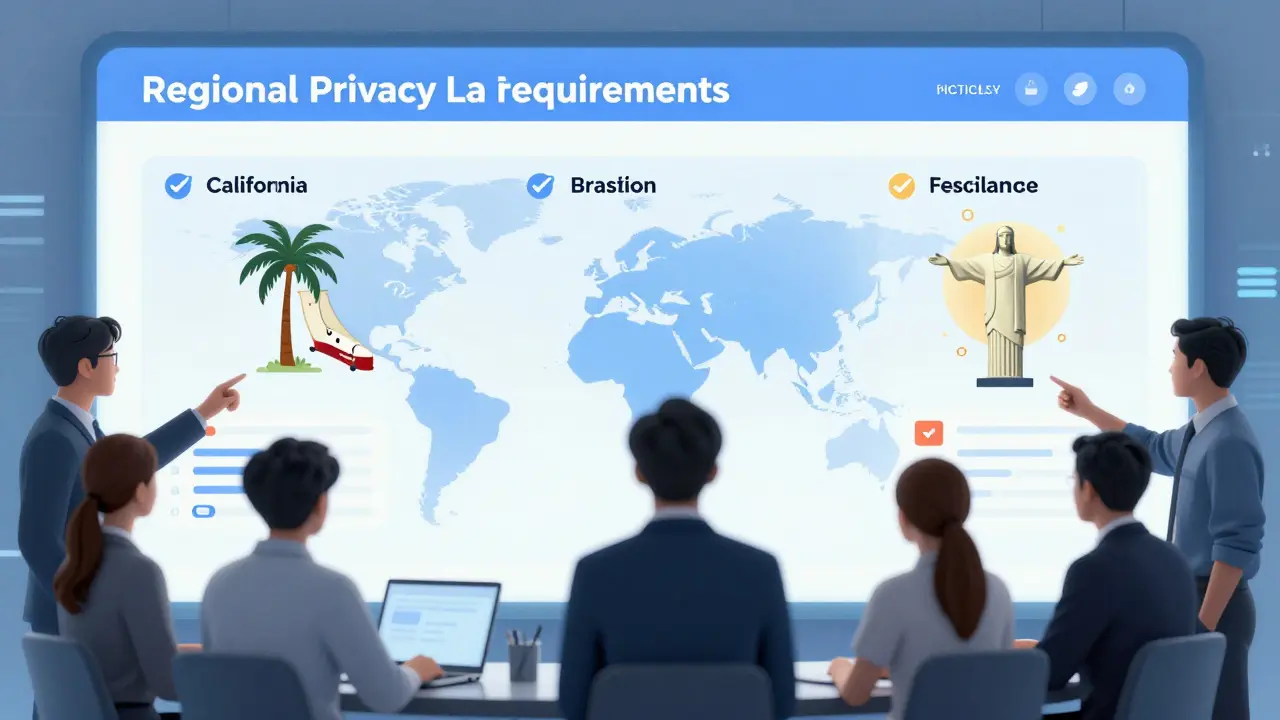
Other Notable Regional Privacy Laws
While CCPA and LGPD are major players, several other regions have enacted robust privacy regulations:
- Virginia Consumer Data Protection Act (VCDPA): Effective January 2023, this law applies to Virginia residents and requires businesses to obtain consent for sensitive data processing. It mirrors CCPA but includes additional requirements for data minimization and purpose limitation.
- Colorado Privacy Act (CPA): Launched August 2023, CPA grants Colorado residents similar rights to CCPA but with stricter rules on data minimization and algorithmic transparency. Fines can reach $20,000 per violation.
- Personal Information Protection and Electronic Documents Act (PIPEDA): Canada's federal privacy law since 2001, governing private-sector data handling. It requires organizations to obtain consent and protect personal information during cross-border transfers.
- Personal Data Protection Act (PDPA): Singapore's comprehensive data protection framework since 2012. It mandates consent for data collection and imposes fines up to SGD 1 million for serious breaches.
- Nevada Privacy Law (SB 220): Enacted in 2019, this law gives Nevada residents the right to opt out of data sales. It applies to businesses operating in Nevada with over $25 million in revenue.
| Law | Effective Date | Key Rights | Penalties | Applicability Threshold |
|---|---|---|---|---|
| CCPA (California) | 2020 | Access, deletion, opt-out of sales | Up to $7,500 per violation | $25M+ revenue, 50k+ residents' data |
| LGPD (Brazil) | 2020 | Access, correction, deletion, portability | Up to 2% of revenue | Any processing of Brazilian residents' data |
| VCDPA (Virginia) | 2023 | Access, deletion, correction, opt-out | Up to $7,500 per violation | $25M+ revenue or 100k+ residents' data |
| CPA (Colorado) | 2023 | Access, deletion, correction, opt-out | Up to $20,000 per violation | $25M+ revenue or 100k+ residents' data |
| PIPEDA (Canada) | 2001 | Access, correction, consent | Civil penalties up to $100k | Private sector organizations in commercial activities |
| PDPA (Singapore) | 2012 | Access, correction, consent | Up to SGD 1M | Organizations processing data in Singapore |
Staying Compliant Across Multiple Jurisdictions
Managing compliance across different privacy laws is challenging but manageable with a structured approach:
- Map your data flows: Track where personal data enters, moves through, and exits your systems. Use tools like data discovery software to identify all touchpoints.
- Update privacy policies: Create jurisdiction-specific disclosures that clearly explain data practices for each region. For example, CCPA requires a "Do Not Sell My Personal Information" link, while LGPD needs a dedicated DPO contact.
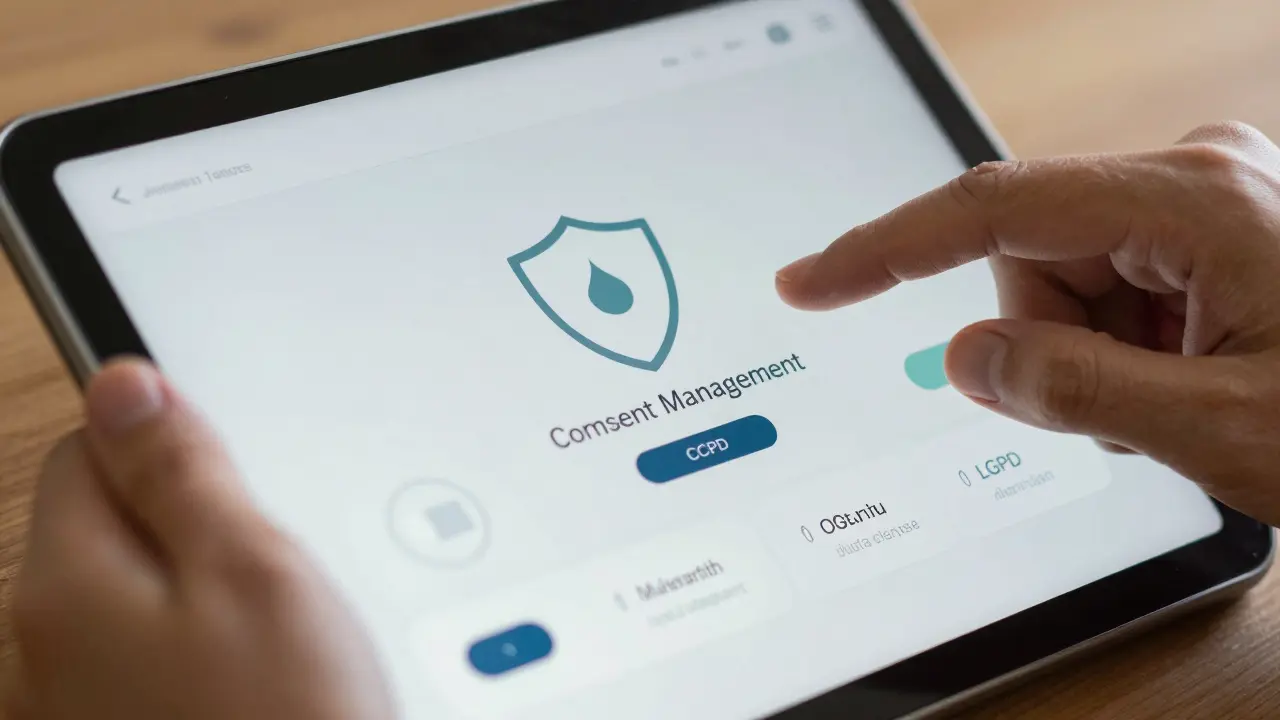
- Implement consent management: Use a unified consent platform that adapts to regional requirements. For instance, GDPR requires explicit opt-in consent, while CCPA focuses on opt-out mechanisms.
- Train staff on regional differences: Educate teams on specific obligations. Sales teams need to know about CCPA's opt-out rules, while customer support must handle LGPD's 72-hour breach notification.
- Conduct regular audits: Test your systems quarterly for compliance gaps. For example, check if data retention policies align with each region's requirements-Brazil's LGPD mandates deletion after 10 years, while California's CCPA has no fixed timeframe.
Common Mistakes and How to Avoid Them
Many businesses stumble on these pitfalls when navigating regional privacy laws:
- Assuming GDPR covers everything: GDPR and CCPA have different definitions of "personal data." For example, IP addresses and device identifiers count as personal data under CCPA but not always under GDPR. Always verify definitions per jurisdiction.
- Ignoring local enforcement trends: Brazil's LGPD enforcement has been aggressive since 2023, with fines increasing 30% year-over-year. Similarly, California's Attorney General has filed 12 lawsuits against businesses for CCPA violations in 2024 alone.
- Overlooking third-party risks: If your marketing agency shares data with advertisers without proper consent, you're liable. Ensure contracts with vendors include specific compliance clauses for each region.
- Delaying breach response: LGPD requires breach notifications within 72 hours, while CCPA has no specific timeline but demands "reasonable and timely" action. Having a pre-defined incident response plan is critical.
Does GDPR compliance cover CCPA requirements?
No. While GDPR and CCPA share similarities like data subject rights, CCPA has unique requirements such as the right to opt-out of data sales and specific business thresholds. GDPR applies globally to EU residents, while CCPA is limited to California residents. Businesses must address both separately.
What's the biggest mistake companies make with regional privacy laws?
Assuming GDPR compliance covers all other laws. Many companies overlook that each region has unique rules. For example, LGPD requires a Data Protection Officer (DPO) in Brazil, while CCPA does not. Ignoring these differences can lead to hefty fines.
How do I know if my business is subject to LGPD?
LGPD applies if you process personal data of individuals in Brazil or offer goods/services to Brazilian residents. This includes foreign companies with websites accessible in Brazil or processing data from Brazilian customers. Even small businesses with one Brazilian customer must comply.
Can I use the same privacy policy for all regions?
No. Each law has specific disclosure requirements. For example, CCPA requires a "Do Not Sell" link, while GDPR mandates detailed explanations of data processing purposes. Using a generic policy risks non-compliance. Tailor disclosures for each jurisdiction.
What happens if I ignore regional privacy laws?
Penalties can be severe. For instance, Brazil's LGPD fines can reach 2% of a company's revenue (up to R$50 million per violation). California's CCPA allows $7,500 per intentional violation. In 2024, a major tech firm paid $4.5 million to settle CCPA violations after failing to honor consumer deletion requests.

Comments (12)
Taylor Hayes February 6 2026
Regional privacy laws can be overwhelming, but this breakdown really helps.
I've been struggling to keep up with all these regulations, but seeing them compared side-by-side makes it clearer.
It's crucial for businesses to map their data flows properly-many overlook how data moves across departments and third parties.
A structured approach like the one outlined here is exactly what's needed.
Also, the mention of LGPD's 72-hour breach notification is a good reminder; companies often forget the urgency there.
Overall, a solid guide for anyone navigating this maze.
Sanjay Mittal February 6 2026
CCPA's requirements are clear, but many businesses miss the mark on the 'opt-out of sales' part. It's not just about the link; you need to actually process those requests within 45 days. Also, the $25M revenue threshold is often misunderstood-it's either revenue over $25M OR handling data of 50k+ consumers. Either way, it's a big deal for mid-sized companies. For LGPD, the key is the DPO and 72-hour breach notification. Missing those can lead to huge fines. This article does a good job highlighting the differences.
Mike Zhong February 7 2026
Agree with Taylor's points, but let's get real-regional privacy laws are just a distraction. Companies should focus on global standards instead of chasing every new regulation. The CCPA and LGPD are essentially GDPR clones with minor tweaks. Why can't we just have one universal standard? It's ridiculous how much time and money businesses waste on compliance when it's all just the same thing with different names. This article is just adding to the noise.
Jamie Roman February 8 2026
Man, this article really nails the complexity of regional privacy laws. I've been working with clients trying to comply with CCPA and LGPD, and the overlap is such a headache.
Like, the definition of personal data differs-CCPA includes IP addresses as personal data, while GDPR doesn't always, which means even if you're GDPR-compliant, you might still be missing the mark for California.
And the penalties! $7,500 per intentional violation under CCPA? That's a lot for a small business. I've seen companies get hit with six-figure fines just for not having proper opt-out mechanisms.
The data mapping part is key too. You can't just assume you know where all your data is; you need to use discovery tools to track it.
Also, the VCDPA and CPA in Virginia and Colorado are easy to overlook. They're similar to CCPA but with nuances, like stricter data minimization rules.
And for Brazilian companies under LGPD, the DPO requirement is a big deal. You can't just wing it; you need someone dedicated.
Oh, and third-party risks! So many breaches happen because vendors aren't compliant. I've had clients who didn't check their marketing agencies' data practices, and then got fined because of them.
Training staff is another thing-sales teams need to know about opt-out requests, while support needs to handle breach notifications fast.
It's a lot, but breaking it down step by step helps.
I think the biggest takeaway is that you can't treat all privacy laws the same. Each region has its own quirks, and a one-size-fits-all policy is a recipe for disaster.
Maybe start with a compliance audit to see where you stand. It's not easy, but it's doable if you take it one step at a time.
Salomi Cummingham February 8 2026
Oh my goodness, Jamie, you've absolutely nailed it! I've been dealing with this exact issue for months, and your breakdown is spot on.
Just last week, a client of mine got hit with a $1.2 million penalty because they didn't have the 'Do Not Sell' link properly implemented on their site.
And the data mapping part-so true! We used a tool to track everything, and it was a game-changer.
But here's the thing: the VCDPA and CPA are sneaky. They seem similar to CCPA, but the data minimization rules are way stricter.
And the DPO requirement for LGPD? Total game-changer for companies in Brazil. I've seen so many small businesses ignore that and then get slammed.
Third-party risks are the worst. I had a client who thought their marketing agency was compliant, but they weren't, and then the whole thing blew up.
Training staff is crucial. Sales teams need to know about opt-out requests, but they're often not trained properly.
It's such a mess, but this article is a lifesaver.
I can't believe how much detail you went into-this is exactly what businesses need.
Maybe we should all push for a unified global standard? But until then, we've got to tackle each law individually.
Thanks for sharing this-really appreciate it!
Johnathan Rhyne February 8 2026
Salomi, you're close, but let's correct some things.
First, 'Do Not Sell' link is actually 'Do Not Sell or Share My Personal Information' under CCPA-'sell' alone is outdated.
And 'data minimization' under CPA isn't 'stricter'-it's explicitly required, unlike CCPA's vague language.
Also, LGPD's DPO isn't a 'game-changer'-it's a legal requirement, period.
And third-party risks aren't 'the worst'-they're the primary cause of breaches.
Grammar check: 'I've seen so many small businesses ignore that and then get slammed'-should be 'slammed' or 'fined'-'slammed' is slang.
Also, 'push for a unified global standard'-no, that's unrealistic. Each region has unique needs.
Just saying, details matter.
Jawaharlal Thota February 9 2026
Reading this article really helped me understand the nuances between different privacy laws.
For example, the CCPA and LGPD both have deletion rights, but LGPD also includes data portability, which is a big deal for users.
I've been advising clients to create jurisdiction-specific privacy policies-generic ones just don't cut it.
And the penalties section is eye-opening. $20,000 per violation under CPA? That's brutal for startups.
One thing missing here is how to handle cross-border transfers. PIPEDA in Canada has specific rules for that.
Also, the Nevada Privacy Law (SB 220) is often overlooked-it's only for Nevada residents, but if your business operates there, you need to comply.
Training employees is critical. I've seen companies fail because their support staff didn't know how to handle deletion requests.
Maybe add a section on how to train teams effectively? Like, role-specific training modules.
This article is a great start, but there's more to cover.
Overall, it's a solid resource for businesses trying to stay compliant.
Thanks for the detailed breakdown!
Lauren Saunders February 9 2026
Jawaharlal, your advice is so basic. Of course, jurisdiction-specific policies are needed-anyone with half a brain knows that.
But you're missing the bigger picture. The real issue is that these laws are all just copy-pasted from GDPR with minor tweaks.
And 'cross-border transfers' under PIPEDA? That's irrelevant for most businesses outside Canada.
Also, 'Nevada Privacy Law'-who even cares about Nevada? It's a tiny market.
And training employees? Please. It's not rocket science.
This article is adequate, but your comments are beneath the topic.
Maybe focus on something more substantive next time.
Andrew Nashaat February 9 2026
First off, the article has a glaring error: 'LGPD' is spelled correctly, but the section says 'LGPD'-wait, no, it's correct. However, in the 'Comparison' table, it says 'LGPD (Brazil)'-wait, no, it's correct. However, the article says 'LGPD took effect in September 2020'-but it was actually August 2020. September is wrong.
Also, 'data protection officer' should be capitalized as 'Data Protection Officer' (DPO).
And 'penalties can reach $20,000 per violation' for CPA-actually, it's $20,000 per violation, but the law states 'up to $20,000', so the phrasing is off.
Also, in the table, 'VCDPA (Virginia)'-it's 'Virginia Consumer Data Protection Act', so the table should say 'VCDPA' not 'VCDPA (Virginia)'-redundant.
And 'PIPEDA (Canada)'-it's 'Personal Information Protection and Electronic Documents Act', so the acronym is correct, but the table says 'PIPEDA (Canada)', which is fine.
But the biggest mistake is the claim that 'GDPR and CCPA have different definitions of personal data'-actually, they're very similar, but CCPA includes 'household' data. However, the article says 'IP addresses and device identifiers count as personal data under CCPA but not always under GDPR'-that's incorrect; GDPR does consider IP addresses as personal data.
So, the article is full of inaccuracies. Please correct them.
Janiss McCamish February 10 2026
CCPA's opt-out link is non-negotiable. Skip it and you're risking fines.
Richard H February 10 2026
Janiss, you're absolutely right-CCPA's opt-out is critical. But what about the US federal laws? We don't need state-specific rules. It's a mess. Why can't we have one national standard? California's law is driving the whole country crazy with these regulations. We need federal preemption. Stop the chaos!
Kendall Storey February 10 2026
From a compliance standpoint, leveraging a unified consent management platform (CMP) is essential for handling multi-jurisdictional requirements. The article's emphasis on data flow mapping is spot-on-without it, you're flying blind. Also, ensuring that your DPO (for LGPD) and privacy officers are properly trained on regional nuances is non-negotiable. The penalties for non-compliance are severe, so proactive audits and vendor risk assessments should be baked into your ops. Overall, this is a solid primer for navigating the regulatory landscape-just remember to tailor your approach per jurisdiction. Stay chill, but stay compliant!