

When a company sends its team to a meeting in Tokyo, Berlin, or São Paulo, the real barrier isn’t the flight cost-it’s the language gap. Employees who can’t ask the right questions, read a contract in Spanish, or make small talk in Mandarin lose opportunities before they even sit down. Corporate language training isn’t about adding another box to the HR checklist. It’s about unlocking performance, building trust, and closing deals that would otherwise slip away.
Why Corporate Language Training Fails (And How to Fix It)
Most companies treat language training like a one-size-fits-all course: 12 weeks of online lessons, a final quiz, and a certificate that gathers dust. That’s not training. That’s a performance review with extra steps.
Real success starts with a simple question: What do your employees actually need to say? A sales rep in Germany needs to negotiate pricing terms and handle objections. A project manager in India needs to clarify deadlines and manage remote teams over Zoom. A logistics coordinator in Mexico needs to read customs forms and confirm delivery windows.
One UK-based engineering firm realized their team was losing contracts in Brazil because they couldn’t follow technical discussions in Portuguese. They didn’t need general fluency-they needed 50 key phrases for engineering specs, 20 common negotiation phrases, and the ability to understand regional accents. They redesigned their program around real job tasks. Within six months, their win rate in Brazil jumped by 42%.
Generic courses fail because they teach vocabulary, not context. Effective programs map language skills directly to job functions. That means working with managers to identify the exact situations where language barriers hurt performance. Then, building lessons around those moments.
Designing a Program That Actually Works
There’s no magic formula, but there are five non-negotiables for a corporate language program that delivers results.
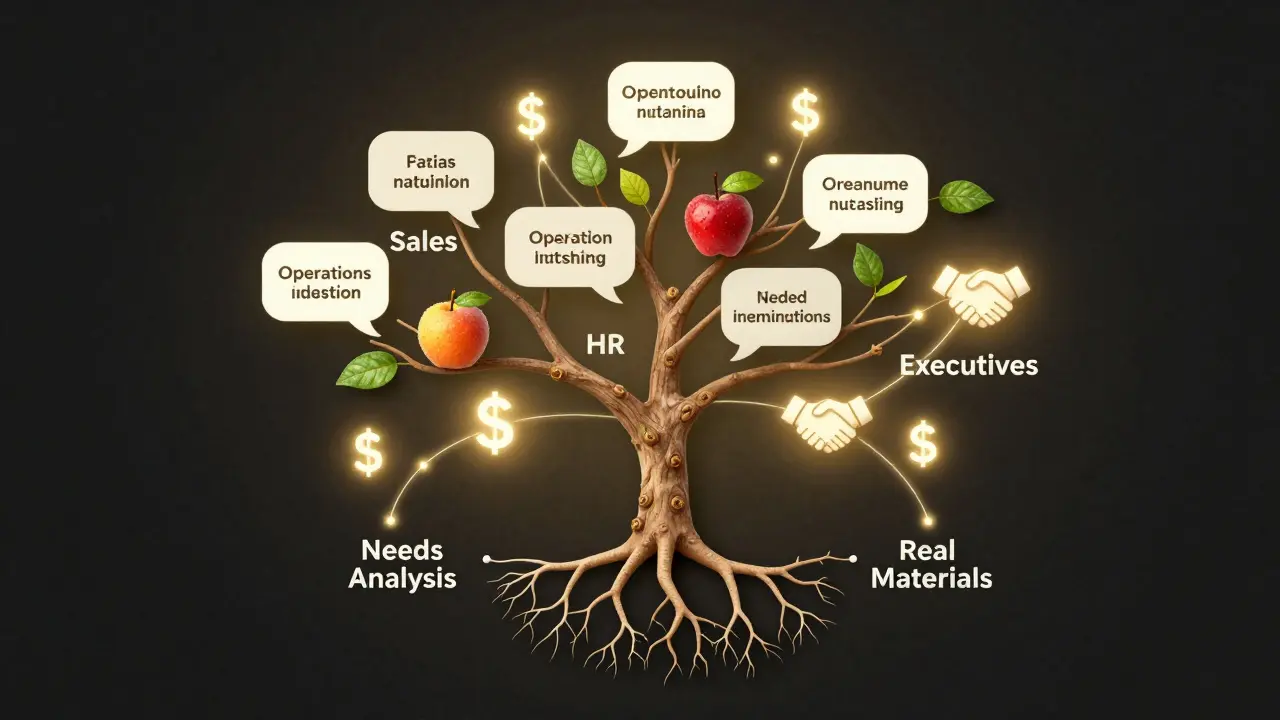
- Start with a needs analysis-not a survey. Sit with department heads. Review past miscommunications. Listen to recorded client calls. Find the phrases people stumble over.
- Use real materials-emails your team receives, contracts they sign, presentations they give. Don’t use textbook dialogues about ordering coffee. Use actual documents from your business.
- Focus on speaking and listening first-reading and writing matter, but in global meetings, it’s the spoken word that builds trust. Prioritize pronunciation, intonation, and real-time comprehension.
- Keep it short and frequent-20 minutes a day, five days a week, beats a 90-minute weekly class. Microlearning sticks better. People forget what they learn in long sessions if they don’t use it right away.
- Include cultural context-saying ‘no’ directly might be clear in English, but in Japan or South Korea, it can come across as rude. Training should include how tone, silence, and body language change meaning across cultures.
One multinational logistics company switched from monthly in-person classes to daily 15-minute mobile lessons with AI-powered feedback. Employees practiced negotiating delivery delays with Spanish-speaking suppliers. After three months, their on-time delivery rate improved by 28%. Why? Because they were practicing the exact conversations they had every week.
Measuring Outcomes: Beyond Fluency Scores
Most companies measure success by test scores. That’s like judging a chef by how well they can name ingredients-not by how tasty the food is.
Real outcomes are visible in business results:
- Reduction in project delays caused by miscommunication
- Increase in client retention in international markets
- Higher employee confidence in cross-border meetings (measured by internal surveys)
- More deals closed without needing a translator
- Faster onboarding of international hires because local staff can communicate directly
A Canadian software firm tracked how often their sales team had to pause calls to get help from a bilingual colleague. Before training, it happened 3-5 times per call. After nine months of targeted Spanish training, that dropped to once every 10 calls. The time saved added up to 140 extra client conversations per quarter.
Don’t just ask, “Did they learn Spanish?” Ask, “Did they close more deals?” “Did clients say they felt understood?” “Did internal friction drop?” Those are the metrics that matter to leadership.

Technology’s Role-And Its Limits
AI tutors, speech recognition apps, and language platforms like Duolingo for Business have made training more accessible. But tech alone won’t fix a poorly designed program.
Good tech enhances human interaction. It gives employees instant feedback on pronunciation. It tracks progress on specific phrases. It simulates client calls with realistic accents. But it can’t replace coaching.
One company in Edinburgh used an AI platform to teach Mandarin to their procurement team. The software flagged pronunciation errors. But when they added monthly one-on-one sessions with a native-speaking business coach, completion rates jumped from 52% to 89%. Why? Because the coach helped them navigate awkward silences, interpret indirect refusals, and adjust tone based on the supplier’s reaction.
Technology is a tool. The human element-the coach, the manager, the peer who practices with you-is what turns language learning into real-world skill.
Who Benefits the Most?
Not every employee needs language training. But some roles benefit far more than others:
- Sales and account managers-direct client contact in foreign markets
- Project and operations leads-managing international teams or suppliers
- Customer support teams-handling complaints or inquiries from non-native speakers
- HR and recruitment staff-onboarding global hires or managing remote teams
- Executives and board members-attending global summits or negotiating with overseas partners
Companies that prioritize these roles see the fastest ROI. Training everyone at once spreads resources too thin. Start with the teams that lose money-or opportunities-because of language.
Common Pitfalls to Avoid
Even well-intentioned programs stumble. Here’s what to watch out for:
- Assuming everyone learns the same way-some people learn best by listening. Others need to write things down. Offer multiple formats.
- Not involving managers-if managers don’t encourage practice or create opportunities to use the language, training fades.
- Only training the “high performers”-language skills should be a tool for everyone, not a reward. Exclude no one who needs it.
- Forgetting about retention-without regular practice, skills decay fast. Build in peer practice groups or monthly language challenges.
- Using native speakers as teachers without training them-just because someone speaks fluent French doesn’t mean they know how to teach it to adults in a business context.
One UK-based manufacturing company trained 50 employees in German. Six months later, only 12 were still using it regularly. Why? No one in their department spoke German. There were no meetings with German clients. No one asked them to use it. They had the skills-but no reason to use them. They fixed it by pairing each trained employee with a German supplier for monthly check-ins. Usage shot up.
What Success Looks Like in 12 Months
After a year of a well-designed program, you’ll see:
- Employees initiating conversations in the target language without hesitation
- Reduced reliance on translators for routine communications
- Higher satisfaction scores from international clients
- More employees volunteering for international assignments
- Managers citing language skills as a key factor in promotions
It’s not about fluency. It’s about confidence. It’s about knowing you can say the right thing at the right time-even if your grammar isn’t perfect.
Companies that treat language as a business skill-not a soft skill-outperform those that don’t. They close deals faster. They retain talent better. They build stronger relationships across borders.
The question isn’t whether your company needs language training. It’s whether you can afford not to have it.
How long does it take for employees to see real results from corporate language training?
Real results show up in 3 to 6 months if the training is tied to actual job tasks. Employees who practice daily in real situations-like sending emails, joining calls, or negotiating with clients-start using the language naturally within that timeframe. Fluency takes longer, but confidence and clarity come much faster.
Should we train employees in multiple languages at once?
No. Trying to learn two languages at once splits focus and slows progress. If your team works with clients in Spain and Japan, train them in Spanish first, then add Japanese later. Prioritize based on business volume and impact. One language mastered is worth more than two half-learned.
What’s the average cost of a corporate language training program?
Costs vary widely. Basic online platforms start at £50-£100 per employee per year. Custom programs with coaching and real-business materials range from £500 to £1,500 per person annually. The ROI often comes back in just a few months through faster deal closures, fewer errors, and improved client retention.
Can remote employees benefit from language training?
Absolutely. In fact, remote teams benefit even more. Without face-to-face interaction, clear communication becomes critical. Mobile-based lessons, video role-plays, and virtual practice sessions with native speakers work well for remote workers. The key is making practice part of their daily routine, not an extra task.
How do we get leadership to invest in language training?
Don’t sell it as a perk. Sell it as a revenue driver. Show data: lost deals, delayed projects, or customer complaints tied to language issues. Present a pilot program with clear KPIs-like reduction in translation costs or increase in international sales. Track results for 90 days. Then show the numbers. Leadership cares about outcomes, not language lessons.

Comments (14)
Paritosh Bhagat December 31 2025
Okay but let’s be real-most companies throw Duolingo at employees and call it a day. I’ve seen this so many times. HR sends out a link, everyone ignores it for 11 weeks, then takes the quiz while eating lunch. Certificate printed. Done. No one speaks the language. No one cares. It’s theater. And the worst part? They still bill it as ‘investment in global growth.’ Lol.
Adrienne Temple January 2 2026
My team in Mexico just started daily 15-min Spanish drills using real client emails. We used to have to loop in the bilingual guy for every contract tweak. Now? My ops lead just handled a delivery delay call herself. No translator. No panic. Just calm, clear Spanish. It’s not perfect-but it’s working. Small wins add up.
Tom Mikota January 4 2026
Grammar police here: you say ‘read customs forms’ but you mean ‘interpret’ or ‘understand’-reading is literal, not contextual. And ‘make small talk’? That’s not a skill-it’s a social expectation. Also, ‘win rate’? Not a metric. It’s ‘conversion rate.’ Fix your jargon before you fix your training.
Chris Heffron January 4 2026
LOL at the grammar nazi 😂 But seriously-this is the best breakdown I’ve seen. Real materials > textbook nonsense. I work in logistics too, and we started using actual shipping manifests in training. Crazy how much faster people picked it up. Also, the 20-min-a-day thing? YES. I do mine while brushing my teeth. 😅
Ben De Keersmaecker January 5 2026
One thing missing here is the role of cognitive load. Learning business phrases under pressure isn’t just about vocabulary-it’s about working memory. That’s why microlearning works: it reduces overload. Also, cultural context isn’t an add-on-it’s the core. In Japan, silence after a proposal isn’t disagreement. It’s consideration. If your training doesn’t teach that, you’re just teaching phrases with a side of cultural ignorance.
Antonio Hunter January 7 2026
I’ve led language programs for 12 years across 17 countries. The biggest mistake isn’t the content-it’s the lack of accountability. Training means nothing if managers don’t create space for it. One client had a brilliant program-until they realized their managers never let employees speak in the target language during meetings. They’d jump in and translate. So the team stopped trying. The fix? Managers had to sit through one call a week where they couldn’t speak English. It was brutal. And it worked.
Nick Rios January 8 2026
I’ve been on both sides-employee who struggled, then manager who implemented this. The real shift happens when people stop being afraid of sounding stupid. It’s not about being fluent. It’s about being brave enough to say, ‘Can you repeat that?’ or ‘I’m not sure I understood.’ That’s the moment trust starts. And yeah, the AI tools help-but nothing beats a teammate saying, ‘Try it again, I got you.’
Jessica McGirt January 9 2026
Love this. But I’d add: don’t just train the sales team. Train the support staff too. I had a client from Brazil complain that our support team ‘sounded cold’-turns out they were using direct English phrasing. In Portuguese, you soften everything with ‘por favor’ and ‘se possível.’ We trained them on tone, not just words. Complaints dropped 70%. Culture isn’t decoration. It’s communication.
Amanda Harkins January 11 2026
So we spent $120k on a ‘custom’ program. Got fancy videos. AI feedback. A whole dashboard. Six months later, no one used it. Why? Because it didn’t solve anything. We didn’t need to learn French-we needed to stop losing deals because our emails sounded like robots. We made a cheat sheet: 10 phrases, 3 common replies, one email template. That’s it. We saved $115k and closed 5 deals. Sometimes the best training is a sticky note.
Jeanie Watson January 11 2026
Okay, but what about the people who just don’t care? My coworker is 52, hates learning languages, and says ‘I’ll just use Google Translate.’ And honestly? He’s right 80% of the time. Why spend $1k per person on training when a free app does the job? This feels like corporate virtue signaling to me.
Mark Tipton January 12 2026
Let’s not pretend this is about ‘trust’ or ‘confidence.’ This is about risk mitigation. A miscommunication in a contract clause can cost millions. A wrong tone in a negotiation can trigger a lawsuit. Language training isn’t a perk-it’s a compliance layer. The real failure isn’t poor grammar-it’s legal exposure. And if your CFO doesn’t see that, you’re not being a strategic partner-you’re being a naive HR drone.
Adithya M January 13 2026
My team in Bangalore was losing deals because they couldn’t handle client objections in English. We didn’t train grammar. We trained rebuttals. ‘I understand your concern, but our solution reduces downtime by 40%’-that’s the phrase. We drilled it. Now they close 60% more. You don’t need fluency. You need scripts. Real ones. Not textbook ones.
Donald Sullivan January 14 2026
My boss says we need Mandarin training for our Shanghai team. But half the team’s never been there. They don’t even know what ‘Shanghai’ means beyond the airport. Why train them for a place they’ll never go? This feels like a box-ticking exercise. If we’re going to spend money, let’s train the people who actually have clients there.
Aaron Elliott January 15 2026
While the data presented is statistically compelling, one must question the epistemological foundation of conflating linguistic proficiency with organizational efficacy. The very notion that language acquisition can be reduced to a set of performative tasks-‘50 key phrases,’ ‘20 negotiation utterances’-is a reductive anthropological fallacy. Language is not a tool, but a lived, embodied episteme. To instrumentalize it is to erase its cultural ontology. Thus, the real failure is not in the program design, but in the capitalist paradigm that demands quantifiable ROI on human expression.