
It’s easy to think that because an NFT lives on the blockchain, it’s safe, permanent, and authentic. But that’s not true. The blockchain records ownership - not quality, not origin, not truth. That’s where counterfeit NFTs and metadata swaps come in. These aren’t just shady side hustles - they’re systematic attacks that are stealing real value from unsuspecting buyers every day.
What Even Is a Counterfeit NFT?
A counterfeit NFT looks just like the real thing. It has the same image, the same name, even the same collection logo. But it’s not minted by the official project. It’s cloned, copied, or outright stolen. The fake NFT might be uploaded by someone who took a screenshot of a Bored Ape, uploaded it to OpenSea, and called it "Bored Ape #12345" - even though the original is owned by someone else. Because the marketplace doesn’t verify authenticity, it gets listed. Buyers see the familiar art, check the collection name, and assume it’s legit. The real danger isn’t just the fake art. It’s what happens behind the scenes. Many NFTs store their metadata - the name, description, traits, and image link - off-chain. That means it’s hosted on a server, not on the blockchain. And servers can be hacked. They can be changed. They can be swapped.Metadata Swaps: The Silent Heist
Here’s how a metadata swap works: You buy an NFT from a trusted collection. You see the image. You check the blockchain. Everything looks fine. Months later, you log in and your NFT now shows a completely different image - maybe a blank screen, a meme, or even a phishing link. The blockchain still says you own it. But the metadata that tells your wallet what to display? That’s been altered. This isn’t theory. In late 2024, a major NFT project had its metadata hosted on a centralized server that was compromised. Attackers changed the image links for over 1,200 NFTs. Owners didn’t notice until they tried to sell - and buyers refused because the art was gone. The project had no way to reverse it. The blockchain doesn’t store images. It stores a URL. And URLs can be rewritten. The same thing happened with the Adidas NFT project. A flaw in their smart contract allowed an attacker to bypass purchase limits. But even worse - the metadata for those NFTs was later altered to show fake traits, making them appear rarer than they were. Buyers paid premium prices based on false data.How Marketplaces Enable This
Most NFT marketplaces, including OpenSea and Magic Eden, rely on off-chain sell orders. This means when you list your NFT for sale, the price, expiry, and other details aren’t stored on the blockchain. They’re saved on the marketplace’s servers. That’s faster and cheaper - but it’s also a backdoor. In 2025, hackers exploited this exact flaw on OpenSea. They created fake listings with prices far below floor value. Because the listing wasn’t on-chain, sellers never got notified. Buyers paid pennies for NFTs worth thousands. The marketplace didn’t stop it - they couldn’t. The system was designed to trust off-chain data. And here’s the kicker: Even if you’re the original owner, you can still be tricked. Attackers send you a message claiming your NFT needs to "migrate" to a new contract for "gas optimization." They give you a link. You approve it. Suddenly, your wallet is connected to a contract that can swap your NFT’s metadata. Or drain your ETH. Or mint a fake version of your NFT under a different address.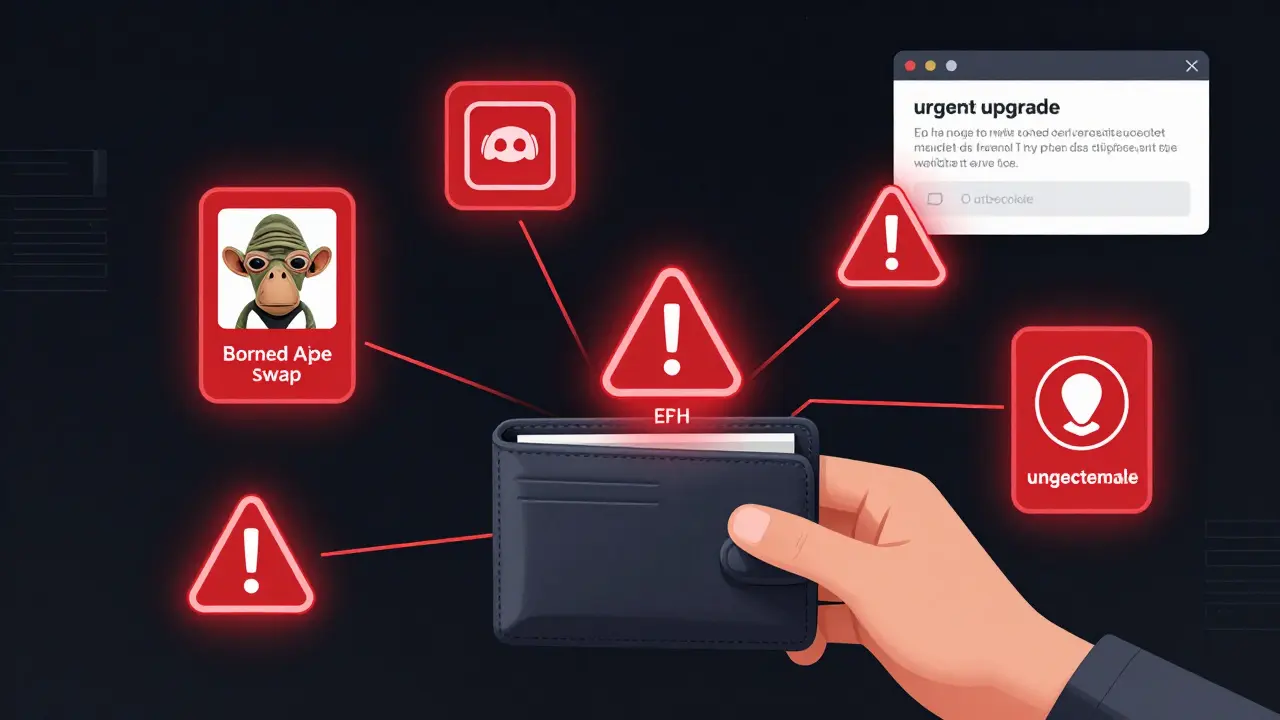
Phishing and Social Engineering: The Human Weakness
NFT communities are built on trust. Discord servers, Twitter threads, Telegram groups - they feel like family. That’s why attackers target them. A common scam: Someone posing as a project manager posts in the official Discord: "Emergency upgrade! Click here to verify your NFTs before the deadline." The link looks real. The logo matches. The tone is urgent. People click. And boom - their wallet gets permission to let another contract spend their funds or replace their NFTs. Check Point’s 2025 report found that over 68% of NFT scams start with a fake announcement. The attacker doesn’t need to hack the blockchain. They just need to trick one person into clicking. Then they use that person’s trust to spread the scam to dozens more. And it’s not just Discord. Fake customer support emails, cloned websites, and even deepfake voice messages have been used to convince users to approve malicious transactions. The most dangerous part? You’re not being hacked. You’re volunteering.Wallet Permissions: The Hidden Backdoors
Most users don’t realize how many contracts they’ve approved. When you connect your wallet to a new NFT marketplace, you’re not just logging in. You’re giving it permission to move your assets. Tools like Revoke.cash show you exactly what contracts have access to your wallet. And the results are shocking. One user found 47 active approvals - some from sites they’d visited once in 2022. Each one is a potential entry point for a metadata swap or theft. A single approval can let an attacker:- Replace your NFT’s image with a scam link
- Transfer your NFT to another wallet
- Drain your ETH balance
- Mint a counterfeit version of your NFT
Smart Contracts: The Code That Can’t Be Trusted
Smart contracts are supposed to be self-executing and tamper-proof. But they’re just code. And code has bugs. The Adidas NFT exploit wasn’t a hack. It was a poorly written smart contract that didn’t check purchase limits. The attacker called a function once - and got 330 NFTs. No password. No phishing. Just bad code. Vibranium Audits found that over 70% of new NFT projects skip security audits. Why? Cost. Speed. Ignorance. But the cost isn’t just money - it’s trust. And once trust is broken, the project is dead. Even if a contract looks clean, extra features - like royalties, dynamic traits, or whitelisting - add complexity. And complexity invites bugs. The safest contracts are the simplest ones.How to Protect Yourself
You can’t stop every scam. But you can make yourself a terrible target.- Enable 2FA - not SMS. Use an authenticator app like Authy or Google Authenticator. Nifty Gateway and Sorare offer it - but don’t enable it by default. You have to turn it on yourself.
- Never click links from DMs, Discord, or Twitter. Go to the official website manually. Bookmark it.
- Check metadata before buying. Use Etherscan or Solana Explorer to see if the image URL is hosted on a known, reputable server (like IPFS). If it’s on a random .xyz domain - walk away.
- Review wallet approvals monthly. Use Revoke.cash. Remove anything you don’t use.
- Don’t trust "urgent" offers. If it says "limited time," "last chance," or "emergency migration," it’s fake. Legit projects give you weeks to act.
- Verify contracts on Etherscan. Look for the green "Verified" tag. If it’s not verified, don’t interact.
Who’s Responsible?
Marketplaces blame users. Users blame marketplaces. Projects blame hackers. Everyone’s right - and everyone’s wrong. Security isn’t one person’s job. It’s a chain. The marketplace has to build safer systems. The project team has to audit contracts. The user has to protect their wallet. And right now, the weakest link is the user. But that’s changing. Magic Eden paused operations after rug pulls and refunded users. OpenSea added on-chain listing options. Some projects now host metadata on decentralized storage like Arweave. The future won’t be free of scams. But it can be safer. If you stop clicking, stop trusting, and start verifying - you’ll be one of the few who walk away unharmed.Can I get my NFT back if it’s been swapped or stolen?
If your NFT’s metadata was swapped, you can’t restore the original image unless the project team has a backup and is willing to fix it - which is rare. If your NFT was stolen via wallet compromise, you might recover it by immediately disconnecting the compromised wallet, moving remaining assets to a new wallet, and reporting the theft to the marketplace. But once an NFT is transferred, blockchain immutability means you can’t reverse the transaction. Prevention is your only real defense.
Are all NFTs on OpenSea at risk of metadata swaps?
Not all - but many are. NFTs that store metadata off-chain (which is most of them) are vulnerable if the hosting server is compromised or if the owner’s wallet permissions are misused. NFTs with metadata stored on IPFS or Arweave are more secure because those systems are decentralized and immutable. Always check where the image URL points before buying.
Why don’t marketplaces verify NFT authenticity?
Marketplaces prioritize speed and low fees over verification. Verifying every NFT’s origin would require manual review, which slows down listings and increases costs. Since blockchain is permissionless by design, marketplaces argue it’s not their job to police authenticity. That leaves users responsible - which is why education and personal security are so critical.
Can I trust NFTs from well-known projects like Bored Ape or CryptoPunks?
The original NFTs from these projects are generally safe - but counterfeit versions flood marketplaces daily. Even if you buy from the official contract, your NFT’s metadata could still be swapped if hosted on a centralized server. Always verify the image source and wallet permissions. Trust the contract, not the image.
Is there a way to detect a fake NFT before buying?
Yes. Check the contract address on Etherscan - does it match the official one? Look at the metadata URL - is it on IPFS or a random domain? Review the seller’s history - are they new? Do they have other listings? Check if the project has a verified social media account and compare the listing details. If anything feels off, it probably is.

Comments (15)
sonny dirgantara February 22 2026
so i just bought an nft last week and now im scared to even look at it lmao
Andrew Nashaat February 23 2026
Let me just say this: if you're still trusting off-chain metadata, you're not just naive-you're actively inviting disaster. Every. Single. Time. Someone says, "But it looks legit!"-I want to scream. The image is not the NFT. The blockchain doesn't care what your wallet displays. It cares about the contract address and the token ID. Everything else? A mirage. And yet, people still click "Buy Now" on a .xyz domain. Seriously?!
And don't get me started on "emergency migrations." That's not a feature-it's a phishing lollipop. You're not helping the network. You're handing over your keys to a stranger who typed "official_support" into Discord. Stop. Just stop.
Also, Revoke.cash? Use it. Monthly. Like brushing your teeth. If you have 47 active approvals? You're not a holder-you're a walking vulnerability. And yes, I checked my wallet yesterday. Two were from a site I visited in 2021. Gone. Done. Fixed.
Marketplaces won't save you. Projects won't save you. Only you can save yourself. And if you don't? Well, then you deserve to lose it. No sympathy here.
Gina Grub February 25 2026
Metadata swaps aren't bugs-they're features of a broken system. The entire NFT ecosystem is built on trust, and trust is the most fragile asset in crypto. When you tokenize art, you're not securing value-you're creating a vector for exploitation. The blockchain doesn't store the image. It stores a URL. And URLs? They're just pointers. Pointers can be redirected. Pointers can be poisoned. Pointers can be erased.
What we're seeing isn't fraud. It's systemic collapse dressed up as innovation. The fact that OpenSea still allows off-chain listings? That's not laziness. That's complicity. They profit from volume, not integrity. And users? We're the collateral damage.
And don't even get me started on "verified" projects. The Bored Apes? Their metadata is still hosted on AWS. One server breach. One admin logout. And every single one of those NFTs becomes a blank canvas. The contract is immutable. The art? Not even close.
Nathan Jimerson February 26 2026
It's a tough space but you can stay safe if you're careful. Always check the contract address. Always verify the metadata source. And never rush a decision. Take your time. Do your homework. You'll be fine.
Sandy Pan February 28 2026
There's something deeply ironic about how we treat digital ownership. We build entire economies around the idea of permanence-blockchain, immutability, decentralization-but we still rely on centralized servers to display the very thing we're supposed to own. It's like building a fortress out of glass. We scream about security, yet we hand the keys to a third party every time we mint, list, or trade.
Is the NFT the token? Or is it the image? Or the traits? Or the community? The truth is-it's all of them. And none of them. The blockchain records a transaction. It doesn't record meaning. Meaning is human. And humans are fallible. So maybe the real question isn't how to secure the NFT-but how to secure the story behind it.
Because if the story dies, the value evaporates. Even if the token remains.
Eric Etienne March 1 2026
so like... people still buy nfts? wow. just wow.
Dylan Rodriquez March 3 2026
There's a lot of fear here, and rightly so-but let's not forget the progress too. Magic Eden refunding users? OpenSea adding on-chain listings? Projects moving metadata to Arweave? These aren't perfect fixes, but they're steps forward. The ecosystem is learning. Slowly. Messily. But it's learning.
The key isn't to abandon NFTs. It's to demand better. Hold projects accountable. Reward those who use decentralized storage. Walk away from the ones who don't. And yes-review your approvals. Every month. Like a ritual. Because security isn't a one-time setup. It's a habit.
You're not alone in this. We're all figuring it out together. And that’s okay.
Ashton Strong March 3 2026
As a technical advisor in blockchain security, I can confirm that the risks outlined in this post are not only accurate-they are underreported. The majority of users operate under the misconception that blockchain = security. In reality, blockchain only secures the token transfer, not the associated metadata or external dependencies. The real vulnerability lies in the integration layer: centralized hosting, wallet permissions, and user behavior.
For institutional adoption to occur, we must move toward on-chain metadata standards (ERC-1155 with embedded data, or IPFS + CID verification). Projects that do this are already seeing a 70% reduction in fraud-related disputes. The technology exists. What's missing is enforcement.
I urge all holders to use tools like Revoke.cash and Etherscan’s contract verification. These are not optional. They are foundational.
Steven Hanton March 5 2026
I appreciate how thorough this breakdown is. It's rare to see someone lay out the mechanics of metadata swaps without just saying "be careful." The fact that marketplaces prioritize speed over safety is a structural flaw, not a user error. We need to stop blaming individuals and start demanding better from platforms.
That said, I think there's hope. More projects are now embedding metadata directly into the token, or using decentralized storage. The shift is slow, but it's happening. The users who learn to verify contracts and revoke permissions aren't just protecting themselves-they're pushing the whole ecosystem toward better standards.
It's not about being paranoid. It's about being informed. And this post helps with that.
Pamela Tanner March 6 2026
Correcting a minor error in the original post: The phrase "gas optimization" is often misused in phishing scams. The correct technical term is "contract migration," and legitimate migrations are announced via official blog posts-not DMs. Always verify the source. Also, ".xyz" domains are not inherently malicious, but they are statistically more likely to be used in scams due to low registration costs. Always cross-reference with the project’s official documentation.
Additionally, 2FA via SMS is vulnerable to SIM-swapping. Authenticator apps are the minimum standard. Hardware wallets like Ledger or Trezor offer the highest level of protection for high-value assets.
Kristina Kalolo March 6 2026
I’ve been holding NFTs since 2021 and never had an issue-but I’ve also never clicked a single link from a DM. I manually type in URLs. I check contract addresses. I revoke permissions. It takes five minutes a month. That’s the price of entry. If you don’t want to do that, maybe don’t buy NFTs. Simple as that.
Robert Byrne March 8 2026
Look, I get it. You’re mad. I’m mad too. But here’s the thing: the people who get scammed aren’t dumb. They’re tired. They’re excited. They saw a Bored Ape, thought "this is my ticket," and clicked because they didn’t want to miss out. We need to stop treating them like fools and start treating them like people who got caught in a system designed to exploit hope.
Yes, review your approvals. Yes, use Revoke.cash. But also-marketplaces need to make this easier. A one-click revoke button. Auto-expiring permissions. Default IPFS hosting. These aren’t hard. They’re just not prioritized.
Stop blaming the victim. Start fixing the system.
Tia Muzdalifah March 8 2026
so i just learned about metadata swaps today and now i’m double checking every nft i own. honestly? kind of cool to understand how it works. not cool that it’s so easy to get fooled tho. but hey, at least i’m learning.
Zoe Hill March 9 2026
i didn't even know about metadata swaps until i read this. now i'm going to check my wallet tonight. thanks for breaking it down so clearly. i feel less scared now that i know what to look for.
Albert Navat March 9 2026
Let’s be real: if you’re not using IPFS or Arweave for metadata, you’re not owning an NFT-you’re renting a link. And rentals can be revoked. The entire NFT space is a house of cards built on centralized DNS records. We’re all just waiting for the DNS server to go down. Or get hacked. Or get bought by a venture fund that decides to "optimize costs."
And don’t even get me started on "verified" collections. The verification badge on OpenSea? That’s just a marketing tool. It doesn’t mean the metadata is safe. It doesn’t mean the contract is audited. It just means they paid for a badge.
True decentralization? That’s still a myth. And until marketplaces stop treating users like sheep, we’re all just one phishing email away from losing everything.