
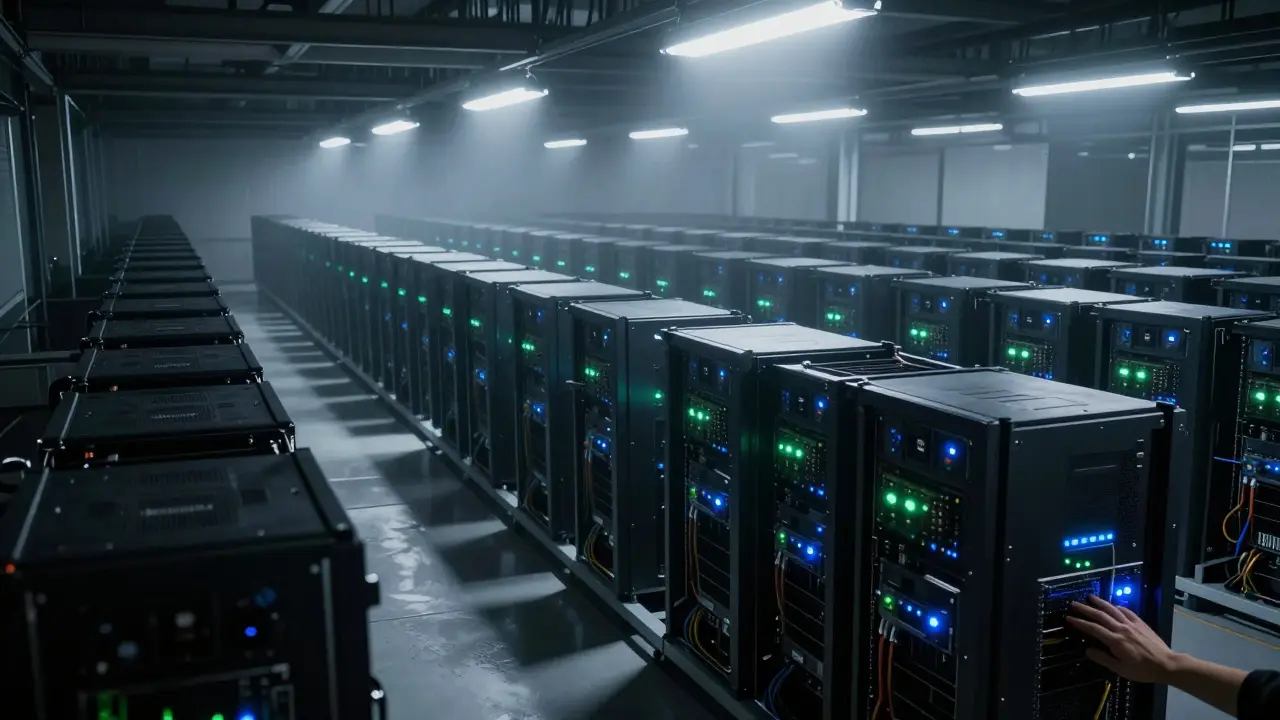
Every time you check your Bitcoin balance or send a transaction, you are triggering a global race for computational power. This race consumes as much electricity as mid-sized countries like Poland or Norway. But where does that power come from? The answer isn't just "the grid." It is a complex mix of stranded natural gas, repurposed coal plants, and seasonal hydroelectric dams. Understanding this energy mix is crucial because it determines whether crypto mining is a green tech innovation or a significant driver of carbon emissions.
The core issue lies in Proof-of-Work (PoW), which is a consensus mechanism used by cryptocurrencies like Bitcoin that requires miners to solve complex mathematical puzzles to validate transactions and secure the network. This process is intentionally energy-intensive. As more people join the network, the difficulty of these puzzles increases, demanding more hash rate-the total computing power of the network. More hash rate means more electricity. And since most of the world’s electricity still comes from burning fossil fuels, the environmental footprint grows with every new miner plugged in.
How Hash Rate Drives Electricity Demand
To understand the fuel behind the hash rate, you first need to grasp how mining works. Miners use specialized hardware called ASICs (Application-Specific Integrated Circuits) to guess random numbers until one matches a target set by the network. When someone wins, they get rewarded with Bitcoin. To keep blocks coming every 10 minutes, the network automatically adjusts the difficulty based on the total hash rate.
In 2009, you could mine Bitcoin on a laptop. Today, the network’s hash rate exceeds 400 exahashes per second (EH/s). That is 400 quintillion calculations every second. Modern ASICs, like the Bitmain Antminer S19 XP, are efficient, using about 21.5 joules per terahash. But efficiency gains are outpaced by the sheer scale of the operation. A single large mining farm can draw hundreds of megawatts-enough to power a small city. Because miners operate on thin margins, they constantly hunt for the cheapest electricity available. This economic pressure dictates the energy mix.
The Role of Coal in Crypto Mining
Coal has historically been the backbone of Bitcoin mining, particularly before China’s crackdown in 2021. Regions like Xinjiang and Inner Mongolia offered some of the lowest industrial electricity rates in the world, often below $0.04 per kWh. However, these grids were heavily reliant on coal. In 2019, over 80% of Inner Mongolia’s electricity came from coal-fired plants.
When China banned PoW mining in 2021, the hash rate didn’t disappear; it moved. Much of it shifted to Kazakhstan and Russia, countries with similar coal-heavy energy profiles. Kazakhstan’s grid was roughly 68% coal-powered in 2020. Even in the United States, some operators have revived old coal plants or converted them to natural gas to serve mining operations. For example, Greenidge Generation in New York converted a coal plant to natural gas but faced intense scrutiny for increased CO2 emissions, leading to denied permit renewals in 2022.
| Region | Primary Fuel Source | Approx. Fossil Share | Key Characteristic |
|---|---|---|---|
| Xinjiang, China (Pre-2021) | Coal | >60% | Low cost, high emissions |
| Kazakhstan | Coal & Gas | ~88% | Post-China ban migration hub |
| Texas, USA | Natural Gas & Wind | ~61% Fossil | Demand response programs |
| Sichuan, China (Seasonal) | Hydro | Low (Rainy Season) | Migratory mining during floods |
Natural Gas: Flared Methane and Grid Power
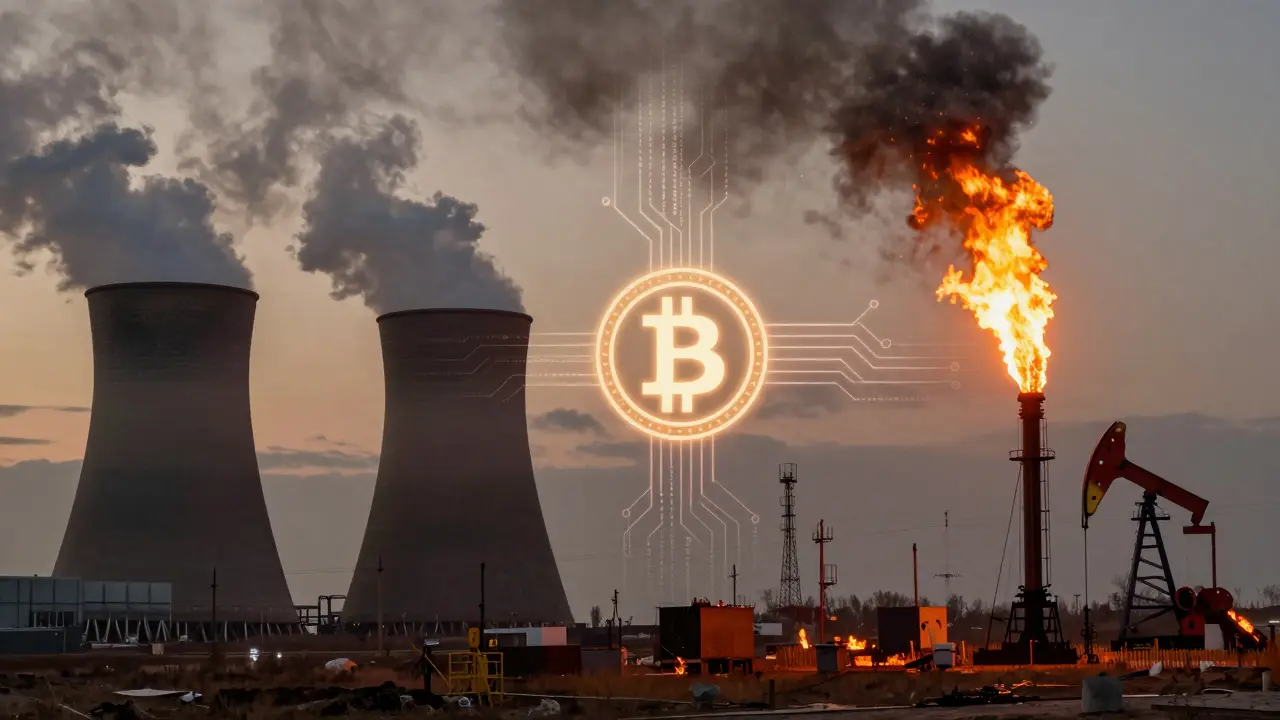
Natural gas plays a dual role in modern mining. First, it powers many traditional grid-connected mines, especially in the U.S. Texas and North Dakota. A 2024 study by O’Donnell et al. found that 34 large U.S. Bitcoin facilities consumed 32.3 TWh of electricity in one year, with 85% of that demand met by fossil-fuel plants, primarily natural gas. This surge in demand led to increased output from gas-fired units, contributing to air pollution exposure for millions of Americans living downwind.
Second, a growing segment of the industry uses "behind-the-meter" generation. Companies like Crusoe Energy and Upstream Data deploy mobile data centers directly to oil fields. They capture methane that would otherwise be flared (burned off) and use it to generate electricity on-site. Proponents argue this reduces greenhouse gas emissions because methane is a potent climate pollutant, with a global warming potential nearly 30 times higher than CO2 over a century. However, critics point out that this model can incentivize more fossil fuel extraction and doesn’t address upstream leaks. The net climate benefit remains debated among researchers.
The Renewable Myth vs. Reality
If you read industry reports, you might believe Bitcoin is mostly green. The Bitcoin Mining Council, an industry group, reported a 63.8% "sustainable" energy mix in late 2022. But there’s a catch: their survey only included members who chose to report data. Self-selection bias is a major problem here. Independent academic studies paint a different picture.
The Cambridge Centre for Alternative Finance (CCAF) estimated that renewables accounted for only 39% of Bitcoin’s electricity in 2020. More recent analyses suggest fossil fuels still dominate, especially after the exodus from China to places like Texas and Kazakhstan. While some miners do use surplus wind or hydro power-such as Riot Platforms curtailing load during peak hours in Texas to earn credits-this represents a fraction of the total. The majority of mining still runs on the marginal grid mix, which is heavily fossil-based.
Health and Environmental Costs
The impact goes beyond carbon dioxide. Burning coal and gas releases particulate matter (PM2.5), nitrogen oxides, and sulfur dioxide. These pollutants cause respiratory diseases, heart conditions, and premature deaths. The 2024 O’Donnell study linked increased power plant output for mining to additional PM2.5 exposure for 1.9 million Americans. Economists estimate the annual climate damages from Bitcoin’s emissions alone could reach billions of dollars when factoring in the social cost of carbon.
Locally, communities near mining farms report noise pollution from cooling fans, water usage for cooling systems, and strain on local infrastructure. In Plattsburgh, New York, residents pushed back against rising electricity prices caused by mining loads, leading to a local moratorium. These real-world consequences highlight that the energy mix isn’t just an abstract statistic; it affects public health and community well-being.
Regulation and Future Outlook
Governments are starting to take notice. New York State enacted a two-year moratorium in 2022 on new or renewed air permits for fossil-fuel power plants hosting PoW mining unless they use 100% renewable energy. Other regions are considering carbon pricing or stricter efficiency standards. Meanwhile, Ethereum’s shift to Proof-of-Stake in 2022 reduced its energy use by over 99.95%, proving that alternative consensus mechanisms exist. However, Bitcoin developers largely reject such changes, citing security and decentralization concerns.
Looking ahead, the trajectory depends on policy and technology. If grids decarbonize rapidly through solar, wind, and nuclear expansion, Bitcoin’s indirect emissions will fall. But if miners continue to flock to cheap, dirty power sources, the environmental burden will persist. The key takeaway is clear: without regulatory pressure or a fundamental change in consensus mechanism, crypto mining will remain tightly coupled with fossil fuels.
Does Bitcoin mining really use that much energy?
Yes. Estimates vary, but independent indices like Digiconomist and CBECI place Bitcoin’s annual consumption between 70 and 150 TWh. This is comparable to the electricity use of countries like Poland or Argentina. The high demand stems from the competitive nature of Proof-of-Work, where miners continuously add hardware to increase their share of rewards.
Is crypto mining mostly powered by renewable energy?
Industry groups claim high renewable shares, but independent academic research suggests fossil fuels still account for the majority. A 2020 CCAF study found only 39% renewable energy use. While some miners use stranded hydro or wind, most rely on the general grid, which is dominated by coal and natural gas in major mining hubs like Texas and Kazakhstan.
What is the difference between Proof-of-Work and Proof-of-Stake?
Proof-of-Work (used by Bitcoin) requires miners to solve energy-intensive puzzles to validate transactions. Proof-of-Stake (used by Ethereum post-Merge) relies on validators who lock up cryptocurrency as collateral. PoS uses less than 0.1% of the energy required by PoW, making it significantly more environmentally friendly.
How does mining affect local air quality?
Mining increases demand on power plants, many of which burn coal or natural gas. This leads to higher emissions of PM2.5 and other pollutants. A 2024 study found that 1.9 million Americans were exposed to increased PM2.5 levels due to power plants ramping up for mining, contributing to respiratory and cardiovascular health risks.
Are governments regulating crypto mining energy use?
Yes. China banned PoW mining in 2021. New York State imposed a moratorium on new fossil-fuel-based mining permits in 2022. Other regions are exploring carbon taxes, efficiency standards, and restrictions on renewable energy subsidies for mining operations to mitigate climate impacts.
