
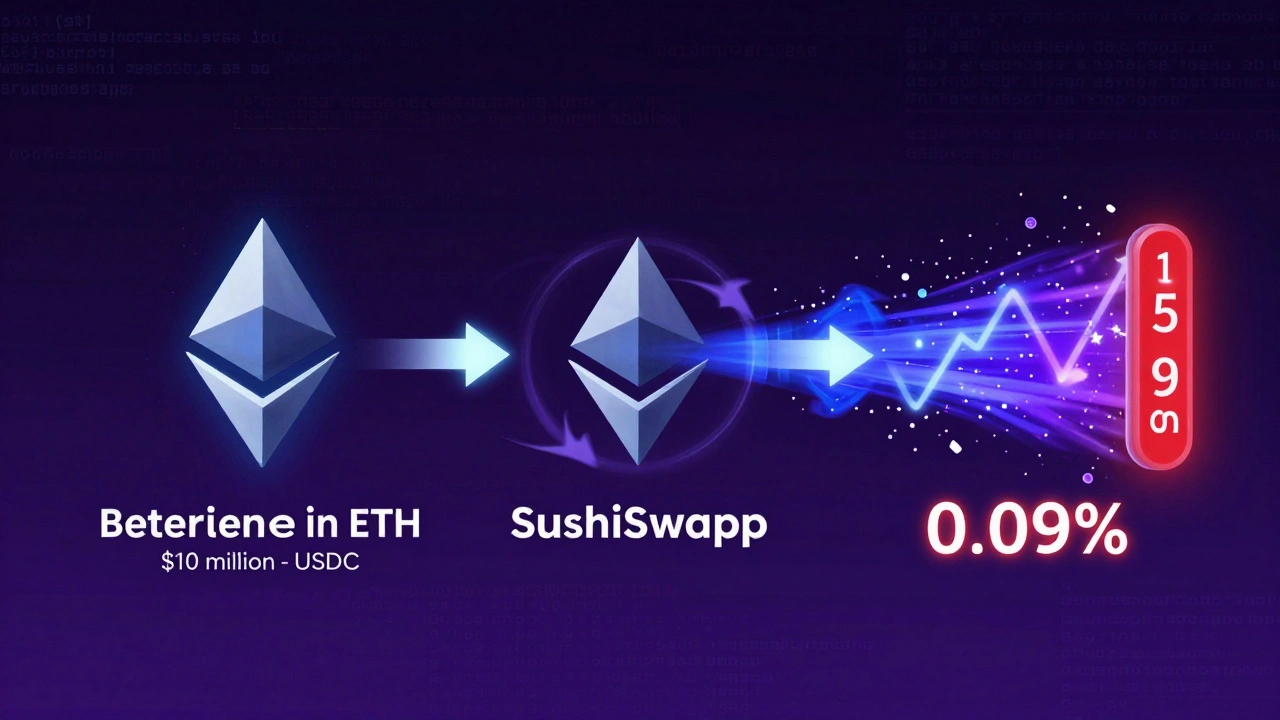
Imagine borrowing $10 million without putting up a single dollar as collateral. No credit check. No bank approval. No waiting days or weeks. You get the money, use it, pay it back-all in under 15 seconds. If you fail, the whole thing vanishes like it never happened. This isn’t science fiction. It’s flash loans, and they’re changing how money moves in decentralized finance.
What Exactly Is a Flash Loan?
A flash loan is a type of uncollateralized loan that exists only within a single blockchain transaction. Unlike traditional loans, you don’t need to lock up crypto as security. You don’t even need to prove who you are. All you need is a smart contract that can execute a sequence of actions before the transaction ends. The magic happens because of blockchain atomicity. Think of it like a domino effect: every step must succeed, or everything rolls back. If you borrow 10,000 DAI, you have to return it-plus a small fee-before the transaction closes. If you don’t, the entire transaction is canceled. No money is transferred. No one loses anything. It’s as if the loan never happened. Aave was one of the first major DeFi protocols to bring flash loans to the mainstream in early 2020. Today, it handles more than two-thirds of all flash loan volume. Other platforms like Balancer and dYdX also support them, but Aave remains the leader.How Flash Loans Actually Work
There are three simple steps-but they require precise coding:- Borrow: You deploy a smart contract that requests funds from a DeFi protocol like Aave. The protocol sends the loan amount instantly-say, 5,000 ETH or 1 million USDC.
- Execute: While the transaction is still open, your contract does something valuable. This could be buying low on one exchange, selling high on another, swapping collateral between protocols, or triggering a liquidation.
- Repay: Before the transaction ends, your contract sends back the borrowed amount plus a fee (usually 0.09% on Aave). If it can’t, the whole thing reverses.
Why Flash Loans Are Revolutionary
Flash loans break every rule of traditional finance. In a bank, borrowing $10 million requires collateral worth $15 million or more, months of paperwork, and a team of underwriters. In DeFi? You can do it with a few lines of code and $200 in gas. This unlocks new kinds of financial operations:- Arbitrage: Buying an asset cheap on one exchange and selling it expensive on another-faster than any human trader can react.
- Collateral swaps: Switching your collateral from one asset to another without selling it first. For example, swapping ETH for WBTC to get better interest rates on Aave-all in one go.
- Liquidations: When someone’s loan is undercollateralized, a bot can use a flash loan to buy their position at a discount, repay the debt, and pocket the difference. In June 2023 alone, over 12,000 liquidations were executed this way.

The Dark Side: Flash Loan Attacks
Flash loans aren’t just for profit. They’re also weapons. Because they let anyone borrow huge sums instantly, they’re perfect for manipulating prices. Attackers use flash loans to artificially inflate or deflate the price of a token on a decentralized exchange. Then they exploit that fake price to drain funds from other protocols. One of the worst cases happened in October 2020, when hackers used a flash loan to crash the price of HARVEST tokens on Uniswap. They then borrowed the token, sold it at the fake low price, and drained $31 million from the Harvest Finance protocol. Chainlink’s post-mortem showed the attack worked because the price oracle relied on a single exchange’s data-something flash loans can easily distort. Between 2020 and 2023, flash loan-based attacks stole over $737 million from DeFi protocols, according to Chainlink’s research. The Cream Finance hack in October 2021 stole $114 million using the same tactic. These aren’t random glitches. They’re systematic. A 2022 audit by Trail of Bits found that 63% of DeFi protocols had vulnerabilities that could be exploited using flash loans-mostly because their price oracles were too simple.Who Uses Flash Loans-and Who Shouldn’t
Flash loans aren’t for casual users. They’re for developers, quant traders, and automated bots. On Reddit, you’ll find stories like ‘DeFi_Dev_42’ who made $50,000 in profit from a single flash loan arbitrage. But you’ll also find ‘CryptoLoser87’ who lost $12,000 in a failed exploit during the Hundred Finance attack. If you’re not a developer who understands Solidity, Ethereum’s gas limits, and how price oracles work, you shouldn’t touch flash loans. Even small mistakes can cost you everything. The most common error? Messing up the callback function. That’s the part of the smart contract that tells the protocol how to repay the loan. If it’s written wrong, the transaction fails-and you lose your gas fees, but nothing else. Still, $200 down the drain for a typo isn’t worth it. For most people, flash loans are better understood as a force of market efficiency-not a tool to use.
The Future of Flash Loans
The industry is reacting to the risks. In December 2023, Aave rolled out V3, which introduced time-locked flash loans. Instead of requiring repayment in the same block, some loans now allow up to two blocks (about 30 seconds) to repay. This gives more room for complex operations and reduces the chance of accidental failures. Chainlink’s CCIP bridge, launched in late 2023, now lets flash loans work across eight different EVM-compatible blockchains. That means you can borrow on Ethereum, swap on Polygon, and repay on Arbitrum-all in one atomic transaction. Regulators are watching. In March 2023, SEC Chair Gary Gensler called flash loans “high-risk vectors.” But no laws have been passed yet. Traditional banks like JPMorgan are experimenting with private blockchain versions-but they’re years away from anything resembling public flash loans. The big question is whether flash loans will survive as a core DeFi primitive-or become a relic of the wild west era of crypto. Consensys predicts annual flash loan volume will hit $45 billion by 2025. MIT’s Digital Currency Initiative warns that without better oracle protections, attacks could triple by 2026. One thing is clear: flash loans aren’t going away. They’re evolving. And with every upgrade, they’re becoming more secure, more powerful, and more essential to how DeFi works.Final Thoughts
Flash loans are the ultimate expression of DeFi’s promise: permissionless, borderless, and frictionless finance. They let anyone with code access to capital that would take months to secure in the traditional world. But they’re also a double-edged sword. They fix price imbalances-and they create them. They enable innovation-and they fund theft. The real value of flash loans isn’t in the money they move. It’s in what they reveal about the system. They show that markets can self-correct at machine speed. They prove that trust doesn’t need to be placed in banks or governments-it can be built into code. For now, flash loans remain a tool for the few who understand them. But as DeFi matures, the lessons learned from them will shape the next generation of financial systems-whether we’re using them or not.Can anyone take out a flash loan?
Technically, yes-but only if you can deploy a smart contract that executes a borrow, act, and repay sequence within one blockchain transaction. Individual users can’t do this directly. You need coding skills in Solidity and access to a wallet that can interact with DeFi protocols. Most flash loans are used by bots, quant funds, and developers-not regular people.
Do flash loans require collateral?
No. That’s what makes them unique. Flash loans are completely uncollateralized. The only requirement is that you repay the loan plus a small fee before the transaction ends. If you don’t, the entire transaction is reverted, and no funds are transferred.
How much does a flash loan cost?
There’s a fee of 0.09% on Aave for the loan itself. But the real cost is gas-Ethereum transaction fees. These can range from $15 to over $200 depending on network congestion. Most successful flash loan users optimize their code to fit within 500,000 gas to keep costs low.
Are flash loans legal?
There are no specific laws banning flash loans as of December 2025. However, regulators like the SEC have flagged them as high-risk. Using flash loans for market manipulation or exploiting protocol vulnerabilities may violate securities or fraud laws, even in DeFi. Legitimate use-like arbitrage-is generally not illegal, but the legal landscape is still evolving.
Which DeFi platforms offer flash loans?
Aave is the largest, handling over 68% of all flash loan volume. Balancer and dYdX also support them, though at much smaller scales. Emerging platforms like Radiant Capital are expanding cross-chain support. Flash loans are only available on EVM-compatible blockchains like Ethereum, Polygon, Arbitrum, and Optimism.
Can you lose money with flash loans?
You can’t lose the borrowed funds-if you fail to repay, the transaction reverses and no money changes hands. But you can lose your gas fees, which can be hundreds of dollars. Poorly coded contracts can also get exploited, leading to wasted time and resources. In short: you can’t lose the loan, but you can lose your time and money on failed attempts.
What’s the difference between flash loans and regular DeFi loans?
Regular DeFi loans like those on Compound or Aave require you to lock up collateral-usually 150% of the loan value. Flash loans require zero collateral but must be repaid within one block. Regular loans last days or weeks; flash loans last seconds. Regular loans are for holding or leveraging; flash loans are for rapid, one-time financial operations.
Are flash loans only on Ethereum?
Originally, yes. But with Chainlink’s CCIP bridge and cross-chain protocols like Radiant Capital, flash loans now work across multiple EVM-compatible chains including Polygon, Arbitrum, Optimism, and BNB Chain. Non-EVM chains like Solana or Avalanche don’t support native flash loans yet due to different transaction models.

Comments (13)
ujjwal fouzdar December 5 2025
Flash loans are just digital magic tricks where the wizard disappears after stealing your lunch money.
They don't create value, they just shuffle it around like a sleight of hand while the crowd claps.
It's not finance, it's performance art with gas fees.
And we call this innovation?
When the house of cards collapses, who pays?
Not the devs. Not the bots.
Us.
Again.
Same story, different blockchain.
We're not building a financial future.
We're just making the casino bigger.
And everyone's still betting on the wheel spinning forever.
It's beautiful. And terrifying.
And we love it anyway.
Anand Pandit December 5 2025
Honestly, flash loans are wild but they’re also super cool when used right.
Like, imagine being able to fix a price gap between exchanges in seconds - that’s market efficiency at its finest.
And yeah, there are bad actors, but that’s true in every financial system - even banks have fraud.
The key is better oracles and smarter contracts, not shutting it down.
DeFi is still young, and this is just part of growing pains.
Keep building, keep auditing, keep learning.
We’ll get there.
Reshma Jose December 6 2025
Okay but like… why is everyone acting like flash loans are new? They’re just automated arbitrage with a fancy name.
People forget that hedge funds have been doing this for decades with high-frequency trading.
The only difference? Now it’s open to anyone with a wallet and a GitHub account.
And honestly? That’s kind of beautiful.
Not saying it’s safe, but it’s democratized.
Even if it’s chaotic.
And yes, I lost $80 on a failed attempt last week.
Worth it for the lesson.
rahul shrimali December 7 2025
Flash loans are the real deal no collateral no waiting no BS just code and speed
if you cant handle it dont touch it
gas fees are the price of admission
profit or learn
no middle ground
Eka Prabha December 9 2025
Let’s be clear - this isn’t finance, it’s a regulatory nightmare dressed up as innovation.
Flash loans exploit systemic weaknesses in oracle design, which are not bugs - they’re features of a fundamentally insecure architecture.
The fact that $737 million has been stolen through them is not a statistic - it’s a indictment.
And yet, the DeFi community celebrates these exploits as ‘smart contracts’ working as intended.
That’s not resilience. That’s delusion.
Regulators are watching because this is a vector for systemic financial collapse.
And no, ‘gas fees are the cost’ doesn’t absolve the structural fragility.
We’re building a skyscraper on quicksand and calling it a revolution.
It’s not a feature. It’s a flaw.
And we’re all complicit by pretending otherwise.
Bharat Patel December 10 2025
Flash loans are like a mirror. They show us what we really value in finance.
Not stability. Not fairness.
But speed. And arbitrage. And extraction.
They reveal that under the hood of DeFi, we’re still chasing the same old game - just with different rules.
And maybe that’s the real lesson.
Not whether they’re safe or dangerous.
But why we’re so eager to play.
Are we building a new system?
Or just a faster version of the old one?
That’s the question no one wants to ask.
Bhagyashri Zokarkar December 11 2025
i just dont get why people think this is a good idea like you borrow 10 million and then like boom its gone and you lose your gas and its like okay cool but what if you had a family and you spent all your savings on this and then it failed and now you have nothing and you just sit there staring at your phone like why why why why why
its not even about the money its about the feeling of being tricked by code and now you feel stupid and everyone on reddit is laughing and saying you shouldve known
but you did know you just wanted to believe
and now you cant sleep
and your dog is judging you
and you just want to cry
and no one cares
because they all made it
but i didnt
and now i hate crypto
Rakesh Dorwal December 11 2025
Flash loans? More like flash scams.
Western tech bros think they’re so smart using Ethereum to steal from Indian and African users.
They call it DeFi but it’s just digital colonialism.
They build systems that only they can understand, then profit while the rest get wiped out.
And now they’re talking about cross-chain bridges like it’s progress.
It’s not.
It’s just a bigger net to catch more victims.
We need real finance, not casino code.
And if you’re defending this, you’re part of the problem.
Vishal Gaur December 13 2025
So i read this whole thing and honestly i think most of it is just hype.
Flash loans are cool in theory but in practice they’re just a way for devs to make a few grand while everyone else pays for the gas.
And the part about liquidations? That’s just bots hunting people who didn’t understand leverage.
And the 63% vulnerability stat? That’s not a feature, that’s a disaster waiting to happen.
Plus, the gas fees are insane right now.
I tried doing a test flash loan last month and it cost me $170 and the transaction failed because i missed a semicolon.
Like, who the hell designs a system where a typo costs you a week’s rent?
It’s not innovation.
It’s gambling with a code editor.
Nikhil Gavhane December 14 2025
I’ve been in crypto since 2017 and I’ve seen a lot of hype cycles.
Flash loans are one of the most fascinating things to come out of DeFi, not because they’re profitable, but because they reveal how fragile trust can be in code.
They’re not about making money.
They’re about testing boundaries.
And maybe that’s the real value.
Not the $50k profits.
But the lessons learned when things go wrong.
Every attack teaches us how to build better.
So I don’t hate them.
I respect them.
And I’m still learning.
Rajat Patil December 14 2025
It is important to consider the ethical implications of uncollateralized financial instruments operating in a decentralized environment.
While the technical mechanism is elegant, the potential for systemic disruption remains significant.
One must ask whether the pursuit of efficiency justifies the erosion of financial safeguards.
It is not a question of whether it can be done, but whether it should.
And if the majority of users lack the technical literacy to participate safely, is the system truly inclusive?
Or merely exclusionary under the guise of openness?
These are questions we must not ignore.
deepak srinivasa December 15 2025
Wait, so if you fail to repay, the whole transaction just reverses? So technically, no one loses money?
Then how do the attackers profit?
Do they exploit the price change before the revert?
Like, if the price of a token drops because of a fake sell-off, and then the flash loan gets reverted, but the market hasn’t recovered yet - can they just buy low before the revert and still profit?
Is that how it works?
Or am I missing something?
pk Pk December 17 2025
Flash loans are not for everyone - but they’re not meant to be.
They’re tools for builders, not gamblers.
If you’re trying to get rich quick, you’re already on the wrong path.
But if you’re trying to understand how money moves in a permissionless world - then this is your classroom.
I’ve mentored five new devs through their first flash loan contracts.
Three failed. Two succeeded.
All of them learned more in 14 seconds than in six months of reading whitepapers.
That’s the real power.
Not the money.
But the speed of learning.
So don’t fear them.
Learn from them.