

You want exposure to Bitcoin or Ethereum. Do you buy the asset directly and hold it in a wallet? Or do you buy shares in an Exchange-Traded Fund (ETF) that tracks the price? It sounds like a simple choice, but by August 2026, the gap between these two methods has widened in ways that affect your wallet, your taxes, and your peace of mind.
The landscape has shifted. Regulations like the EU’s MiCA and the US GENIUS Act have matured. Automatic tax reporting is now standard. The days of flying under the radar with direct crypto holdings are over. Now, the decision comes down to three hard trade-offs: who holds your keys, how much you pay in fees, and how messy your tax return becomes.
The Fee Trap: Upfront Costs vs. Perpetual Drains
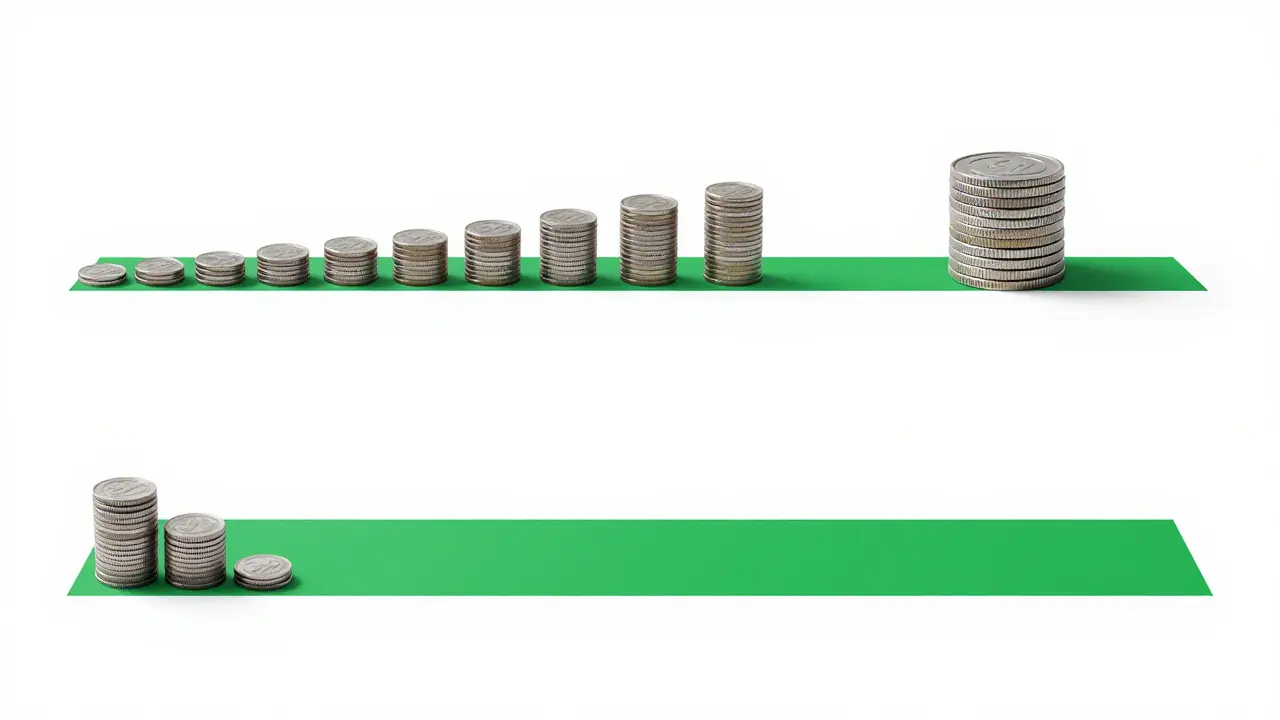
Let’s talk money first because this is where most investors get burned without realizing it. The fee structures for ETFs and direct ownership are fundamentally different. One charges you once; the other charges you forever.
When you buy a spot Bitcoin ETF, such as BlackRock’s IBIT or Fidelity’s FBTC, you pay an annual expense ratio. As of mid-2026, major players charge exactly 0.25% per year. This sounds small. But it compounds silently.
- Year 1: On a $10,000 investment, you pay $25.
- Year 5: You have paid $125 total.
- Year 10: You have paid $250 total.
This is just the base fee. ETFs also suffer from tracking error-the difference between the ETF’s price and the actual spot price of Bitcoin due to operational delays and custodial costs. This typically adds another 0.1% to 0.3% in hidden drag annually. Over ten years, you might lose 2.5% to 5% of your principal purely to structural inefficiencies.
Direct ownership flips this model. You pay upfront trading fees when you buy, and network fees when you move assets. If you use a centralized exchange like Coinbase or Binance, trading fees range from 0.1% to 0.6%. If you use a fiat on-ramp like Paybis, fees can spike to 3.5%-4.5% depending on your payment method. Let’s say you pay a steep 3.5% ($350 on $10,000) plus a $10 network fee. Your entry cost is roughly $360.
Here is the critical distinction: Once you own the Bitcoin directly, your ongoing annual cost is zero. You hold it. It sits there. No one takes a cut every year. The breakeven point between the two strategies is approximately 15 years. If you plan to hold for less than a decade, the ETF’s low annual fee might feel cheaper initially. But if you are a long-term holder, direct ownership wins mathematically.
| Timeframe | ETF Cost (0.25% Annual) | Direct Ownership Cost (One-time ~3.5%) |
|---|---|---|
| 1 Year | $25 | $350 |
| 5 Years | $125 | $350 |
| 10 Years | $250 | $350 |
| 15 Years | $375 | $350 |
For smaller investors with under $1,000, the ETF often makes more sense because the absolute dollar amount of the annual fee is negligible compared to the fixed transaction costs of buying small amounts of crypto directly. But for serious capital, the perpetual drain of the ETF is a significant wealth leak.
Custody: Trusting Institutions vs. Being Your Own Bank
This is the philosophical heart of the debate. When you buy an ETF, you do not own Bitcoin. You own a piece of paper-a share-that represents a claim on Bitcoin held by a professional custodian.
You cannot verify those coins on the blockchain yourself. You rely entirely on the custodian’s security, solvency, and honesty. This introduces counterparty risk. If the custodian fails, gets hacked, or faces regulatory seizure, your access to the underlying asset is threatened. Proponents of direct ownership argue this defeats the purpose of Bitcoin, which was designed to be trustless.
With direct ownership, you control the private keys. You can verify your balance on any block explorer. No one can freeze your funds unless they steal your keys. However, this freedom comes with a heavy burden. Eleven percent of users report security concerns with self-custody. Losing your seed phrase means losing your money forever. There is no customer support hotline to call.
ETF holders benefit from institutional-grade security and insurance. They trade during regular stock market hours, which simplifies life for passive investors. Direct owners trade 24/7, allowing them to react to global news instantly. For active traders, this flexibility is vital. For someone setting and forgetting their retirement savings, it is irrelevant.
Consider estate planning. If you die holding an ETF, your heirs receive the shares through your brokerage account. It is seamless. If you die holding direct crypto, your heirs must find your hardware wallet, your seed phrase, and know how to recover it. Many families lose crypto simply because the deceased never documented their keys.
Tax Reporting: Automated Simplicity vs. Manual Chaos
By 2026, tax reporting has become the decisive factor for many investors. Both Bitcoin ETFs and direct crypto are classified as property by the IRS, subject to capital gains tax. But the administrative burden differs wildly.
ETFs integrate into traditional brokerage accounts. You receive automatic Form 1099 documentation. Your cost basis is tracked for you. More importantly, you can hold Bitcoin ETFs inside tax-advantaged accounts like Roth IRAs and 401(k)s. A $50,000 Roth IRA investment growing to $200,000 generates zero taxable events upon withdrawal. This is a massive advantage.
Direct ownership usually happens in taxable accounts. Every time you sell, trade, or even spend Bitcoin, you trigger a taxable event. You must manually track the date, price, and cost basis of every single transaction. While exchanges now provide better reporting under the GENIUS Act and MiCA regulations, the data is rarely plug-and-play for tax software. You still need to reconcile spreadsheets.
There is a nuance regarding wash-sale rules. These rules prevent claiming a loss deduction if you repurchase a substantially identical asset within 30 days. They are strictly enforced for ETFs. For direct Bitcoin ownership, the application remains debated. Some investors exploit this gray area to optimize taxes, though regulators are closing the loop. If the IRS clarifies that wash-sale rules apply to all crypto, the tax advantage of direct ownership shrinks further.

Yield and Staking: The Hidden Opportunity Cost
Fees aren't the only thing eating your returns. Consider yield. Ethereum allows staking, generating roughly 4% annual yield. Bitcoin does not natively offer yield, but wrapped versions and lending protocols exist.
If you hold ETH directly, you can stake it. Over five years, with 10% price appreciation and 4% staking yield, 1 ETH grows to approximately 1.21 ETH. An ETH ETF cannot stake. It pays no yield. With the same 10% price appreciation but minus 0.25% annual fees, 1 unit of ETF grows to roughly 1.0 ETH. That is a 17% performance differential over five years. The ETF doesn't just charge fees; it prevents you from earning yield.
Which Path Fits Your Profile?
There is no single winner. The right choice depends on your specific goals.
Choose ETFs if:
- You want to invest in crypto via a Roth IRA or 401(k).
- You prefer simplicity and hate managing wallets.
- You are a short-to-medium term trader (under 10 years).
- Your investment size is small (under $1,000), making transaction fees prohibitive.
Choose Direct Ownership if:
- You plan to hold for 10+ years.
- You want to stake assets for yield.
- You value self-custody and blockchain verification.
- You want to avoid perpetual annual fees.
Can I hold Bitcoin ETFs in a Roth IRA?
Yes. Unlike direct Bitcoin, which is difficult to hold in traditional retirement accounts, Bitcoin ETFs are treated like stocks. You can buy them in a Roth IRA, allowing for tax-free growth and withdrawals after age 59½.
Is direct crypto ownership safer than ETFs?
It depends on your definition of safety. Direct ownership eliminates counterparty risk (no bank or fund can fail), but increases personal risk (you can lose your keys). ETFs eliminate key management risk but introduce custodial and regulatory risk.
How do taxes differ for ETFs vs direct crypto?
Both are taxed as property. However, ETFs provide automatic 1099 forms and can be held in tax-advantaged accounts. Direct crypto requires manual tracking of every transaction and is typically held in taxable accounts, leading to higher administrative complexity.
What is the breakeven point for fees?
Approximately 15 years. After this period, the cumulative annual fees of an ETF (0.25% per year) exceed the one-time transaction fees of direct ownership (typically 0.5% to 3.5%).
Do ETFs allow me to stake my crypto?
Generally, no. Most spot Bitcoin and Ethereum ETFs do not distribute staking yields to shareholders. You miss out on potential 3-5% annual yields available to direct holders who stake their assets.
