

Imagine a world where you don't need to beg a foundation for money or wait months for a committee to approve your project. Instead, a global community votes on whether your idea deserves support, and the funds are transferred instantly via blockchain. This isn't science fiction; it is the reality of Grant DAOs, which are decentralized autonomous organizations that collectively manage treasuries to allocate grants to projects and public goods through transparent governance. These organizations have fundamentally changed how we think about funding innovation, moving power from centralized institutions back to the people.
But how do they actually work? And can a group of strangers really make better funding decisions than seasoned experts? Let's break down the mechanics, the history, and the real-world impact of Grant DAOs.
The Rise of Grant DAOs
The concept of community-driven funding didn't start with blockchain. Early crypto communities informally supported each other, but dedicated Grant DAOs emerged around 2018-2019. MolochDAO, launched in February 2019, is widely considered one of the first purpose-built grant DAOs. It focused on funding Ethereum ecosystem public goods using a pooled membership treasury and a unique "ragequit" feature, allowing members to withdraw their share if they disagreed with a decision.
Following MolochDAO, MetaCartel DAO emerged to fund application-layer experiments, while Gitcoin revolutionized the space by introducing quadratic funding in 2019. Gitcoin later evolved into a full DAO structure in 2021, becoming one of the most influential ecosystems for public goods funding. Today, the landscape includes sector-specific DAOs like DeSci (decentralized science) organizations such as ResearchHub and VitaDAO, which apply these models to scientific research.
How Grant DAOs Are Structured
At their core, Grant DAOs consist of three main components:
- Treasury: A pool of cryptoassets held in smart contracts. This can include governance tokens, native protocol tokens, or liquid assets like stablecoins.
- Governance Mechanisms: Smart contracts combined with off-chain discussion forums (like Discord or forums) where proposals are submitted, debated, and voted on.
- Execution Infrastructure: The system that disburses funds once a proposal passes. This can be fully automated on-chain or managed by trusted intermediaries.
For example, Algorand Governance uses a hybrid model. General token holders decide broad allocation strategies, while an expert layer called xGov handles specific grant allocations. This combines broad legitimacy with specialized expertise.
Decision-Making Models
Not all Grant DAOs operate the same way. There are two primary decision-making structures:
- Full Community Vote: Every holder of the DAO’s governance token can vote on every grant application. This maximizes decentralization but can lead to voter fatigue and low participation.
- Council-Based Vote: A smaller group of elected or appointed representatives reviews proposals against set criteria. This is faster and more efficient but introduces centralization risks.
Many DAOs use a hybrid approach. For instance, Gitcoin employs Ephemeral DAOs, which are temporary governance instances spun up for each quarterly grants round. These dissolve automatically after funds are distributed, allowing for focused, time-bound governance without permanent bureaucracy.
Quadratic Funding: Leveling the Playing Field
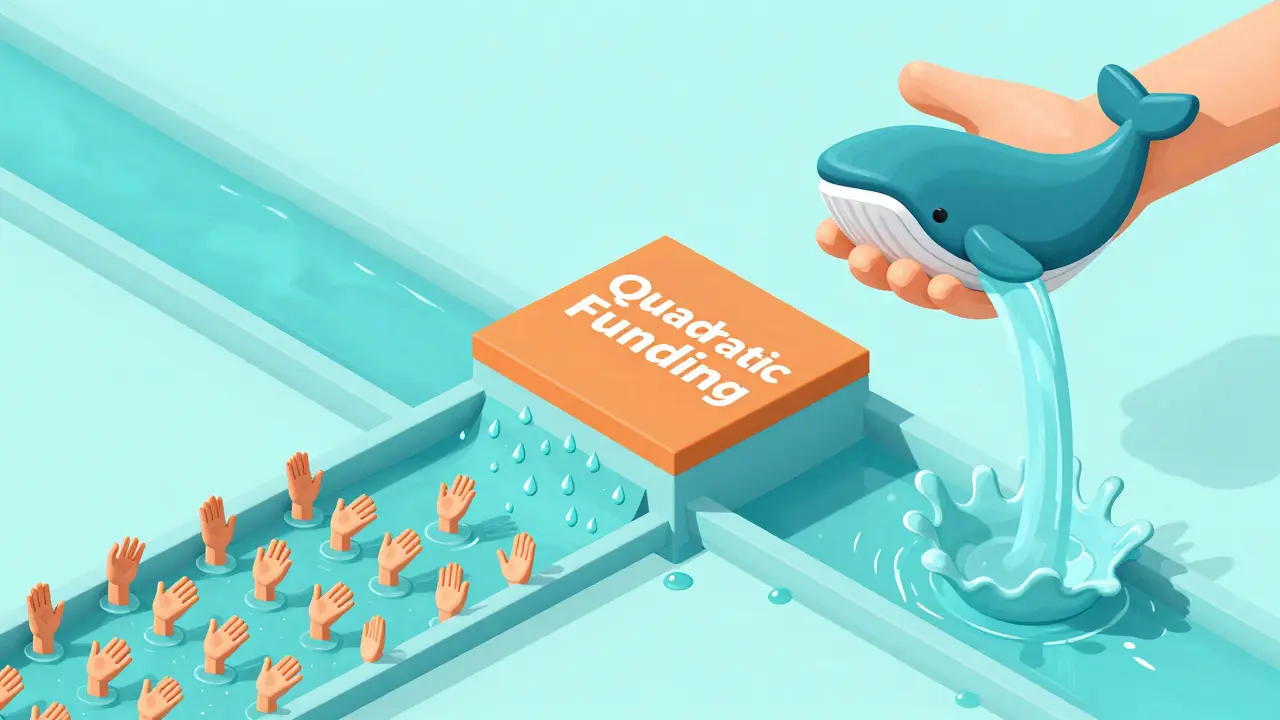
One of the most innovative aspects of Grant DAOs is Quadratic Funding. Popularized by Vitalik Buterin and others, this mechanism matches individual contributions from a central pool based on the square root of donations. This amplifies broad-based support and reduces the influence of "whales" (large donors).
Here is how it works in practice: If 100 people donate $10 each to Project A, and one person donates $1,000 to Project B, Project A will likely receive significantly more matching funds because it demonstrates wider community support. This ensures that diverse voices matter, not just deep pockets.
| Feature | Traditional Grants | Grant DAOs |
|---|---|---|
| Transparency | Low (opaque committees) | High (on-chain records) |
| Speed | Slow (months to years) | Fast (days to weeks) |
| Participation | Limited to applicants/reviewers | Open to community/token holders |
| Bias Resistance | Vulnerable to institutional bias | Uses mechanisms like quadratic funding |
| Cost | High administrative overhead | Lower (automated execution) |
Challenges and Risks
Despite their promise, Grant DAOs face significant challenges:
- Sybil Attacks: Bad actors create multiple fake identities to manipulate quadratic funding rounds. Gitcoin has invested heavily in fraud detection and identity solutions to combat this.
- Whale Capture: In token-weighted voting systems, large holders (including venture funds) may steer grants toward their own interests.
- Grant Farming: Applicants submit many small, low-effort proposals to exploit generous matching pools.
- Voter Apathy: Turnout often falls below 20% of token supply, leading to decisions made by a tiny minority.
To mitigate these issues, researchers like Manuel Lüscher et al. (2025) recommend "blinded" proposal processes, reputation-weighted voting, and rotating councils to ensure fairness and efficiency.

Real-World Impact
Grant DAOs have already funded impactful projects. UkraineDAO raised millions in humanitarian aid rapidly during the 2022 conflict, demonstrating how community-controlled treasuries can mobilize resources faster than traditional NGOs. Similarly, the Internet Archive received crucial early survival funding through Gitcoin Grants. As of recent reports, Gitcoin alone has facilitated over 5.3 million donations totaling $67.2 million.
In academia, universities are exploring DAO-inspired governance to improve transparency in research funding. Studies suggest that incorporating community voting and anonymous reviews can reduce bias and increase inclusivity compared to traditional peer review.
Getting Started with Grant DAOs
If you want to apply for a grant or participate in a DAO, here are the steps:
- Identify Relevant Programs: Use platforms like DeepDAO to find active grant programs aligned with your project.
- Understand Eligibility: Read guidelines carefully. Note timelines, funding scopes, and required milestones.
- Prepare Your Proposal: Include clear budgets, impact metrics, and IP considerations (especially for DeSci DAOs).
- Engage the Community: Join Discord servers and forums. Discuss your proposal openly to build support.
- Submit and Iterate: Apply, respond to feedback, and be prepared for milestone-based disbursements.
Remember, running a successful Grant DAO requires expertise in smart contracts, treasury management, and legal compliance. For applicants, success depends on genuine community engagement and transparent communication.
What is a Grant DAO?
A Grant DAO is a decentralized autonomous organization that uses blockchain technology to collectively manage a treasury and allocate funds to projects or public goods through transparent, community-driven governance processes.
How does quadratic funding work?
Quadratic funding is a matching mechanism where the amount of matching funds a project receives is proportional to the square of the sum of the square roots of individual donations. This rewards broad community support over large donations from few individuals.
Are Grant DAOs safe from fraud?
No system is immune, but Grant DAOs use various anti-fraud measures. These include sybil resistance tools, identity verification, blinded reviews, and community reporting. Platforms like Gitcoin continuously update their security protocols to detect and prevent manipulation.
Can I join any Grant DAO?
Most Grant DAOs are open-source and permissionless. You can typically join by acquiring their governance token or simply participating in discussions. However, voting rights often depend on token holdings or reputation scores.
What are Ephemeral DAOs?
Ephemeral DAOs are temporary governance structures created for specific purposes, such as a single grants round. They dissolve automatically after completing their task, allowing for focused decision-making without long-term administrative overhead.
