
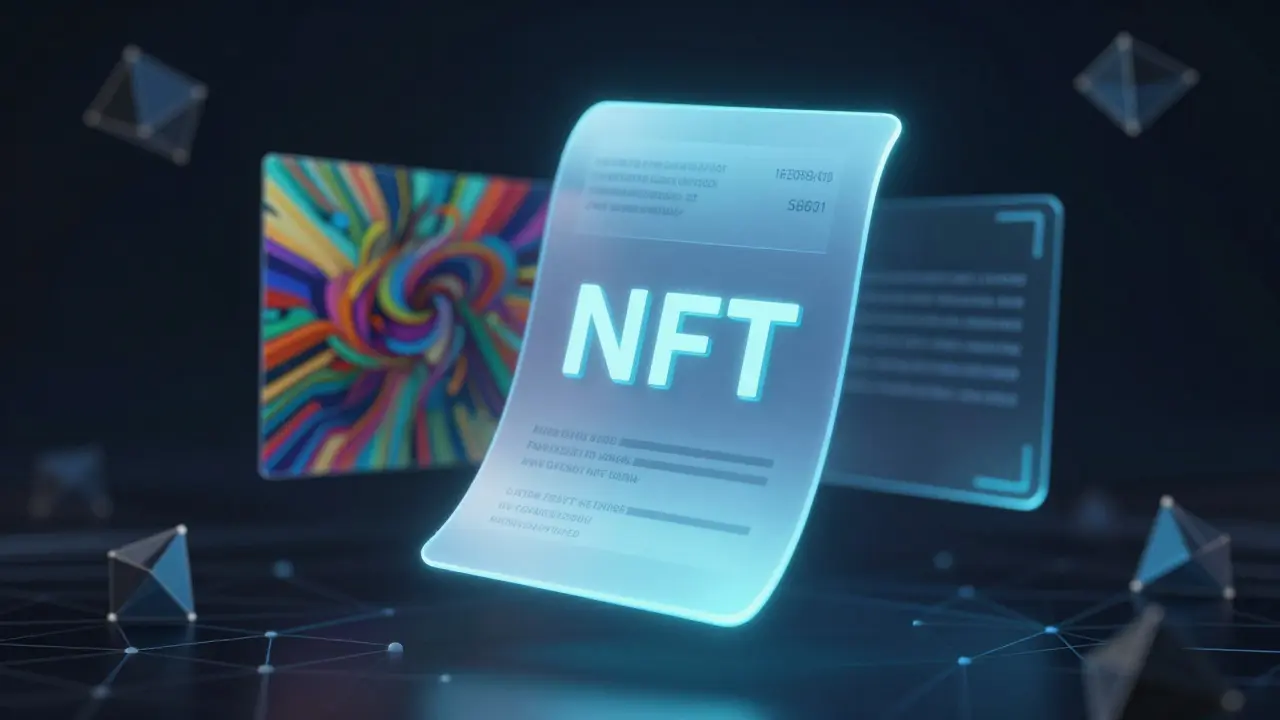
Most people think buying an NFT is like buying a JPEG or a video file. They are wrong. When you hold an NFT, you aren't holding the image itself. You are holding a unique digital receipt that proves you own a specific record on a blockchain. This distinction matters because it changes everything about how we understand value, ownership, and security in the digital world.
To really get what an NFT is, we have to look past the hype and examine the three pillars that make it work: the ERC-721 standard, which acts as the rulebook for uniqueness; the metadata, which describes what the token represents; and on-chain provenance, which creates an unbreakable history of who owned it and when. Let’s break down each piece so you know exactly what you’re dealing with.
The Rulebook: How ERC-721 Creates Uniqueness
At its core, an NFT on Ethereum follows a technical specification called ERC-721. Proposed in 2018 by developers William Entriken, Dieter Shirley, Jacob Evans, and Nastassia Sachs, this standard solved a major problem: how do you create tokens that are not interchangeable?
Think of it this way. If you swap one dollar bill for another, nothing changes. That’s fungibility, governed by the older ERC-20 standard. But if you swap your house deed for someone else’s, chaos ensues. Your house is unique. ERC-721 brings that concept of uniqueness to code. It assigns every single token a distinct identifier, known as a uint256 token ID. This number can range up to roughly 1.16×10^77 possibilities within a single contract, ensuring that no two tokens in that collection are ever the same.
The standard defines specific functions that wallets and marketplaces use to interact with these assets. For example, ownerOf(tokenId) tells anyone exactly who holds a specific token right now. The function safeTransferFrom ensures that if you try to send an NFT to a smart contract that doesn’t know how to handle NFTs, the transaction fails rather than locking your asset away forever. This safety mechanism is crucial. It prevents accidental loss and establishes a reliable infrastructure for trading unique digital items, from art to virtual real estate.
Metadata: The Bridge Between Code and Content
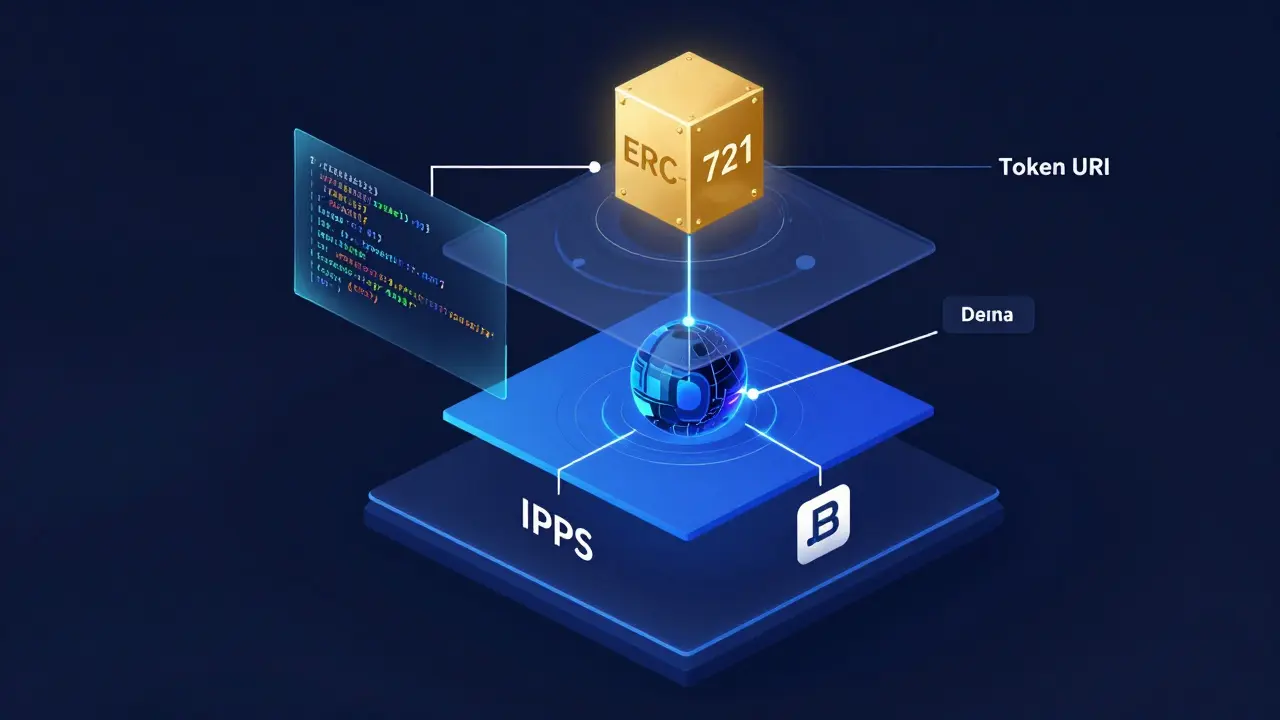
If the token ID is the serial number, the metadata is the instruction manual. It tells the marketplace what to show the user. However, here is where things get tricky. Storing large files directly on the Ethereum blockchain is prohibitively expensive due to gas fees. So, instead of storing the image or video inside the token, the token stores a link-a URI (Uniform Resource Identifier)-that points to where the data lives.
This process usually involves two steps of indirection:
- The Token URI: The smart contract returns a URL when queried for a specific token ID.
- The JSON File: That URL leads to a text file (usually JSON) containing fields like
name,description, andimage. - The Media File: The
imagefield in the JSON then points to the actual picture or video file.
Where does this data live? Often, it sits on centralized servers or decentralized storage networks like IPFS (InterPlanetary File System). IPFS uses content addressing, meaning the link includes a cryptographic hash of the file. If even one pixel of the image changes, the hash changes, and the link breaks. This provides a layer of integrity. However, if the project team hosts the metadata on their own private server and they shut it down, your NFT might still exist on the blockchain, but the image will disappear. This is known as "link rot," and it’s a critical risk buyers must understand.
Some projects choose to store metadata entirely on-chain using Base64 encoding. This makes the NFT fully self-contained and immune to link rot, but it drastically increases the cost of minting each token. Most collections strike a balance, keeping the pointer on-chain while hosting the heavy media off-chain.
On-Chain Provenance: The Immutable History
This is the killer feature of NFTs. Every time an ERC-721 token is minted, transferred, or burned, the Ethereum network records a Transfer event. These events are stored permanently in the blockchain’s append-only ledger. You cannot edit them. You cannot delete them. This creates a transparent, public history of ownership known as provenance.
You can trace any NFT back to its origin. Take Beeple’s famous work "Human One," which sold for $28.9 million at Christie’s. By looking at the contract address on Etherscan, you can see the exact moment it was created, the transfer to the auction house’s escrow wallet, and the final sale to the buyer. Each step has a unique transaction hash, verifiable by anyone in the world.
This level of transparency is impossible in traditional art markets, where provenance relies on paper trails and trusted intermediaries. With NFTs, the truth is mathematically enforced. However, remember: provenance tracks the *token*, not necessarily the underlying copyright or physical rights unless explicitly stated in the metadata or separate legal agreements.
| Feature | ERC-721 (NFTs) | ERC-20 (Fungible Tokens) | ERC-1155 (Multi-Token) |
|---|---|---|---|
| Uniqueness | Every token is unique (1-of-1) | All units are identical | Supports both unique and identical tokens |
| Divisibility | Not divisible (whole numbers only) | Highly divisible (e.g., 0.001 ETH) | Depends on configuration |
| Transfer Logic | Per-token authorization required | Balance-based transfers | Batch transfers possible (saves gas) |
| Primary Use Case | Digital art, collectibles, identity | Currencies, governance votes | Gaming items, complex inventories |
Common Risks and What to Watch For
Understanding the technology helps you spot red flags. Here are the most common pitfalls:
- Mutatable Metadata: Some contracts allow the creator to change the base URI after minting. This means they could theoretically swap out high-quality images for low-quality ones later. Always check if the contract has admin functions that can alter metadata.
- Centralized Hosting: If the metadata points to a standard HTTP website rather than IPFS or Arweave, you are trusting the project owner to keep their servers running. If they go bankrupt, your NFT might become a blank placeholder.
- Copyright Confusion: Owning an NFT rarely means owning the copyright to the underlying work. Unless the smart contract or a separate license explicitly grants IP rights, you usually just own the token record. The creator typically retains the right to reproduce and sell copies of the image.
How to Verify an NFT Before You Buy
You don’t need to be a coder to do basic due diligence. Here is a simple checklist:
- Check the Contract Address: Ensure you are interacting with the official contract. Scammers often deploy fake contracts with similar names.
- Inspect the TokenURI: Use a block explorer like Etherscan. Go to the "Read Contract" tab and query
tokenURIfor a sample token ID. Does it point to IPFS? A reputable domain? Or a suspicious short-link service? - Review Ownership History: Look at the "Events" tab on Etherscan. Are there dozens of transfers indicating active trading, or just a few suspicious movements between wallets controlled by the same entity?
- Read the License: Look for links in the metadata description that explain what rights you actually possess.
The NFT space has matured since the boom of 2021. While speculation remains, the underlying utility of ERC-721-verifiable ownership and transparent provenance-is finding steady footing in gaming, ticketing, and digital identity. By understanding the mechanics of metadata and on-chain records, you move from being a passive speculator to an informed participant in the digital economy.
Is the image file stored on the blockchain?
Rarely. Due to high costs, most NFTs store a link (URI) to the image on external servers or decentralized storage like IPFS. The blockchain only stores the token record and the link itself. Some projects store small images directly on-chain using Base64 encoding, but this is less common due to expense.
What happens if the website hosting my NFT goes offline?
If the metadata and image are hosted on a centralized server that shuts down, your NFT may lose its visual representation. The token will still exist on the blockchain, but marketplaces might display a broken image or placeholder. Using decentralized storage like IPFS mitigates this risk significantly.
Does owning an NFT mean I own the copyright?
Not automatically. In most cases, buying an NFT only transfers ownership of the specific token ID, not the intellectual property rights to the underlying artwork. The creator usually retains copyright unless explicitly stated otherwise in the project’s terms or metadata.
How is ERC-721 different from ERC-20?
ERC-20 tokens are fungible, meaning each unit is identical and interchangeable (like dollars). ERC-721 tokens are non-fungible, meaning each token has a unique ID and distinct properties, making them suitable for representing unique assets like art or collectibles.
Can I verify the history of an NFT?
Yes. Every transfer of an ERC-721 token generates an immutable event on the Ethereum blockchain. You can view the complete history of ownership, including the original mint and all subsequent sales, using block explorers like Etherscan.
