

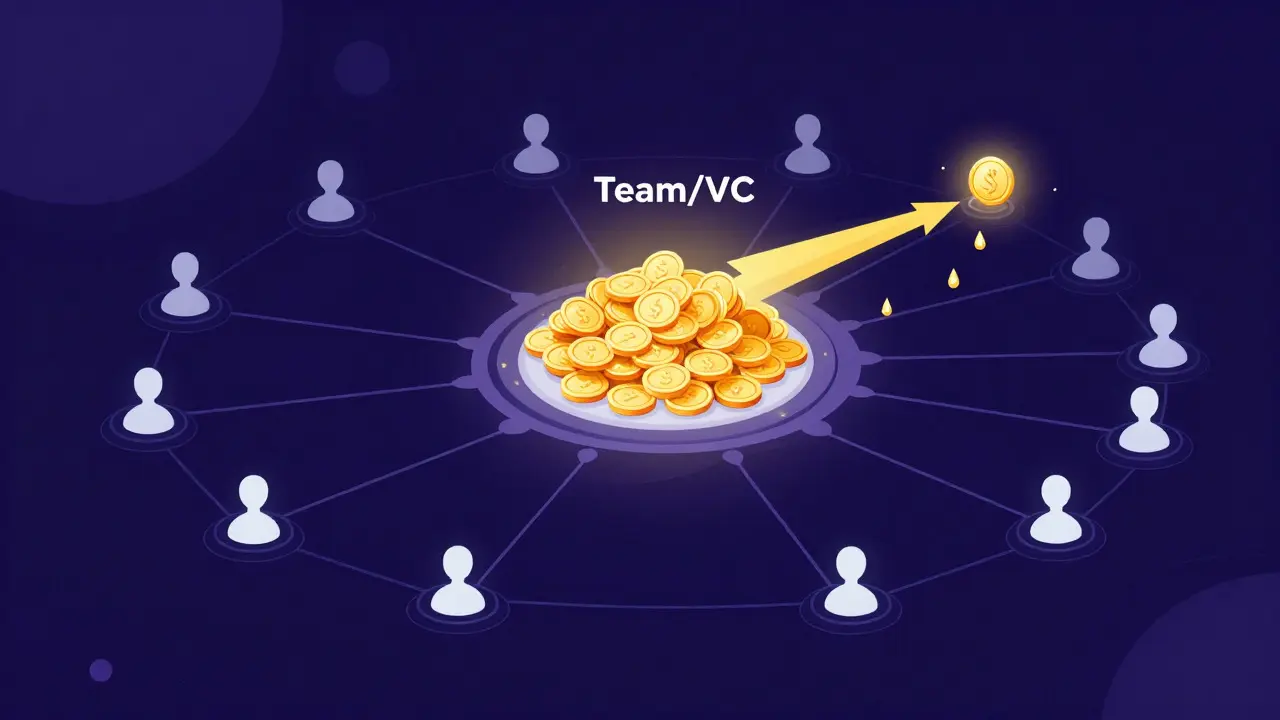
Imagine buying a ticket to a concert where the organizers already sold half the seats to their friends at a discount. That is essentially what happens in many altcoin launches. While marketing materials promise decentralization and community ownership, the reality often involves significant insider allocations that skew the playing field before the first block even mines. Understanding how these distributions work is no longer just for deep-dive researchers; it is a critical skill for any investor looking to avoid post-launch price crashes caused by token unlocks.
The core issue isn't just about who gets tokens first, but how much power they hold afterward. We are moving past the era of simple "trust me" pitches. Today, we measure fairness using hard data like the Gini coefficient and Nakamoto coefficient. This article breaks down the major launch models-fair launches, VC-backed sales, and airdrops-to show you exactly where the traps lie and how to spot a genuinely equitable project in 2026.
What Actually Defines a Fair Launch?
Let's clear up the confusion. A Fair Launch is a genesis distribution where no tokens are pre-mined or pre-allocated to insiders, ensuring equal access from day one. In this model, there is no private sale, no seed round, and no team allocation. Everyone, including the founders, must acquire tokens under identical conditions, usually through mining or an open auction.
Bitcoin is the classic example here. When it launched in 2009, there was zero pre-allocation. But does a fair start guarantee a fair outcome? Not necessarily. Even with perfect initial equality, market dynamics can quickly concentrate wealth. Studies show that Bitcoin's ownership Gini coefficient-a metric measuring inequality where 0 is perfect equality and 1 is total concentration-exceeded 0.92 between 2020 and 2025. This means that despite its fair start, a tiny fraction of holders control the vast majority of supply. So, while a fair launch removes the *initial* unfairness, it doesn't stop long-term accumulation by whales and institutions.
The Spectrum of Launch Models: From ICOs to IDOs
Most altcoins don't use strict fair launches because they need funding to build. Instead, they fall into a spectrum of models, each with different fairness trade-offs.
- ICOs (Initial Coin Offerings): Popular from 2014 to 2018, these sold tokens directly via smart contracts. Data from that era shows founders held on average 39% of supply, presale investors held 11%, and only about 2% went to miners. This heavy insider concentration is why many ICO-era projects struggled with trust issues later on.
- IEOs (Initial Exchange Offerings) & IDOs (Initial DEX Offerings): These shifted the sale to centralized or decentralized exchanges. While they added some credibility through exchange vetting, they often kept discounted private rounds for VCs and market makers. The public sale tranche was usually smaller, meaning retail investors got a smaller slice of the pie compared to early backers.
- VC-Backed SAFT Rounds: Simple Agreement for Future Tokens allow venture capital firms to buy tokens at a steep discount before the public knows the price. If not capped properly, this can lead to massive dumping pressure once the lockup expires.
The key takeaway here is that "public" sales are rarely truly public if the majority of the supply was already allocated to insiders at a lower price point. Always check the allocation table before buying.
Airdrops and Points Programs: Fairness by Usage?
In recent years, airdrops have become the go-to method for distributing tokens to existing users. The idea is that if you used the protocol, you deserve a share of its value. Sounds fair, right? Well, the execution is often messy.
Take Uniswap's UNI launch in 2020 as a benchmark. They minted 1 billion tokens, allocating 60% to the community via airdrop and liquidity mining. It was widely praised. However, within weeks, analytics showed that the top 50 addresses controlled about 91.5% of the supply. Why? Because large liquidity providers and institutional actors accumulated huge amounts during the farming period. The airdrop didn't prevent concentration; it just changed who held the bags initially.
More recent examples highlight specific pitfalls:
- EigenLayer (2024): Only 5% of EIGEN tokens went to restakers, while insiders controlled ~55%. Many users felt ignored, leading to withdrawals.
- Catizen (2025): Promised 43% to the community but reduced it to 34% shortly before launch, redirecting funds to an exchange launchpool. This bait-and-switch tactic angered genuine players.
- Towns (2025): Allocated only 3% to core community point holders versus 4-5% to exchange users, prioritizing speculative listings over real contributors.
These cases prove that usage-based models can still be skewed by eligibility criteria and weighting formulas. If the rules aren't transparent and immutable, "fairness by usage" becomes "fairness by connection."
Measuring Inequality: Gini Coefficients and Nakamoto Coefficient
You can't manage what you don't measure. Two primary metrics help quantify distribution fairness:
| Metric | Definition | What High Values Mean | Typical Range for Healthy Projects |
|---|---|---|---|
| Gini Coefficient | Measures inequality across all token balances (0 = equal, 1 = one holder has all). | Extreme concentration; high risk of governance capture. | < 0.70 (though most DeFi tokens sit between 0.85-0.95) |
| Nakamoto Coefficient | Minimum number of entities needed to control consensus or governance. | Fewer entities can collude to change rules or halt network. | > 10 for robust decentralization |
Research consistently shows that application tokens (like governance tokens for DeFi protocols) are more centralized than base-layer coins. A 2024 study found that tokens generally have higher Gini scores and smaller Nakamoto coefficients than their underlying cryptocurrencies. This makes sense: fewer people run nodes for Bitcoin than govern a specific DeFi protocol. Therefore, when evaluating a new altcoin, don't just look at the launch date; check the current on-chain distribution. Tools that calculate full-distribution Gini coefficients are becoming standard for serious analysts.
Best Practices for Equitable Tokenomics
If you are evaluating a project-or building one-here are the concrete benchmarks that separate sustainable models from potential scams. Industry experts and tokenomics advisors suggest the following structure for a healthy distribution:
- Private Investor Allocation: Keep it under 10% of total supply. Anything higher signals excessive reliance on VC funding rather than product-market fit.
- Team Allocation: Aim for 10-20% with a minimum 12-month cliff and 24-month linear vesting. Shorter lockups erode trust; longer ones make hiring difficult.
- Community & Ecosystem: Combined, these should exceed 50% of the supply. This includes airdrops, liquidity rewards, and ecosystem incentives.
- Vesting Transparency: All non-public buckets must have explicit, published vesting schedules. Opaque "reserves" are red flags.
Furthermore, stress-test your assumptions. Before launching, simulate how different unlock scenarios affect price and holder sentiment. A project that passes a "distribution fairness audit"-benchmarked against thousands of historical launches-is far more likely to retain community support long-term.
Regulatory Implications of Fair Distribution
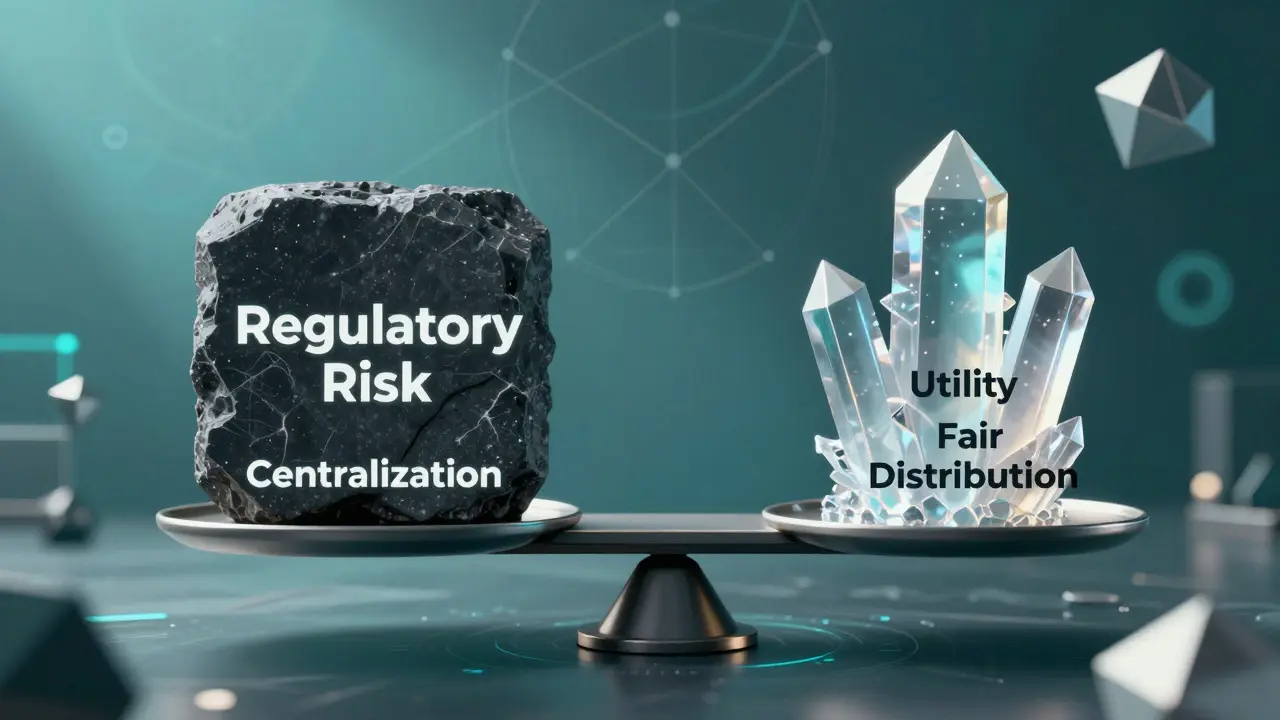
Fairness isn't just a moral or economic concept; it has legal weight. In the US and Canada, securities laws apply to token sales that resemble investments in a common enterprise with an expectation of profit. The SEC's 2017 report on The DAO set a precedent: if tokens are concentrated among investors with discounts and lockups, they are likely securities.
Conversely, wide distribution to active users with genuine utility needs strengthens the argument that a token is a commodity or utility asset, not a security. By spreading tokens broadly and tying them to usage rather than speculation, projects reduce both centralization risk and regulatory exposure. This dual benefit makes fair distribution a strategic necessity, not just a nice-to-have feature.
How to Audit a New Altcoin Launch
So, how do you apply this knowledge practically? Here is a quick checklist for your next investment research session:
- Check the Allocation Table: Look for the percentage held by Team, Investors, Foundation, and Community. Flag anything over 10% for private investors.
- Review Vesting Schedules: Are team tokens locked for at least 2 years? Is there a cliff? Avoid projects with immediate unlocks for insiders.
- Analyze On-Chain Data: Use tools to check the current Gini coefficient. If it's above 0.95, be cautious. Check the Nakamoto coefficient for governance tokens.
- Read the Whitepaper Critically: Does it promise "community ownership" but allocate 60% to the foundation? That's a contradiction.
- Look for Independent Audits: Has a third party reviewed the mint logic and distribution code? "Fairness theater" is common, so independent verification is key.
Token distribution fairness is a continuous journey, not a one-time event. As dynamic mechanisms like usage-based unlocking and adaptive emissions become more common, the gap between promised fairness and actual fairness will continue to shrink. But until then, staying informed and asking tough questions about who holds the tokens is your best defense.
What is a fair launch in crypto?
A fair launch is a token distribution model where no tokens are pre-mined or allocated to insiders. Everyone, including the team, acquires tokens under equal conditions, typically through mining or open auctions, ensuring no one has an early advantage.
Why are VC-backed altcoins often criticized?
VC-backed altcoins are often criticized because venture capital firms buy tokens at a significant discount before the public sale. This creates a two-tier pricing system where insiders pay less, leading to potential dumping pressure when their lockup periods end and harming retail investors.
What is the Gini coefficient in tokenomics?
The Gini coefficient measures inequality in token distribution. A score of 0 means perfect equality, while 1 means one person owns all tokens. Most DeFi tokens have high Gini scores (0.85-0.95), indicating that a small number of wallets hold the majority of the supply.
Are airdrops always fair?
Not necessarily. While airdrops aim to reward users, they can be skewed by complex eligibility criteria, sybil attacks, or changes in allocation percentages close to launch. Large liquidity providers often accumulate disproportionate amounts, reconcentrating ownership despite the initial broad distribution.
How does token distribution affect regulation?
Concentrated token distributions among investors with discounts and lockups increase the risk of being classified as securities under laws like the Howey test. Broad distribution to active users with utility-focused design helps argue that the token is a commodity or utility asset, reducing regulatory scrutiny.

Comments (11)
Chris Neal August 20 2026
Most people think the Gini coefficient is a magic number, but it's really just a snapshot. You have to look at the velocity of those tokens too. A high Gini score with low turnover is actually more stable than a lower score with massive daily volume. The article misses this nuance entirely. It treats static distribution as the whole story when liquidity dynamics are what actually break prices.
Jeff Falcon August 20 2026
I've been following this space since the ICO days, and honestly? This feels like a bit of a relief! Finally someone is breaking down the math without making you feel stupid for not knowing it all already!! I always get so confused by these vesting schedules, but seeing the specific percentages for private vs public sales makes it click!! It’s wild how much 'trust' we place in teams that don't even show their work properly!!
Vishnu Vardhan Reddy M S August 22 2026
Ooh, bold take on the velocity thing. Sure, if your whales are just sleeping on the coins, maybe you're fine. But let's be real, most altcoins in 2026 are launched specifically to dump on retail. If the Gini is high AND the volume is high, that's not stability, that's a countdown timer. Don't overthink the metrics, just watch where the money flows out of.
Alyson Karson August 22 2026
ok so i read the part about the eigenlayer allocation and im still mad about it lol. 5% for the people who actually staked?? that is crazy. i spent months keeping my node up to date and got crapped on while some vc got 55%. its never fair unless you know the guys running the protocol. love the guide tho, finally some numbers instead of vibes!
Kyle Ware August 22 2026
The distinction between a fair start and a fair outcome is crucial here. Many investors forget that Bitcoin itself became highly concentrated despite its genesis. So when evaluating a new DeFi token, don't just look at the launch day chart. Check the current on-chain distribution tools. If the Nakamoto coefficient is below 10, governance capture is likely regardless of how 'community-focused' the marketing is.
Onyinyechi Nwosu August 24 2026
i just wish more projects would publish their vesting schedules upfront. half the time they hide the team allocation behind vague terms like 'ecosystem growth'. if you cant see the lockup dates you are basically flying blind. nice breakdown of the red flags though.
Iva Grekova August 24 2026
This is such a good reminder to check the allocation table before buying. I used to just look at the price action and hope for the best, but now I always cross-reference the whitepaper promises with the actual smart contract data. It saves so much heartache. Thanks for putting this together, it’s very clear and easy to follow.
Brannen Hall August 24 2026
Great article. Definitely one of the best guides on tokenomics I've seen recently. The section on regulatory implications was particularly helpful for understanding why broad distribution matters legally, not just economically. Good work.
Chandan Singh August 26 2026
Actually, the regulatory angle is the biggest factor right now. The SEC isn't going to care about your Gini coefficient if they classify the token as a security. In the US, the Howey test is the only thing that matters. All this talk about 'fairness' is mostly academic until the lawyers decide otherwise. Just buy blue chips or wait for clarity.
tiffany King August 27 2026
Love the optimistic view on dynamic mechanisms! I think we are really close to seeing a wave of projects that adapt their emissions based on real usage rather than just time-based unlocks. It feels like the community is getting smarter and holding projects accountable. The future looks bright for genuine decentralization!
john randall August 27 2026
Just wanted to drop a quick note: the checklist at the end is super practical. I printed it out for my next research session. Thanks for the info.