

Cloud computing bills are getting out of hand. If you are training large language models or running complex financial simulations, the prices from Amazon Web Services, Microsoft Azure, and Google Cloud Platform can feel like a tax on innovation. But there is a new way to get that power without paying the premium. It’s called decentralized compute, and it is reshaping how we access processing power.
This model connects people with idle GPUs-graphics cards sitting in home rigs or small data centers-to organizations that need raw computational muscle. Instead of renting from a monopoly, you buy time from a global network. In 2026, this isn’t just theory. Platforms like IO.net and Akash Network are already generating millions in revenue by offering cheaper, faster alternatives to traditional cloud providers. Let’s look at how this works, why it matters for AI and High-Performance Computing (HPC), and which marketplaces actually deliver.
How Decentralized Compute Works
Imagine Airbnb, but for computer chips. That is the simplest way to understand decentralized compute. In the traditional model, a company like AWS owns massive data centers, buys thousands of servers, and rents them to you at a markup that covers their overhead, profit, and monopoly power. In the decentralized model, anyone with a powerful GPU or CPU can list their resources on a blockchain-based marketplace.
The magic happens through three key components:
- Resource Providers: These range from individual crypto miners repurposing their hardware to institutional data centers with spare capacity. They offer CPU cycles, GPU power, storage, and bandwidth.
- Blockchain Infrastructure: This acts as the trust layer. Smart contracts automatically handle payments when tasks are completed. There is no middleman taking a cut, and every transaction is recorded immutably on the ledger.
- AI Matching Algorithms: These systems connect requesters with the best available resources. They ensure your task goes to a node that has the right specs, low latency, and verified uptime.
When you submit a job, the system breaks it down, distributes it across multiple nodes, verifies the results using cryptographic proofs, and pays the providers instantly. This peer-to-peer architecture eliminates the inefficiencies of centralized billing and resource allocation.
Why AI and HPC Need Decentralization
The demand for compute power is exploding. According to research from NodeStream and Blockware Solutions, AI-generated revenue in the finance sector alone is projected to exceed $2.7 trillion by 2032. This growth requires unprecedented amounts of processing power for machine learning model training, inference, and complex financial modeling.
Traditional cloud providers struggle to keep up. They face physical limits on how fast they can build new data centers and often restrict access to the most advanced GPUs due to supply shortages. Decentralized compute solves this by aggregating resources from thousands of providers globally. You aren’t limited by one company’s inventory; you have access to a worldwide pool of hardware.
For High-Performance Computing (HPC) tasks like scientific simulations, drug discovery, or climate modeling, this scalability is crucial. Instead of waiting weeks for a centralized provider to allocate resources, you can spin up a cluster of thousands of GPUs in minutes. The cost savings are significant because providers price their unused capacity competitively, often undercutting major cloud providers by 50% or more.
Leading Decentralized Compute Marketplaces
Several platforms are leading this charge in 2026, each with slightly different strengths. Here is a breakdown of the top players:
| Platform | Base Blockchain | Primary Focus | Key Advantage |
|---|---|---|---|
| IO.net | Solana | GPU Access for AI | Low-cost, scalable GPU clusters; $20M+ annual revenue |
| Akash Network | Cosmos | Production-Grade Workloads | Security and reliability for persistent applications |
| Cysic Network | Custom Layer | ComputeFi (Hardware Integration) | Vertical integration with ASICs and custom hardware |
| AIOZ | Ethereum L2 | Distributed AI & Streaming | Content delivery combined with compute |
| Flux | Multichain | Interoperability | Connects to 85+ blockchain networks and APIs |
IO.net stands out for its focus on accessibility. Built on Solana, it offers real-time settlement with minimal fees, making it ideal for developers who need to scale GPU usage up or down quickly. Its transparent billing means you only pay for what you use, with no hidden costs.
Akash Network, led by CEO Greg Osuri, takes a different approach. It is designed for production-grade workloads that require stability and security. If you are running a critical application that cannot afford downtime, Akash’s smart contract architecture provides the reliability needed for enterprise use.
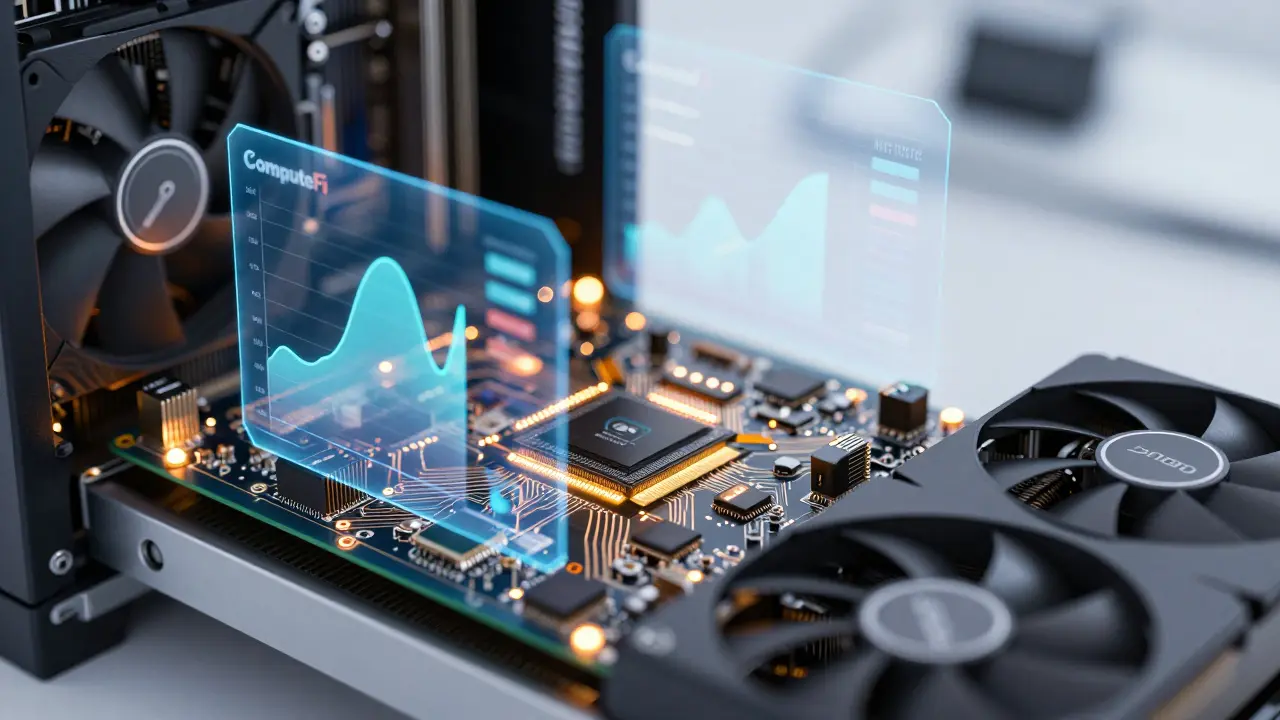
Cysic Network introduces the concept of "ComputeFi," treating compute resources as liquid assets. By integrating custom hardware like ASICs and portable miners, Cysic creates a deeper level of efficiency and control over the physical infrastructure.

Cost Savings and Economic Benefits
The economic argument for decentralized compute is strong. Traditional cloud pricing is opaque and often includes premiums for brand loyalty and convenience. Decentralized marketplaces operate on competitive bidding. Providers compete for your jobs by offering lower prices or better performance metrics.
This competition drives down costs. For example, IO.net has reported substantial pricing advantages over AWS, Azure, and GCP for similar GPU configurations. Additionally, the pay-per-use model eliminates waste. In centralized clouds, you often rent fixed capacity even if your workload fluctuates. In decentralized networks, you scale precisely with your needs.
There is also an environmental benefit. Centralized data centers consume massive amounts of energy and water for cooling. Decentralized networks leverage existing hardware that is already powered and cooled, reducing the carbon footprint per unit of computation. Advanced cooling technologies in distributed nodes further enhance sustainability.
Security and Trust Mechanisms
You might wonder: how do I know the node I’m renting isn’t returning fake results? Security is built into the architecture through several layers:
- Smart Contracts: Payments are held in escrow and released only when the task is verified as complete. This removes the risk of non-payment or unauthorized charges.
- Cryptographic Verification: Results are checked using zero-knowledge proofs or redundant computation. If two nodes return different answers, the system flags the discrepancy and penalizes the dishonest provider.
- Reputation Systems: Every transaction is recorded on the blockchain. Providers with poor uptime or failed tasks lose reputation scores, making them less attractive to future requesters.
- Immutable Audit Trails: All activity is visible on-chain. This transparency ensures accountability and allows users to verify resource specifications and performance history.
These mechanisms create a trustless environment where you don’t need to know or trust the provider personally. The code enforces the rules.
Future Trends: Quantum and Specialized Hardware
The decentralized compute landscape is evolving rapidly. Beyond standard GPUs, we are seeing the integration of specialized hardware. ASICs (Application-Specific Integrated Circuits) and tensor processors are being added to networks to handle specific tasks more efficiently than general-purpose GPUs.
Quantum computing is also entering the conversation. While still nascent, quantum-enhanced infrastructure could revolutionize fields like algorithmic trading and risk assessment by enabling complex Monte Carlo simulations at speeds impossible for classical computers. Decentralized networks are positioning themselves to integrate these quantum resources as they become available, creating a hybrid compute ecosystem.
Regulatory frameworks are likely to emerge soon to standardize service quality, security, and data privacy. As compute becomes recognized as a foundational pillar of Web3 infrastructure-alongside DeFi, storage, and bandwidth-expect increased investment and enterprise adoption.
Getting Started with Decentralized Compute
If you want to try decentralized compute, here is a simple path forward:
- Identify Your Workload: Determine if your task is batch-oriented (like model training) or real-time (like inference). Batch jobs are easier to distribute across decentralized nodes.
- Choose a Platform: For cost-sensitive AI projects, start with IO.net. For production apps needing stability, look at Akash Network.
- Set Up Wallets: You will need a crypto wallet compatible with the platform’s base blockchain (e.g., Phantom for Solana-based IO.net).
- Deploy via CLI or API: Most platforms offer command-line tools or APIs to deploy Kubernetes pods or Docker containers directly to the network.
- Monitor Performance: Use dashboard tools to track latency, cost, and completion rates. Adjust your provider selection based on real-world performance.
The barrier to entry is lower than ever. With clear documentation and growing community support, developers can migrate workloads from centralized clouds to decentralized networks in days, not months.
Is decentralized compute secure enough for enterprise use?
Yes, for many workloads. Platforms like Akash Network are designed for production-grade reliability. Security is enforced through smart contracts, cryptographic verification, and reputation systems. However, for highly sensitive data, you should still consider encryption and private node options.
How much cheaper is decentralized compute compared to AWS or Azure?
Prices vary by task and provider availability, but users often report savings of 30-50%. Competitive bidding and the utilization of idle hardware drive costs down significantly compared to centralized cloud markups.
Can I use my own GPU to earn money on these networks?
Absolutely. Platforms like IO.net allow individuals and small data centers to list their GPU resources. You set your price and availability, and the network matches you with tasks. This is a great way to monetize underutilized hardware.
What types of tasks are best suited for decentralized compute?
Tasks that are parallelizable and fault-tolerant work best. This includes AI model training, rendering, big data analysis, and scientific simulations. Real-time applications requiring ultra-low latency may still prefer centralized clouds, though improvements are ongoing.
Do I need to be an expert in blockchain to use these platforms?
Not necessarily. Most platforms provide user-friendly interfaces, SDKs, and APIs that abstract away the blockchain complexity. You interact with the system similarly to how you would with traditional cloud services, just with different authentication methods.

Comments (9)
Amit Umarani May 16 2026
the grammar in this post is actually fine which is refreshing but the premise that decentralized compute is just airbnb for gpus is a massive oversimplification. you are ignoring the latency issues entirely. if you are training a model, sure, maybe it works for batch jobs but for anything requiring low latency communication between nodes, this network architecture falls apart. also 'monopoly power' is a bit of a stretch when aws azure and gcp are competing fiercely on price already.
Noel Dhiraj May 18 2026
hey everyone! i think this is such an exciting development for us developers who are always struggling with cloud costs. honestly it feels like we finally have some real alternatives to the big three. i know people say its risky but imagine the savings if we can just rent out idle hardware from our home rigs or small local data centers. lets support each other as we try these platforms out! no need to be afraid of trying something new 🚀
vidhi patel May 19 2026
This article exhibits a profound lack of technical rigor regarding the security implications of distributed computing environments. The assertion that smart contracts provide sufficient trust mechanisms is demonstrably false without robust zero-knowledge proof implementations at every layer. Furthermore, the comparison to Airbnb is intellectually lazy and misleading. One must consider the provenance of the hardware, the potential for side-channel attacks, and the regulatory compliance issues inherent in cross-border data processing. It is unacceptable to present such a superficial analysis as fact.
Priti Yadav May 20 2026
you really think they are going to let you just mine crypto or run ai models on their grid without tracking you? please. this is just another way for the tech giants to harvest more data about your usage patterns while pretending to give you freedom. io.net and akash are probably fronting for larger surveillance capitalism initiatives. they want to own your compute footprint so they can sell your behavioral data to advertisers. wake up sheeple.
Ajit Kumar May 21 2026
I feel compelled to address the ethical dimensions of this technological shift, which often go unexamined in such breathless promotional material. When we decentralize compute, we are effectively outsourcing the environmental burden of energy consumption to individuals who may not have adequate cooling systems or renewable energy sources, thereby exacerbating the carbon footprint of AI training in a less regulated manner than centralized facilities might allow. Moreover, there is a moral imperative to consider the digital divide; by creating a market where only those with high-end GPUs can participate as providers, we risk creating a new class of digital landlords who exploit the labor of others through algorithmic management systems that offer no job security or benefits, thus perpetuating systemic inequality under the guise of innovation.
Diwakar Pandey May 23 2026
i noticed that most people here are focusing on the cost aspect but i think the reliability part is what matters most for me personally. i tried running a small inference task on one of these networks last week and it was surprisingly smooth. the documentation could be better though, i had to dig around a bit to find the right api endpoints. but overall it seems promising for hobbyist projects where downtime is not critical. good read.
Soham Dhruv May 24 2026
yo i been using akash for my ml projects and its pretty cool man. saves me a ton of cash compared to aws. dont get me wrong its not perfect sometimes nodes drop out but for batch processing it works great. just make sure u encrypt ur data before sending it off. also the community is helpful if u get stuck. cheers 🍻
Bob Buthune May 24 2026
I cannot help but feel a deep sense of melancholy when reading about this fragmentation of computational resources. We are tearing apart the unified fabric of the internet's infrastructure in pursuit of marginal cost savings, losing the cohesion and stability that allowed previous generations of innovators to build upon reliable foundations. The emojis and casual tone of other comments here only serve to highlight the trivialization of this significant architectural shift, which I fear will lead to a fragmented, insecure, and ultimately unsustainable ecosystem where no single entity is accountable for the integrity of the results produced, leaving us all adrift in a sea of unverified outputs 😔📉💻
Jane San Miguel May 25 2026
The notion that one can simply replace enterprise-grade infrastructure with a patchwork of consumer-grade hardware is laughable to anyone with actual experience in high-performance computing. These platforms are toys for amateurs who do not understand the nuances of network latency, hardware consistency, or security protocols required for production environments. True professionals stick to AWS or Azure because reliability is non-negotiable.