

Imagine building a global wireless network or a massive cloud computing farm without owning a single server rack or laying a single mile of fiber optic cable. Sounds like a dream for tech giants? For the creators of DePIN (Decentralized Physical Infrastructure Networks), it’s just Tuesday. These networks use blockchain technology to coordinate thousands of independent people who contribute their own hardware-routers, GPUs, solar panels-to build real-world infrastructure. Instead of a corporation footing the bill, users are rewarded with tokens for providing coverage, storage, or energy.
You might have heard the buzzwords flying around since 2023. But what actually happens when you plug in a device and start earning crypto? Is this just another speculative bubble, or is it genuinely reshaping how we handle connectivity and compute power? By October 2026, DePIN has moved past the hype cycle. Major financial institutions like J.P. Morgan now track these networks as serious competitors to traditional telecom and cloud providers. This guide breaks down exactly how they work, which projects are leading the charge, and whether you should consider joining one.
The Core Mechanism: How Tokens Build Hardware
At its heart, a DePIN project solves the "cold start" problem of new infrastructure. Traditionally, if you want to launch a mobile network, you need billions in capital to buy towers and spectrum licenses before you have a single customer. DePIN flips this model. It uses crypto-economic incentives to get early adopters to buy and deploy hardware themselves. The blockchain acts as the ledger, verifying that your device actually provided the service (like transmitting data) and then paying you in tokens.
Think of it like Uber, but instead of drivers bringing cars, operators bring routers or graphics cards. The platform doesn't own the assets; it owns the protocol that connects supply (your idle GPU) with demand (a studio needing to render a movie). A study published in Frontiers in Blockchain in March 2026 defines these systems as "socio-technical patterns" where individual profit motives align with network goals. If everyone wants better Wi-Fi coverage, everyone buys a hotspot. If AI developers need cheap compute, everyone plugs in their gaming PC.
Connectivity: The Rise of Decentralized Wireless
No discussion about DePIN is complete without mentioning Helium. Launched in 2019, it pioneered the concept of crowd-sourced wireless networks. Originally focused on low-power IoT devices using LoRaWAN technology, Helium allowed users to earn HNT tokens by placing hotspots in their homes or offices. Today, it has evolved into a multi-layered network covering everything from smart sensors to 5G mobile phones.
By mid-2026, nearly one million hotspots were deployed globally. That’s not just a number; it’s a physical mesh of antennas owned by regular people. Helium Mobile takes this further by offering consumer cellular plans. Users sign up for unlimited data, and while they pay for the service, other community members earn MOBILE tokens by providing the coverage those users consume. Partnerships with carriers like AT&T and Telefónica allow traffic offloading, meaning major telcos can use this decentralized layer to reduce congestion on their own expensive infrastructure.
Compute Power: Rendering and AI on Distributed GPUs
If Helium handles bandwidth, Render Network handles processing power. As artificial intelligence exploded in popularity between 2023 and 2024, the demand for GPU compute skyrocketed. Centralized clouds like AWS or Azure couldn’t keep up with the surge, nor could they offer competitive pricing for every workload. Render Network stepped in to aggregate idle GPU capacity from gamers, miners, and small studios.
The workflow is surprisingly straightforward. A creator uploads a 3D scene or an AI inference task. The network splits this job across hundreds of distributed nodes. Each node processes a chunk of the frame or calculation and returns the result. In exchange, the node operator receives RNDR tokens. By June 2025, Render had completed over 63 million cumulative frames, with a significant portion occurring during the recent AI boom. This demonstrates that decentralized compute isn’t just theoretical-it’s handling heavy industrial workloads right now.
| Project Name | Primary Function | Native Token | Key Metric (2026) |
|---|---|---|---|
| Helium | Wireless Connectivity (IoT, 5G) | HNT, IOT, MOBILE | ~1 Million Hotspots Deployed |
| Render Network | Distributed GPU Compute (AI/VFX) | RNDR | 63+ Million Frames Rendered |
| Hivemapper | Decentralized Mapping & Sensing | HONEY | Coverage via Dashcam Data |
| Filecoin | Decentralized Storage | FIL | Petabytes of Active Storage |

Storage and Sensing: Beyond Bandwidth and Compute
Connectivity and compute are the big headlines, but DePIN extends to storage and sensing too. Filecoin allows individuals to rent out unused hard drive space. Unlike centralized cloud storage where you trust Amazon with your files, Filecoin uses cryptographic proofs to ensure your data is stored correctly and available. You pay FIL tokens to store data, and miners earn FIL for keeping it safe.
Then there’s mapping. Hivemapper uses dashcams attached to regular cars to update road maps in real-time. Drivers earn HONEY tokens for capturing fresh imagery and GPS data. This solves the staleness problem in traditional map services, where roads change faster than corporate survey teams can update them. It’s a perfect example of turning passive daily activity (driving) into active network contribution.
Why Traditional Providers Can’t Ignore DePIN
You might wonder why companies like Verizon or Microsoft care about a bunch of guys with routers in their basements. The answer lies in marginal costs. Once a DePIN network reaches critical mass, adding new capacity becomes incredibly cheap because the hardware is already paid for by the users. Centralized providers have to spend billions upfront. DePIN spreads that cost across thousands of micro-investors.
However, it’s not all smooth sailing. DePIN networks face challenges with equitable coverage. Early rewards often attract users to dense urban areas where signals overlap, leaving rural regions underserved until incentives shift. Additionally, token volatility affects earnings. If the price of HNT crashes, a hotspot operator’s return on investment drops overnight, even if their technical performance remains perfect. Traditional providers offer stable pricing, whereas DePIN offers dynamic, market-driven rates that can be cheaper but less predictable.
Getting Started: What Do You Actually Need?
So, how do you join? It depends on which sector you choose. For connectivity, you typically buy a certified hotspot from manufacturers like Nebra or Sensecap. Installation is usually plug-and-play: connect to power and internet, scan a QR code, and you’re live. For compute, you need a decent GPU (NVIDIA RTX series are common) and software that interfaces with the network. You don’t need to be a coder, but you do need reliable uptime and good internet speed.
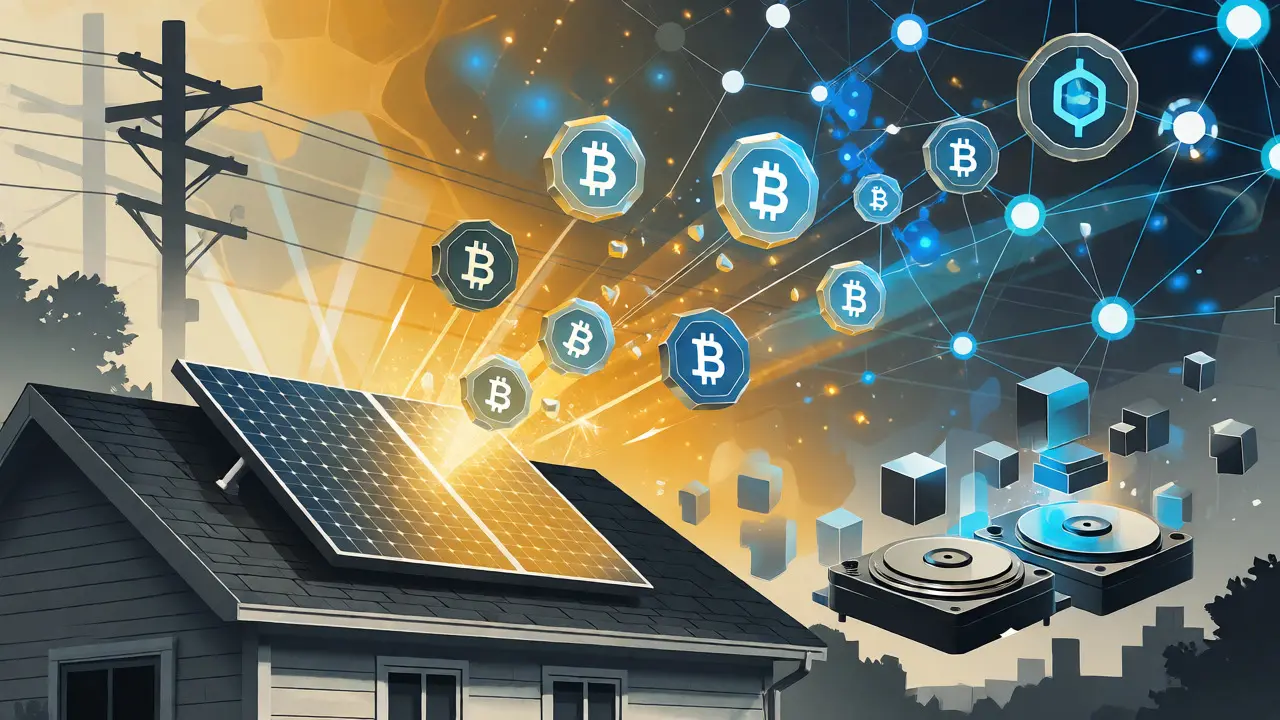
Energy is the next frontier. Projects are emerging that let homeowners sell excess solar power back to the grid or to neighbors via blockchain-managed contracts. While still in early stages compared to Helium or Render, this promises to decentralize the energy grid itself, allowing peer-to-peer trading without utility middlemen taking a huge cut.
The Future Outlook for DePIN in 2026 and Beyond
Institutional interest is growing. J.P. Morgan’s 2026 analysis suggests DePIN could become a core pillar of Web3, bridging digital finance with physical reality. As AI models grow larger, the demand for distributed compute will only increase. Centralized clouds are hitting power and cooling limits; decentralized networks tap into idle resources everywhere, from gaming PCs to data centers in colder climates.
The trend is clear: infrastructure is becoming programmable. We are moving away from monolithic ownership toward modular, token-governed ecosystems. Whether you see this as an investment opportunity or a technological shift, understanding DePIN is essential for anyone tracking the future of the internet.
What does DePIN stand for?
DePIN stands for Decentralized Physical Infrastructure Networks. It refers to blockchain-based systems that use token incentives to encourage users to deploy and operate physical hardware, such as wireless hotspots, storage drives, or GPUs, creating community-owned infrastructure.
Is Helium still relevant in 2026?
Yes, Helium remains a leading DePIN project. It has expanded from IoT-only coverage to include 5G mobile services through Helium Mobile, with partnerships with major carriers like AT&T. It continues to host nearly one million hotspots globally.
How do I earn money with DePIN?
You earn native network tokens by providing a specific resource. For example, Helium pays HNT for wireless coverage, Render Network pays RNDR for GPU compute time, and Filecoin pays FIL for storage space. These tokens can be held or sold on exchanges.
Do I need expensive hardware to join DePIN?
It varies. Basic IoT hotspots for Helium can cost under $100-$200. However, participating in high-performance compute networks like Render requires powerful GPUs, which can cost several hundred to thousands of dollars. Storage networks require large-capacity hard drives.
What are the risks of investing in DePIN tokens?
Risks include token price volatility, regulatory uncertainty, and potential oversaturation of hardware in certain regions. If too many people join a network, individual rewards may decrease due to dilution. Always research the specific economic model of each project.
