
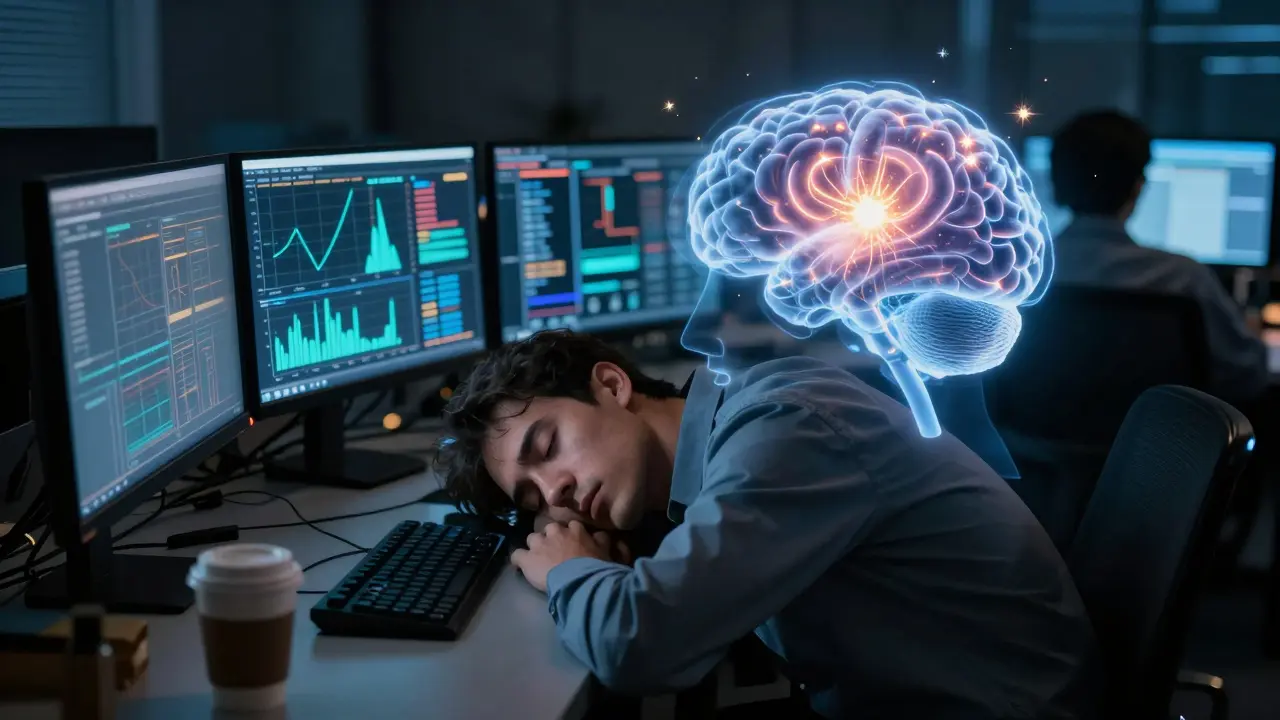
Most traders focus on charts, indicators, and news feeds. They study candlestick patterns, track macroeconomic data, and optimize their entry and exit points. But one of the biggest performance killers is invisible - sleep. If you’re trading while tired, you’re not just fatigued. You’re making decisions with a brain that’s functionally impaired. And in trading, where milliseconds matter and emotions run high, that’s dangerous.
How Sleep Deprivation Rewires Your Trading Brain
Your prefrontal cortex is the part of your brain that handles logic, risk assessment, and impulse control. When you don’t get enough sleep, it shuts down - not completely, but enough to make you act like a different person. A 2015 study from the Journal of Neuroscience showed that sleep loss directly damages this region. Without it, you lose the ability to weigh long-term consequences. You start reacting instead of planning. Meanwhile, your amygdala - the emotional alarm system - goes into overdrive. A 2007 UC Berkeley study found that sleep-deprived people had a 60% spike in amygdala activity. What does that mean for trading? You panic-sell after a 1% dip. You double down on a losing trade because you’re convinced the market "owes you" a win. You ignore your rules because your brain is flooded with fear and false confidence. This isn’t theory. It’s measurable. A 2019 study in Sleep Health tested financial professionals on risk-reward tasks. Those who slept poorly performed 20% worse than well-rested peers. That’s not a small gap. That’s the difference between breaking even and losing money month after month.The Sunset Experiment: Sleep Has a Direct, Causal Impact on Trading
Most studies say "sleep and trading performance are linked." But a groundbreaking 2023 study from LMU’s College of Business Administration didn’t stop at correlation. They proved causation - and they did it using sunset times. Here’s how: They looked at retail traders living on opposite sides of time zone borders. One side got sunset an hour earlier. That meant those traders went to bed earlier and got more sleep. The other side stayed up later, naturally. The researchers tracked their trading behavior over months. The results were clear. Traders with less sleep were 4.27% more likely to trade right after earnings announcements - not because they were smarter or more informed, but because they missed the news. Their brains couldn’t process new information properly. They were too cognitively drained to react rationally. Even more telling: those sleep-deprived traders were 4.5% more likely to take asymmetric risks - betting big on long shots while avoiding balanced, calculated moves. This isn’t luck. It’s neurobiology.Caffeine and Alcohol: The Hidden Saboteurs
You think coffee helps you trade better. It doesn’t. It just tricks you into thinking you’re awake. A PLOS One study tracked traders over weeks using wearable sleep monitors. Each cup of coffee they drank cost them over ten minutes of sleep. That’s not much - until you add up five cups a day. You lose over an hour of rest. And here’s the twist: traders didn’t notice. Their self-reported sleep quality stayed the same. But their bodies were running on empty. That’s a sleep-state mismatch - feeling fine while your brain is failing. Alcohol is worse. It doesn’t just reduce sleep quality - it shatters it. The same study found alcohol made traders wake up 3-4 times a night, even if they fell asleep fast. And when you combine alcohol and caffeine? The damage triples. Together, they explain over 10% of sleep quality variance - nearly double what either does alone. The caffeine keeps you from feeling tired. The alcohol ruins your deep sleep. You wake up exhausted, but you think you’re ready to trade.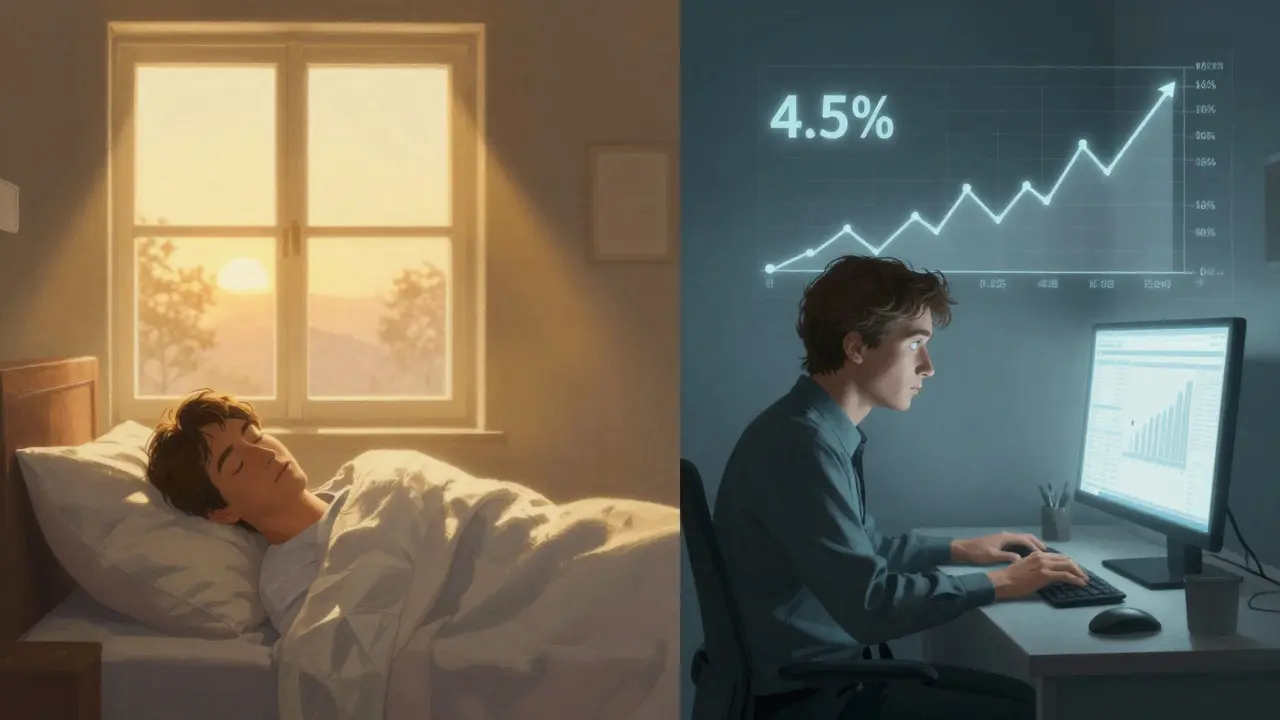
Consistency Beats Duration - Even When You Can’t Sleep Enough
You might think: "I’ll just sleep 7 hours tonight." But if you go to bed at 1 a.m. one night and 4 a.m. the next, your brain can’t reset. Your circadian rhythm gets scrambled. Your cortisol spikes. Your focus drops. Your reaction time slows. A 2020 study in the Journal of Sleep Research found that traders who kept consistent sleep-wake times - even if they only slept 6 hours - outperformed those who slept 8 hours but on wildly different schedules. Why? Because your brain thrives on predictability. When your body knows when to rest, it rests better. When it doesn’t, it stays half-awake. This matters most for traders who follow global markets. If you’re trading Asian sessions one day, European the next, and U.S. the day after, your schedule is chaos. But you can still win. Set a fixed wake-up time every day. No exceptions. Even on weekends. Let your bedtime adjust around that. Your brain will thank you.The Real Cost of Poor Sleep in Trading
Think about it: You’re not just losing sleep. You’re losing decision-making power. A Harvard Medical School study tracked investment bankers over two weeks. For every extra hour of sleep, their reaction time on trading decisions improved by 15%. That’s not a luxury. In algorithmic or high-frequency trading, a 15% faster reaction means capturing a better price. In discretionary trading, it means avoiding a panic sell or catching a reversal before it’s too late. And it compounds. One bad trade because you were tired? Maybe $500. Ten bad trades over a month? $5,000. A year of this? $60,000 - and that’s just the money. Add the stress, the confidence erosion, the burnout. That’s harder to quantify. Sleep isn’t about feeling rested. It’s about staying sharp. It’s about protecting your edge. And in trading, your edge is everything.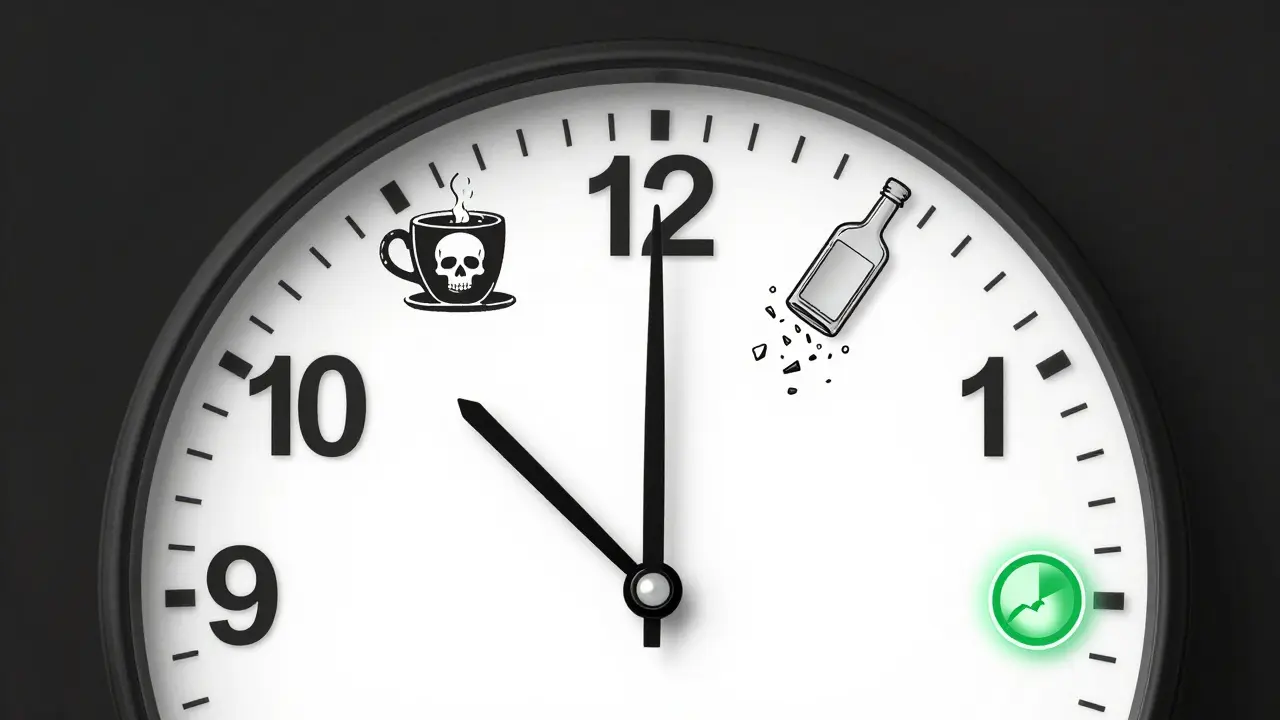
What Traders Actually Need to Do
You don’t need to sleep 9 hours. You don’t need to quit coffee. You need structure.- Set a fixed wake-up time - every day, no exceptions.
- Avoid caffeine after 2 p.m. Even if you "don’t feel it," it delays sleep onset.
- Don’t drink alcohol within 3 hours of bedtime. It doesn’t help you sleep - it ruins the quality.
- Track your sleep for two weeks. Use a simple app or wearable. You’ll be shocked at how often you think you slept well but didn’t.
- Protect your sleep like you protect your stop-loss. If you skip it, you’re not being disciplined - you’re being reckless.

Comments (9)
Ian Maggs March 23 2026
It’s fascinating, isn’t it?-how the brain, this intricate, evolved organ, is so utterly vulnerable to the absence of rest. We treat sleep like a luxury, a concession to weakness-but it’s the very architecture of rationality. The prefrontal cortex doesn’t just ‘shut down’-it withers. Like a garden starved of rain. And we wonder why we chase losses, why we ignore stop-losses, why we double down on irrationality. It’s not greed. It’s neurochemistry. And yet, we don’t track our sleep like we track our P&L. We should. We really should.
Michael Gradwell March 25 2026
Stop overthinking it. Sleep is just recovery. You don’t need a 2019 study to tell you that being tired makes you dumb. I’ve traded drunk, tired, and hungover. Lost money every time. Wake up. Go to bed. Trade better. Done.Flannery Smail March 26 2026
Yeah but what if you’re a night owl? The market’s open at 3 a.m. EST. You can’t just force yourself to sleep at 10 p.m. because some professor says so. This feels like a productivity cult.Emmanuel Sadi March 27 2026
Oh wow. A whole article about sleep. Did you also read that breathing improves lung function? Maybe try not being an amateur trader who thinks science is magic. Your ‘sunset experiment’ is just chronotype bias wrapped in fancy jargon. You’re not special. Your sleep schedule isn’t a trading edge. It’s basic biology. Everyone knows this.Nicholas Carpenter March 27 2026
This is one of the most important pieces I’ve read in years. Not because it’s groundbreaking-but because it’s so rarely said out loud. Trading is a mental sport. You wouldn’t show up to a marathon with a sprained ankle, yet we show up to the market with sleep-deprived brains and call it ‘grind culture.’ Protecting sleep isn’t self-care. It’s risk management. And if you’re not treating it that way, you’re already losing.
Chuck Doland March 29 2026
It is, indeed, a matter of profound epistemological significance that the physiological state of the organism directly modulates the quality of its decision-making apparatus. The prefrontal cortex, as the executive center of cognitive control, exhibits measurable degradation under conditions of circadian disruption. Moreover, the amygdalic hyperactivation observed in sleep-deprived individuals constitutes not merely a behavioral anomaly, but a systemic failure of normative economic reasoning. One must therefore conclude that the discipline of trading-when divorced from biological fidelity-is not a science, but an exercise in stochastic self-destruction.
Madeline VanHorn March 29 2026
I mean, duh. If you’re trading while tired, you’re just a broke person with a chart. Everyone knows this. Why are we even talking about this?Glenn Celaya March 30 2026
I dont even know why i read this whole thing. you guys act like sleep is some secret weapon. its not. its just sleep. and coffee. and alcohol. and your 3am trades. and you still lose. so what. you think this changes anything? nah.Wilda Mcgee April 1 2026
Let me tell you something-I used to think I was a night owl who ‘thrived’ on 4 hours of sleep. Then I started tracking my trades. Every time I slept under 6.5 hours? My win rate dropped. My patience vanished. I started blaming the market instead of myself. So I set a 7 a.m. wake-up-no exceptions. Weekends. Holidays. Even after a 3 a.m. trade. And guess what? My P&L improved. Not because I changed my strategy. But because my brain stopped being a drunk, emotional mess. You don’t need more hours. You need consistency. And yes, it’s weirdly beautiful-how something so simple can rebuild your entire edge.