
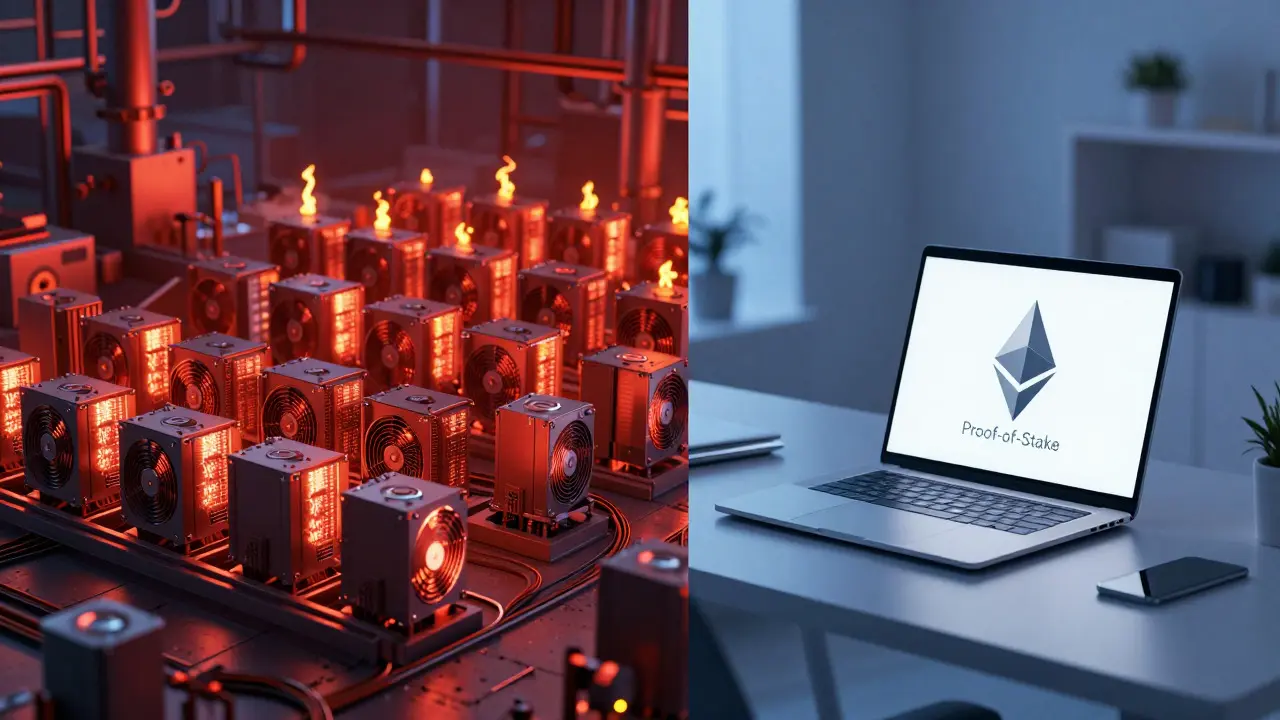
Imagine a digital network that once consumed as much electricity as the entire country of Finland. Now imagine that same network running on less power than a typical household uses in a month. This isn't science fiction; it is what happened to Ethereum, the second-largest cryptocurrency platform, after its historic upgrade known as "The Merge".
On September 15, 2022, Ethereum switched from an energy-intensive method called Proof-of-Work (PoW) to a more efficient system called Proof-of-Stake (PoS). The result? A reduction in annual energy consumption by roughly 99.95%. For years, critics pointed to Bitcoin and early Ethereum as major contributors to global carbon emissions. Today, Ethereum stands as one of the most sustainable large-scale blockchains in existence. But how exactly did this happen, and what does it mean for the future of green technology?
From Mining Farms to Validator Nodes: What Changed?
To understand the scale of this shift, you have to look at how Ethereum used to work. Before 2022, securing the Ethereum network required miners using powerful computers to solve complex mathematical puzzles. This process, known as mining, was a competitive race. Miners spent billions of dollars on specialized hardware like ASICs and high-end GPUs, running them 24/7 to earn transaction fees and new ETH tokens.
This competition drove up energy use significantly. Estimates varied widely, but credible sources like the Cambridge Centre for Alternative Finance (CCAF) and Digiconomist placed Ethereum's pre-Merge annual electricity consumption between 23 and 94 terawatt-hours (TWh). To put that in perspective, that is comparable to the yearly energy usage of countries like Switzerland or Finland.
The Merge changed the rules entirely. Instead of competing with computing power, participants now compete with capital. In the Proof-of-Stake (PoS) model, validators lock up, or "stake," their ETH to participate in securing the network. They are chosen randomly to propose and validate blocks based on the size of their stake and their history of honest behavior. There is no longer a need for massive data centers filled with humming servers solving useless puzzles. Validators can run nodes on standard consumer laptops or modest cloud servers.
| Feature | Proof-of-Work (Pre-Merge) | Proof-of-Stake (Post-Merge) |
|---|---|---|
| Energy Source | Electricity for computational hashing | Electricity for server operation |
| Hardware Requirement | ASICs, High-end GPUs | Standard CPUs, Low-power servers |
| Annual Energy Use | ~23-94 TWh | ~0.0026-0.01 TWh |
| Environmental Impact | High carbon footprint (~11M tons CO₂) | Negligible (<870 tons CO₂) |
| Security Basis | Hash Power (Computational Work) | Staked Capital (Economic Skin in the Game) |
The Numbers Behind the 99% Claim
When people say Ethereum cut its energy use by "about 99%," they are actually being conservative. Multiple independent studies confirm the drop is closer to 99.95% to 99.99%. Let’s break down the data from reputable sources to see where these numbers come from.
The Crypto Carbon Ratings Institute (CCRI), commissioned by Consensys, calculated that Ethereum’s electricity consumption fell from nearly 23 million megawatt-hours (MWh) per year under PoW to just over 2,600 MWh per year under PoS. That is a reduction of more than 99.988%. In terms of carbon emissions, the CCRI report estimated a drop of 99.992%, falling from over 11 million tons of CO₂ equivalents annually to fewer than 870 tons.
The European Union Blockchain Observatory and Forum (EUBOF) provided similar findings in their trend reports. They noted that post-Merge, Ethereum’s continuous power demand dropped to roughly 0.015 terawatts, with annual consumption hovering around 0.0096 TWh. The Cambridge Centre for Alternative Finance (CCAF) updated its models in 2026 to reflect an annual consumption of approximately 6.6 gigawatt-hours (GWh), which is 0.0066 TWh.
Why do the numbers vary slightly? It comes down to methodology. Some estimates only count the core consensus layer, while others include the energy used by Layer 2 scaling solutions, staking pools, and the broader infrastructure supporting the network. However, all credible analyses agree on one thing: the order of magnitude change is staggering. We went from a nation-sized energy load to something comparable to a mid-sized office building.
What Does 0.01 TWh Actually Look Like?
Digits like "terawatt-hours" can be abstract. To make this real, let’s compare Ethereum’s current energy profile to everyday objects and places.
- A Single US Household: The average American home consumes about 10,000 kWh (or 0.01 MWh) per year. Ethereum’s entire network now uses roughly 260 times that amount. So, instead of powering a country, it powers about 260 homes.
- An Office Building: A typical commercial office building might consume between 100,000 and 500,000 kWh annually. Ethereum’s usage fits comfortably within this range.
- Global Context: Before the Merge, Ethereum accounted for a noticeable fraction of global digital emissions. Now, its footprint is so small that it is often considered negligible in global climate discussions, especially when compared to industries like aviation or traditional banking.
This dramatic shift has allowed Ethereum to rebrand itself not just as a financial tool, but as a sustainable infrastructure for Web3 applications, decentralized finance (DeFi), and non-fungible tokens (NFTs). Institutional investors, who were previously wary of crypto due to Environmental, Social, and Governance (ESG) concerns, now view Ethereum as a viable asset class.
Beyond Energy: E-Waste and Hardware Efficiency
Sustainability isn’t just about electricity; it’s also about physical waste. The Proof-of-Work era generated significant electronic waste (e-waste). Miners would buy expensive graphics cards and application-specific integrated circuits (ASICs), use them until they became obsolete or broke, and then discard them. Because the hardware was specialized, it had little resale value outside of mining farms.
The transition to Proof-of-Stake eliminated the need for this specialized hardware. Validators do not need constant upgrades to stay competitive. A validator node from 2022 can still operate effectively today with minimal maintenance. This reduces the turnover rate of hardware and, consequently, the volume of e-waste produced by the ecosystem.
Furthermore, because validators can run on standard equipment, there is less pressure to manufacture millions of identical, single-purpose chips. This aligns better with circular economy principles, where general-purpose technology has a longer lifecycle and greater utility beyond a single task.

Criticisms and Trade-offs: Is It Perfect?
While the environmental benefits are undeniable, the shift to Proof-of-Stake introduced new debates. Critics argue that PoS may lead to centralization. In PoW, anyone with enough electricity and hardware could mine. In PoS, you need ETH to stake. Since staking requires locking up 32 ETH for a solo validator (which can cost thousands of dollars depending on the price), some worry that wealth concentration will dictate network security.
However, the rise of liquid staking protocols and staking pools has mitigated this barrier. Smaller holders can now contribute fractional amounts of ETH to collective stakes, earning rewards without needing 32 ETH upfront. While centralization risks remain a topic of academic and industry discussion, the decentralization metrics of Ethereum remain robust, with thousands of independent validators operating globally.
Another common misconception is that the Merge improved transaction speeds or lowered gas fees directly. It didn’t. The Merge was purely a consensus-layer upgrade. Scalability improvements came later through Layer 2 solutions like Arbitrum and Optimism, which build on top of Ethereum’s secure base layer. Understanding this distinction is crucial: the Merge fixed the energy problem; Layer 2s are fixing the speed and cost problems.
The Future of Sustainable Blockchain
Ethereum’s success serves as a blueprint for other networks. As of 2026, many smaller chains have followed suit, migrating to PoS or hybrid models to reduce their environmental impact. Regulators in the EU and elsewhere are increasingly looking at energy efficiency as a criterion for approving digital assets. The EU Blockchain Observatory explicitly cites Ethereum’s Merge as a case study in aligning blockchain infrastructure with the European Green Deal.
For developers and users, the message is clear: you don’t have to choose between innovation and sustainability. By leveraging efficient consensus mechanisms, blockchain technology can support a growing global economy without burning through natural resources. Whether you are building a DeFi app, trading NFTs, or simply holding ETH, you are participating in a network that has successfully decoupled digital security from excessive energy consumption.
Did Ethereum really cut its energy use by 99%?
Yes, estimates from independent bodies like the CCRI and CCAF show a reduction of between 99.95% and 99.99%. Annual consumption dropped from tens of terawatt-hours to less than 0.01 terawatt-hours.
What is the difference between Proof-of-Work and Proof-of-Stake?
Proof-of-Work relies on miners using computational power to solve puzzles, consuming vast amounts of electricity. Proof-of-Stake relies on validators locking up cryptocurrency (ETH) to secure the network, requiring minimal energy similar to running a standard computer.
How does Ethereum’s energy use compare to Bitcoin?
Bitcoin still uses Proof-of-Work and consumes significantly more energy, estimated at over 100 TWh annually. Ethereum’s post-Merge consumption is orders of magnitude lower, making it far more energy-efficient than Bitcoin.
Does staking Ethereum require special hardware?
No. Solo validators can run nodes on standard consumer-grade hardware or cloud instances. This eliminates the need for specialized ASICs or high-end GPU farms used in mining.
What was "The Merge"?
The Merge was the network upgrade on September 15, 2022, that combined Ethereum’s existing execution layer with the Beacon Chain’s Proof-of-Stake consensus layer, officially ending mining on the mainnet.
