

Most global organizations track their training budgets like a black hole. You send money into the system-platforms, content, facilitators-and you hope something valuable comes out. But when leadership asks for the return on investment (ROI) of your global learning programs, do you have a single number that holds up? Or do you scramble through spreadsheets, guessing at productivity gains?
The problem isn't just calculating ROI; it's doing it fairly across different countries and regions. A dollar spent in Germany doesn't buy the same labor hours as a dollar spent in Vietnam. Cultural attitudes toward training vary wildly. Regulatory environments shift the cost structure entirely. If you treat every region the same, your data will lie to you.
To get real insight, you need a framework that respects local realities while delivering a unified global view. This guide breaks down how to measure global program ROI by country and region, turning messy data into clear business value.
Why Standard ROI Formulas Fail Globally
The classic ROI formula is simple: (Net Program Benefits / Program Costs) x 100. It works fine if you are running one workshop in one city. It falls apart when you scale to twenty countries.
First, currency fluctuations distort costs. If you budget in USD but pay vendors in EUR or JPY, a 5% exchange rate swing can make your program look more expensive or cheaper overnight, without changing the actual quality or outcome. Second, baseline performance varies. Sales teams in mature markets might already be hitting 90% of quota, making it hard to prove training added value. In emerging markets, the same training might lift performance from 40% to 60%, showing massive impact but potentially lower absolute revenue per participant.
Third, attribution gets muddy. Did sales go up because of the new compliance training, or because the region launched a new product line last month? Without isolating variables, you risk taking credit for market trends or blaming training for external economic downturns.
You cannot use a one-size-fits-all metric. You need a layered approach that standardizes the core methodology but adapts the inputs to local contexts.
Step 1: Define Consistent Cost Categories Across Borders
Before you can calculate returns, you must accurately capture costs. Many organizations only count direct expenses: platform licenses, instructor fees, and venue rentals. This misses half the picture. To measure true ROI, you need to account for three layers of cost in every region.
- Direct Costs: These are easy. Software subscriptions, content development, travel for trainers, and materials. Track these in local currency first, then convert to your base currency using the average exchange rate for the quarter, not the spot rate on day one.
- Indirect Costs: Administrative time, HR coordination, and IT support. If your L&D team spends 20 hours configuring a module for the APAC region, that’s a cost. Assign an hourly burdened rate to internal staff time.
- Opportunity Costs: This is the biggest hidden killer. When an employee attends training, they are not working. Calculate this by multiplying the number of training hours by the employee’s fully loaded hourly wage (salary + benefits). A senior engineer in Silicon Valley has a much higher opportunity cost than a junior admin in Manila. Ignoring this skews ROI downward for high-wage regions.
Create a standardized cost template that forces each regional manager to input these three categories. Use a central dashboard to aggregate them. This ensures you’re comparing apples to apples, even if the underlying economics differ.
Step 2: Select Region-Specific Performance Metrics
Benefits are harder to quantify than costs. You need to link training outcomes to business KPIs that matter in each specific market. Don’t just measure "completion rates" or "happy sheets." Those are vanity metrics. Look for behavioral and results-level data.
| Department | Mature Market Metric (e.g., US, UK) | Emerging Market Metric (e.g., India, Brazil) |
|---|---|---|
| Sales | Upsell/Cross-sell ratio improvement | New customer acquisition rate |
| Customer Support | Reduction in call handle time | First-contact resolution rate |
| Manufacturing | Defect rate reduction (%) | Output units per hour |
| Compliance | Audit finding severity score | Incident reporting frequency |
Notice the difference. In mature markets, efficiency and optimization often drive ROI. In emerging markets, growth and adoption are the bigger levers. Tailor your success criteria accordingly. For example, if you roll out a new CRM tool globally, measure "time saved per entry" in Europe, but "number of active users" in Southeast Asia where digital adoption might still be ramping up.
Work with regional business leaders to agree on these metrics before the program launches. If you wait until after, they won’t trust your numbers. Get sign-off on what "success" looks like in their specific context.
Step 3: Isolate Training Impact from External Noise
This is the hardest part. How do you know the ROI came from the training and not from a competitor failing, a seasonal spike, or a new marketing campaign? You need control groups or statistical adjustment.
In large global programs, randomizing participants into treatment and control groups is ideal. Train Group A, leave Group B untrained for six months, then compare performance. If Group A outperforms Group B significantly, you can attribute that delta to the training. However, ethical and political issues often prevent withholding training from employees.
If you can’t use a control group, use historical baselines and trend analysis. Look at the 12-month trend of the KPI before the training. Project that trend forward. The difference between the projected trend and the actual post-training performance is your estimated impact. Adjust for known external factors. If you know a price cut happened in Q3, model its expected effect and subtract it from the total gain.
Use regression analysis if you have the data science resources. Multivariate regression allows you to hold other variables constant (like marketing spend or economic indicators) and isolate the coefficient for training participation. This provides a much cleaner signal of causality.
Step 4: Normalize Data for Currency and Purchasing Power
Comparing raw USD values across countries is misleading due to purchasing power parity (PPP). $1,000 in productivity gain means very different things in Zurich versus Jakarta. To make fair comparisons, normalize your financial data.
Convert all local currency figures to your base currency using PPP adjustments rather than just market exchange rates. International organizations like the World Bank provide PPP conversion factors. This gives you a "real" cost and benefit comparison. Alternatively, express ROI as a percentage return relative to local salary costs. This creates a universal metric: "For every $1 we pay in salaries, we gained $X back through training." This percentage is comparable across borders regardless of wage levels.
Also, consider inflation rates. High-inflation countries can show artificial ROI increases if costs rise slower than revenues. Adjust your financial data for local inflation to see the real operational improvement.

Step 5: Build a Regional ROI Dashboard
Manual Excel sheets don’t scale. You need a centralized learning analytics dashboard that pulls data from your LMS (Learning Management System), HRIS (Human Resources Information System), and business performance tools (CRM, ERP).
Your dashboard should allow drilling down from global totals to country-specific views. Key features to include:
- Cost Breakdown by Region: Visualize direct vs. indirect vs. opportunity costs.
- KPI Trends: Line charts showing pre- and post-training performance for each agreed-upon metric.
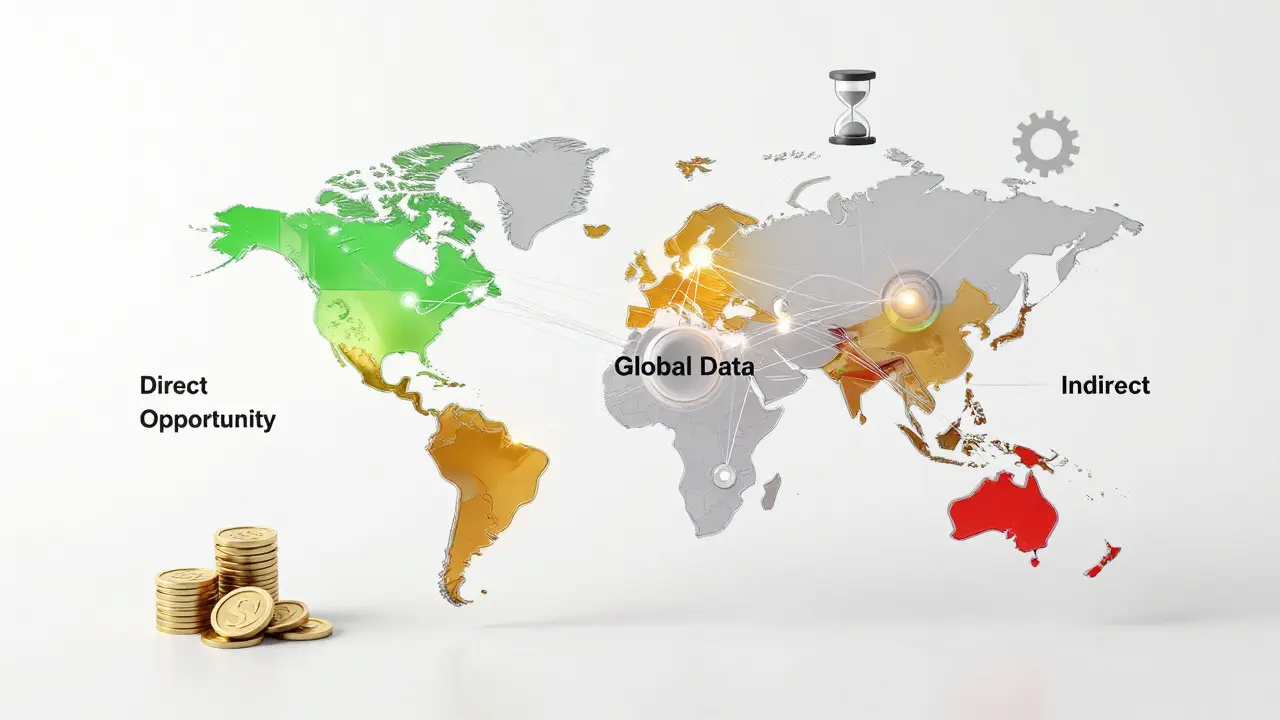
- ROI Heatmap: A world map colored by ROI percentage. Green for high return, red for low. This instantly highlights which regions are maximizing value and which need intervention.
- Payback Period: How many months did it take for the benefits to exceed the costs? Faster payback indicates higher efficiency.
Automate data feeds where possible. If your LMS integrates with Salesforce, pull deal sizes and win rates automatically. Reducing manual data entry reduces errors and makes the report timely. Leadership cares about recent data, not reports from six months ago.
Common Pitfalls to Avoid
Even with a solid framework, mistakes happen. Watch out for these common traps:
- Ignoring Cultural Bias in Feedback: In some cultures, employees rarely give negative feedback. High satisfaction scores in Japan might mean "adequate," not "excellent." Correlate survey data with behavioral metrics to get the truth.
- Short-Termism: Some training, like leadership development, takes 12-18 months to show ROI. Measuring it after three months will show zero return, leading you to cancel valuable programs. Set realistic timelines for different learning types.
- Over-Attribution: Claiming 100% of a positive business outcome belongs to training is naive. Be conservative. Attribute 20-50% of the change to training, depending on the strength of your evidence. Credibility matters more than hype.
Putting It Into Practice
Measuring global program ROI by country and region requires discipline, collaboration, and smart data handling. Start small. Pick one global initiative and one region. Apply this framework rigorously. Document the process. Refine it. Then scale.
When you can show leadership exactly how much value each region generates from its learning investments, you stop being a cost center and start being a strategic partner. You’ll secure better budgets, design more relevant programs, and drive real business results.
What is the best way to calculate opportunity cost for global training?
Multiply the total hours of training by the employee's fully loaded hourly wage. Fully loaded wage includes salary, bonuses, benefits, and overhead. Use local salary data for each country to ensure accuracy. Do not use a global average, as this will skew costs for high-wage and low-wage regions.
How do I handle currency fluctuations in ROI calculations?
Record all costs and benefits in local currency first. Then convert to your base currency using the average exchange rate for the period covered (e.g., quarterly average). Avoid using spot rates from a single day, as they introduce volatility that doesn't reflect actual business conditions. Consider using Purchasing Power Parity (PPP) for cross-region comparisons.
Can I use control groups for global training programs?
Yes, but it can be politically sensitive. Randomly assign some employees to receive training immediately (treatment group) and others to receive it later (control group). Compare their performance over the delay period. If ethical concerns prevent this, use historical baselines and statistical controls to estimate impact instead.
What metrics should I use for soft skills training ROI?
Soft skills are harder to quantify. Link them to downstream behaviors. For leadership training, track retention rates of direct reports, promotion velocity, or 360-degree feedback scores. For communication training, track project delivery times or client satisfaction scores. Always tie the behavior to a business outcome.
How often should I update my global ROI dashboard?
Monthly updates are ideal for tracking trends and catching issues early. Quarterly deep dives allow for more thorough analysis of external factors and currency impacts. Annual reviews are necessary for strategic planning and budget justification. Real-time dashboards are great for monitoring completion, but financial ROI requires lagging indicators that take time to materialize.
