

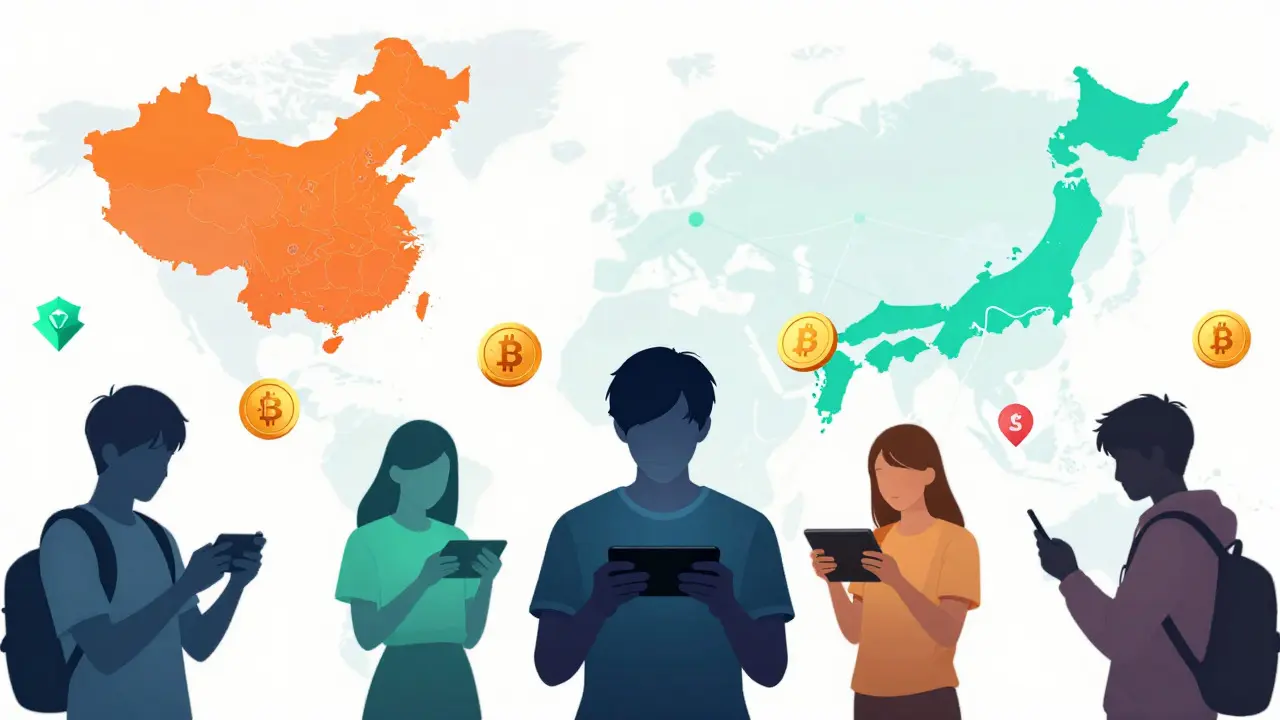
Who actually runs the global crypto economy? It’s not a single country or one massive corporation. Instead, leadership is split across different regions, each dominating a specific slice of the pie. If you look at decentralized finance (DeFi), North America holds the institutional weight. But if you check who is playing blockchain games or using Layer 2 networks for daily transactions, Asia-Pacific takes the lead. Understanding these regional differences isn’t just academic-it explains where the money flows, where the users are, and which markets offer the best opportunities for growth in 2026.
The Battle for DeFi Dominance
Decentralized Finance (DeFi) is a financial system built on blockchain technology that allows lending, borrowing, and trading without traditional intermediaries like banks. When we talk about who leads this sector, we have to look at two very different metrics: Total Value Locked (TVL) and active user participation.
In terms of raw capital and infrastructure, North America is the region with the highest concentration of institutional investment and DeFi protocol development remains the heavyweight champion. According to a January 2026 study by Coinlaw.io, North America accounted for roughly 36-43% of the global DeFi market by revenue and TVL in 2024. The United States alone drove 35.6% of global DeFi wallet activity that year. This dominance is supported by over 112 blockchain startups focusing exclusively on DeFi infrastructure in the region, creating a robust ecosystem for high-value transactions.
However, volume doesn't always equal user count. While North America handles the big institutional trades, Asia-Pacific is the region leading in retail crypto adoption and on-chain usage intensity has emerged as the largest market in aggregate when measuring actual people using the tech. Countries like India, Vietnam, and the Philippines are driving this surge. The Chainalysis Global Crypto Adoption Index ranks India as number one worldwide for overall crypto adoption. Indonesia takes the top spot globally for DeFi value received, indicating that everyday users there are interacting with DeFi protocols more frequently than their Western counterparts.
Europe sits comfortably in the middle, controlling 25-30% of global DeFi activity. With over $8.6 billion in DeFi assets and $320 billion in trading volumes in 2024, Europe benefits from strong digital connectivity. Eurostat data shows that nearly two-thirds of the EU population uses online social networks regularly, providing the digital literacy base needed for DeFi adoption. Regulatory frameworks like MiCA (Markets in Crypto-Assets) also provide a layer of stability that attracts both developers and cautious investors.
Blockchain Gaming: Asia’s Clear Victory
If DeFi is a tug-of-war between North America and Asia, blockchain gaming is a landslide victory for the latter. Blockchain Gaming is video games that integrate non-fungible tokens (NFTs) and cryptocurrencies to allow true ownership of in-game assets.
Asia-Pacific captured 46.32% of worldwide blockchain gaming revenue in 2024, according to Data Bridge Market Research. By 2025, that share remained steady at around 46%, while the region also commanded approximately 35% of all blockchain gaming traffic. China, Japan, and South Korea are the engines here, combining massive gamer populations with high mobile penetration rates.
Why does Asia lead here? It comes down to culture and access. In many Asian countries, mobile gaming is already the default way people play. Adding crypto elements-like earning tokens or owning NFTs-is a natural evolution for these players. DappRadar reports that 32% of the audience for top-ranked blockchain games originates from Asia. Furthermore, the device split is interesting: 62% desktop vs 38% mobile, showing a mature multi-device ecosystem rather than just casual mobile-only play.
North America still plays a significant role, accounting for roughly 31% of global blockchain gaming activity. However, its strength lies more in studio development and venture funding than in current revenue generation. The Blockchain Game Alliance (BGA) survey shows that while 36.8% of respondent organizations were based in Europe and 26.2% in Asia, only 15.4% were in North America. This suggests that while US companies might fund the projects, the actual building and playing happen elsewhere.
| Region | DeFi Share (Revenue/TVL) | Blockchain Gaming Revenue Share | Key Driver |
|---|---|---|---|
| North America | 36-43% | ~31% | Institutional Investment & Infrastructure |
| Asia-Pacific | 20-25% (Highest User Count) | 46% | Retail Adoption & Mobile Gaming Culture |
| Europe | 25-30% | Growing (~10%) | Regulatory Clarity (MiCA) & Digital Literacy |
| Latin America & Africa | <10% | <5% | High Growth Potential & Emerging Markets |
Layer 2 Networks: The Invisible Backbone
Layer 2 Networks are scaling solutions built on top of Ethereum, such as optimistic rollups and zk-rollups, designed to increase transaction speed and reduce fees. Unlike DeFi and gaming, there is no single public dashboard that tracks Layer 2 usage by country directly. However, we can infer adoption patterns by looking at what sits on top of these layers.
Since most major DeFi protocols and blockchain games deploy on Layer 2 solutions to save costs, the geographic distribution of L2 usage mirrors the sectors above. A June 2026 adoption overview concludes that North America and Asia are the primary hubs for Layer 2 usage. In North America, it’s driven by complex DeFi strategies requiring low-latency execution. In Asia, it’s driven by the sheer volume of micro-transactions in gaming and retail DeFi.
This creates a symbiotic relationship. As Asia’s gaming sector grows at a compound annual growth rate (CAGR) of over 12% through 2032, the demand for cheap, fast Layer 2 transactions will skyrocket. Conversely, as North American institutions lock more value into DeFi, they rely on Layer 2 security and efficiency. The result is a bifurcated but interconnected global network where the infrastructure is largely US-centric, but the daily activity is increasingly Asian-led.

Emerging Markets: The Next Frontier
We cannot ignore Latin America and the Middle East/Africa. While their current shares are smaller, their growth trajectories are steep. Brazil and Mexico consistently rank in the top ten for overall crypto adoption. In gaming, forecasts suggest Latin America’s market size metric could rise from 0.17 in 2024 to 1.40 by 2033. These regions are adopting crypto not just as an investment vehicle, but as a tool for financial inclusion and remittances, which naturally feeds into DeFi usage.
Frequently Asked Questions
Which country leads in DeFi adoption?
It depends on how you measure it. The United States leads in Total Value Locked (TVL) and institutional revenue, accounting for over 35% of global wallet activity. However, India ranks first in the Global Crypto Adoption Index for overall usage, and Indonesia leads in DeFi value received by retail users.
Why does Asia dominate blockchain gaming?
Asia-Pacific holds 46% of the global blockchain gaming revenue share due to high mobile penetration, a deep-rooted gaming culture, and supportive national policies in countries like China, Japan, and South Korea. The region combines a massive player base with early adoption of Web3 concepts.
What is the role of Layer 2 networks in regional adoption?
Layer 2 networks enable scalability for DeFi and gaming. Since direct regional data is sparse, analysts use correlated indicators. North America and Asia are identified as key hubs because they drive the majority of DeFi TVL and gaming transactions, both of which rely heavily on Layer 2 solutions for cost-effective processing.
How does Europe compare to other regions in crypto?
Europe controls 25-30% of global DeFi activity and hosts significant blockchain gaming development talent (36.8% of BGA respondents). Its strength lies in regulatory clarity through frameworks like MiCA and high digital connectivity, making it a stable hub for cross-border DeFi transactions.
Which regions show the fastest growth potential?
Asia-Pacific is projected to grow at a CAGR of over 12% in blockchain gaming through 2032. Latin America and Africa also show robust growth trajectories, driven by emerging market adoption and increasing use of crypto for financial inclusion and remittances.
