

You spend hours designing a high-impact workshop. You demo it to the procurement team. They love it. Then comes the email from legal with a forty-page master services agreement (MSA) that turns your excitement into dread. This is the reality of selling to enterprise clients. The product isn't just the training; it's the deal structure.
For trainers, consultants, and learning development agencies, the gap between closing a sale and getting paid is often filled with red tape. Enterprise buyers don't just buy content; they buy risk mitigation. Your job in enterprise training contracts is to prove that your solution reduces their operational risk while delivering measurable value. If you treat the negotiation like a battle over price, you will lose. If you treat it as a partnership on scope and outcomes, you might just win.
Understanding the Enterprise Buyer's Mindset
To negotiate effectively, you need to understand who sits across the table. In small businesses, the decision-maker is often the owner. In enterprises, the process is fragmented. You usually have three distinct groups influencing the deal:
- The Champion: Usually an HR Director or Head of Learning & Development. They care about engagement, skill gaps, and employee satisfaction. They want your solution because it solves their pain points.
- The Economist: The CFO or Finance Controller. They care about budget adherence, total cost of ownership (TCO), and return on investment (ROI). They will scrutinize every line item.
- The Guardian: Legal, Procurement, and Compliance teams. They care about liability, data privacy (GDPR/CCPA), and standardizing vendor terms. Their goal is to protect the company, not necessarily to get the best training outcome.
Your negotiation strategy must address all three. If you only speak to the Champion about pedagogical benefits, the Guardian will kill the deal over indemnity clauses. If you only talk to the Economist about price, the Champion will find a competitor who offers better learner experience. Successful negotiations align these interests early.
Structuring the Deal: Monetization Models That Work
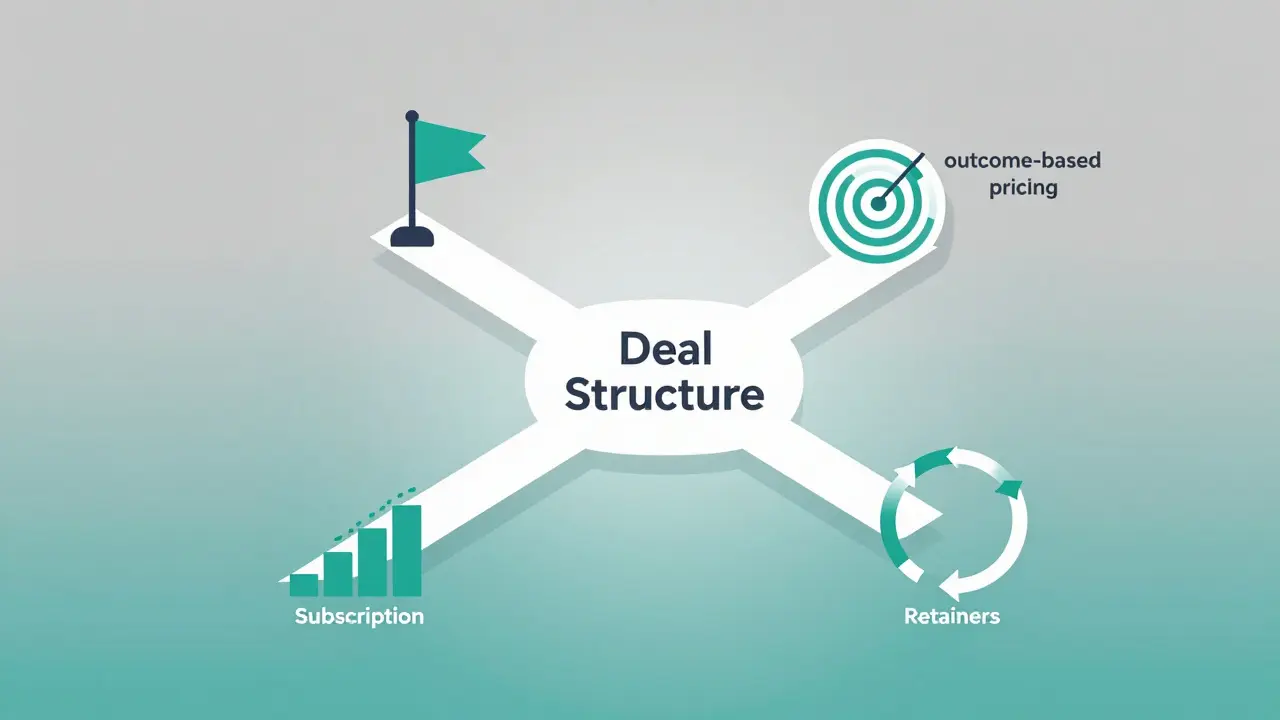
The way you price your training dictates how easily it gets approved. Enterprise budgets are rigid. If you propose a model that doesn't fit their financial planning cycles, you face rejection regardless of quality. Here are the most effective monetization models for enterprise training:
| Model | Best For | Pros | Cons |
|---|---|---|---|
| Per-License Subscription | SaaS platforms, digital courses | Predictable revenue, scalable | Churn risk, requires volume |
| Project-Based Fee | Custom workshops, consulting | High margin, clear scope | Scope creep, hard to scale |
| Outcome-Based Pricing | High-stakes skills (sales, safety) | Aligns incentives, easy approval | Hard to measure, higher risk for you |
| Retainer Model | Ongoing coaching, support | Steady cash flow, deep relationship | Requires constant delivery |
Avoid hourly billing for large projects. Enterprises view hourly rates as a lack of confidence in efficiency. Instead, use fixed-fee project pricing with clearly defined deliverables. If you offer software or digital content, annual subscriptions with upfront payment are preferred by finance teams because they simplify budgeting and improve your cash flow.
Negotiating Key Contract Terms
Once the price is agreed upon, the real work begins. Legal reviews can drag on for months if you aren't prepared. Focus your energy on the five terms that matter most:
- Payment Terms: Standard enterprise terms are Net 60 or Net 90 days. This hurts your cash flow. Negotiate for Net 30, or require a 50% deposit upfront. For multi-year deals, insist on annual prepayment.
- Liability and Indemnification: Large companies will try to make you liable for everything. Push back on unlimited liability. Cap your liability at the total value of the contract. Never accept indemnity for issues outside your control, such as third-party platform failures.
- Intellectual Property (IP): Clarify who owns what. You should retain ownership of your core methodology and pre-existing materials. The client may own custom content created specifically for them. Be explicit about this distinction to avoid future disputes.
- Service Level Agreements (SLAs): Define what "success" looks like. Is it uptime for a platform? Completion rates for a course? Response time for support? Vague SLAs lead to penalties. Use specific metrics: "99.9% uptime during business hours" rather than "high availability."
- Termination Clauses: Ensure there is a mutual right to terminate for cause. Protect yourself against termination without cause by requiring a notice period (e.g., 90 days) and payment for services rendered up to that date.
Defining Scope to Prevent Creep
Scope creep is the silent killer of profit margins. An enterprise client might start with a request for "leadership training for managers" and end up expecting a full organizational change management program. To prevent this, your Statement of Work (SOW) must be granular.
List exactly what is included and, crucially, what is excluded. If the client wants additional modules, revisions, or integration with their Learning Management System (LMS), state that these require a change order and additional fees. Frame this not as being difficult, but as ensuring quality. "To maintain the high standard of customization you expect, any changes beyond the initial scope will require a separate agreement."
Use pilot programs for new engagements. Propose a small-scale rollout to a single department before committing to a global deployment. This reduces the client's perceived risk and gives you a chance to refine your approach without taking on massive liability.
Measuring ROI to Justify Renewals
Enterprise contracts are rarely one-off. The real money is in renewals and expansions. To secure these, you must prove value. Move beyond "smile sheets" (happy sheets) where learners rate the fun factor. Implement Kirkpatrick’s Levels of Evaluation:
- Level 1: Reaction: Did they like it? (Basic surveys)
- Level 2: Learning: Did they acquire knowledge? (Pre/post tests)
- Level 3: Behavior: Are they applying it on the job? (Manager observations, performance data)
- Level 4: Results: Did it impact business goals? (Sales figures, error rates, retention)
Build these metrics into your contract from day one. Agree on baseline data before training starts. Report progress quarterly. When renewal time comes, present a case study showing how your training contributed to their bottom line. Data beats emotion every time in enterprise negotiations.

Common Pitfalls to Avoid
Even experienced negotiators stumble. Watch out for these traps:
- Accepting Verbal Promises: If it's not in writing, it doesn't exist. Do not rely on "we'll add that later" emails. Get signed change orders.
- Underestimating Implementation Time: Enterprise IT security reviews can take weeks. Build buffer time into your schedule so you aren't penalized for delays caused by their internal processes.
- Ignoring Data Privacy: If you collect learner data, you must comply with GDPR, CCPA, or other local regulations. Include a Data Processing Agreement (DPA) in your contract package proactively. It shows professionalism and speeds up legal review.
Next Steps for Your Next Deal
Start preparing your next enterprise pitch today. Audit your current contract templates. Do they cap liability? Do they define IP clearly? Create a one-page "Deal Sheet" that outlines your non-negotiable terms and your flexible areas. Share this with your sales team so everyone speaks the same language. Remember, the goal isn't just to sign a contract; it's to build a partnership that lasts years. By structuring deals that protect your business while meeting enterprise needs, you turn training from a cost center into a strategic asset.
How long do enterprise training negotiations typically take?
Negotiations for enterprise training contracts can range from four weeks to six months. Smaller deals with established vendors may close in 30-45 days. Larger, customized implementations involving multiple stakeholders, legal reviews, and IT security checks often take 3-6 months. Building relationships early with the champion can help streamline this process.
What is the standard payment term for enterprise training?
Standard enterprise payment terms are often Net 60 or Net 90 days. However, many service providers successfully negotiate for Net 30 terms or require a significant upfront deposit (e.g., 50%) for custom projects. Annual subscriptions usually require upfront payment. Always clarify payment schedules in the contract to manage cash flow.
Should I accept an enterprise client's standard MSA?
You should review their Master Services Agreement (MSA) carefully before signing. While using their template can speed up the process, it often contains unfavorable terms regarding liability, indemnity, and IP. Identify key deal-breakers early and propose redlines. If the deal size is significant, consult a lawyer specializing in commercial contracts.
How do I handle scope creep in enterprise training projects?
Handle scope creep by defining clear boundaries in your Statement of Work (SOW). List inclusions and exclusions explicitly. Establish a formal change order process that requires written approval and additional fees for any work outside the original scope. Communicate the impact of changes on timeline and budget immediately.
What is the difference between B2B and enterprise training contracts?
B2B contracts are often simpler, faster, and more flexible, focusing on direct value exchange. Enterprise contracts are complex, heavily regulated, and involve multiple stakeholders (legal, procurement, finance). They prioritize risk mitigation, compliance, and standardized terms over speed. Enterprise deals also tend to have longer sales cycles and stricter payment terms.

Comments (15)
kimberly de Bruin June 12 2026
the enterprise machine is a beast that feeds on ambiguity so you must become the clarity it craves because without clarity there is only chaos and profit margins dissolve into thin air like morning fog in a boardroom
Edward Nigma June 14 2026
this advice is fundamentally flawed because enterprises do not care about your feelings or your pedagogy they care about liability and if you think you can negotiate net 30 with a Fortune 500 company you are living in a fantasy world where small business logic applies to global conglomerates which it does not
Francis Laquerre June 14 2026
I have witnessed the sheer devastation of a deal collapsed by a single indemnity clause and it is heartbreakingly tragic how legal teams wield power with such cold indifference while the human element of learning is crushed under the weight of bureaucratic compliance protocols that seem designed to stifle innovation rather than foster growth
michael rome June 15 2026
It is imperative that one understands the nuanced dynamics of stakeholder alignment as the Champion often lacks the authority to override the Guardian thus requiring a sophisticated approach that bridges pedagogical value with risk mitigation strategies to ensure sustainable partnerships
Andrea Alonzo June 15 2026
I really appreciate how this article breaks down the complex web of enterprise negotiations because I have found that many consultants struggle immensely with the transition from selling content to selling outcomes and when you take the time to explain the roles of the Economist and the Guardian it helps us understand why our proposals get stuck in limbo for months at a time which is incredibly frustrating but also necessary to navigate if we want to succeed in this space
Saranya M.L. June 16 2026
The epistemological framework of enterprise procurement necessitates a rigorous adherence to standardized compliance metrics wherein the vendor must demonstrate quantifiable ROI through Kirkpatrick’s Level 4 evaluations thereby validating the pedagogical intervention within the broader strategic objectives of the organization while mitigating operational risk through precise contractual delineations of intellectual property rights and liability caps
Patrick Dorion June 17 2026
Think about the nature of trust in these contracts. It's not just about money. It's about who holds the leverage when things go wrong. The MSA is essentially a pre-written breakup letter. If you don't read it, you're agreeing to terms that could bankrupt you.
Lisa Puster June 17 2026
typical american optimism thinking you can just walk in and change their standard msa please try again in canada maybe but here in the us you are nothing more than a line item to be squeezed until you break and then replaced by some offshore firm willing to work for pennies so save your breath and lower your rates before you lose the contract entirely
Joe Walters June 19 2026
i mean its all well and good to talk about scope creep but lets be real most trainers cant even define scope properly let alone enforce it so dont blame the client for adding extra modules when you failed to create a bulletproof sow in the first place which is basically what happens 99% of the time because people are lazy and dont want to do the hard work upfront
Robert Barakat June 20 2026
the essence of negotiation lies not in the words spoken but in the silence between them where the true value is hidden and understood only by those who listen closely to the unspoken fears of the guardian and the desperate hopes of the champion
Michael Richards June 20 2026
You need to stop coddling clients. If they want Net 90, tell them no. If they want unlimited liability, walk away. Weak vendors create weak markets. Stand your ground or don't bother showing up.
Laura Davis June 21 2026
I am so tired of hearing people complain about legal reviews when they haven't even prepared a proper data processing agreement! Do your homework before you pitch! If you can't handle basic GDPR compliance requirements then you don't deserve to work with enterprise clients period!
Lisa Nally June 23 2026
Let me elucidate the critical distinction between transactional B2B engagements and strategic enterprise partnerships wherein the latter demands a holistic integration of pedagogical excellence with robust fiscal accountability mechanisms ensuring that every deliverable aligns seamlessly with the overarching corporate governance frameworks established by the chief financial officer and validated by the legal department
Edward Gilbreath June 24 2026
they want you to sign their msa because it protects them from everything including their own incompetence and you are too naive to realize that the whole system is rigged against independent contractors so just accept the payment terms they give you and pray you get paid eventually because fighting back will only make them blacklist you from future opportunities which is exactly what they want
om gman June 26 2026
oh look another western guide trying to simplify the complexities of global trade agreements as if a simple table can capture the nuance of cross-border intellectual property laws which vary wildly between jurisdictions and yet here we are pretending that a one size fits all approach works when in reality you need a team of lawyers just to decipher the fine print of a single paragraph in an indian context let alone a global one