

Imagine holding a digital dollar that doesn't sit in a bank account. It lives on the blockchain, pays you interest just for existing, and can't be frozen by a regulator or a CEO. That is the promise of Synthetic Stablecoins, which are cryptocurrency tokens that maintain price stability through algorithmic mechanisms and smart contracts rather than holding direct fiat reserves. Unlike traditional stablecoins like Tether (USDT) or Circle's USDC, which rely on banks to hold cash reserves, synthetic versions use financial engineering to stay pegged to the US dollar. This approach eliminates counterparty risk from traditional finance but introduces new complexities involving derivatives and smart contracts. If you are looking for higher yields in decentralized finance (DeFi) without giving up your keys, this is the space to watch.
The Core Innovation: Decoupling Stability from Banks
To understand why synthetic stablecoins matter, you first need to look at what they replace. Traditional stablecoins operate on a simple model: for every token issued, there is a matching dollar in a bank account. While effective, this creates a single point of failure. If the bank freezes assets, as seen in the collapse of Silicon Valley Bank in 2023, the stablecoin's value can wobble. Synthetic stablecoins solve this by creating "synthetic exposure" to the dollar. Instead of holding cash, they hold volatile crypto assets like Ethereum (ETH) or Bitcoin (BTC) and hedge them using derivatives markets.
This mechanism allows these tokens to generate yield naturally. When you mint a synthetic stablecoin, the protocol takes your collateral and opens short positions in perpetual futures markets. As long as the market moves, the funding rates from these shorts provide income. This is a significant shift from older crypto-backed models like MakerDAO's DAI, which historically offered near-zero yields because they relied solely on over-collateralization without active hedging strategies. By integrating with liquid derivatives markets, synthetic stablecoins turn idle capital into productive assets while maintaining a peg close to $1.00.
How the Mechanisms Actually Work
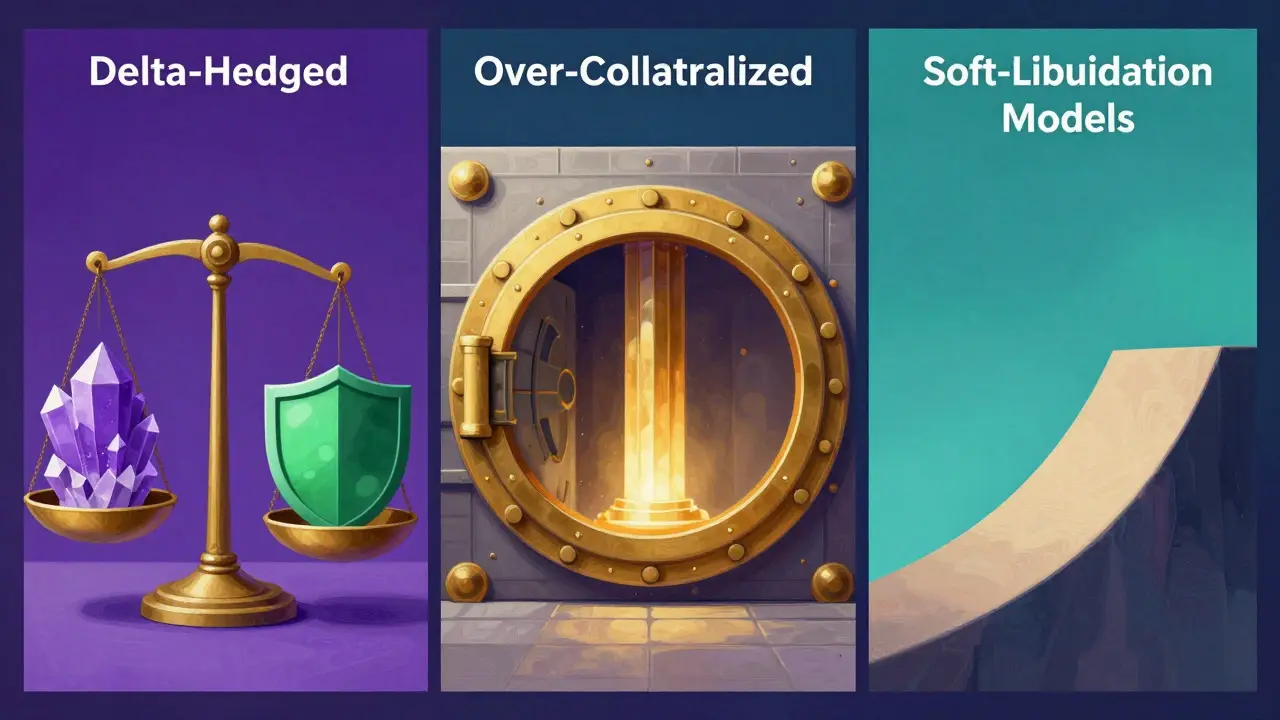
Not all synthetic stablecoins use the same recipe. There are three primary architectural approaches currently dominating the market, each with distinct risk profiles and technical requirements.
- Delta-Hedged Models: Pioneered by Ethena's USDe, this method accepts crypto deposits and simultaneously opens equivalent short positions in derivatives. For example, a $1,000 ETH deposit triggers a $1,000 short position in Ethereum perpetual futures. The goal is to remain "delta-neutral," meaning the token's value stays flat regardless of whether ETH goes up or down. This is the most efficient way to generate yield but requires deep liquidity in derivatives markets.
- Over-Collateralized Models: Used by MakerDAO's GHO, this approach requires users to deposit significantly more collateral than the value of the stablecoin they mint. Typically, a 150% collateralization ratio is required for ETH deposits. Dynamic ratios adjust based on market volatility, providing a safety buffer against price drops without relying heavily on external hedging.
- Soft-Liquidation Models: Implemented in Curve Finance's crvUSD, this system uses a two-tier collateral structure. Base and limit tiers activate at specific thresholds (e.g., 110% and 103%). This design aims to reduce user losses during volatility by triggering gradual adjustments rather than sudden, harsh liquidations.
These systems rely heavily on price oracles, such as Chainlink, which require minimum 30-second update intervals to ensure accurate pricing. If an oracle fails or updates too slowly, the peg can break. Therefore, the stability of these tokens is directly tied to the health of the underlying blockchain infrastructure and the derivatives exchanges they interact with.
Comparing Synthetic vs. Traditional Stablecoins
The choice between synthetic and traditional stablecoins comes down to your tolerance for complexity versus your desire for yield and censorship resistance. Below is a comparison of the key attributes that differentiate these two categories in 2026.
| Feature | Traditional (USDT/USDC) | Synthetic (USDe/GHO) |
|---|---|---|
| Collateral Type | Fiat currency in banks | Crypto assets + Derivatives |
| Yield Generation | None (usually) | 4-12% APY (variable) |
| Censorship Resistance | Low (bank dependent) | High (on-chain control) |
| Primary Risk | Counterparty/Bank failure | Smart contract/Oracle failure |
| Market Share (2024) | ~96% | ~2.1% |
Traditional stablecoins dominate the market with over $130 billion in circulation, driven by ease of use and regulatory familiarity. However, they offer no native yield. Synthetic stablecoins, while smaller in market cap (with USDe reaching $3.2 billion by late 2024), attract users seeking passive income and independence from traditional banking rails. The trade-off is clear: you gain yield and autonomy but must accept the technical risks associated with complex financial instruments.
Risks You Need to Understand Before Entering
No asset is risk-free, and synthetic stablecoins carry specific vulnerabilities that don't exist in the traditional world. The most critical risk is oracle dependence. Since these tokens rely on external data feeds to determine prices, a bug or manipulation in the oracle could cause incorrect liquidations. NIST’s 2023 security report highlighted that all synthetic protocols tested failed stress tests simulating 30% price moves within five minutes, suggesting that extreme volatility remains a threat.
Another major concern is smart contract risk. Because the entire mechanism runs on code, any bug in the protocol could lead to fund loss. Unlike a bank, where deposit insurance might protect you, DeFi offers no such guarantee. Additionally, derivatives exposure means that if the hedging strategy fails-perhaps due to exchange insolvency or low liquidity-the delta-neutral stance breaks, and the token depegs. During the March 2023 banking crisis, some synthetic stablecoins experienced temporary depegs of up to 3.2%, reminding users that stability is not absolute.
Regulatory uncertainty also looms large. In the EU, the MiCA framework classifies these tokens as 'asset-referenced tokens,' requiring specific capital and disclosure requirements. In the US, the SEC has hinted that yield-generating mechanisms might fall under securities regulations. Until clarity emerges, institutional adoption may remain limited, keeping the market somewhat niche.

Getting Started: A Practical Guide
If you decide to try synthetic stablecoins, preparation is key. The learning curve is steep; experienced DeFi users report spending 8-12 weeks understanding the mechanics before feeling comfortable. Here is a straightforward path to getting started:
- Acquire Base Cryptocurrency: You will need ETH or BTC to serve as collateral. Ensure you have enough to cover gas fees, which can range from $15 to $50 per transaction on Ethereum mainnet.
- Select a Protocol: Choose between USDe for higher yield via delta-hedging, GHO for simpler over-collateralization, or crvUSD for its soft-liquidation features. Review their documentation carefully; Ethena’s docs are rated highly for clarity, while others may be more technical.
- Understand Collateralization Ratios: Know exactly how much collateral you need to deposit. For GHO, it’s typically 150%. For USDe, it varies based on the hedging strategy. Monitor these ratios daily, especially during volatile markets.
- Monitor Your Position: Use dashboard interfaces provided by the protocol to track your health factor. Set alerts for when your collateralization ratio gets close to liquidation thresholds.
Support resources are abundant. Ethena’s Discord server has grown to over 42,000 members, with active daily discussions. GitHub issue trackers and community-run educational content on YouTube also provide valuable troubleshooting tips. Just remember that 76% of successful users had prior DeFi experience, so don’t rush in with your life savings.
Future Outlook and Market Potential
The trajectory for synthetic stablecoins looks promising, though cautious. ARK Invest projects that these models could capture 15-20% of the stablecoin market by 2027, potentially reaching a $50 billion market cap. This growth is driven by increasing institutional interest, with 68% of surveyed traditional financial institutions expressing interest in using them for cross-border payments. Recent developments, such as Ethena’s multi-collateral support and planned integration with Bitcoin L2 networks, aim to expand accessibility beyond Ethereum-based ecosystems.
However, challenges remain. Competition from Central Bank Digital Currencies (CBDCs) is growing, with 130 countries exploring their own digital currencies. If CBDCs offer similar stability with government backing, the appeal of synthetic stablecoins might diminish for mainstream users. Long-term viability assessments vary: Consensys Research gives a 65% probability of sustained success through 2030, while skeptics like Nouriel Roubini assign only 35% due to structural vulnerabilities. For now, synthetic stablecoins represent a high-potential, high-risk frontier in finance, offering a unique blend of innovation and utility for those willing to navigate the complexities.
Are synthetic stablecoins safer than traditional stablecoins?
It depends on your risk profile. Synthetic stablecoins eliminate bank counterparty risk but introduce smart contract and oracle risks. Traditional stablecoins are simpler but rely on the solvency of banking institutions. For tech-savvy users who want yield, synthetics can be safer in terms of asset preservation, but they require active monitoring.
What is the typical yield on synthetic stablecoins?
Yields vary based on market conditions, but historical averages range from 4% to 12% APY. This income comes from staking rewards and perpetual futures funding rates. During periods of high volatility, yields can spike, but so can the risk of depegging.
Which synthetic stablecoin is best for beginners?
MakerDAO's GHO is often considered more beginner-friendly because it uses a simpler over-collateralization model without complex derivatives hedging. Ethena's USDe offers higher yields but requires a better understanding of delta-hedging mechanics. Always start with small amounts to learn the interface.
Can synthetic stablecoins lose their peg permanently?
While rare, permanent depegs are possible if a catastrophic failure occurs in the smart contract or if the derivatives market becomes illiquid. Historical events like the TerraUSD collapse show that algorithmic stability can fail, but synthetic models include overcollateralization buffers to prevent such total collapses.
How do gas fees affect using synthetic stablecoins?
Gas fees on Ethereum mainnet can be significant, averaging $15-$50 per mint or redeem transaction. This makes frequent trading less profitable. Users often wait for lower network congestion times or use Layer 2 solutions to reduce costs. Factor these fees into your yield calculations.

Comments (9)
michelle veluz August 16 2026
Oh my GOD!! Look at this!!! They are literally trying to replace the dollar with some code written by a guy in a hoodie!!! Who do they think they are?!? The banks are already failing, and now we have to trust a 'smart contract' that could be hacked by a teenager in his parents basement?!? It is all a conspiracy to take our money and hide it in the blockchain where the government can't touch it (or so they say)! I bet the SEC is just waiting for the perfect moment to freeze everything again. You people need to wake up! This is not finance, this is a casino run by robots!
Jacob Baby Official August 18 2026
You are all missing the point entirely. The article talks about 'censorship resistance,' but let's be real, the only thing being resisted here is your own ability to understand derivatives. Most of you don't know what a delta-neutral position is, yet you are ready to mint USDe. It is like buying a jet engine because you saw a plane on TV. The risk isn't the bank; the risk is you. Stop pretending DeFi is easy and start reading the whitepaper. Seriously, go read page 42. It will hurt, but it will help.
john randall August 20 2026
Fair point. I was actually surprised how much of the yield comes from funding rates rather than staking rewards. It makes me nervous thinking about how thin liquidity gets during a crash though. If the perp markets dry up, does the whole thing just... stop working?
Jeff Falcon August 20 2026
Well, look, I have been watching this space for a while now, and honestly, the biggest hurdle for most people isn't the tech, it is just the sheer amount of stuff you have to keep track of, like the collateral ratios and the oracle prices, which can change super fast if the market gets volatile, so you really need to set up those alerts or else you might get liquidated without even realizing it until you check your wallet next morning, which is a pretty scary thought when you consider that gas fees alone can eat up a chunk of your profit if you try to fix things quickly on mainnet, so maybe using a layer two solution is a smarter move for anyone who doesn't want to spend an hour calculating the exact cost of their transactions every single time they interact with the protocol, especially since the interface can be a bit clunky sometimes and you don't want to make a mistake with the decimals involved in the minting process.
Alyson Karson August 22 2026
omg finally someone said it! i dont care about the bank risk i care about the YIELD. why would i hold usdc for 0% when i can get 8% on ethena? yeah its risky but life is risky! also the gas fees on eth mainnet are a joke lol use arbitrum or base or whatever. stop overthinking it and just start small. you learn by doing not by reading 50 articles. get in before the next bull run hits and thank me later! 🚀
Vishnu Vardhan Reddy M S August 23 2026
Ah, the classic 'just start small' advice. Very helpful, thanks. I am from India, so for us, the regulatory headache is even bigger. We are still fighting with the tax authorities over basic crypto gains, and now you want us to deal with synthetic stablecoins? Sure, the yield is nice, but can you explain how I report the 'funding rate income' on my Indian tax return? Because last I checked, the IRS and the CBET haven't exactly aligned on this. But sure, I will ignore the compliance nightmare and chase the 12% APY. Why not?
Kyle Ware August 25 2026
regarding the tax issue in india it is indeed complex. generally speaking you treat the yield as capital gains or income depending on your local jurisdiction but always consult a pro. back to the mechanics though if you are worried about the oracle risk mentioned in the post chainlink has improved significantly. the update intervals are tighter now. also remember that depegging is rare. the system is designed to self-correct via liquidations. just monitor your health factor daily. it takes 5 minutes. worth it for the passive income.
Iva Grekova August 25 2026
I appreciate the calm breakdown. I was leaning towards GHO because it feels less 'finicky' than the delta-hedged models. The idea of soft-liquidation tiers in crvUSD is also appealing if you are someone who panics easily when red candles show up. It’s nice to see options that aren’t just 'high risk high reward' but actually have different risk profiles tailored to different comfort levels. Just wish the documentation was a bit more uniform across protocols.
Onyinyechi Nwosu August 26 2026
it is interesting to see how these mechanisms rely so heavily on external data feeds. in nigeria we have had our own struggles with banking rails and currency volatility so the promise of censorship resistance is very attractive. however the complexity is a barrier for many. most of my friends would not understand what a 'perpetual future' is. it feels like a tool for the already wealthy and tech-savvy. but good to know the options exist for those who are ready to dive deep.