

Getting a token listed on a major exchange used to be a relatively simple process-sometimes just a matter of having enough hype and a decent community. But times have changed. By 2026, the "wild west" era of effortless listings is officially over. Today, token listing compliance is a rigorous gauntlet that projects must run to prove they aren't a security risk, a legal nightmare, or a sophisticated scam.
For centralized exchanges (CEXs), the stakes are higher than ever. A single bad listing can lead to massive user losses or a crushing lawsuit from regulators. Because of this, exchanges have shifted from being mere marketplaces to acting as primary gatekeepers. If you're a project founder or an investor, understanding these standards isn't just about following rules; it's about survival in a professionalized market.
The Human Element: Team Verification and Identity
Exchanges no longer accept "anonymous founders" as a valid business model. The first thing a due diligence team looks for is a verified identity. In the industry, this is often called being "doxxed." If the leadership team is hiding behind avatars and pseudonyms, the application is likely to be rejected immediately.
The process is thorough. It starts with KYC (Know Your Customer) checks, where founders submit government IDs and proof of address. But it doesn't stop there. Compliance officers dig into LinkedIn profiles to verify professional histories and scour GitHub to see if the developers are actually writing the code they claim to be. They want to see a track record of success-or at least a history of honest failure-rather than a team that appeared out of nowhere two weeks before the token launch.
Navigating the Legal Minefield
The biggest fear for any exchange is the SEC (U.S. Securities and Exchange Commission). If a token is classified as an unregistered security, the exchange could face severe penalties for facilitating its trade. This makes legal documentation the heaviest part of the listing dossier.
Projects are now required to provide formal legal opinions. These aren't just casual letters from a lawyer; they are detailed analyses explaining why the token does or does not meet the criteria of a security in specific jurisdictions. The 2020 lawsuit against Ripple and its XRP token serves as a permanent warning to the industry about the dangers of regulatory ambiguity.
Beyond securities law, exchanges demand evidence of AML (Anti-Money Laundering) protocols. They need to know that the token's distribution didn't involve laundering money and that the project has a plan to maintain these standards moving forward. If you're operating as a VASP (Virtual Asset Service Provider), your internal controls are scrutinized to ensure you aren't creating a backdoor for illicit financial flows.
Hardening the Code: Security Audits
A token with a bug in its code is a liability that can wipe out millions in seconds. To mitigate this, exchanges mandate third-party security audits. You cannot simply say "our code is secure"; you must prove it with a report from a recognized firm.
| Audit Firm | Primary Focus | Industry Reputation |
|---|---|---|
| Certik | Automated & Manual Analysis | High - Industry Standard |
| OpenZeppelin | Library Standards & Security | Elite - Gold Standard for Devs |
| Quantstamp | Comprehensive Protocol Review | Very High - Trusted by Top CEXs |
These audits check for common vulnerabilities like reentrancy attacks or integer overflows. Exchanges also look at the token's architecture and consensus mechanism. If the technical specifications are vague or the whitepaper reads like a marketing brochure rather than a technical manual, it's a red flag. Professionalism in documentation is seen as a proxy for professionalism in coding.
Market Readiness and Liquidity
Listing a token that has no trading volume is a waste of resources for an exchange. They aren't charities; they are businesses. Therefore, they conduct a "liquidity assessment" to ensure the token will actually attract traders.
They look at the community's genuine engagement-not just the number of followers on X (formerly Twitter), but the quality of the discussions on Reddit and Telegram. They also analyze the tokenomics: how is the supply distributed? If a few "whales" hold 90% of the tokens, the risk of a massive price dump is too high, making the token a liability for the exchange's reputation and its users' wallets.
The Listing Process: How it Actually Works
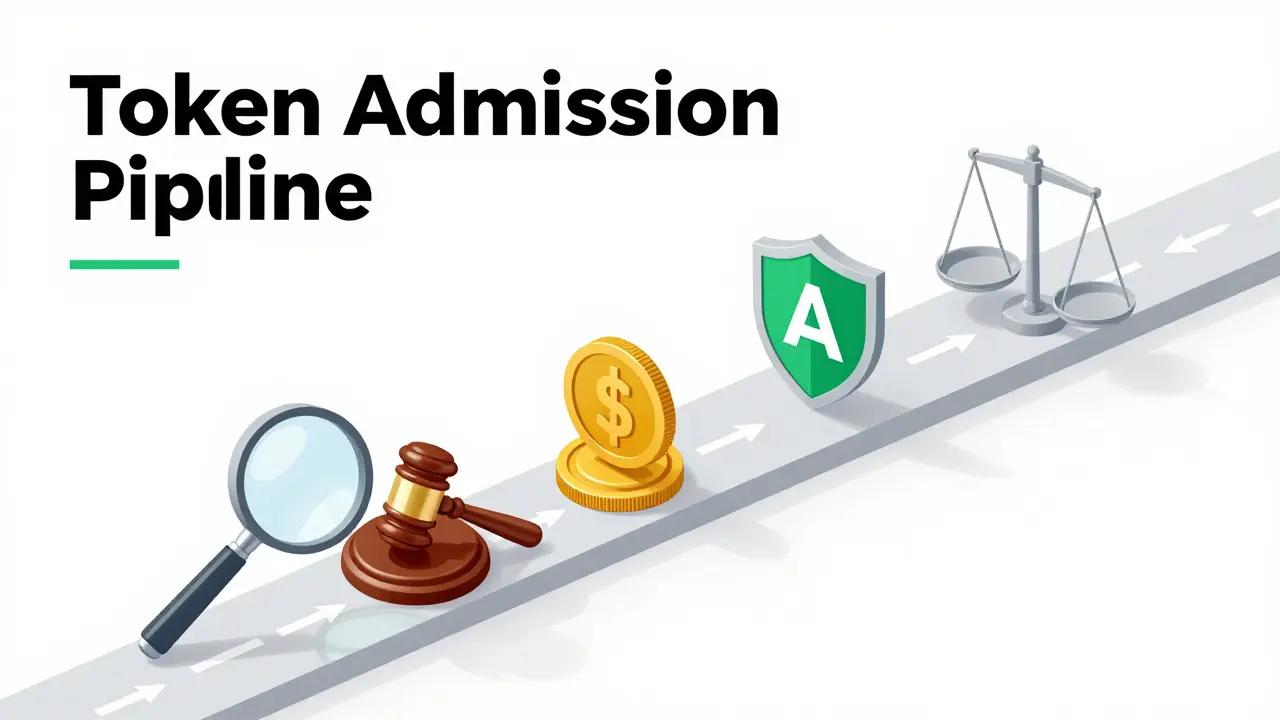
While every exchange has its own secret sauce, most follow a structured evaluation framework. Take Crypto.com as an example. They don't just have a person reviewing applications; they have a dedicated Token Admission and Review Committee.
The typical workflow follows these steps:
- Information Collection: The project submits a full dossier (Whitepaper, KYC docs, Audit reports).
- Business Risk Assessment: The exchange checks if the project's business model is viable.
- Compliance Review: Legal experts verify the token's status and the team's background.
- Technical Audit: Security teams review the smart contract and GitHub activity.
- Liquidity Analysis: Market makers assess potential trading volume.
- Final Approval: The committee makes a go/no-go decision based on the cumulative risk score.
The Regulatory Pressure Cooker
This shift toward extreme caution isn't happening in a vacuum. Regulatory bodies are putting the squeeze on exchanges. For instance, FINRA (Financial Industry Regulatory Authority) has flagged failures in due diligence under Rule 3110, essentially telling firms that "we didn't know" is not a valid defense for listing a fraudulent asset.
Similarly, the New York State Department of Financial Services has pushed for rigorous coin-listing policies. When the regulators start auditing the auditors, exchanges have no choice but to tighten their internal controls. This is why the bar for listing in 2026 is significantly higher than it was in 2021.
Special Considerations for Privacy and On-Chain Risk
Privacy coins present a unique headache for compliance officers. Because these assets hide transaction data, they are magnets for money laundering. Exchanges now distinguish between "trading-only" listings and those that allow deposits and withdrawals.
Allowing users to send privacy coins on-chain is a high-risk activity. If an exchange permits this, they must have incredibly sophisticated monitoring tools to ensure they aren't facilitating criminal activity. Many exchanges now simply refuse to list any asset that doesn't allow for transparent on-chain tracking, as the regulatory risk outweighs the trading fees.
Proactive Compliance: A Checklist for Projects
If you're preparing for a listing, don't wait for the exchange to tell you what's missing. A proactive approach can shorten your review time by weeks. Use this mental checklist before you even hit the "apply" button:
- Identity: Are all core team members ready to undergo full KYC? Is your LinkedIn presence professional and consistent?
- Legal: Do you have a formal legal opinion from a reputable firm regarding your token's status?
- Security: Has your code been audited by a top-tier firm like Certik or Quantstamp? Is the report public and up to date?
- Documentation: Is your whitepaper technical, clear, and free of grammatical errors? Does it explain the actual utility of the token?
- Tokenomics: Is your distribution fair, or is it heavily concentrated in a few hands?
Why are exchanges rejecting so many projects in 2026?
The primary reason is increased regulatory pressure from bodies like the SEC and FINRA. Exchanges are now held accountable for the assets they list. To avoid massive fines or legal action, they have implemented much stricter due diligence standards, focusing heavily on legal status and smart contract security.
Can a project get listed without a professional security audit?
In the current environment, it is extremely unlikely for a project to be listed on a top-tier CEX without a third-party audit from a recognized firm. Unaudited code represents a critical technical risk that most exchanges are no longer willing to take.
What is a "doxxed" team and why does it matter?
A doxxed team is one where the founders have publicly revealed their real identities and professional backgrounds. It matters because it creates accountability. Exchanges use this information to perform background checks and ensure the team isn't composed of known fraudsters.
What is the role of the Token Admission and Review Committee?
This is a specialized internal group at an exchange that evaluates a token's risk across multiple dimensions: legal, technical, and financial. They act as the final decision-makers to ensure a listing doesn't compromise the exchange's regulatory standing or user security.
How does the SEC's action against Ripple affect new tokens?
The Ripple case highlighted the danger of tokens being classified as securities. It forced exchanges to demand clear legal opinions from projects to ensure that the token doesn't trigger unregistered securities offerings, which could lead to the token being delisted and the exchange being sued.

Comments (9)
Liam Hesmondhalgh April 21 2026
Typical corporate rubbish! They just want to control everything and squeeze out the little guy while the big firms keep making the rules. Absolute joke of a system!
Patrick Tiernan April 21 2026
honestly who cares about doxxing just follow the code if the code is good the team can be whoever they want lol
Tyler Springall April 21 2026
Imagine thinking an anonymous team is a viable strategy in a trillion-dollar market. The sheer audacity of some people to believe that the 'wild west' ethos is still a badge of honor is simply exhausting. It is a matter of basic institutional competence, which seems to be a foreign concept to most of you.
Colby Havard April 23 2026
One must ponder the inherent paradox of decentralization... when we invite the state to curate our ledgers, do we not forfeit the very essence of the revolution??? The pursuit of security, while noble, often leads to the altar of surveillance; thus, we sacrifice liberty for the illusion of safety!!!
Amy P April 24 2026
OH MY GOD! This is absolutely wild! I can't believe how much the SEC is just breathing down everyone's necks! Like, seriously, who even has the time to put together a whole dossier just to get listed?! This is just insane levels of bureaucracy!
michael Melanson April 25 2026
Makes total sense. Better to have a few strict rules now than a complete market crash later because of some bad code.
Denise Young April 26 2026
Oh sure, because adding another layer of institutional gatekeeping via a 'Token Admission and Review Committee' is exactly what the decentralized ethos was built for, right? I just love how we're pivoting toward a highly centralized synergistic framework where the alphanumeric risk score becomes the new holy grail of valuation while ignoring the organic liquidity spikes that actually drive retail momentum in a high-volatility environment. Truly a masterpiece of regulatory capture that ensures only the projects with the most expensive legal counsel can even get a foot in the door, essentially creating a pay-to-play ecosystem under the guise of 'due diligence' and 'compliance' while the actual innovators are left to rot in the depths of obscure DEXs because they can't afford a Certik audit that costs more than their initial seed funding. Absolutely brilliant strategy for killing innovation!
Sam Rittenhouse April 28 2026
It's really heartbreaking to think about all the small, honest developers who might get pushed out by these walls. We have to find a way to guide them through this madness without letting the scammers win. It's a heavy burden for the community to carry, but we've got to support each other through this shift!
Patrick Bass April 29 2026
Fair point.