

Imagine a classroom where students aren't repeating "The apple is red" for the tenth time. Instead, they are arguing over a budget to plan a weekend trip, negotiating with a fake landlord about a leaky roof, or figuring out train schedules to get to a concert on time. This isn't chaos; it's Task-Based Language Teaching, or TBLT. It is an approach to language instruction that focuses on the use of authentic language and tasks similar to real-life situations as the core of the curriculum.
If you've ever felt stuck in the cycle of grammar drills that lead nowhere, you know the frustration. Traditional methods often treat language like a math problem: learn the formula, plug in the numbers, get the answer. But language isn't math. It's messy, social, and situational. TBLT flips the script. You don't learn the language to do the task; you do the task to learn the language.
Why Task-Based Learning Beats Grammar Drills
The core philosophy behind TBLT is simple: we remember what we use. When you are focused on solving a problem-like finding the cheapest flight to Edinburgh-your brain prioritizes communication over perfection. You might make a grammar mistake, but you still got the ticket. That success builds confidence and retention far better than filling out a worksheet on past tense verbs.
This method aligns closely with Communicative Language Teaching (CLT), which emphasizes interaction as both the means and the ultimate goal of study. While CLT is the broad umbrella, TBLT is the specific engine under the hood. It structures lessons around outcomes rather than linguistic forms. Research from the early 2000s, including work by scholars like Rod Ellis, showed that learners in TBLT environments often developed more natural fluency and pragmatic competence-the ability to use language appropriately in social contexts-compared to those in traditional structural syllabi.
Think about how you learned your first language. Did someone hand you a chart on noun genders? No. You wanted a cookie, so you pointed and said "cookie." You had a task (get food) and used whatever tools you had to achieve it. TBLT replicates this natural acquisition process for second-language learners.
The Three Stages of a TBLT Lesson
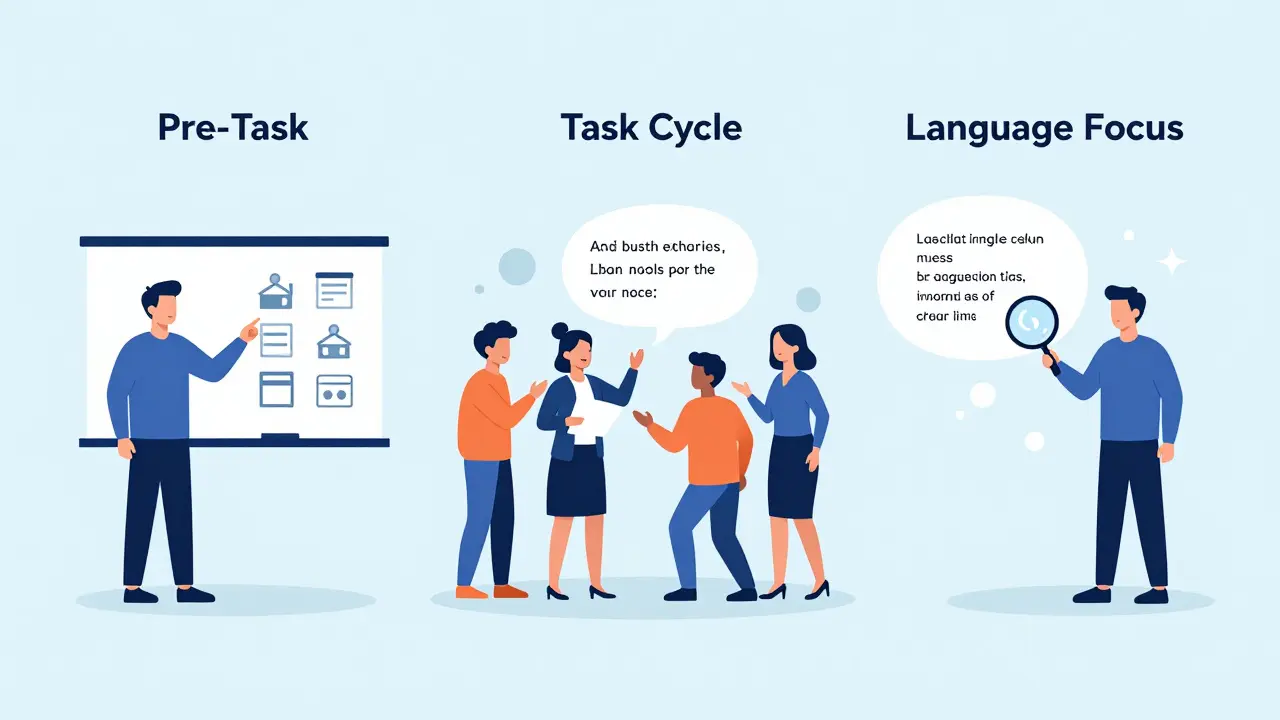
Designing a TBLT lesson isn't just about throwing students into a role-play and hoping for the best. It requires a structured framework to ensure learning actually happens. Most educators follow a three-phase model popularized by Jane Willis:
- The Pre-Task Phase: This is where you set the stage. Introduce the topic, highlight key vocabulary if necessary, and explain the task clearly. The goal here is to activate existing knowledge and reduce anxiety. For example, before asking students to book a hotel, show them a sample booking confirmation and discuss common terms like "check-in," "deposit," and "cancellation policy."
- The Task Cycle: This is the meat of the lesson. Students perform the task in pairs or groups. The teacher monitors but does not interrupt. Afterward, students prepare a report on their performance (what did they decide? why?). Finally, they present this report to the class. This shifts the focus from individual struggle to collaborative problem-solving.
- The Language Focus: Only after the task is complete do you address language form. Look at the recordings or transcripts of their conversations. Identify common errors or useful phrases they missed. Now, teach the grammar or vocabulary explicitly. Because students have already tried to communicate, they understand *why* this specific grammar point matters. They have a need for it.
This structure ensures that communication comes first, while accuracy is refined later. It prevents the paralysis that often occurs when teachers correct every mistake during a speaking activity.
Designing Authentic Tasks for Real-World Scenarios
The quality of a TBLT lesson depends entirely on the quality of the task. A good task must have a clear outcome, involve meaningful negotiation of meaning, and connect to the outside world. Here are some concrete examples across different proficiency levels:
| Level | Task Scenario | Real-World Outcome | Key Language Functions |
|---|---|---|---|
| Beginner (A1-A2) | Plan a picnic menu within a £20 budget using a local supermarket flyer. | A finalized shopping list and total cost. | Naming food, comparing prices, basic quantifiers (some, any). |
| Intermediate (B1-B2) | Resolve a complaint about a delayed flight with an airline representative (role-play). | An agreement on compensation (voucher, refund, rebooking). | Expressing dissatisfaction, making requests, polite persuasion. |
| Advanced (C1-C2) | Debate the pros and cons of remote work vs. office work for a company policy change. | A consensus statement or voted decision. | Hedging, complex argumentation, idiomatic expressions. |
Notice that none of these tasks ask students to "practice the past perfect." They ask them to solve problems. The language emerges naturally from the need to be understood. When designing your own tasks, ask yourself: "Would someone do this in real life?" If the answer is no, tweak it until it feels authentic.
Common Pitfalls and How to Avoid Them
TBLT looks great in theory, but implementation can be tricky. Many teachers fall into the trap of creating "pseudo-tasks." These are activities that look interactive but lack genuine cognitive engagement. For example, asking students to fill out a form together isn't a task if there's only one right way to fill it out. A true task allows for multiple solutions and requires negotiation.
Another common issue is neglecting the Language Focus phase. Some teachers fear that focusing on grammar will kill the communicative spirit. However, without explicit feedback on errors, students fossilize bad habits. The key is timing. Don't correct during the task cycle. Save it for the end, when students are receptive because they've experienced the gap between what they wanted to say and what they actually said.
Assessment is also a challenge. How do you grade a group discussion? Shift your criteria from pure grammatical accuracy to communicative effectiveness. Did they achieve the goal? Was the message clear? Did they use appropriate register? Rubrics should reflect these functional outcomes rather than just counting verb tense errors.
Integrating Technology into TBLT
In 2026, technology offers powerful tools to enhance task authenticity. Instead of paper flyers, use real-time websites. Instead of role-playing with a partner, use video conferencing tools to connect with native speakers or other classes globally. Platforms like Zoom or Microsoft Teams allow for asynchronous tasks where students collaborate on shared documents, mirroring modern workplace dynamics.
You can also use AI-driven chatbots for low-stakes practice. Imagine a task where students must book a restaurant table through a simulated chat interface. The bot provides immediate, consistent feedback, allowing students to retry until they succeed. This reduces the anxiety of performing in front of peers and gives everyone equal opportunity to practice.
Conclusion: Making Language Stick
Task-Based Language Teaching transforms the classroom from a lecture hall into a workshop. It respects the learner's intelligence and mirrors the way humans naturally acquire skills. By focusing on real-world outcomes, you create motivation that worksheets never could. Your job as a teacher shifts from being the source of all knowledge to being a facilitator who designs engaging challenges and provides timely, relevant feedback. Start small. Pick one lesson a week to redesign as a task. Watch your students engage differently. You'll see the difference in their confidence and their ability to use English outside the classroom.
Is Task-Based Language Teaching suitable for young learners?
Yes, absolutely. Young learners thrive on play and problem-solving. Tasks for children might include building a tower with blocks while following verbal instructions, or sorting toys into categories based on color and size descriptions. The key is keeping the tasks short, concrete, and highly interactive to match their attention spans.
How do I handle mixed-ability classes in TBLT?
Mixed-ability classes are actually ideal for TBLT. Stronger students can take leadership roles in the task, while weaker students contribute in other ways, such as note-taking or visual aids. Grouping students heterogeneously encourages peer scaffolding, where stronger learners help weaker ones, reinforcing their own understanding in the process.
Does TBLT ignore grammar?
No, it doesn't ignore grammar; it delays it. Grammar is taught reactively rather than proactively. After the task, you analyze the language used. This makes grammar instruction more relevant because students see exactly how the structure helps them communicate. It moves grammar from abstract rules to practical tools.
What if my students prefer traditional grammar lessons?
This is common, especially if students are used to exam-focused education. Start by blending approaches. Keep some grammar explanation but add a communicative task at the end of each lesson. Gradually increase the proportion of task-based activities. As students experience the joy of successful communication, their preference will shift.
How long should a typical TBLT lesson last?
A standard TBLT lesson usually lasts 60 to 90 minutes. The Pre-Task takes about 10-15 minutes, the Task Cycle (including preparation and reporting) takes 30-40 minutes, and the Language Focus takes 15-20 minutes. Adjust these times based on the complexity of the task and the proficiency level of your students.
