
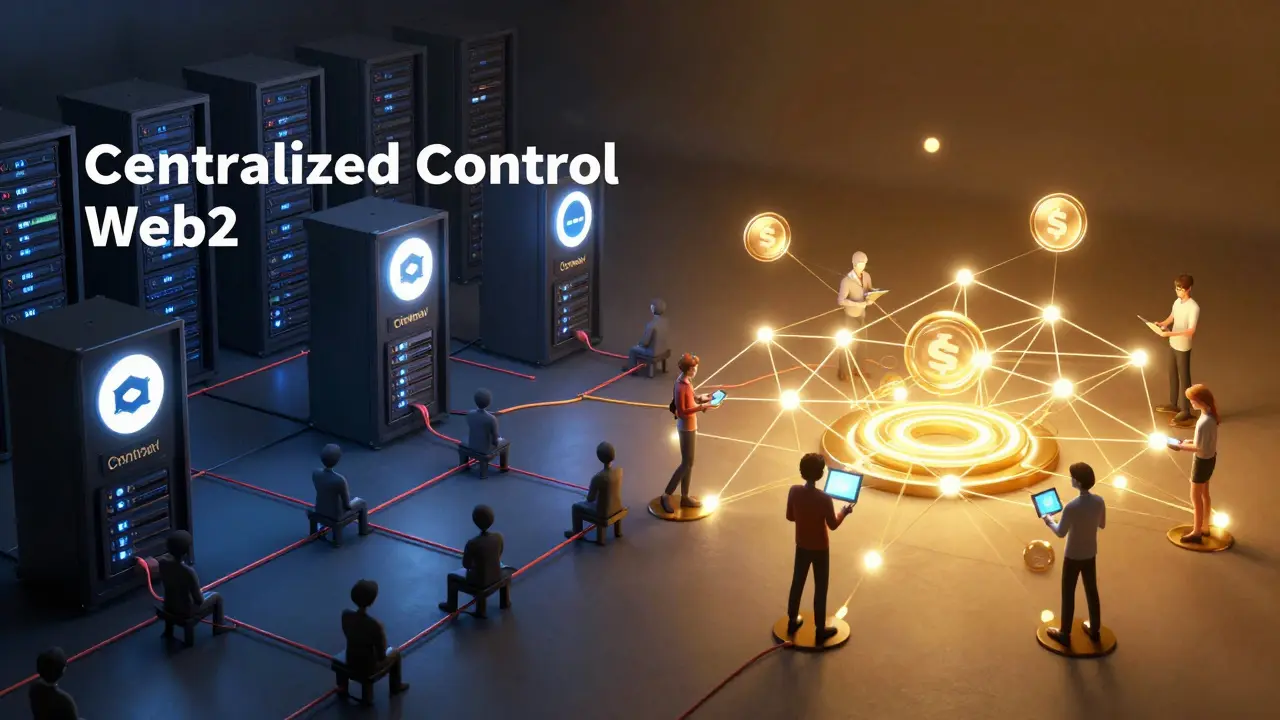
Have you ever noticed how much of your digital life is actually owned by a handful of companies? You post photos, write reviews, and build social networks, yet the platforms hosting them keep the profits and control the rules. That is the essence of Web2, the current internet era dominated by centralized giants like Google, Meta, and Amazon. But there is a growing movement challenging this model. It’s called Web3, a decentralized internet built on blockchain technology where users own their data and assets.
The shift from Web2 to Web3 isn’t just about new tech buzzwords; it’s a fundamental change in how we interact online. While Web2 gave us the power to create content (read-write), Web3 aims to give us the power to own it (read-write-own). Understanding these differences is crucial because they affect your privacy, your money, and your voice on the internet. Let’s break down exactly what changes when you move from a centralized server to a decentralized network.
From Static Pages to User-Owned Networks
To understand where we are going, we need to look at where we’ve been. The internet has evolved through three distinct generations. Web1 (roughly 1991-2004) was a "read-only" web. It consisted of static HTML pages where users consumed information published by a small number of website owners. Interaction was limited to guestbooks or simple forms.
Then came Web2, popularized by Tim O'Reilly in 2004. This era introduced dynamic, user-generated content. Platforms like Facebook, YouTube, and Twitter allowed anyone to publish, share, and communicate. However, this interactivity came with a cost: users traded their personal data for free services. Companies harvested this data to build detailed profiles for targeted advertising.
Web3, a term coined by Ethereum co-founder Gavin Wood around 2014, proposes a different path. It leverages blockchain technology to create a peer-to-peer network where no single entity controls the infrastructure. Instead of storing data on corporate servers, Web3 applications run on decentralized networks of nodes. This architectural shift moves control back to the individual, allowing users to participate without surrendering their privacy or ownership rights.
Centralized Control vs. Decentralized Governance
The most significant difference between Web2 and Web3 lies in who holds the power. In Web2, governance is centralized. A company decides the terms of service, moderates content, and can ban users at will. If a platform changes its algorithm, your reach might vanish overnight. If a bank freezes your account, you lose access to your funds. These decisions are made by opaque corporate entities.
In contrast, Web3 relies on decentralized governance models, often through Decentralized Autonomous Organizations (DAOs). In a DAO, decision-making is distributed among token holders. Changes to the protocol require community voting, recorded on the blockchain. This doesn’t mean chaos; it means transparency. Every rule is written into smart contracts-self-executing code that runs automatically when conditions are met. No CEO can unilaterally alter the rules without the community’s consent.
| Feature | Web2 (Current Internet) | Web3 (Decentralized Internet) |
|---|---|---|
| Architecture | Centralized servers controlled by corporations | Distributed network of nodes (blockchain) |
| Data Ownership | Platforms own and monetize user data | Users own their data via private keys |
| Governance | Top-down corporate decisions | Community-driven via DAOs and tokens |
| Identity | Email/password accounts managed by providers | Self-sovereign identity (SSI) via crypto wallets |
| Censorship | High risk of content removal or account bans | Censorship-resistant due to distributed nature |
Who Owns Your Data?
In the Web2 world, you don’t really own your social media profile. You license it to the platform. They collect your browsing habits, location data, and social connections to sell ads. This creates a massive asymmetry: platforms capture almost all the economic value generated by user activity.
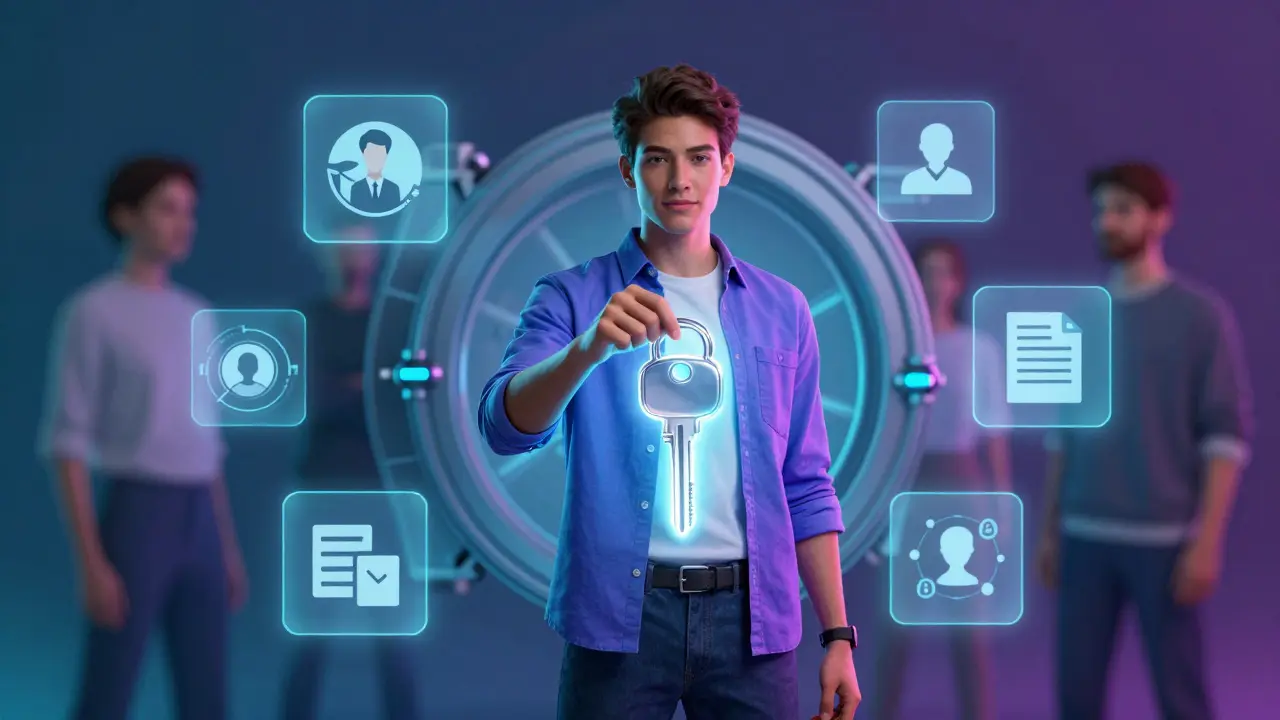
Web3 flips this script. Through cryptographic tools, users maintain control over their digital identities. When you use a crypto wallet like MetaMask, you are authenticating yourself not with a password stored on a server, but with a private key that only you hold. This concept is known as Self-Sovereign Identity (SSI). You can choose exactly what information to share with an application, and you can revoke that access anytime. Furthermore, if you create digital art or content, you can tokenize it as a Non-Fungible Token (NFT), proving true ownership and enabling direct monetization without intermediaries taking a large cut.
The Role of Tokens and Digital Assets
Money and incentives work differently in Web3. In Web2, loyalty points or reputation scores are locked within a specific ecosystem. You can’t transfer your Amazon Prime status to Netflix. In Web3, value is represented by tokens that exist on public blockchains. These tokens can serve multiple purposes:
- Governance: Holding tokens gives you voting rights in protocol decisions.
- Access: Tokens can act as keys to enter exclusive communities or services.
- Value Transfer: Cryptocurrencies like Bitcoin and Ethereum allow for peer-to-peer payments without banks.
This integration of finance into the web stack gives rise to Decentralized Finance (DeFi), which allows users to lend, borrow, and trade assets directly with each other using smart contracts. This reduces reliance on traditional banking institutions and opens up financial services to anyone with an internet connection, promoting greater inclusion.
Challenges: Scalability and User Experience
Despite its promise, Web3 faces significant hurdles. The primary issue is scalability. Because every transaction must be verified by a network of nodes, blockchains are currently slower than centralized databases. Ethereum, for example, processes far fewer transactions per second than Visa. This leads to higher latency and variable costs known as "gas fees," which can spike during periods of high demand.
User experience (UX) is another major barrier. Managing private keys, seed phrases, and connecting wallets is complex and risky. Unlike Web2, where you can reset a forgotten password, losing your private key in Web3 means permanently losing access to your assets and identity. There is no customer support hotline to call. This steep learning curve limits mass adoption, keeping Web3 largely confined to tech-savvy early adopters.

Security Risks and Trust
Web3 proponents argue that decentralization enhances security by eliminating single points of failure. However, it introduces new risks. Smart contracts are immutable once deployed; if they contain bugs, hackers can exploit them. We have seen billions of dollars stolen from DeFi protocols due to coding errors. Additionally, while blockchain data is transparent, the pseudonymous nature of transactions can facilitate illicit activities, complicating regulatory compliance.
In Web2, centralized companies bear the burden of security breaches, often compensating victims. In Web3, responsibility shifts to the individual. This requires a cultural shift towards better digital hygiene and education. Users must verify contract addresses, audit projects before investing, and secure their hardware wallets.
The Future: Coexistence or Replacement?
Will Web3 replace Web2 entirely? Probably not in the near future. Most experts predict a hybrid model where Web2 front-ends provide familiar user experiences, backed by Web3 infrastructure for ownership and transactions. For instance, a social media app might look like Twitter but store posts on a decentralized ledger, giving users control over their content.
As layer-2 solutions improve scalability and abstract away complexity (like account abstraction), Web3 could become more accessible. Regulatory frameworks, such as the EU’s MiCA regulation, are also evolving to provide clarity. The transition won’t happen overnight, but the trajectory is clear: the internet is moving towards a model where users have more agency, ownership, and control over their digital lives.
Is Web3 safer than Web2?
It depends on the threat. Web3 is more resistant to censorship and large-scale data breaches because data is distributed across many nodes rather than stored in central servers. However, it is vulnerable to smart contract exploits and user error. In Web2, you risk data leaks; in Web3, you risk irreversible loss of funds if you lose your private key or fall for a scam.
Do I need to buy cryptocurrency to use Web3?
Generally, yes. Most Web3 applications require a small amount of cryptocurrency to pay for transaction fees (gas). However, emerging technologies like "account abstraction" aim to allow users to pay fees in fiat currency or have sponsors cover them, making entry easier for non-crypto natives.
What happens if I forget my Web3 password?
In Web3, there is no central authority to reset your password. Access to your account is controlled by a private key or seed phrase. If you lose this, you lose access to your assets and identity permanently. This is why securing your seed phrase offline is critical.
How does Web3 affect content creators?
Web3 allows creators to own their audience and monetize directly. Through NFTs and token-gated communities, creators can sell digital works and receive royalties automatically via smart contracts, bypassing platforms that typically take large cuts of revenue.
Is Web3 legal?
The legality varies by jurisdiction. While using cryptocurrencies and blockchain technology is legal in many countries, regulations around token sales, DeFi, and taxation are still evolving. The EU has implemented MiCA, providing clearer rules, while other regions may have stricter or ambiguous laws.
