
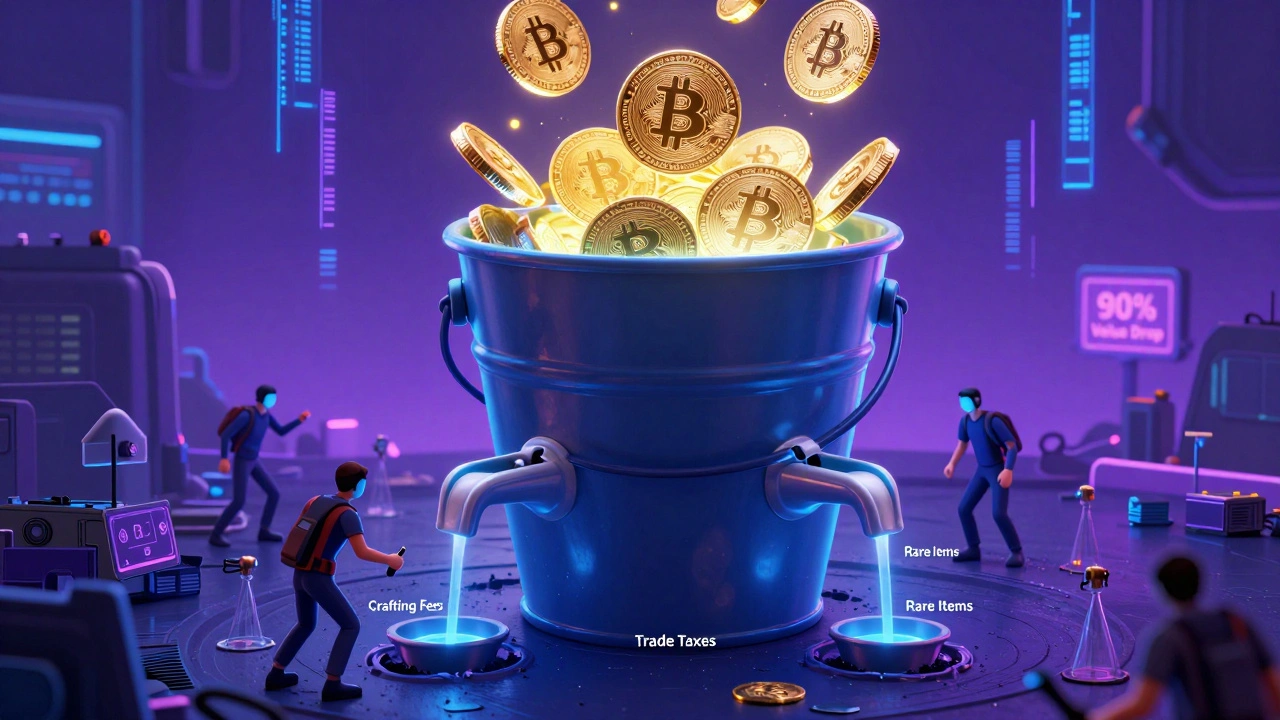
Most metaverse economies fail within two years. Not because the tech is broken, but because the money doesn’t work. Players flood in for free tokens, spend them on flashy avatars, and then watch everything collapse when the value of their hard-earned coins drops 90% in six months. That’s not a bug-it’s a design flaw. The real challenge isn’t building a virtual world. It’s building a metaverse economy that doesn’t implode under its own weight.
Why Virtual Money Breaks So Easily
Think of a metaverse economy like a leaky bucket. Every day, new tokens pour in through quests, land sales, and gameplay rewards-that’s the faucet. But if there’s no drain, the water overflows. In The Sandbox, SAND tokens were worth $0.50 in early 2022. By late 2023, they hit $0.03. Why? Too many faucets. Too few sinks.
Traditional games like Fortnite or Roblox avoid this by keeping their currency locked inside their own systems. They can delete items, change prices, or reset balances whenever they want. But in Web3 metaverses, players own their assets. That’s powerful-but it also means you can’t just hit undo when things go wrong. Once a token is minted and traded, it’s out there. Forever.
That’s why simple play-to-earn models fail. Axie Infinity started with players earning SLP tokens just by playing. But without enough ways to spend them, supply exploded. Prices crashed. Players quit. The same thing happened with STEPN’s GMT token. More users meant more tokens. No sinks. No balance. A 97% drop in value.
The Three Pillars of a Working Economy
A stable metaverse economy runs on three things: faucets, sinks, and rewards. Get one wrong, and the whole system wobbles.
- Faucets are how players earn tokens. Quests, land rentals, NFT sales, daily logins.
- Sinks are how tokens leave circulation. Taxes, crafting fees, rare item purchases, land upgrades.
- Rewards are what keep players motivated-not just tokens, but status, creativity, and ownership.
The best systems don’t just balance supply and demand. They make spending feel meaningful. In Decentraland, buying a plot of land isn’t just a transaction-it’s a claim to territory. In The Sandbox, spending 200 SAND to craft a rare weapon isn’t a cost-it’s a story. Players remember those moments. And they come back.
Real Sinks That Actually Work
Not all sinks are created equal. A 10% tax on every trade sounds smart-but if players can’t find anything worth buying, they’ll just stop trading. Effective sinks need to feel natural, not forced.
Here’s what works:
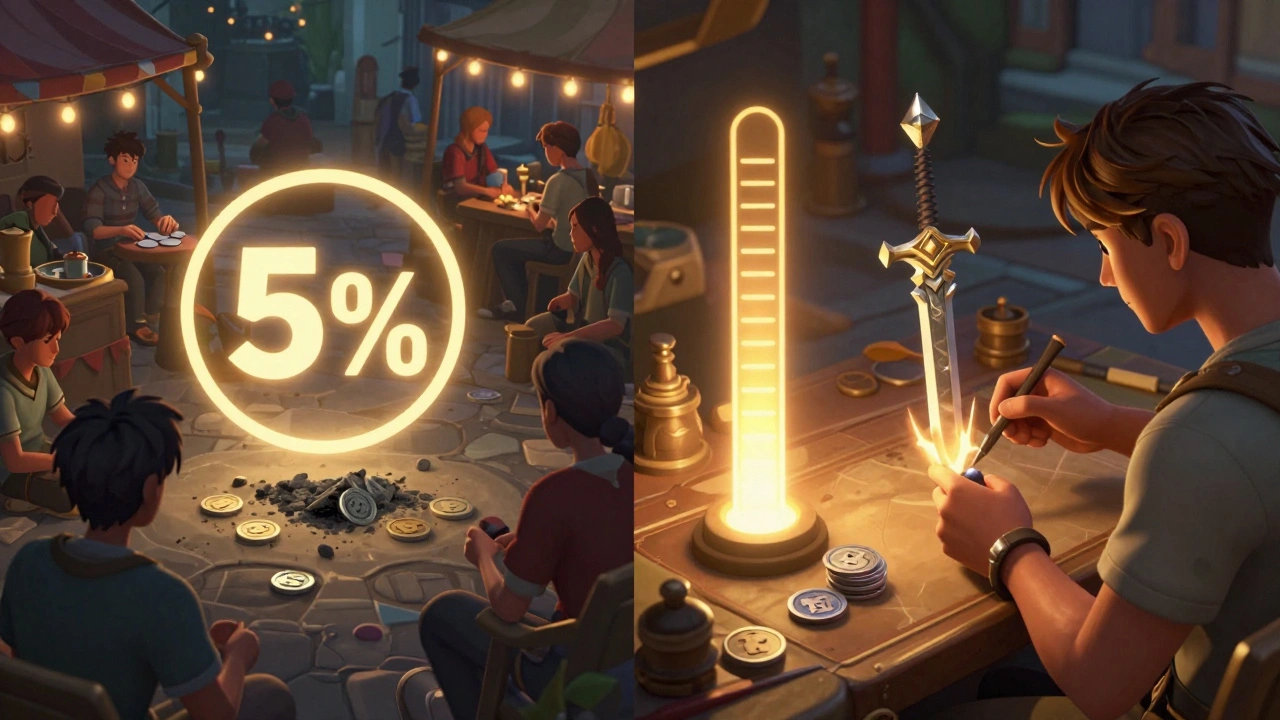
- Taxes on trade: 2.5%-10% per transaction. Splinterlands uses 5%, lowered to 3% during downturns. That’s smart. It slows down speculation without killing activity.
- Crafting fees: Spend two common items and 50 tokens to make one rare one. The system eats up 30-70% of the input value. Redapple Tech’s 2025 analysis shows this removes 15-25% of circulating tokens monthly.
- Rare collectibles: Only 0.1%-1% chance to drop a legendary item. Players chase them. Tokens get locked in auctions. No one sells them-they hold, trade, or display them.
- Land and avatar upgrades: A basic avatar costs 100 tokens. A fully customized one with rare skins, animations, and effects? 800-1,200 tokens. That’s a sink with emotional value.
- Season passes and events: Pay 500 tokens for a limited-time event with exclusive rewards. Tokens vanish. Players feel special. That’s not a tax-it’s an experience.
Compare that to STEPN, which only had a “repair” sink for shoes. When users doubled, the system couldn’t absorb the new tokens. No crafting. No rare items. No upgrades. Just grinding. And then-collapse.
Designing Rewards That Last
Money isn’t the only thing that keeps people engaged. If all you offer is cash, you’ll get cash-seekers. Not players. Not creators. Not community.
The most successful metaverse economies tap into human motivation-not just greed. Yu-kai Chou’s 8 Core Drives of Human Motivation explain why. Core Drive 3: Empowerment of Creativity and Feedback. Core Drive 1: Epic Meaning and Calling. Core Drive 5: Social Influence and Relatedness.
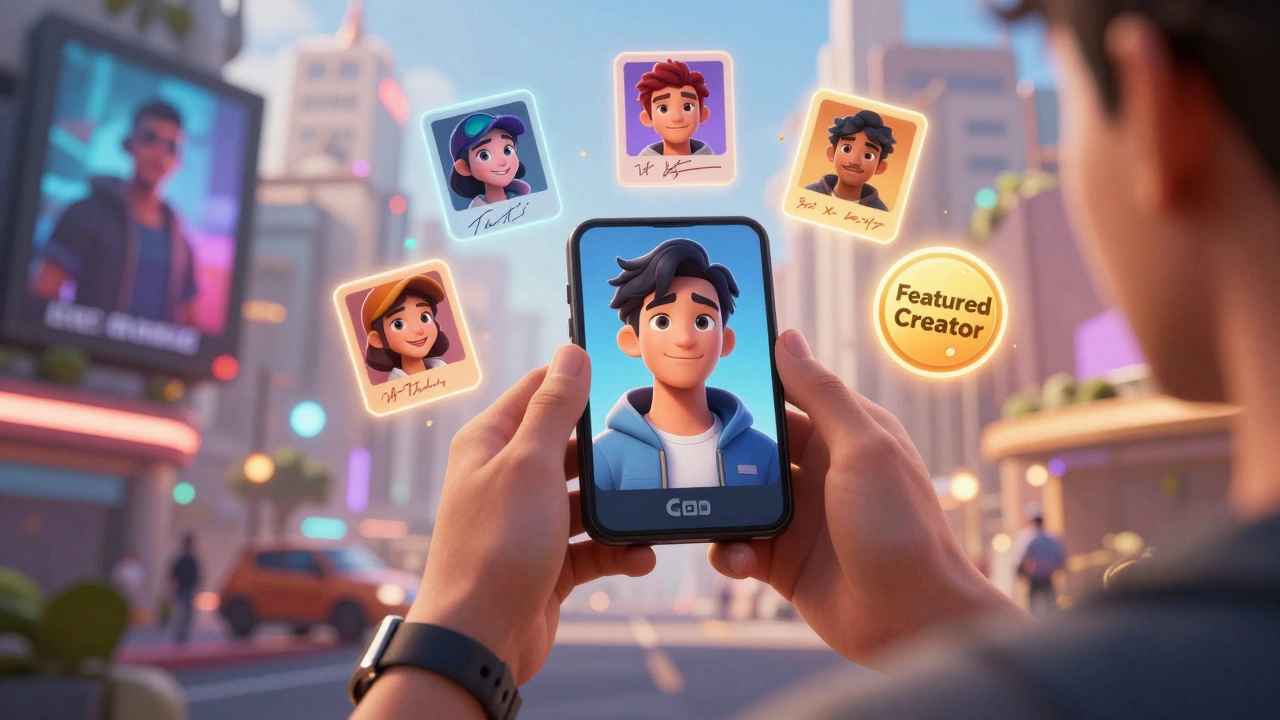
Look at Guild of Guardians. Players earn tokens, yes-but they also earn recognition. Top creators get their NFTs featured in the game. Their names are on the website. Their art is sold in the official store. That’s not just a reward. It’s legacy.
Ember Sword’s Artist Workshop lets players design cosmetics and sell them directly. The platform takes a cut, but the artist keeps 80%. That’s not a marketplace. That’s a career path.
And in The Sandbox’s “Project X,” AI now suggests personalized items based on how you play. If you spend hours building, it nudges you toward rare building materials. If you fight a lot, it recommends battle gear. That’s not random. That’s psychological design.
What Happens When You Get It Right
Splinterlands is the quiet success story. No flashy ads. No celebrity endorsements. Just a stable economy. Since 2022, its token has stayed within 15% volatility for over a year and a half. How?
- 5% trade tax (adjustable)
- Weekly card burning events (tokens destroyed)
- Card upgrades that consume resources
- Player-run tournaments with entry fees paid in tokens
Players don’t just play. They invest. They compete. They build. And they trust the system because it doesn’t feel rigged.
Compare that to Decentraland’s MANA. In 2021, land parcels sold for $10,000. By 2023, many were under $1,000. Why? Too many faucets. Too few meaningful sinks. Land was bought as speculation, not use. When the hype faded, so did the value.
Why Most Metaverse Projects Fail
73% of play-to-earn games die within 18 months, according to Lemniscap Research. Why? Three reasons:
- Over-rewarding: Give too many tokens too easily, and they become worthless.
- No real sinks: If players can’t spend tokens on things they care about, they’ll just hoard or dump them.
- Hidden rules: If the economy isn’t transparent, players lose trust. The Sandbox publishes quarterly economic reports. Many smaller projects don’t even have a whitepaper.
And then there’s the human factor. Dr. Jamie Wooders from 300mind Studio says: “Preventing deflation is as critical as controlling inflation.” If players lose too many tokens too fast, they feel stuck. Progress feels impossible. They quit.
The best systems balance both. They let players win-but not too easily. They make spending feel valuable-but not punishing.
The Future: AI, Real-World Assets, and Regulation
Metaverse economies are evolving. In 2024, Meta’s Horizon Worlds began using AI to personalize store offerings. The Sandbox’s “Project X” adjusts sinks in real time based on token velocity. Decentraland’s “Economic 2.0” now burns 35% of circulating tokens monthly through crafting.
Next up? Tokenized real-world assets. Imagine renting out your virtual store to a real brand. Paying rent in crypto. That could be huge. But it’s also risky. If a metaverse economy becomes tied to real-world inflation, volatility could explode.
Regulation is catching up too. The EU’s MiCA law now requires full transparency on token supply and distribution. The SEC is watching reward structures closely. Platforms that hide their economic models won’t survive.
And enterprise adoption is growing. 42% of Fortune 500 companies are testing metaverse economies for training and customer engagement. Not for speculation. For utility. That’s the real signal.
What You Need to Build a Sustainable Economy
If you’re designing a metaverse economy, here’s your checklist:
- Start small. 5-10 core items. Test for 2-3 months before scaling.
- Build at least 4 real sinks: trade tax, crafting, rare drops, and upgrades.
- Make rewards emotional, not just financial. Let players create, share, and be recognized.
- Publish your economic model. Transparency builds trust.
- Use analytics. Track token velocity (target: 0.5-2.0 transactions per token per day) and Gini coefficient (aim for 0.3-0.5 for fair distribution).
- Don’t rely on speculation. If your economy depends on new players buying in to pay old ones, it’s a pyramid.
Most metaverse economies fail because they treat money like a game. But money isn’t a game. It’s trust. And trust, once broken, is nearly impossible to rebuild.

Comments (9)
Destiny Brumbaugh December 10 2025
this whole metaverse thing is just crypto with better graphics. they keep printing tokens like it's 2021 and nobody cares anymore. i saw a guy sell a virtual shirt for 500 bucks last week. 500. for a pixel. we're all just playing pretend until the next crash.Sara Escanciano December 11 2025
The entire premise is morally bankrupt. You're rewarding people for clicking buttons and calling it an economy. This isn't innovation-it's exploitation dressed up as freedom. People aren't playing games anymore, they're working for worthless tokens. And you call this progress?Elmer Burgos December 13 2025
i get what you're saying about sinks and faucets. i actually tried building a little thing in decenland last year. bought some land, spent a ton on upgrades, and honestly? it felt good. not because of the money, but because i made something that looked like mine. maybe the answer isn't just math-it's meaning.Jason Townsend December 14 2025
they're lying about the sinks. every single one of these 'stable' economies is secretly minting more tokens behind the scenes. splinterlands? they're printing in the background. the gini coefficient? fake. the whole thing is a front for hedge funds to dump on small players. you think you're playing a game? you're the bait.Antwan Holder December 14 2025
we are not building economies. we are building cathedrals of delusion. every token is a prayer whispered into the void. every avatar, a ghost wearing the skin of a dream we sold ourselves. the metaverse doesn't want your money-it wants your soul. and it's hungry. it always was. you think you're crafting weapons? you're forging chains. and you're smiling while you do it.Angelina Jefary December 16 2025
you say 'sink' but you mean 'tax.' and you're pretending it's not a tax. also, 'Gini coefficient' is spelled with a G, not a J. and 'token velocity' isn't a real metric-it's jargon made up by people who don't understand economics. this whole thing is a scam dressed in academic clothing.Jennifer Kaiser December 18 2025
what’s missing here is the human rhythm. people don’t play for tokens-they play for moments. the quiet pride of finishing a build. the laughter when your avatar trips in front of friends. the first time someone says ‘i bought your art.’ those aren’t metrics. they’re memories. if you design for those, the economy follows. not the other way around.TIARA SUKMA UTAMA December 19 2025
just make it free. no tokens. no nfts. just play. why does everything have to be money?Jasmine Oey December 21 2025
you know what's tragic? people still think this is about games. honey, this is the new art world. the new gallery. the new runway. if you can't see that, you're not just behind-you're irrelevant. i spent 2000 tokens on a dress that only 12 people saw. and i cried. because it was beautiful. and it was mine. that's not economy. that's legacy.