
Quick Takeaways
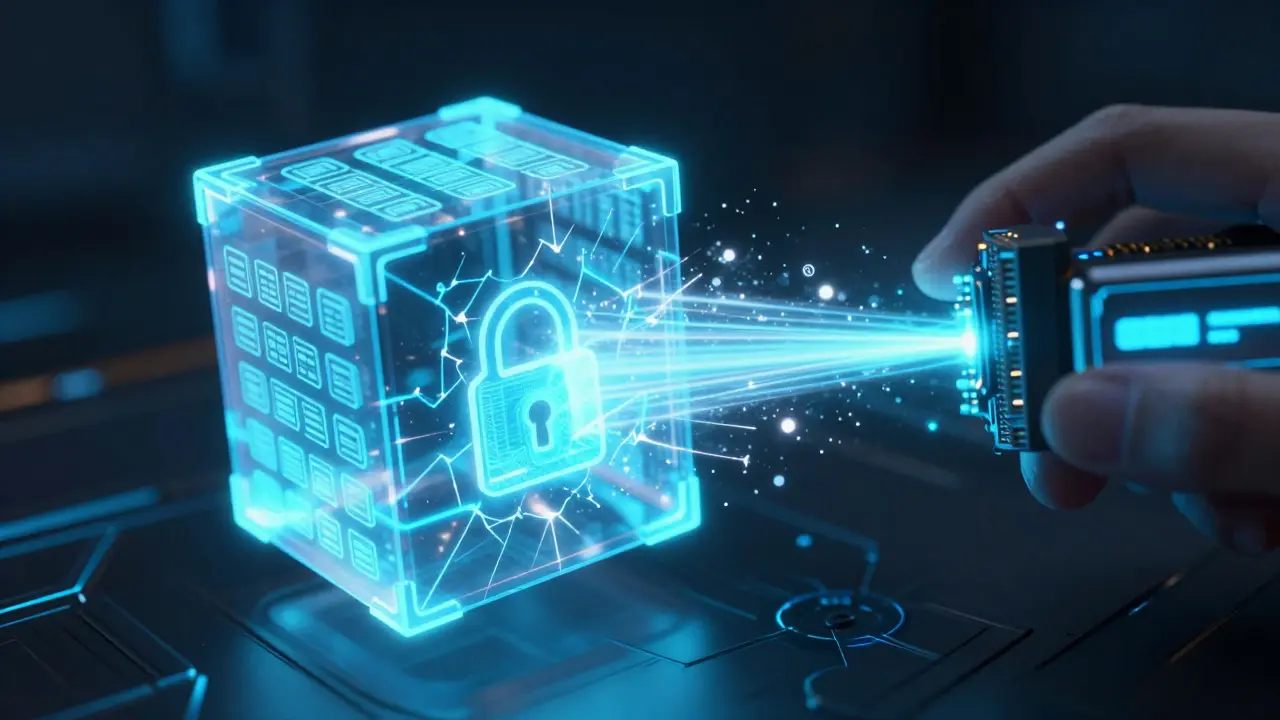
- Quantum computers target the specific math (ECDSA) used to secure private keys.
- The "Harvest Now, Crack Later" strategy makes today's public data a future risk.
- Proof-of-Work mining is safer than digital signatures, but still needs updates.
- Post-Quantum Cryptography (PQC) is the primary defense being built right now.
- The "Q-Day" threat is likely beyond 2030, but preparation must happen today.
The Math That Makes Crypto Vulnerable
Most blockchains rely on something called Elliptic Curve Cryptography (ECC). Specifically, they use the Elliptic Curve Digital Signature Algorithm ( ECDSA ) to ensure that only the person with the private key can move funds. To a normal computer, figuring out a private key from a public key is practically impossible; it would take billions of years. However, enter Shor's Algorithm is a quantum algorithm for integer factorization and solving discrete logarithm problems, which can break most current public-key cryptography. If you run this algorithm on a powerful enough quantum computer, that "billion-year" problem shrinks to a few minutes. Some estimates suggest a Bitcoin signature could be cracked in as little as 30 minutes. If an attacker can derive your private key from your public key, they effectively own your wallet.The "Harvest Now, Crack Later" Nightmare
Here is the part that keeps security experts up at night: you don't need a quantum computer today to start attacking the blockchain. Because blockchain ledgers are public and permanent, an adversary can simply copy and store public keys from the network right now. They can't do anything with them today, but they can just wait. When a cryptographically relevant quantum computer finally arrives, they can run those stored keys through a quantum processor and unlock the funds. This creates a massive asymmetry. Unlike a credit card number that expires or a password you can change, the public key history of an old Bitcoin address is etched in stone. If your public key is already visible on the chain, your funds are essentially a delayed-release gift for the first person to build a stable quantum machine.Who is Actually at Risk?
Not every single coin is equally vulnerable. The level of risk depends on how the address was created and how the network handles signatures.- Legacy Addresses: Early "Pay-to-Public-Key" (P2PK) addresses are the most exposed because the public key is already recorded. Around 6.89 million BTC are estimated to be in these vulnerable states.
- Modern Addresses: Hashed public keys offer some protection until a transaction is actually sent, but once a user spends from an address, the public key is revealed to the network.
- Proof-of-Stake Networks: In Ethereum is a decentralized, open-source blockchain with smart contract functionality that uses a Proof-of-Stake consensus mechanism., validators use BLS signatures. A quantum attacker could potentially impersonate these validators, allowing them to manipulate the consensus and subvert the entire network.
- Mining Operations: For Bitcoin, Grover's Algorithm is a quantum algorithm that provides a quadratic speedup for searching unstructured databases, affecting hashing and mining. provides a speed boost to mining, but it's not as devastating as Shor's. It would likely just lead to a mining arms race where the network increases difficulty to compensate.
| Component | Vulnerability | Impact | Urgency |
|---|---|---|---|
| Digital Signatures (ECDSA) | Critical (Shor's Algorithm) | Total loss of funds | Immediate (due to data harvesting) |
| Mining (Hashcash) | Moderate (Grover's Algorithm) | Mining imbalance | Low to Medium |
| Validator Signatures (BLS) | High | Consensus failure | Medium |
| Zero-Knowledge Proofs | Varies | Privacy breach/forgery | Medium |

The Shield: Post-Quantum Cryptography (PQC)
The industry isn't just sitting around waiting for the crash. The solution is Post-Quantum Cryptography ( PQC ) is cryptographic algorithms that are thought to be secure against a cryptanalytic attack by a quantum computer. These are new mathematical puzzles that even quantum computers find too difficult to solve. Two lattice-based algorithms are leading the charge: Dilithium and Falcon. These are designed to be secure against quantum attacks while remaining efficient enough to run on a standard smartphone or laptop. However, there is a catch: size. A standard Bitcoin signature is tiny-about 70 bytes. A PQC signature can be several kilobytes. If every transaction suddenly became 50 times larger, the blockchain would bloat rapidly, making it slower and more expensive to run. To fix this, developers are exploring "space folding" and aggregate signatures, which allow the network to compress multiple signatures into one, keeping the ledger lean while staying secure.The Reality Check: Hardware vs. Theory
Before we panic, we need to look at the hardware. Google's Quantum AI team has made strides, showing processing speeds 13,000 times faster than supercomputers. However, there is a huge gap between a "fast" quantum computer and one that can break 256-bit encryption. Breaking Bitcoin would likely require millions of stable, error-corrected qubits. Current machines are still fighting high error rates and extreme environmental requirements (like temperatures colder than outer space). Most experts place "Q-Day"-the day quantum computers break current encryption-well beyond 2030. In fact, some argue that we have a bigger problem: implementation bugs. It is far more likely that a hacker will find a bug in a new PQC software update or use a side-channel attack to steal a key from a device than it is for a quantum computer to break the math in the next three years. Complexity is the enemy of security, and PQC is much more complex than the systems we use now.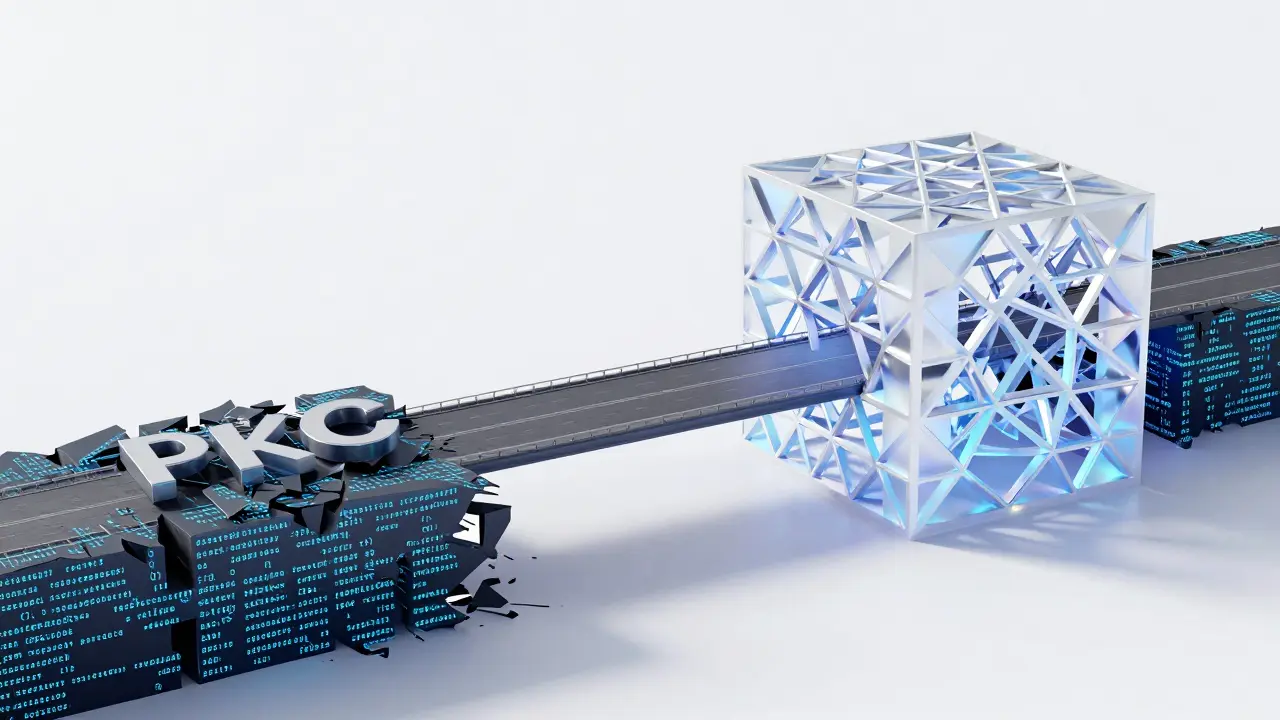
Preparing for the Transition
So, what happens when the transition starts? We won't see the blockchain collapse; we'll see a massive protocol upgrade. Ethereum is already treating this as a strategic priority, with a 2026 roadmap focusing on quantum-resistant algorithms and potentially switching validators to hash-based signatures, which are naturally more resistant to quantum attacks. For the average user, this will likely mean migrating funds. You'll move your coins from an old-style address to a new "quantum-secure" address. The danger is that people who lose their keys or forget about their old wallets will never make this jump, and those funds will eventually be drained by the first quantum-capable attacker.Is my Bitcoin safe right now?
Yes, for today. Current quantum computers do not have enough stable qubits to break the ECDSA encryption used by Bitcoin. However, if you are using very old addresses where the public key is already known, your funds are theoretically vulnerable to "harvest now, crack later" attacks.
What is Q-Day?
Q-Day is the theoretical point in time when quantum computers become powerful enough to break the public-key cryptography that protects most of the world's digital communications and financial systems, including blockchains.
Will quantum computers make mining too easy?
Not exactly. While Grover's Algorithm provides a speedup, it's a quadratic increase, not an exponential one. This means the network can simply increase the mining difficulty to keep the block time consistent, though it may favor those with quantum hardware.
What should I do to protect my crypto?
Stay updated on your wallet software. As networks like Ethereum and Bitcoin implement Post-Quantum Cryptography (PQC) upgrades, you will likely need to migrate your assets to new, quantum-resistant address types. Avoid keeping large amounts of funds in legacy addresses for years on end.
Can blockchain be fully quantum-proof?
Yes, by replacing current signature schemes with lattice-based or hash-based cryptography. While this increases the data size of transactions, it creates mathematical problems that are currently believed to be unsolvable by both classical and quantum computers.

Comments (10)
Rob D April 7 2026
Absolute poppycock to think the government isn't already sitting on a quantum rig in some basement in Maryland. This whole 'Q-Day 2030' timeline is a fairy tale for the masses to keep them complacent while the real power players strip-mine the early wallets. Get a grip on the reality of how geopolitical dominance works!
Jen Becker April 8 2026
Basically we're all doomed.
Samuel Bennett April 10 2026
Imagine believing that a 'protocol upgrade' will magically save us when the very foundations are flawed. Also, the author can't even maintain consistent capitalization in the headers. It's a joke. The globalists are just using this quantum boogeyman to push us toward a centralized digital ID system where they control the 'quantum-safe' keys.
Ryan Toporowski April 10 2026
Stay positive everyone! 🚀 The devs are always one step ahead of the problem. Just keep your wallets updated and you'll be golden! ✨💪
Franklin Hooper April 12 2026
the sheer lack of syntactical precision in this discussion is exhausting if you actually understand the linear algebra involved then you'd realize the lattice-based approach is an elegant necessity not a choice
Jess Ciro April 12 2026
this is literally just a slow motion train wreck and you people are cheering for the conductor who claims he has a new set of brakes coming in 2026 total delusion
saravana kumar April 14 2026
One must observe that the analysis provided here is remarkably rudimentary. The author fails to mention the impact of quantum annealing versus gate-based systems, which is a glaring omission. Furthermore, the assumption that PQC will be seamlessly integrated without causing a hard fork that splits the community is naive at best. It is quite evident that the current discourse lacks a certain intellectual depth required to truly grasp the volatility of the situation. The transition to Dilithium will likely be fraught with errors. Most users lack the technical competence to manage their own migration. We will see a massive loss of capital due to user error, not quantum attacks. This is simply how these systems evolve. The hubris of thinking a software update fixes a mathematical vulnerability is laughable. The inefficiency of larger signatures will cripple the network before the first qubit even fires. It's a textbook example of solving one problem by creating three more. Honestly, the lack of critical foresight here is disappointing.
Tamil selvan April 14 2026
I completely understand the anxiety this causes, but please remember that we are in this together!!! The community has always found a way to adapt to new challenges, and this will be no different...
Mark Brantner April 16 2026
Oh yeah, because a 'massiv protocol upgrade' always goes smothly lol! I can't wait to see the memes when everyone loses their coins cause they didnt move to a quantum-secure adress in time. Absolute chaos, lets gooo!!
Kate Tran April 18 2026
just move your stuff to a cold wallet and stop worrying so much. its not like the world is ending tomorrow even if the math is a bit wonky