
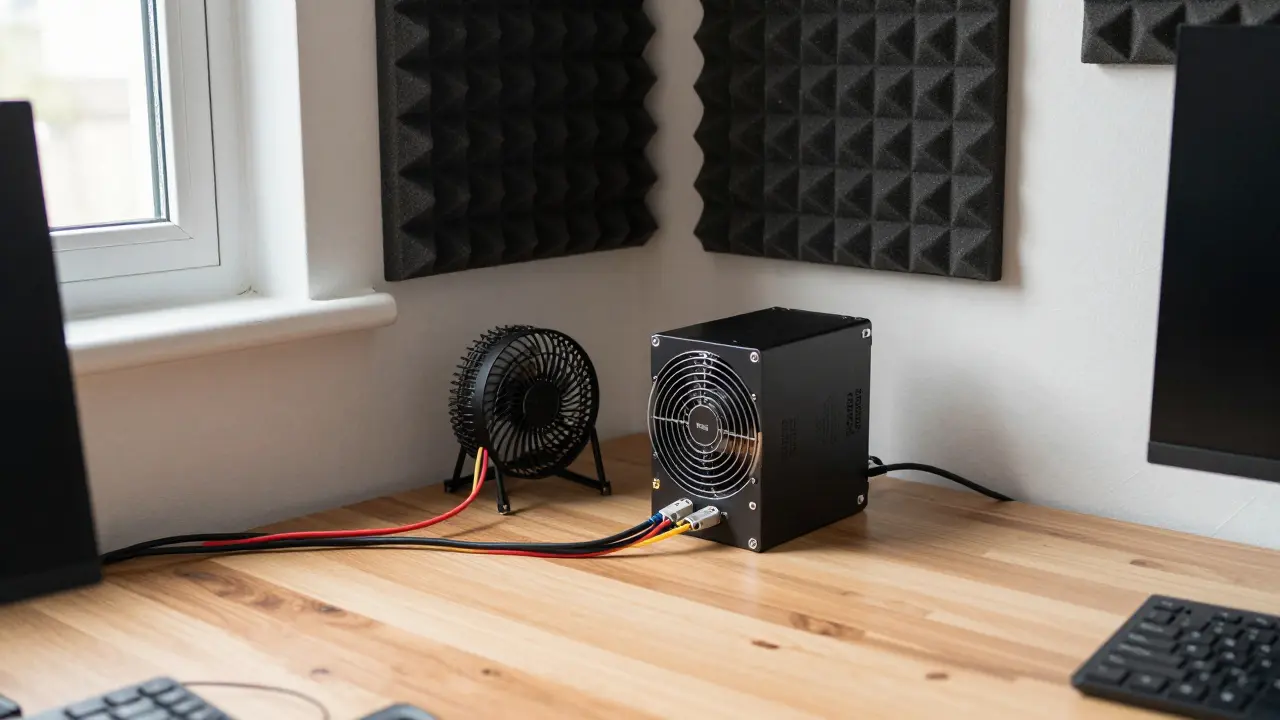
Quick Take: Home vs. Industrial Mining
| Feature | Home Mining | Industrial Farms |
|---|---|---|
| Hardware | Small ASICs (e.g., Bitaxe series) | Enterprise ASICs (e.g., Antminer S21 XP) |
| Power Source | 110-240V Residential | High-Voltage Utility (20,000V+) |
| Cooling | Fans, HVAC, Small Immersion | Industrial Liquid Cooling/Cold Climates |
| Profitability | Low to Negative (Symbolic) | High (Scale-driven) |
| Primary Goal | Education / Decentralization | Maximum ROI / Profit |
Setting Up at Home: The Hobbyist's Path
If you're starting at home, you aren't just buying a machine; you're altering your living space. Most people start with ASIC miners (Application-Specific Integrated Circuits), because using a regular PC is effectively useless in 2026. For a modest start, you might look at the Bitaxe Gamma, which offers over 800 GH/s. These units are accessible, costing between €256 and €1,620, and are great for those who want to learn the ropes. However, the math is brutal. In regions where electricity costs around $0.12/kWh, a Bitaxe Gamma might only net you $0.15 to $0.30 a day after power costs. Beyond the hardware, you have to deal with the "environmental' costs:- Noise: ASICs are loud. We're talking 70-90 decibels-basically like having a lawnmower running in your room 24/7. You'll likely spend $100 to $1,000 on soundproofing just to keep your neighbors happy.
- Heat: These machines are essentially space heaters. You'll need dedicated HVAC systems, which can add several hundred dollars to your monthly power bill.
- Electricity: You can't just plug a high-end miner into a wall outlet. About 30% of home miners find they need electrical upgrades (like 220V circuits) costing between $500 and $2,000.
Going Big: The Industrial Mining Farm
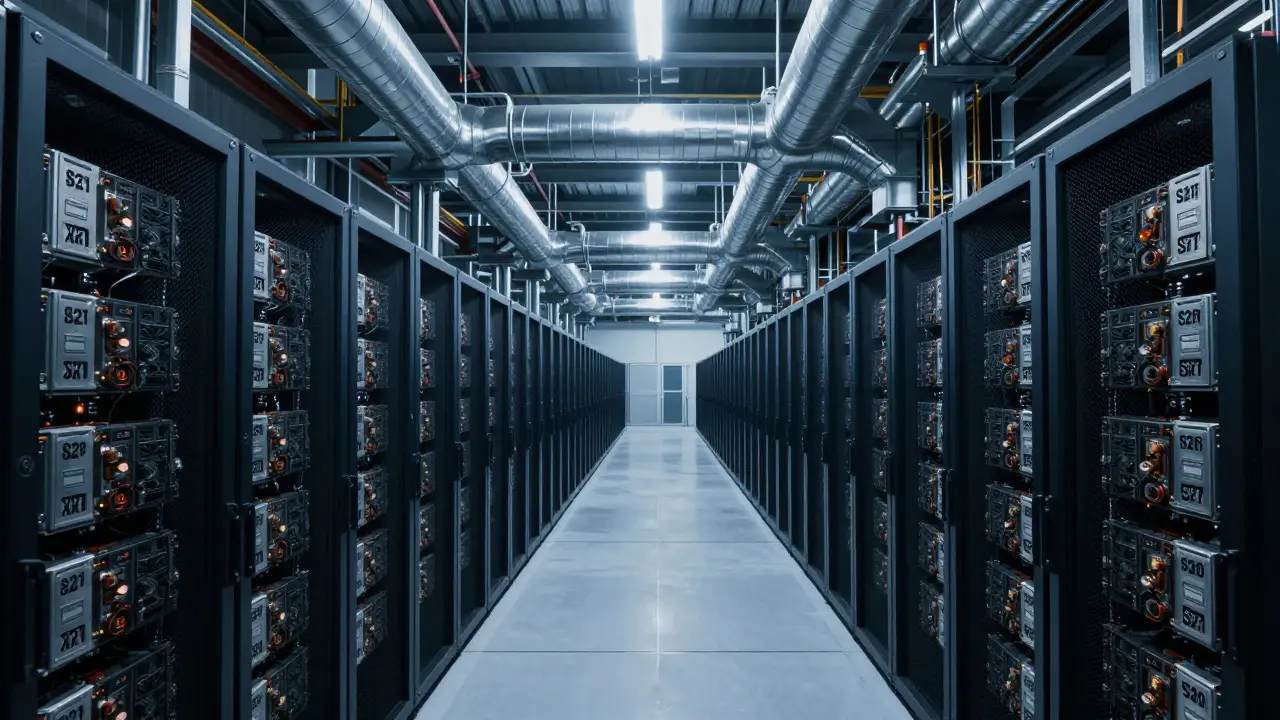
Industrial farms operate on a completely different planet. These are warehouse-scale facilities housing thousands of units like the Bitmain Antminer S21 XP, which pumps out 270 TH/s but gulps 3,645 watts per unit. To make this work, farms don't use residential power. They negotiate Power Purchase Agreements (PPAs) with utility companies to get 20,000+ volt connections, bringing their electricity costs down to as low as $0.03-$0.05/kWh. This is where the real money is made. By buying hardware in bulk and using custom firmware, these giants achieve 30-45% lower operational costs per terahash than any home miner could dream of. Setting up a 10-megawatt facility is a massive undertaking. It requires an initial investment of $8 million to $12 million, with the bulk of that going toward hardware and heavy-duty electrical infrastructure. They also solve the heat problem by moving to places like Iceland or Canada, where the freezing air does the cooling for free.The Regulatory Minefield
Depending on where you live, your mining rig could be a legal asset or a liability. In the US, it's a patchwork. Texas is a paradise for miners, offering tax incentives for using excess grid capacity. Meanwhile, New York State has a moratorium on new industrial farms using carbon-based power. For the small home gamer, the Financial Crimes Enforcement Network (FinCEN) has made things easier: if you're processing fewer than six blocks a month, you're generally exempt from money transmitter regulations. In Europe, the MiCA (Markets in Crypto-Assets) regulations are the gold standard. If your operation exceeds 50 kW, you have to register with national authorities and prove your environmental impact. While most home miners stay under this limit, countries like Germany and France still require electrical certifications for equipment over 10 kW to prevent house fires.
Is Home Mining Even Worth It in 2026?
From a purely financial perspective? For 95% of people, no. With the network difficulty hitting 92.5 trillion in early 2026, solo mining with a small rig is almost like playing the lottery. However, there's a non-financial argument. Some experts argue that distributed mining is the only way to keep Bitcoin decentralized. If only five giant companies in three countries control the hash rate, the network becomes vulnerable. By using mining pools like public-pool.io, home miners can combine their power to earn more consistent, albeit small, rewards. If you have access to incredibly cheap electricity (under $0.06/kWh) or you just want to support the network's resilience, home mining is a rewarding educational journey. Just don't expect it to pay for your mortgage anytime soon.Can I mine Bitcoin on my home laptop in 2026?
No. Standard CPUs and GPUs cannot compete with the specialized ASIC hardware used today. You would spend far more on electricity than you would ever earn in Bitcoin, and you'd likely overheat your laptop.
What is the most affordable ASIC for beginners?
The Bitaxe series, specifically the Bitaxe Gamma, is currently the most accessible entry point. It's designed for low power consumption and is ideal for those interested in solo mining or learning the technology without spending thousands.
How do industrial farms keep electricity costs so low?
They use economies of scale. By negotiating directly with energy providers for high-voltage connections and often locating their facilities near energy sources (like hydroelectric dams or wind farms), they can secure rates as low as $0.03 per kWh.
Do I need a special permit to mine at home in the EU?
Generally, if you are under 50 kW, you don't need MiCA registration. However, local laws in France and Germany may require electrical certifications if your setup exceeds 10 kW to ensure safety standards are met.
What is the noise level of a Bitcoin miner?
Most ASICs operate between 70 and 90 decibels. For context, this is similar to a loud vacuum cleaner or a lawnmower running constantly. Soundproofing is almost always necessary for residential setups.
Next Steps and Troubleshooting
For the Hobbyist: Before buying your first ASIC, audit your electrical panel. If you don't have a 220V outlet, factor in an extra $1,000 for an electrician. Start with a small-scale device like a Bitaxe to understand the software before jumping into high-wattage machines.
For the Aspiring Professional: Focus on the land first, not the hardware. Zoning approvals for industrial mining can take up to 18 months. Your primary goal should be securing a Power Purchase Agreement (PPA) that guarantees low rates, as power costs are the single biggest factor in your long-term survival.

Comments (12)
Richard H April 17 2026
Texas is where the real action is! We have the power and the land to dominate this space while those weak-willed states like New York just get in the way of progress. If you want to win, you move to the Lone Star State and start cranking those ASICs. USA number one!
Kendall Storey April 18 2026
The hash rate is absolutely cracked right now. If you aren't optimizing your firmware for undervolting, you're basically just burning cash. Get those rigs dialed in or just stick to stacking sats because the difficulty adjustment is no joke! Let's get it!
Ashton Strong April 20 2026
It is truly commendable that some individuals continue to mine at home for the sake of network decentralization. While the financial returns may be negligible, the commitment to the core philosophy of Bitcoin is quite admirable. I would suggest that any newcomer carefully evaluate their local electricity tariffs before investing in hardware, as the operational overhead can be quite daunting for the uninitiated.
Steven Hanton April 20 2026
I wonder if there are any community-led cooperatives that allow home miners to share resources more effectively than standard pools. It seems like a logical progression to mitigate the individual risk while still maintaining a level of distributed control over the network.
Pamela Tanner April 21 2026
For those just starting out, please remember that safety should be your absolute priority. Installing a 220V circuit without professional guidance can be extremely dangerous. It is far better to pay a certified electrician for a proper installation than to risk a residential fire over a hobbyist mining rig.
Kristina Kalolo April 23 2026
The mention of MiCA regulations is interesting. I am curious about how the registration process actually works for those hitting the 50 kW threshold in the EU and whether the environmental impact reports are strictly enforced or just a formality.
ravi kumar April 24 2026
Starting small is always a good way to learn.
Megan Blakeman April 25 2026
it's like a little digital garden... just some noise and heat but a lot of hope!!! 😊 maybe the point isn't the money but the feeling of being part of something bigger!!!! ✨
King Medoo April 27 2026
It is truly a tragedy that we have allowed the pursuit of greed to lead to the construction of these massive industrial warehouses that devour energy like parasites while the common man is told that a tiny Bitaxe is enough for him 🙄. We should be reflecting on the moral implications of a system that rewards scale over the individual's right to financial sovereignty and the ethical void left by these corporate entities who only care about their ROI 📉. It is a slap in the face to the original vision of Satoshi 💸.
Rae Blackburn April 28 2026
the government loves the 50kw limit because it lets them track exactly who is mining what they just want a database of every single node so they can shut us down the second they launch the digital dollar it is all a trap
LeVar Trotter April 30 2026
If you're looking at the Bitaxe Gamma, keep in mind that the ROI is basically nonexistent. You're paying for the experience of running a node. It's great for the 'educational journey' part, but don't let anyone tell you it's a viable income stream unless you've got a literal waterfall of free power in your backyard. The hash rate is just too high now for the little guys to make a dent without a massive pool.
Tyler Durden May 1 2026
Man, the grind is real!!! Just imagine the heat in those Canada warehouses... totally wild! I wonder if anyone has tried combining immersion cooling with a home setup to kill the noise? That would be a game changer for the bedroom miners!!