
Imagine you need to prove to a friend that you know the password to a secure server, but you can’t tell them the password. You don’t want to send it over email (insecure) and you don’t want to type it in front of them (shoulder-surfing risk). This is the core problem Zero-Knowledge Proofs solve. It sounds like magic, but it’s pure math. In the world of cryptocurrency, specifically Ethereum, this technology has become the backbone of Layer 2 scaling.
If you’ve ever looked at transaction fees on Ethereum mainnet and winced, you’ve probably heard of ZK-Rollups. They promise faster transactions and lower costs by moving computation off-chain while keeping security on-chain. But how do they actually work? How does Ethereum trust a calculation it didn’t perform itself? The answer lies entirely in zero-knowledge cryptography. Let’s break down the tech without drowning in academic jargon.
The Core Concept: Proving Without Revealing
A zero-knowledge proof (ZKP) is a cryptographic method where one party (the prover) convinces another party (the verifier) that a statement is true, without revealing any information beyond the validity of the statement itself. Think of it like a digital receipt. If you buy a coffee for $5, the merchant gives you a signed receipt proving you paid $5. Anyone can check the signature to see the payment was valid, but they don’t learn your bank account balance or what else you bought today.
In blockchain terms, the "statement" is usually something like: "This batch of 1,000 transactions correctly updates the state from Root A to Root B." The prover generates a small piece of data (the proof) that confirms this math holds up. The verifier checks the proof. If the check passes, the new state is accepted. Crucially, the verifier doesn’t need to re-run those 1,000 transactions to be sure they were valid. This saves massive amounts of computational power and time.
| Property | Description | Why It Matters for Rollups |
|---|---|---|
| Completeness | If the statement is true, an honest prover can convince an honest verifier. | Ensures valid transactions are always accepted. |
| Soundness | If the statement is false, no cheating prover can convince the verifier it is true. | Prevents invalid state transitions from being recorded. |
| Zero Knowledge | The verifier learns nothing other than the fact that the statement is true. | Can enable privacy, though not all ZK-rollups use it for hiding data. |
ZK-Rollups vs. Optimistic Rollups: The Trust Difference
To understand why ZK-Rollups are special, you have to look at their main competitor: Optimistic Rollups. Both move execution off-chain to save gas. But they handle trust differently.
Optimistic Rollups operate on the principle of "innocent until proven guilty." They assume every transaction batch is correct. Users must wait a challenge period (often 7 days) before withdrawing funds to Ethereum. During this window, anyone can submit a "fraud proof" if they spot a bad transaction. If no one complains, the batch is considered final. This relies on at least one honest person watching the network.
ZK-Rollups flip this script. They require mathematical certainty upfront. Before a batch is finalized on Ethereum, the rollup submits a validity proof. Ethereum’s smart contract verifies this proof. If the math checks out, the state update is immediate. There’s no waiting week for withdrawals because there’s no need to hope someone catches a fraud-the math already proved it wasn’t there. As of October 2026, withdrawal times for major ZK-Rollups range from minutes to a few hours, compared to the standard week-long delay for optimistic systems.
The Architecture: How a ZK-Rollup Works
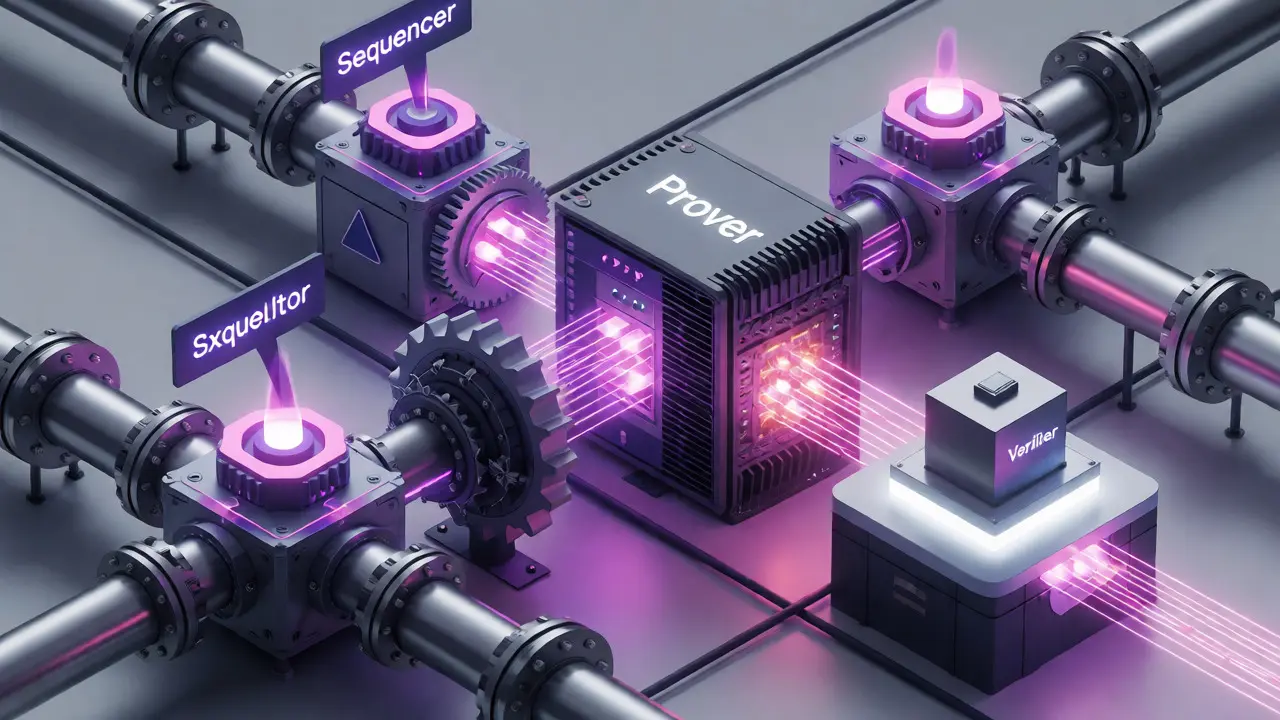
A typical ZK-Rollup isn’t just one big computer; it’s a pipeline of four distinct components working together:
- The Sequencer: This is the entry point. It receives user transactions, orders them, and creates batches. Currently, most sequencers are centralized entities run by the project team, which is a centralization risk we’ll discuss later.
- The Executor: This component runs the transactions against the current state. It calculates the new state root (a hash representing the entire database of accounts and balances).
- The Prover: This is the heavy lifter. It takes the execution trace (the step-by-step log of what happened) and generates the zero-knowledge proof. This process is computationally expensive and requires specialized hardware or software clusters.
- The Verifier Contract: This lives on Ethereum Layer 1. It accepts the proof and the compressed transaction data. It checks the proof’s validity using precompiled functions. If valid, it updates the canonical state root on Ethereum.
The key insight here is asymmetry. Generating the proof (Proving) is slow and resource-intensive. Verifying the proof (Verification) is fast and cheap. By doing the hard work off-chain and only paying for the quick verification on-chain, ZK-Rollups achieve high throughput.
SNARKs, STARKs, and the Proof Systems
Not all zero-knowledge proofs are created equal. The two dominant families in the Ethereum ecosystem are zk-SNARKs and zk-STARKs.
zk-SNARKs (Succinct Non-Interactive Arguments of Knowledge) produce very small proofs (often under 1KB) that are extremely cheap to verify on-chain. However, many SNARK constructions require a "trusted setup." This means a group of people had to generate random numbers to create the system’s parameters. If even one participant kept their random number secret (the "toxic waste") and colluded, they could potentially forge proofs. To mitigate this, projects use multi-party ceremonies with thousands of participants.
zk-STARKs (Scalable Transparent Arguments of Knowledge) avoid trusted setups entirely. They rely on collision-resistant hash functions rather than elliptic curve pairings. This makes them transparent and arguably more resistant to future quantum computing threats. The trade-off? STARK proofs are larger (tens of kilobytes) and verification is slightly more expensive than SNARKs. Projects like Starknet use STARKs, while others like Polygon zkEVM often use SNARK-based approaches or hybrid models.
| Feature | zk-SNARK | zk-STARK |
|---|---|---|
| Proof Size | Small (~300 bytes) | Larger (~100 KB+) |
| Trusted Setup | Usually Required | Not Required |
| Quantum Resistance | Vulnerable (if based on EC pairs) | Resistant (hash-based) |
| Verification Cost | Very Low | Moderate |
EVM Compatibility: The Developer Experience
One of the biggest hurdles for adoption is developer friction. Ethereum developers write code in Solidity, which compiles to EVM bytecode. If a ZK-Rollup uses a different virtual machine (like Cairo for Starknet), developers have to rewrite their apps. This fragmentation hurts liquidity and usability.
This has led to the race for "EVM Equivalence." Projects like Polygon zkEVM and Scroll aim to make the Layer 2 behave exactly like Ethereum Layer 1. From a developer’s perspective, deploying a contract feels identical. Under the hood, the rollup proves that its execution matches the EVM specification precisely. This involves complex circuits that replicate every opcode, memory operation, and storage slot behavior of the EVM.
While perfect equivalence is technically challenging due to performance overheads, the goal is clear: let developers port existing dApps with minimal changes. Non-EVM chains offer better theoretical performance but require learning new languages and tools, creating a steeper barrier to entry.

Security Risks: What Can Go Wrong?
Just because a proof is valid doesn’t mean the system is perfectly safe. Several risks remain outside the scope of the zero-knowledge proof itself:
- Data Availability: The rollup must publish enough transaction data to Ethereum so anyone can reconstruct the state. If this data is withheld, users can’t withdraw funds independently. Ethereum’s Dencun upgrade introduced "blobs" (EIP-4844) to make this data posting cheaper and more reliable.
- Sequencer Centralization: Most current sequencers are single points of failure. They can censor transactions or halt the chain temporarily. Decentralizing sequencers is a major ongoing effort.
- Upgrade Authority: Who controls the smart contracts on Ethereum? Often, it’s a multisig wallet held by the project team. If they decide to change the rules maliciously, users might be forced to exit quickly.
- Bugs: Circuits (the logic inside the prover) can have bugs. If a bug allows a false proof to pass verification, assets could be stolen. Audits are critical but not foolproof.
The Future: Where Is This Technology Heading?
As of late 2026, ZK-Rollups are transitioning from experimental tech to production-grade infrastructure. The focus is shifting toward decentralizing the proving layer. Currently, generating proofs requires powerful servers. Initiatives like CrowdProve aim to allow everyday users to contribute CPU cycles to generate proofs, spreading the load and reducing centralization.
We’re also seeing the rise of "validiums," which store data off-chain to further reduce costs, relying on a committee or Data Availability Committee (DAC) for security. While cheaper, they sacrifice some of the strong guarantees provided by full rollups.
The long-term vision is a modular Ethereum stack where Layer 1 handles consensus and data availability, while multiple specialized Layer 2 networks handle execution. Zero-knowledge proofs act as the glue, ensuring these diverse networks stay synchronized and secure without requiring Ethereum validators to replay every transaction.
Do ZK-Rollups provide privacy?
Not necessarily. While the underlying technology (zero-knowledge proofs) enables privacy, most public ZK-Rollups like Polygon zkEVM or Scroll post transaction data publicly to ensure data availability. Anyone can view the transactions. Privacy-focused ZK-Rollups exist, but they are a specific subset designed to hide sender/receiver details, not the default for all scaling solutions.
Are ZK-Rollups faster than Optimistic Rollups?
Yes, significantly. Because ZK-Rollups use validity proofs, they don't need a 7-day challenge period for withdrawals. Funds can typically be bridged back to Ethereum in minutes to a few hours, depending on proof generation speed and network congestion. Optimistic Rollups require users to wait roughly a week to ensure no fraud proofs are submitted.
What is a trusted setup in zk-SNARKs?
A trusted setup is a one-time ceremony where random numbers are generated to create the system's parameters. If anyone involved in this ceremony keeps their random number secret (and doesn't destroy it), they could theoretically forge proofs. To prevent this, projects use multi-party computations with thousands of participants, ensuring that if even one person acts honestly, the system remains secure.
How does EIP-4844 affect ZK-Rollups?
EIP-4844, implemented in the Dencun upgrade, introduced "blob" transactions. These are temporary data containers that are much cheaper than permanent calldata. Since ZK-Rollups need to post transaction data to Ethereum for security, blobs drastically reduced their operating costs, making transactions on Layer 2 significantly cheaper for users.
Is my money safe on a ZK-Rollup?
Generally, yes, but risks exist. Your assets are secured by Ethereum's consensus mechanism via the validity proof. However, you face operational risks like bridge hacks, sequencer downtime, or upgrade authority misuse. Always check the specific rollup's security model on platforms like L2BEAT to understand its trust assumptions.

Comments (14)
Ian Mason-Laurence October 19 2026
The distinction between validity proofs and fraud proofs is the single most critical architectural difference, yet it is frequently glossed over in introductory materials. Optimistic rollups rely on social consensus and time delays, whereas ZK-rollups rely on mathematical certainty at the moment of finality. This reduces trust assumptions significantly but increases computational overhead for proving.
Ejike Ugwu October 19 2026
They just want to control the data flow. If you don't see the raw transactions on L1 immediately, they are hiding something. The sequencer is a centralized honeypot waiting to rug us all. Wake up!
Kathleen Johnson October 20 2026
While the technical breakdown is adequate, it fails to address the economic viability of proof generation costs at scale. The article assumes hardware improvements will naturally solve the prover bottleneck, which is a naive extrapolation given current energy consumption metrics.
jyotshna Senapati October 21 2026
Oh honey, stop pretending this is simple. You're ignoring the fact that EVM equivalence adds massive complexity to the circuits. It's not just "port your dApp," it's rewriting the entire verification layer logic. People get hurt because they think it's plug-and-play.
Sundaraiah Kollipara October 23 2026
it is fascinating how we are trying to prove truth without revealing the source
is the verifier truly independent if the setup was controlled by a few entities? or are we just shifting the trust from validators to cryptographers?
the philosophical implication of zero knowledge is that truth exists independently of its disclosure
Charles Reah October 23 2026
Great overview for those starting out. Just remember that while ZK-Rollups offer faster withdrawals, the user experience still depends heavily on the specific bridge implementation. Always check the documentation for each project before moving large sums.
SHANNON GRUBER October 24 2026
Lazy writing. You skipped the actual math behind the polynomial commitments entirely. Calling it "pure math" isn't an explanation; it's a dismissal. Most readers won't understand why STARKs are quantum-resistant without knowing about hash-based cryptography vs elliptic curves.
Prayagraj Medicose October 26 2026
Bro, who controls the multi-party ceremony? That's the real question nobody wants to answer. If one guy kept his seed phrase, he can forge infinite money. They say it's secure but I smell rat. 🐀
Brad Walker October 26 2026
We are building castles on sand made of algorithms. The drama isn't in the tech, it's in the hubris of thinking we can code away human error. The circuit bug risk mentioned is understated. One typo in the constraints and the economy collapses.
Howard Hurd October 27 2026
Finally someone explains this without sounding like a robot! :D But seriously, the US needs to lead here, not just follow Ethereum. We need American-made zk-provers. :)
Manoj Kumar October 28 2026
The assertion regarding data availability committees (DACs) introduces a non-cryptographic trust assumption that undermines the very premise of zero-knowledge scaling. By relying on a committee rather than full on-chain data posting, validiums sacrifice the sovereignty guarantees that define the category. Furthermore, the centralization of sequencers remains an unresolved vector for censorship attacks, rendering the "trustless" label somewhat misleading in practice.
Hemali Jaiswal October 30 2026
I love how this breaks down the pipeline! It’s like watching a beautiful dance where the Prover does the heavy lifting so the Verifier can glide across the blockchain effortlessly. The contrast with optimistic rollups really highlights why we’re moving toward mathematical certainty instead of hopeful waiting periods. It’s empowering to know our funds aren’t held hostage by a week-long timer.
Sean Eagen October 31 2026
Trust no one. Verify everything. The rest is noise.
Kieran Mitchell October 31 2026
Wait... hold on!!! Did anyone else notice that the table says SNARKs are vulnerable to quantum computing?? That means our current privacy is FAKE!! We are dancing on the edge of a cliff and calling it a platform!! The trusted setup is a ticking time bomb!!! BOOM!!! 💥💥💥