

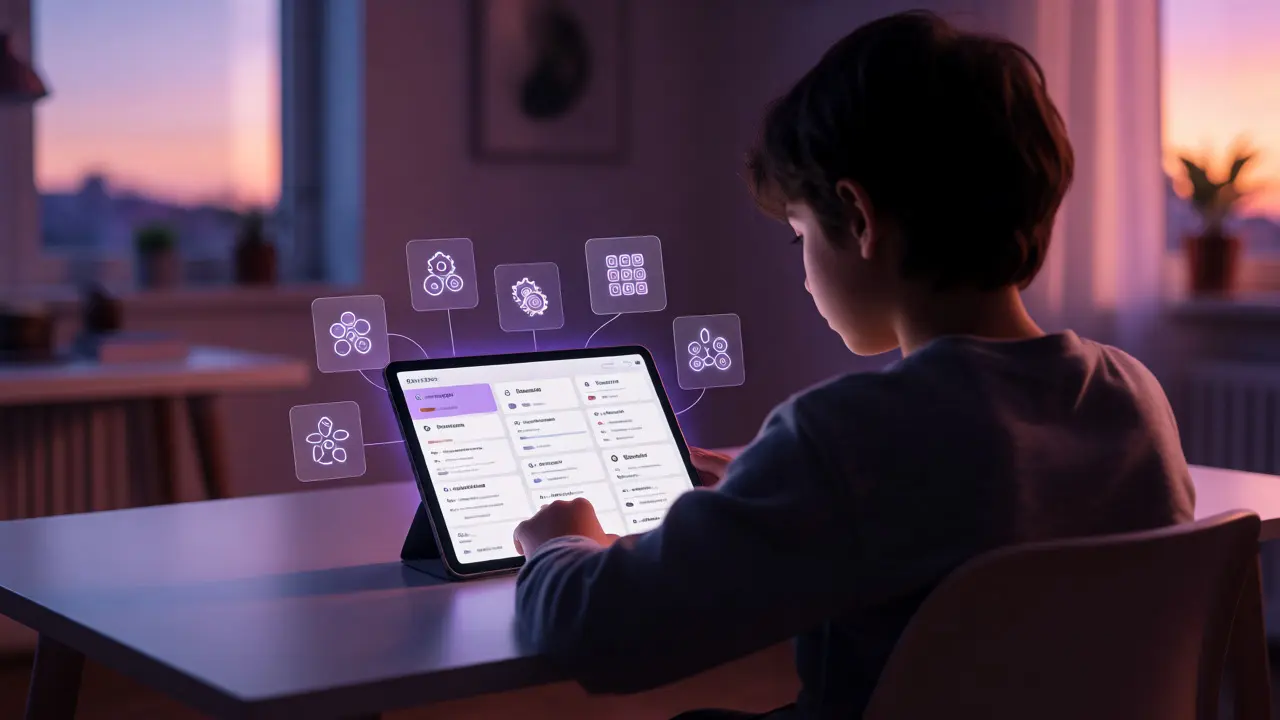
Imagine you are teaching a class of thirty students. Five of them already know the material, ten are struggling with the basics, and fifteen are somewhere in the middle. In a traditional lecture hall, you teach to the middle. The fast learners get bored; the slow learners get lost. Now imagine an online course that notices when you are stuck, offers a hint before you quit, or skips ahead when you have mastered a concept. That is adaptive learning: an educational technology approach that uses algorithms to tailor content, pacing, and difficulty to individual learner needs in real-time.
This isn't science fiction. It is how platforms like Knewton, ALEKS, and Smart Sparrow operate today. If you are an educator, instructional designer, or even a student wondering why some online modules feel eerily intuitive while others feel like hitting a wall, understanding adaptive learning is key. It changes the dynamic from "one size fits all" to "just-in-time, just-for-me." But how does it actually work? And more importantly, does it actually help you learn faster?
What Adaptive Learning Actually Does
At its core, adaptive learning is about data-driven personalization. Traditional online courses are linear. You watch Video A, take Quiz B, read Article C. Everyone follows the same path. Adaptive systems break that linearity.
When you interact with an adaptive platform, it tracks your performance on specific skills. Did you get question 4 wrong? The system doesn't just mark it incorrect. It analyzes *why*. Was it a calculation error? A conceptual misunderstanding? Or did you rush? Based on this diagnosis, the next piece of content changes. If you missed a foundational concept, the system might drop you back to a prerequisite lesson. If you aced it, you skip the review module entirely.
| Feature | Traditional Online Course | Adaptive Learning Platform |
|---|---|---|
| Content Path | Linear (Module 1 → Module 2) | Non-linear (Branching based on mastery) |
| Pacing | Fixed deadlines or self-paced but uniform | Dynamic (Accelerates for experts, slows for novices) |
| Feedback | Generic (Correct/Incorrect) | Diagnostic (Specific misconception addressed) |
| Data Usage | Limited (Completion rates) | Extensive (Granular skill mapping) |
The magic lies in the algorithm. These systems often use Bayesian Knowledge Tracing or similar statistical models. They maintain a probability score for each skill a student possesses. Every interaction updates that score. It’s less like a teacher grading a paper and more like a GPS recalculating your route every time you miss a turn.
The Engine Behind the Personalization
You might wonder what powers these decisions. It’s not magic; it’s math and psychology combined. Most adaptive engines rely on three main components:
- Knowledge Graphs: This is the map of concepts. For a coding course, the graph links "Variables" to "Loops," which link to "Functions." The system knows that you can’t master Loops without Variables.
- Item Banks: Instead of one quiz, there are hundreds of questions tagged by difficulty and concept. The system selects the right question at the right time.
- Decision Rules: These are the logic gates. "If accuracy > 80% on Topic X, unlock Topic Y. If accuracy < 50%, provide remediation Z."
Consider a student learning Spanish. In a traditional app, everyone starts with "Hello" and "Goodbye." In an adaptive system, if you correctly identify five complex verb conjugations immediately, the app assumes you have prior knowledge. It skips the beginner vocabulary and throws you into conversation scenarios. Conversely, if you struggle with gendered nouns, it repeats those drills until you hit a confidence threshold, ignoring other topics until then.
Benefits for Students: Why It Feels Different
For learners, the primary benefit is efficiency. You stop wasting time on things you already know. Research from Carnegie Mellon University suggests that students using adaptive learning tools complete courses up to 30% faster than their peers in traditional settings. Why? Because they aren’t sitting through lectures they don’t need.
But speed isn’t the only win. There is also reduced anxiety. Have you ever felt overwhelmed because you were three chapters behind? Adaptive systems prevent that gap from widening. By catching misconceptions early-when they are small-they prevent the snowball effect. You never feel "lost" because the system adjusts the terrain to match your hiking ability.
Engagement levels tend to rise as well. Psychologists call this the "Zone of Proximal Development"-the sweet spot where tasks are hard enough to be interesting but easy enough to be achievable. Adaptive algorithms are designed to keep you in this zone. If you’re too bored, it ramps up difficulty. If you’re frustrated, it scaffolds the support. It feels responsive, almost human.

Challenges for Educators and Designers
If adaptive learning is so great, why isn’t every course built this way? Because it is expensive and complex to build. Creating a linear course is straightforward: write the script, record the video, upload. Building an adaptive course requires designing a knowledge graph first. You must define every single micro-skill and how they connect. This is known as "learning engineering."
Instructors also face a shift in role. You are no longer the sole source of information. Your job becomes curating the data. You need to look at dashboards showing where the majority of students are stumbling. Maybe 60% of the class fails Question 7. Is the question poorly worded? Is the preceding lesson unclear? The data tells you what to fix. It turns teaching into a continuous feedback loop rather than a broadcast.
There is also the risk of over-optimization. Sometimes, students need to struggle a bit to learn deeply. If the system gives hints too quickly, it might rob students of the productive failure needed for long-term retention. Good adaptive design balances assistance with autonomy.
Real-World Applications and Tools
Several major players dominate this space, each with a different focus. Knewton Alta is widely used in higher education for large enrollment courses like Math and Science. It integrates directly with Learning Management Systems (LMS) like Canvas or Blackboard.
On the corporate side, companies use adaptive training for compliance and sales skills. Imagine a sales team where new hires get basic product training, but top performers get advanced negotiation tactics automatically assigned. This saves thousands of hours in unnecessary training.
Language learning apps like Duolingo have implemented rudimentary adaptive features. While not fully AI-driven in the academic sense, they adjust review frequency based on your errors. More sophisticated tools like ALEKS, developed by McGraw-Hill, use artificial intelligence to assess a student's readiness and create a personalized learning path for subjects ranging from chemistry to business math.
Here is a quick comparison of common approaches:
| Platform Type | Best For | Key Feature |
|---|---|---|
| Higher Ed Platforms (e.g., ALEKS) | STEM subjects with clear prerequisites | Mastery-based progression |
| Corporate LMS Add-ons (e.g., Degreed) | Skill gaps in professional teams | Role-based content recommendations |
| Language Apps (e.g., Babbel) | Vocabulary and conversational practice | Spaced repetition algorithms |
| Custom EdTech Solutions | Niche certifications or unique workflows | Bespoke knowledge graphs |
How to Implement Adaptive Learning Successfully
If you are considering adding adaptive elements to your curriculum, start small. Don’t try to make the entire degree program adaptive overnight. Pick one high-failure module. Analyze the assessment data. Where do students fail most often?
- Map the Skills: Break the module down into atomic concepts. You cannot adapt to "Chapter 3." You must adapt to "Concept 3.1," "Concept 3.2," etc.
- Create Branching Content: Write alternative paths. If a student fails Concept 3.1, show them a video tutorial. If they pass, move to Concept 3.2.
- Set Thresholds: Decide what counts as "mastery." Is it 70% correct? 85%? Be consistent.
- Monitor and Iterate: Watch the analytics. Are students getting stuck in loops? Are they skipping too much? Tweak the rules.
Remember, technology supports pedagogy; it doesn’t replace it. The best results come when instructors use the insights provided by the adaptive engine to intervene personally. If the dashboard shows a cluster of students struggling with a specific topic, schedule a live Q&A session focused exactly on that pain point.
The Future of Personalized Education
We are moving toward hyper-personalization. Current systems react to past mistakes. Future systems will predict future struggles. Using machine learning, platforms could analyze your typing speed, mouse movements, and even facial expressions via webcam (with consent) to gauge frustration or confusion in real-time. If you look confused, the system might offer a simpler explanation before you even click "Next."
However, privacy remains a concern. Collecting granular data on how a student thinks requires robust security. As these technologies mature, transparency about data usage will become a selling point. Students want to know that their data is helping them learn, not just profiling them for advertisers.
Adaptive learning isn't about replacing teachers with robots. It’s about freeing teachers from administrative drudgery and giving students a fair shot at mastering difficult material. It respects the fact that we all learn differently. And honestly, isn't it about time our classrooms reflected that reality?
Is adaptive learning better than traditional online courses?
Generally, yes, for students with varying skill levels. Studies show it improves completion rates and test scores because it prevents boredom for advanced learners and overwhelm for beginners. However, for highly motivated, self-disciplined learners who prefer a structured, linear path, traditional courses may still feel more comfortable. The "better" option depends on the learner's profile and the subject matter complexity.
Does adaptive learning require AI?
Not necessarily. Simple adaptive systems use rule-based logic (if/then statements). However, true personalization at scale usually relies on Machine Learning (ML) or Artificial Intelligence (AI) to handle the vast number of possible student pathways and to predict performance trends. Basic branching can be done without AI, but sophisticated adaptation usually requires it.
Can I build my own adaptive course?
Yes, but it requires effort. You need an authoring tool that supports conditional logic (like Articulate Storyline or Adobe Captivate) or an LMS with adaptive plugins. The hardest part is not the software, but the instructional design: creating multiple versions of content and defining clear success criteria for each branch.
How does adaptive learning affect grades?
Grading structures vary. Some systems grade on mastery (you pass when you prove competence), which can lead to higher final scores since students retry until they understand. Others keep traditional exams but use adaptive prep. Always check the syllabus to see if the adaptive component contributes to the final grade or serves as formative assessment only.
Is adaptive learning suitable for all subjects?
It works best in subjects with clear, sequential knowledge structures, such as mathematics, sciences, languages, and coding. It is harder to implement in subjective fields like creative writing or philosophy, where "correctness" is nuanced. However, hybrid approaches are emerging where adaptive quizzes support essay-based courses.

Comments (12)
Elizabeth Calwell October 30 2026
This is exactly what I’ve been telling my students! We need to stop treating everyone like they’re on the same track. It’s so empowering when a platform actually meets you where you are.
Sabrina Silvani November 1 2026
the philosophical implication here is terrifying
we are outsourcing the human connection in learning to algorithms that optimize for efficiency rather than understanding
is mastery really the goal or is it the struggle itself that builds character
Mithilesh Singh November 1 2026
Finally someone says it. Traditional education is broken. These adaptive systems are the only way forward. No more excuses for lazy teachers who refuse to adapt their methods. The data proves it works better than old-fashioned lecturing which wastes time and money. We must adopt this globally immediately.
Shaina Silver-Baird November 2 2026
One must consider the privacy implications of granular skill mapping. Who owns the data regarding a student's cognitive failures? Are we creating a permanent record of incompetence that follows us into employment? The lack of transparency in these proprietary algorithms is deeply concerning for academic freedom.
Lauren Martin November 4 2026
Let's be real. This is just gamification with extra steps. EdTech companies are selling snake oil to universities desperate for retention metrics. The 'knowledge graph' is often just a fancy decision tree wrapped in AI buzzwords. It doesn't teach critical thinking; it trains pattern recognition for multiple-choice tests. Most instructors don't have the bandwidth to curate these dashboards, so they ignore them anyway. It's performative pedagogy at its finest.
Ejike Ugwu November 5 2026
i feel like i'm being watched all the time now
every click every hesitation is logged
they know when i'm confused before i do
it feels invasive but also kind of helpful??
i hate that i rely on it though
what happens if the algorithm decides i'm not smart enough to continue
Kathleen Johnson November 7 2026
While the concept is theoretically sound, the execution often lacks nuance. Adaptive learning assumes that knowledge acquisition is purely linear and measurable, which ignores the messy reality of how humans actually process information. Furthermore, the cost-benefit analysis rarely favors institutions with smaller class sizes where personalized attention is already feasible.
Brad Walker November 8 2026
The tragedy of modern education is that we seek to eliminate friction.
We want everything smooth and easy.
But growth lives in the friction.
If the machine removes the struggle, does the learner truly grow?
I suspect not.
We are becoming passive consumers of content rather than active architects of knowledge.
The soul of learning is dying in the name of convenience.
It is a sad commentary on our times.
Howard Hurd November 8 2026
US tech is leading this charge 🇺🇸 while other countries lag behind. We need to export this model globally. If your school isn't using ALEKS or similar, you're falling behind. Don't let your kids get stuck in outdated lecture halls. Adapt or die, right? 😎
Manoj Kumar November 8 2026
It appears that the primary objective of these platforms is not educational efficacy but rather data extraction. The user interface is designed to maximize engagement metrics for shareholder value. One should remain skeptical of claims regarding improved learning outcomes without independent verification from non-profit sources.
Hemali Jaiswal November 9 2026
I love the idea of scaffolding support based on immediate needs! It reminds me of how a good mentor adjusts their guidance in real-time. However, we must ensure that the 'hints' provided by the system are pedagogically sound and not just shortcuts that bypass deep processing. Empathy in design is crucial here.
Sean Eagen November 10 2026
tech cant replace human empathy. period.