

Imagine you need to train your sales team on a new software dashboard. Do you show them a real person clicking through the menu, or do you use a cartoon character navigating the interface? This choice isn't just about aesthetics; it directly impacts how much your employees retain and how fast they can apply what they've learned. In 2026, with AI-driven production tools making both options cheaper than ever, picking the wrong format can waste budget and frustrate learners.
The debate between animated video and live action has shifted. It’s no longer about which looks "cooler." It is about cognitive load, emotional connection, and the specific nature of the skill you are teaching. Let's break down exactly when to use each format so you can stop guessing and start producing effective training content.
Understanding the Core Differences
To make a smart decision, we first need to define what these formats actually deliver in an educational context. They are not interchangeable media types; they serve different psychological functions.
Live action video is footage captured using cameras featuring real people, real environments, and real-time interactions. It relies on human presence to build trust and demonstrate physical reality. When a trainer speaks directly to the camera, or when you see a colleague performing a task in a real office, your brain processes this as social proof. It answers the question: "What does this look like in the real world?"
Animated video is digital imagery created frame-by-frame or through motion graphics to illustrate concepts, processes, or abstract ideas. Animation strips away the noise of reality. It allows you to zoom into a microscopic view of a chemical reaction or visualize data flowing through a server network. It answers the question: "How does this work internally?"
The key difference lies in abstraction. Live action grounds the learner in reality. Animation elevates the learner above reality to understand mechanisms. Choosing between them depends entirely on whether your training goal is behavioral modeling or conceptual understanding.
When Live Action Wins: Empathy and Realism
There are specific scenarios where animation fails because it lacks the necessary human element. If your training involves soft skills, compliance with human interaction, or complex physical procedures, live action is usually the superior choice.
- Soft Skills and Leadership: Teaching empathy, conflict resolution, or active listening requires seeing facial expressions, body language, and tone of voice. An animated avatar might say "I hear you," but a real actor showing subtle signs of frustration or patience teaches the nuance that animation often flattens. Studies in non-verbal communication suggest that up to 70% of emotional meaning is conveyed through visual cues other than words. You need high-fidelity human signals for this.
- Compliance and Safety Protocols: If you are training staff on workplace harassment policies or emergency evacuation routes, realism builds authority. Seeing a real person in a real office setting reinforces that these rules apply to them, right now. Animation can sometimes feel too distant or game-like for serious legal topics.
- Physical Demonstrations: Think about manufacturing, healthcare, or construction. If a nurse needs to learn how to insert an IV, or a technician needs to calibrate a machine, they need to see the exact hand movements, the texture of the materials, and the spatial relationships. Animation can simplify this, but it risks omitting critical tactile details that only live footage can capture.
Live action also benefits from authenticity bias. Learners tend to trust information more when it comes from a relatable human source. If your company culture values transparency and personal connection, having your actual CEO or senior trainers on camera strengthens brand alignment.

When Animation Wins: Abstraction and Engagement
Animation shines when the subject matter is invisible, dangerous, expensive to film, or purely theoretical. It is the tool of choice for simplifying complexity.
- Abstract Concepts: How do you explain blockchain, cloud computing architecture, or organizational hierarchy? You can't film a "blockchain." Animation allows you to create metaphors-like boxes connecting to form a chain-that make intangible ideas concrete. This reduces cognitive load by removing irrelevant background details.
- Process Visualization: For internal workflows, such as how a customer support ticket moves from intake to resolution, animation can clearly highlight the path. You can use color coding and arrows to guide the eye, ensuring the viewer focuses on the logic of the process rather than the personalities involved.
- Sensitive or Embarrassing Topics: Sometimes, people freeze when watching a real person discuss mental health struggles or financial mistakes. Animation provides a layer of psychological safety. A cartoon character failing at a task feels less judgmental, encouraging learners to reflect on their own behaviors without feeling exposed.
- Cost and Scalability: While high-end 3D animation is expensive, modern 2D motion graphics have become incredibly affordable. Once you have the assets (characters, backgrounds), updating an animated video is often cheaper than re-shooting live action. If your product UI changes next month, animating the new buttons takes hours; re-filming a live demo might require booking a studio and actors again.
In 2026, AI tools allow for rapid generation of animated avatars and voiceovers, further lowering the barrier to entry for high-quality motion graphics. This makes animation a highly scalable solution for global companies needing to localize content quickly.
Comparing Costs, Production Time, and ROI
Budget is always a constraint. Understanding the investment required for each format helps align expectations with resources. Here is a realistic breakdown based on current market rates for professional-grade corporate training videos.
| Factor | Live Action | Animation (2D Motion Graphics) |
|---|---|---|
| Initial Cost (per minute) | $1,500 - $5,000+ | $2,000 - $8,000+ |
| Production Time | Fast shooting, slow editing | Slow creation, fast revisions |
| Update Frequency | High cost to reshoot | Low cost to edit assets |
| Localization | Requires dubbing/lip-sync | Easy text/audio swap |
| Best For | Human skills, realism | Processes, abstract ideas |
Note that while live action often has a lower upfront cost per minute for simple talking-head videos, costs skyrocket if you need multiple locations, actors, or special effects. Animation has a higher floor due to design work, but its ceiling is determined by complexity, not logistics. The true ROI comes from retention. If animation helps learners grasp a complex concept 40% faster, the higher initial cost may be justified by reduced support tickets and faster time-to-proficiency.
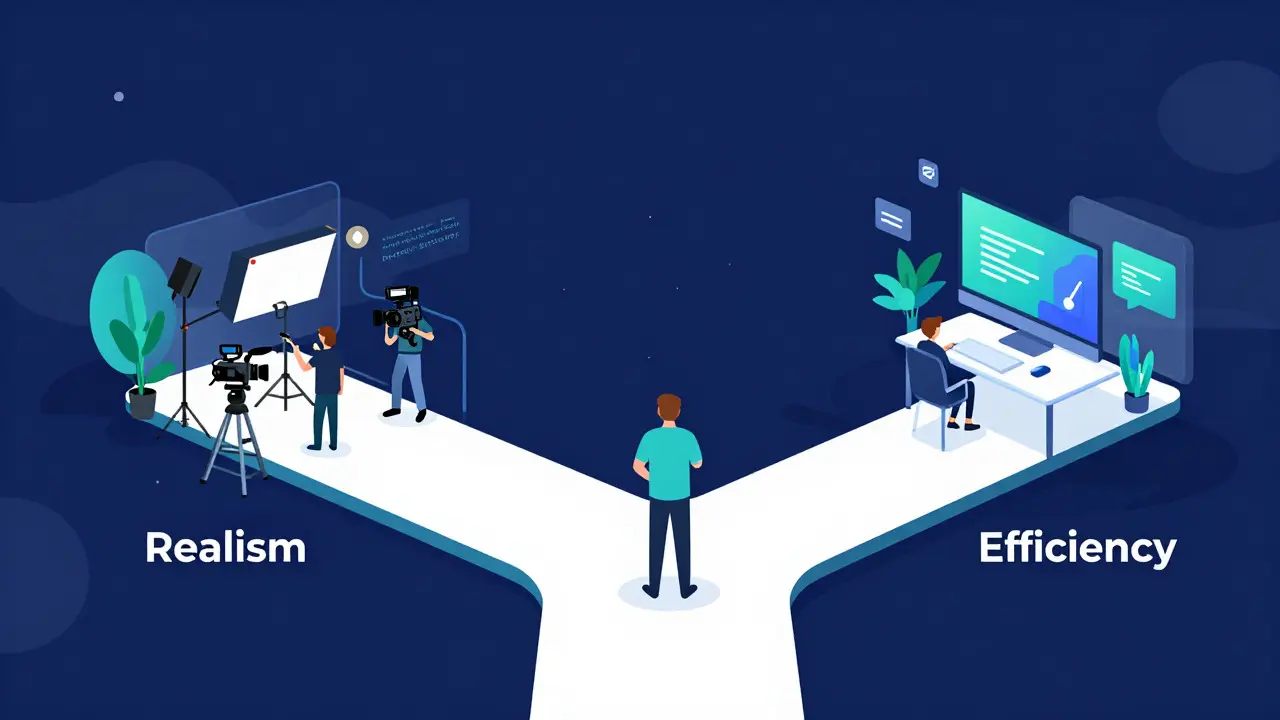
The Hybrid Approach: Best of Both Worlds
You don't always have to choose one exclusively. Many top-tier L&D (Learning and Development) teams use a hybrid model. This approach leverages the strengths of both formats within a single course.
Consider a sales training module. You might start with a live action segment where a seasoned sales manager explains the importance of building rapport, using real anecdotes and facial expressions to convey emotion. Then, transition to animation to visually map out the sales funnel, showing how leads move from awareness to conversion. Finally, return to live action for a role-play scenario where learners watch two actors negotiate a deal.
This variety combats "video fatigue." Switching modalities keeps the brain engaged. It signals to the learner that different parts of the lesson require different types of attention: emotional engagement for the story, analytical focus for the diagram, and observational learning for the demonstration.
Decision Checklist: Which Format Fits Your Project?
Before you hire a production company or open your editing software, run your project through this quick checklist. Answer these questions honestly to determine the best path forward.
- Is the subject visible? If yes, lean toward live action. If no (e.g., data flow, code execution), choose animation.
- Does the learner need to mimic physical actions? If yes, live action is essential for accuracy. If they need to understand logic, animation works better.
- Is emotional connection critical? For empathy, trust, and culture, live action wins. For neutral, factual information, animation is sufficient.
- How often will the content change? If frequently, animation offers easier updates. If static, live action is a one-time investment.
- Who is the audience? Technical audiences often prefer concise animations. New hires may benefit from the welcoming face of live action onboarding.
Remember, there is no universally "better" format. There is only the format that best serves the learning objective. A poorly produced live action video with bad audio will fail harder than a clean, simple animation. Quality execution matters more than the medium itself.
Is animated video better for remote workers?
Not necessarily. Remote workers benefit from clear, concise content regardless of format. However, animation can be more engaging for self-paced learning because it often includes visual cues that keep attention focused without requiring a human presenter. Live action can still be effective if it features relatable colleagues discussing remote work challenges.
Can I mix animation and live action in one video?
Yes, and it is often recommended. This hybrid approach prevents viewer fatigue and allows you to use live action for emotional connection and animation for complex explanations. Just ensure the transition between styles is smooth and consistent in branding.
Which format is cheaper for long-term training programs?
For long-term programs with frequent updates, animation is generally more cost-effective. Once you have the character models and background assets, updating text or graphics is cheap. Live action requires re-shooting, which involves scheduling actors, locations, and crew every time content changes.
Does animation reduce credibility in corporate training?
Only if it looks amateurish. High-quality motion graphics are perceived as professional and modern. In fact, for technical or data-heavy topics, animation can increase credibility by demonstrating clarity and precision in explanation. Avoid childish cartoons for serious business topics.
How do I measure the effectiveness of my training videos?
Use completion rates, quiz scores, and post-training behavior metrics. Track if learners are applying the skills correctly. Additionally, gather qualitative feedback through surveys asking specifically about clarity and engagement. Compare these metrics across different formats to see what resonates with your specific audience.
