
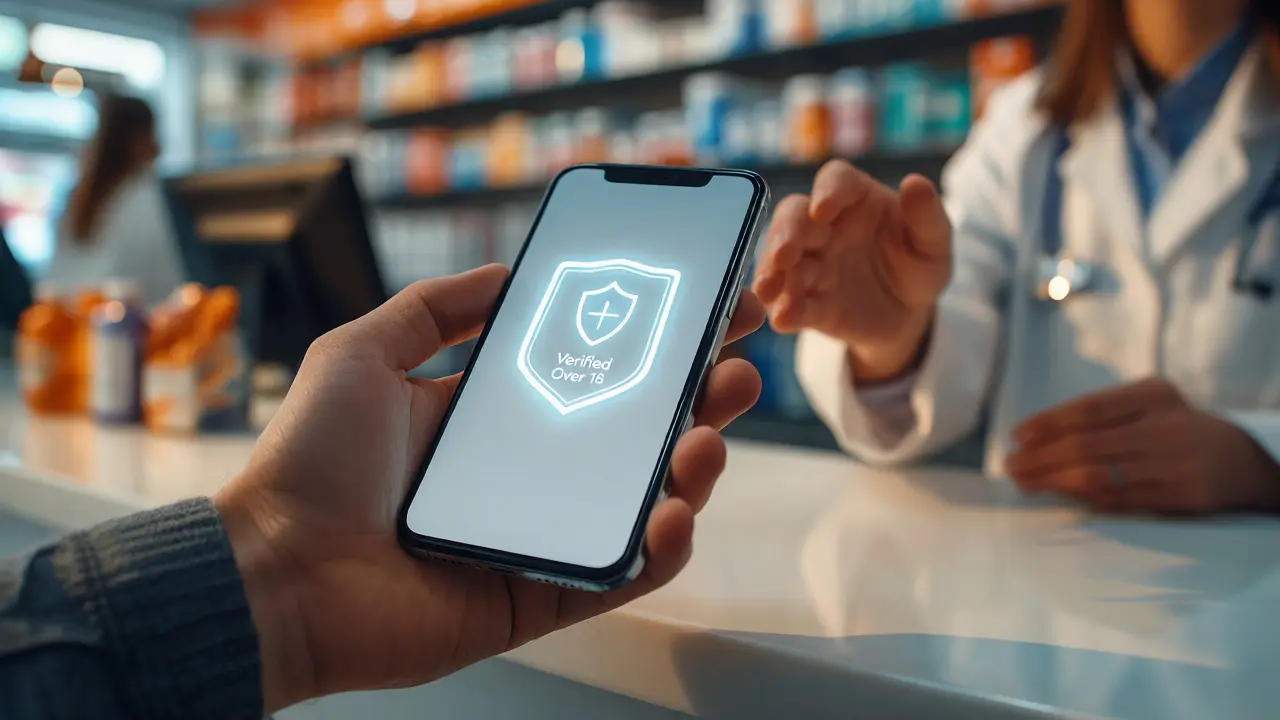
Imagine walking into a pharmacy to buy age-restricted medication. You don't hand over your entire passport, exposing your home address, date of birth, and document number. Instead, you show a digital badge on your phone that simply says "Over 18." The pharmacist verifies it instantly, and you walk out with your privacy intact. This isn't science fiction; it's the core promise of Verifiable Credentials (VCs) and Decentralized Identifiers (DIDs). These open web standards are reshaping how we prove who we are online, moving away from centralized databases toward cryptographic proof.
For years, digital identity has been broken. We rely on passwords, social logins, or government databases that can be hacked or shut down. VCs and DIDs offer a different path. They allow you to hold your own identity data in a digital wallet, sharing only what is necessary for a specific transaction. But how does this actually work in practice? And where is it being used right now?
The Core Mechanics: How VCs and DIDs Work Together
To understand the use cases, you first need to grasp the architecture. Think of Decentralized Identifiers (DIDs) as globally unique, persistent identifiers that do not require a central registration authority. A DID is a string like did:example:123456789abcdefghi. It resolves to a DID Document, which contains public keys and service endpoints. This allows anyone to verify control over an identifier without asking a central server.
Verifiable Credentials are tamper-evident claims made by an issuer about a subject, cryptographically signed for verification. They are essentially digital versions of paper certificates-diplomas, driver's licenses, or health passes-but built on JSON-LD standards so machines can read them.
| Component | Traditional Model | VC/DID Model |
|---|---|---|
| Identifier | Email address, Username (controlled by provider) | DID (controlled by user via private key) |
| Credential Storage | Central database (e.g., Facebook, DMV) | User's Digital Wallet (self-custody) |
| Verification | Query central API or check physical document | Cryptographic signature check against Issuer's DID |
| Privacy | All-or-nothing disclosure (often shares full profile) | Selective Disclosure (share only specific claims) |
The interaction involves three parties: the Issuer (who signs the credential), the Holder (you, storing it in your wallet), and the Verifier (the party checking your claim). When a Verifier asks for proof, you present a subset of your credentials. The Verifier checks the cryptographic signature against the Issuer's DID Document. If the math checks out, the claim is valid. No central database query is needed at the moment of verification.
Use Case 1: Cross-Border Education and Hiring
One of the most immediate applications is in education. Currently, if you apply for a job abroad, you might need to send certified copies of your university degree. This process is slow, expensive, and prone to fraud. With VCs, your university issues a Digital Diploma as a verifiable credential containing your name, degree type, and graduation date.
You store this in your digital wallet. When applying for a job in another country, you share the diploma with the employer. The employer’s system automatically verifies the signature against the university’s DID. This works regardless of whether the university uses Ethereum, Hyperledger, or a simple database for its DID method, because the standard is agnostic to the underlying ledger. This interoperability is crucial. It means a student in Edinburgh can have their credentials verified by a company in Singapore without needing a third-party authentication service like LinkedIn to act as a middleman.
Use Case 2: Healthcare Data Portability
Healthcare records are notoriously siloed. If you visit a specialist outside your local hospital network, they often lack your full medical history. VCs offer a solution through patient-controlled health records. Your doctor acts as the Issuer, signing a VC that confirms specific attributes, such as vaccination status, blood type, or allergy information.
Instead of giving every new provider access to your entire file, you can use selective disclosure. For a routine dental checkup, you might only share your allergy info and insurance eligibility. For an emergency room visit, you might share more. This approach respects patient privacy while ensuring doctors have the critical data they need. In Scotland, pilot programs are exploring how NHS data could be structured into VCs, allowing patients to carry their health history across different care providers securely.

Use Case 3: Financial Services and KYC
"Know Your Customer" (KYC) compliance is a headache for banks and fintechs. Users hate uploading photos of passports repeatedly. Banks hate managing sensitive personal data. DIDs and VCs streamline this. Once a bank verifies your identity, it can issue a "Verified Person" VC. You then present this VC to other financial institutions.
This doesn't mean the second bank trusts the first blindly. They trust the cryptographic proof that a regulated entity issued the credential. This reduces friction for users opening multiple accounts and lowers costs for institutions that no longer need to re-collect and store raw passport images. It also helps with anti-money laundering efforts, as the chain of custody for the identity proof is clear and auditable.
Use Case 4: Supply Chain Provenance
Identity isn't just for people. DIDs can identify things. Imagine buying a luxury handbag or organic coffee. Counterfeiting is rampant. By attaching a DID to a product, manufacturers can issue VCs that certify its origin, materials, and ethical sourcing.
A consumer scans a QR code linked to the product's DID. Their phone resolves the DID to see a series of VCs: one from the farm confirming organic certification, another from the manufacturer confirming fair labor practices. Because these are cryptographically signed, they cannot be forged easily. This builds trust without requiring the consumer to research each supplier individually. It turns supply chain transparency from a marketing buzzword into a verifiable fact.

Why Blockchain Matters Here (And Why It Doesn't Always)
A common misconception is that VCs and DIDs *must* run on a public blockchain like Bitcoin or Ethereum. While blockchains provide excellent immutability and decentralization for storing DID Documents and revocation lists, they aren't strictly required by the W3C standards. The standards are designed to be flexible.
However, blockchain adds significant value in scenarios where trust is low or intermediaries are costly. Public blockchains ensure that once a DID is registered, it cannot be censored or deleted by a single entity. Private or permissioned ledgers (like Hyperledger Fabric) are often preferred by enterprises for speed and cost efficiency. The key takeaway is that the *identifier* and the *credential* are portable across different infrastructures. You can move your digital identity from one platform to another without losing your data or your ability to prove it.
Challenges and Current State
Despite the promise, adoption is still early. User experience remains a barrier. Managing private keys is scary for non-tech-savvy users. If you lose your recovery phrase, you lose your identity. Standards are evolving, too. The W3C released the Verifiable Credentials Data Model v1.1 in March 2022, but newer drafts like v2.0 are already influencing implementation guides.
Interoperability between different wallets and issuers is improving but not perfect. Some systems use proprietary extensions that break compatibility. Regulatory frameworks are also catching up. Governments are beginning to recognize VCs as legally binding proofs, but laws vary by jurisdiction. In the UK, initiatives like the UK Digital Identity Trust Framework are working to align these technologies with national standards.
Key Takeaways for Implementation
- Start Small: Don't try to digitize your entire life at once. Pick one high-friction process, like employee ID badges or customer loyalty cards, and implement VCs there.
- Focus on UX: Hide the complexity of keys and signatures. Users should see a simple "Verify" button, not a JSON-LD object.
- Plan for Revocation: What happens if a credential needs to be revoked before it expires? Ensure your infrastructure supports efficient revocation checks.
- Standard Compliance: Stick closely to W3C recommendations to avoid vendor lock-in. Use established libraries for signing and verification.
Do I need a cryptocurrency wallet to use DIDs?
No. While DIDs are often associated with blockchain, they function independently of cryptocurrency transactions. You need a digital wallet capable of storing keys and credentials, but you don't necessarily need to hold or trade crypto tokens to manage your identity.
Can a Verifiable Credential be forged?
It is computationally infeasible to forge a VC if the issuer's private key remains secure. The credential includes a cryptographic signature that ties the data to the issuer's DID. Any alteration to the data invalidates the signature, making tampering evident.
What happens if the issuer goes out of business?
The credential remains valid as long as the cryptographic proof holds. However, future updates or revocations might become difficult if the issuer's DID Document is no longer maintained. This is why long-term storage solutions for DID Documents and revocation registries are critical for enterprise deployments.
Are VCs compatible with existing login systems like OAuth?
Yes, they can complement them. OAuth handles authorization (access to resources), while VCs handle authentication and attribute proof (who you are and what you know). Many modern architectures use OAuth for session management and VCs for verifying user attributes during registration or specific actions.
Is my data stored on the blockchain?
Typically, no. Only the DID Document (public keys) and sometimes a hash of the credential or revocation status are stored on-chain. The actual personal data inside the Verifiable Credential stays in your digital wallet, preserving privacy and reducing storage costs.

Comments (13)
Brannen Hall September 20 2026
Technically the W3C specs allow for non-blockchain DIDs but that's missing the point entirely. You're just trading one central authority (Facebook) for another (the issuer's server). If the issuer goes down your 'decentralized' identity is useless. Also selective disclosure adds massive computational overhead on mobile devices which nobody talks about because it sounds cool in whitepapers.
Meagan Mueller September 20 2026
theyre gonna track us harder than ever before with this stuff mark my words
tiffany King September 21 2026
I really hope this works out! The idea of not having to hand over my whole passport at a pharmacy feels so liberating and private. It’s amazing to see tech finally prioritizing user control instead of just harvesting data. Fingers crossed for widespread adoption soon!
Brenna Gonedrman September 21 2026
It is literally the only way forward. We have been shackled by centralized silos for decades and it is absolutely terrifying how fragile our current digital identities are. This is revolutionary. Truly revolutionary.
Bonnie Watt September 23 2026
Yeah great until some corporation decides they don't like you and revokes your credential without warning or recourse. Sounds like a nightmare scenario for anyone who isn't rich enough to afford their own node infrastructure. Typical tech utopianism ignoring power dynamics.
Dave Gibbeson September 24 2026
You’re right to be cautious but the architecture supports long-term validity even if the issuer stops maintaining the DID doc immediately. The cryptographic proof stands. Plus, we’re seeing more interoperability standards emerging to prevent single points of failure. It’s a work in progress but the trajectory is solid.
Courtney Wagstaff September 25 2026
honestly i just want to stop carrying my wallet around lol. if i can leave my driver's license at home and just flash my phone like some kind of sci-fi spy that would be pretty sweet. also love the supply chain bit, knowing where my coffee came from without digging through websites is nice.
Joanna Mucha September 25 2026
The ontological implications here are profound yet largely unexamined by the mainstream discourse. By decoupling identity from institutional validation, we are essentially reconstructing the social contract in code. However, the aesthetic of these interfaces remains dreadfully utilitarian, lacking the human touch necessary for true societal integration. One must consider the phenomenology of holding one's own truth versus being granted it.
Sabrina Newland September 27 2026
i think its fascinating how this shifts power back to individuals 🤔 but im worried about the learning curve for older generations. typos aside, do u think govts will actually adopt this or just keep using old databases? 😕
Elisabeth Ballet September 29 2026
Listen, adoption starts with utility, not philosophy. Look at Estonia. They’ve been doing e-identity for years. VCs are the next logical step. Don’t get bogged down in the metaphysics; focus on the friction reduction. That’s what sells. That’s what gets people to change their habits. Start small, scale fast, and ignore the critics who haven’t tried the tech themselves.
Kim Edwards September 30 2026
OH MY GOD THE PRIVACY PARADOX IS KILLING ME. We trade one surveillance system for another and call it freedom?! I’m literally shaking thinking about losing my recovery phrase. Imagine waking up tomorrow and realizing you legally don't exist because you forgot a string of letters. TRAGEDY.
Amara Akbar October 1 2026
It is truly heartening to see such thoughtful engagement with these emerging technologies. While the challenges regarding key management are valid, the potential for empowerment is undeniable. Perhaps educational initiatives could help bridge the gap for those less familiar with cryptographic concepts. We should remain optimistic while remaining vigilant about security protocols.
Mark Harvey October 1 2026
totally agree with the need for better UX. hiding the complexity is key. once it feels as easy as scanning a qr code people will use it no problem. keep pushing for simplicity