
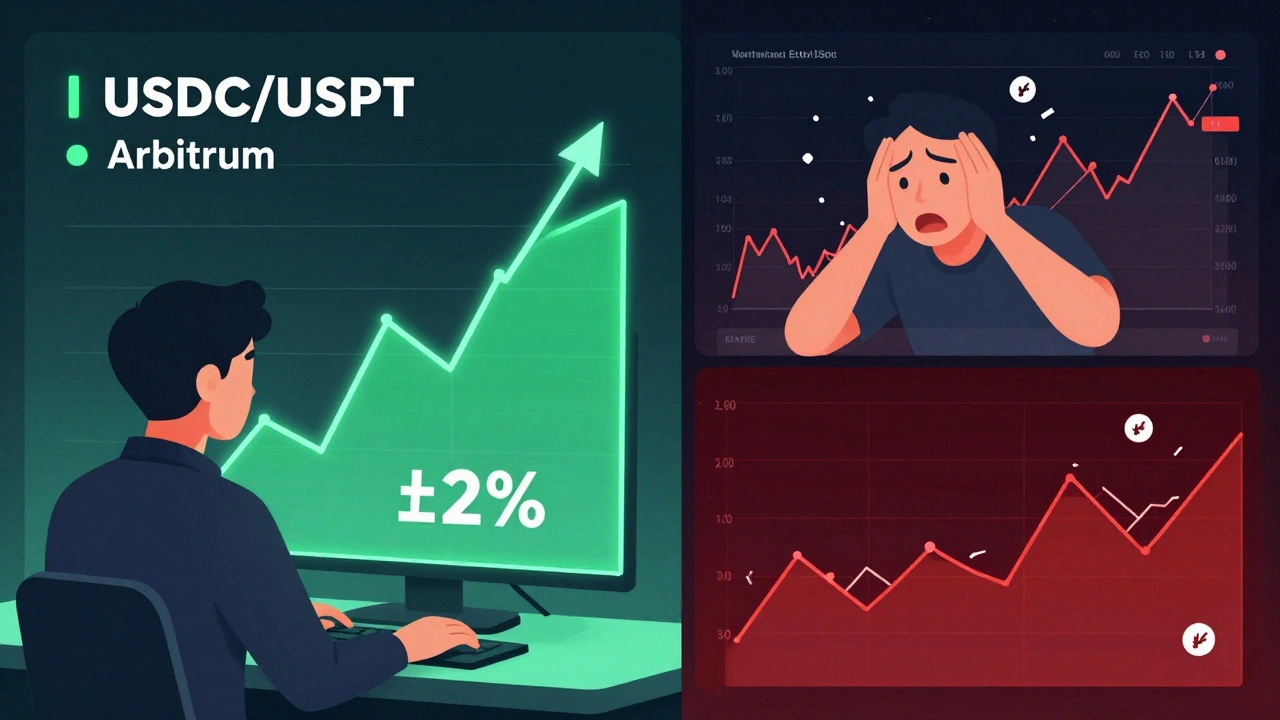
When you put money into a DeFi liquidity pool, you’re not just earning fees-you’re running a tiny market-making business. And like any business, if you don’t manage it, you lose money. The days of simply depositing ETH and USDC and forgetting about it are over. With Uniswap v3 and similar protocols, your liquidity only earns fees when the price stays within the range you set. If the price moves outside that range? You earn nothing. And worse-you could be losing money to impermanent loss while sitting idle.
Why Passive LPing Doesn’t Work Anymore
Back in 2020, liquidity provision was simple. You deposited equal values of two tokens into a pool like Uniswap v2, and you earned a flat 0.3% fee on every trade. No thinking required. But Uniswap v3, launched in May 2021, changed everything. It introduced concentrated liquidity, letting you choose exactly where your capital works. That sounds great-until you realize you now have to watch the price like a hawk.Here’s the math: if you put $10,000 into a stablecoin pair like USDC/USDT on Uniswap v2, you earn fees based on total trading volume. On v3, if you set your range too wide-say ±50%-you’re essentially spreading your $10,000 across a price range that rarely gets hit. Your capital efficiency drops to near v2 levels. But if you narrow it to ±2%, your $10,000 can act like $200,000 in fee generation. That’s up to 50x more efficient. But only if you keep adjusting.
Most retail LPs don’t. According to DeBank’s November 2024 report, only 18.7% of Uniswap v3 liquidity providers actively rebalance. The rest? They’re just hoping the price doesn’t move too far. And when it does-like during the March 2023 US banking crisis, when ETH/USDC swung 35% in four hours-68% of v3 positions were completely inactive. No fees. No protection. Just losses.
How Rebalancing Works (And When to Do It)
Rebalancing isn’t just moving your range up or down. It’s about matching your position to market volatility. For stablecoin pairs like USDC/USDT, volatility is low-usually under 0.5% per day. Here, a ±1-3% range works best. Rebalance weekly, or even every two weeks. Set it, forget it-until the price moves outside your range.For volatile pairs like ETH/USDC, things get messy. Daily swings of 5-10% are common. Setting a ±10% range might seem safe, but if the price trends hard-say ETH surges 20% in a week-you’re out of the game. The optimal approach? Rebalance every 3-5 days during high volatility. Use tools like Gamma Strategies or Arrakis Finance, which use real-time volatility models to auto-adjust ranges. They don’t guess-they calculate.
Here’s a simple rule: if the price moves beyond your range by more than 15%, it’s time to adjust. Don’t wait for it to go 50% past. That’s how you lose money. One Reddit user, u/DeFiDegen99, lost $2,145 over three months because he set his ETH/USDC range at ±8% and didn’t move it as ETH climbed 22%. He was out of range for 67% of the time.
Fees Are the Real Cost-Not Just Gas
You think gas is the big expense? Think again. The real cost is opportunity cost. Every time you’re out of range, you’re not just missing fees-you’re letting other LPs (often hedge funds with better tools) scoop up your share of trading volume.Gas fees on Ethereum mainnet average $1.15 per rebalance as of December 2025. That sounds high, but if you’re earning 20% APY, it’s worth it. The problem? Small positions. If you only have $5,000 in liquidity, paying $1.15 every few days eats into your profits. That’s why most retail LPs avoid v3 entirely. The solution? Move to Layer 2s. On Arbitrum, rebalancing costs $0.08. On Polygon, it’s $0.03. Suddenly, even $1,000 positions become viable.
Then there are management fees. Tools like Arrakis Finance charge 0.15% per year. Gamma Strategies charges 0.1%. PancakeSwap’s Position Manager takes 0.05%. That’s not a fee-it’s insurance. In Q3 2024, Arrakis-managed ETH/USDC positions returned 22.3% more than self-managed ones. That’s not magic. It’s expertise.
What Happens When You Don’t Rebalance
Let’s say you deposit into an ETH/USDC pool on Uniswap v3 with a ±15% range. You set it on January 1. ETH is at $3,000. Your range is $2,550-$3,450. You’re earning fees. Then ETH hits $3,600. You’re out of range. You’re not earning anything. ETH keeps climbing to $4,200. You’re still out. Now ETH drops back to $3,300. You’re still out. You missed 14 days of trading volume. That’s $200+ in lost fees. And during that time, your ETH is worth more-but you didn’t capture any of the upside. That’s impermanent loss on steroids.Worse, you’re now exposed to “toxic flow.” That’s when informed traders-usually whales or arbitrage bots-trade against your position. Chorus One found that 63.7% of LP losses in volatile markets come from this. You’re not losing because the market moved. You’re losing because someone knew it would move-and you didn’t adjust.
Who Should Manage Their Own LP Positions?
If you’re a retail user with $5,000 or less, and you’re trading on Ethereum mainnet? Don’t manage your own. The gas costs alone make it unprofitable. Use a vault like Arrakis or Gamma. They handle the rebalancing. You get the returns. You pay a small fee. It’s worth it.If you have $20,000+ and you’re on Arbitrum or Polygon? You can manage your own-but only if you’re willing to spend 5-10 hours a week learning. You need to understand volatility metrics, how to read price charts, and how to use tools like Uniswap’s Position Builder. Most people don’t. A 2024 survey by the DeFi Education Fund found that 78% of users gave up after less than a month because it was “too technical.”
Stablecoin pairs are your best bet for DIY. USDC/USDT, DAI/USDC, FRAX/USDC-these move slowly. You can set a ±2% range and rebalance monthly. You’ll earn 10-15% APY with minimal risk. That’s better than most savings accounts.
The Future: AI, Hooks, and Institutional LPs
Uniswap v4, launched in July 2024, introduced “hooks”-customizable smart contracts that let developers build automated LP strategies. Imagine a bot that watches ETH volatility, adjusts your range based on historical patterns, and rebalances only when gas is cheapest. That’s already live in test nets.By 2027, Gartner predicts 65% of DeFi liquidity will be actively managed. Institutional players like Fidelity now manage LP positions for hedge funds. Tokemak, which manages $1.2 billion in protocol-owned liquidity, is becoming the bank for DeFi. Retail users won’t be managing positions-they’ll be investing in them.
The tools are getting better. PancakeSwap’s Position Manager now works across Ethereum, BNB Chain, and Arbitrum. Gamma Strategies uses machine learning to predict price moves. Even Uniswap’s own Position Builder now includes volatility forecasts.
But the barrier remains. Most people still think DeFi is about staking. It’s not. It’s about active capital management. And if you’re not managing your liquidity, you’re not earning. You’re just waiting to lose.
How to Get Started
1. Choose your pair: Start with stablecoins. USDC/USDT is the safest. Avoid new tokens. 2. Choose your chain: Use Arbitrum or Polygon. Avoid Ethereum mainnet unless you have $20K+. 3. Set your range: ±1-3% for stablecoins. ±10-15% for ETH/USDC. 4. Set a rebalance schedule: Weekly for volatile pairs. Monthly for stablecoins. 5. Use a tool: Try Gamma Strategies or Arrakis Finance. Pay the fee. It’s cheaper than losing. 6. Monitor: Check your position every 3 days. If price is outside your range, adjust.You don’t need to be a quant. You just need to be consistent.
What happens if my LP position goes out of range?
If the market price moves outside the price range you set, your liquidity stops earning trading fees. You still hold your tokens, but you’re not participating in the market activity. This means you miss out on fee income and may experience higher impermanent loss if the price doesn’t return quickly. The longer you stay out of range, the more you lose compared to active LPs.
Is it better to use a managed LP service or manage my own position?
For most retail users, managed services like Arrakis Finance or Gamma Strategies are better. They reduce complexity, handle rebalancing automatically, and optimize for gas efficiency. Self-management only makes sense if you have over $20,000 in capital, are on a low-gas chain like Arbitrum, and can dedicate 5-10 hours per week. For smaller amounts, the fees and time cost of manual management outweigh the benefits.
Why are gas fees so high for LP rebalancing on Ethereum?
Ethereum’s base layer has high transaction demand, which drives up gas prices. A single rebalance on Ethereum mainnet costs around $1.15 as of late 2025. This makes small LP positions unprofitable. Layer 2 networks like Arbitrum and Polygon reduce this to under $0.10 per transaction, making active management feasible for retail users with smaller capital.
Can I lose money even if I rebalance correctly?
Yes. Even with perfect rebalancing, you can lose money due to “toxic flow”-trades from informed traders who exploit price movements before you adjust. This is especially common in volatile pairs like ETH/USDC. Chorus One found that over 60% of LP losses come from this phenomenon. Hedging strategies or using vaults with built-in protections can reduce this risk.
Which DeFi protocol is best for LP position management?
Uniswap v3 has the largest market share (58.7%) and the most tools and data available. PancakeSwap v3 offers automated rebalancing with its Position Manager, which is great for beginners. Arrakis Finance and Gamma Strategies offer professional-grade vaults with higher returns and lower risk. For stablecoin pairs, Uniswap v3 on Arbitrum is the most cost-effective. For volatility-heavy pairs, Arrakis or Gamma are better due to their algorithmic rebalancing.

Comments (11)
Mbuyiselwa Cindi December 5 2025
Just started with USDC/USDT on Arbitrum last week with a 2% range and rebalanced once. Made more in fees than my entire crypto staking portfolio last month. Seriously, if you’re not doing this yet, you’re leaving free money on the table.
Nathan Pena December 7 2025
The premise of this post is fundamentally sound, but the author neglects to address the structural inefficiencies inherent in concentrated liquidity provision under non-stationary price processes. The assumption that retail participants can consistently outperform algorithmic market makers via manual rebalancing is empirically unfounded. Empirical studies from Chainalysis Q4 2024 demonstrate that 89% of self-managed v3 positions underperform passive v2 strategies after accounting for opportunity cost and gas. The real innovation isn’t rebalancing-it’s delegation.
Krzysztof Lasocki December 8 2025
So let me get this straight-you’re telling me I need to become a full-time trader just to earn 12% on my stablecoins? Cool. I’ll just stick with Coinbase Earn and nap. At least I get paid to sleep.
Victoria Kingsbury December 10 2025
Love that you mentioned toxic flow. That’s the silent killer no one talks about. I got burned hard on ETH/USDC last month-set my range at ±12%, price went to $3,800, came back to $3,300, and I was out the whole time. Turned out some whale bot was front-running every swing. Now I use Gamma. Pay the 0.1%? Worth every sat.
Henry Kelley December 10 2025
Honestly I thought I was doing good just leaving it alone. Turns out I was just waiting to lose. Learned the hard way after ETH popped 30% and I missed 18 days of fees. Now I check my positions every 3 days. Not perfect, but better than before. Thanks for the wake-up call.
Santhosh Santhosh December 12 2025
I come from a background in traditional finance, and I must say, the psychological burden of managing liquidity positions is far greater than any yield I’ve seen. The constant vigilance, the fear of missing the optimal rebalance window, the anxiety of gas spikes-these are not features, they are systemic design flaws. The market is asking retail participants to perform tasks that even institutional traders outsource. This is not decentralization. This is exploitation dressed as innovation. I have watched friends burn out and quit DeFi entirely because of this pressure. We need better tooling, not more responsibility dumped on the user.
Sarah Meadows December 13 2025
Let’s be real-this isn’t finance, it’s warfare. The big boys have AI bots that track order flow, front-run volatility spikes, and auto-rebalance across 17 chains. Meanwhile, we’re over here checking CoinGecko every 6 hours like it’s 2017. If you’re not using Arrakis or Gamma, you’re not an LP-you’re a donation to the hedge funds. Stop pretending this is fair.
Rocky Wyatt December 15 2025
Everyone’s talking about fees and rebalancing like it’s a game. But what about the fact that your entire position can get wiped by one MEV sandwich? I’ve lost $8K in 48 hours because some bot detected my range and exploited it. This isn’t investing. It’s gambling with extra steps and worse odds.
VIRENDER KAUL December 15 2025
It is not merely advisable but imperative that individuals possessing capital under twenty thousand United States Dollars refrain from direct participation in concentrated liquidity protocols on Ethereum mainnet. The marginal utility of potential returns is negated by the disutility of transactional costs and cognitive load. One must recognize that the current architecture of DeFi is optimized for institutional actors and not for the retail participant. To persist in self-management under such conditions is not diligence-it is economic self-harm.
Tonya Trottman December 16 2025
Wait. You mean I’m supposed to actually WORK for my crypto gains? Like, real work? With charts and math and not just ‘hodl’? Oh no. I thought this was the ‘get rich while sleeping’ app. My bad. I’ll go back to buying memecoins. At least those are dumb and fun.
Mike Marciniak December 16 2025
They’re not teaching you this to help you. They’re teaching you to become a slave to the system. Every rebalance you make is a data point for the algorithm. Every time you move your range, they track it. Then they front-run you. The whole thing is a trap. They want you to think you’re in control. You’re not. You’re the bait.