
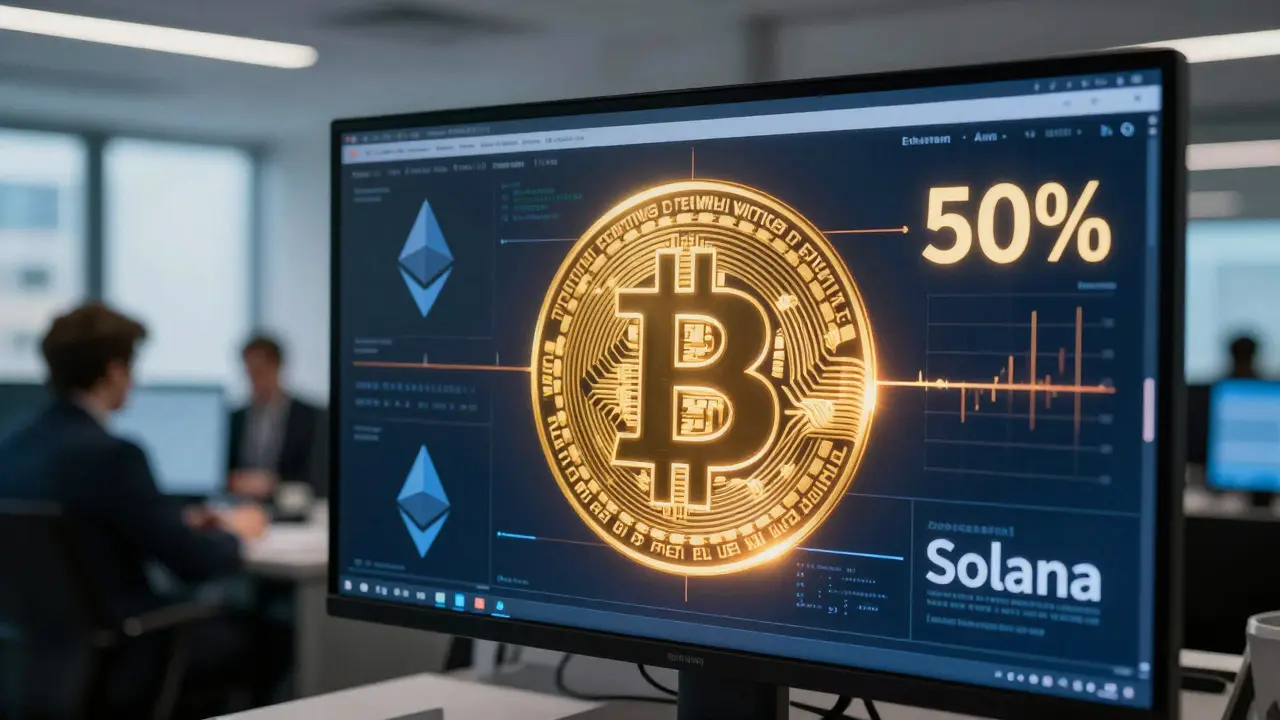
Walk into any financial newsroom or browse a crypto trading dashboard today, and one thing stands out immediately. Bitcoin isn't just leading the pack; it is carrying the entire industry on its back. As of mid-2026, Bitcoin commands roughly 56% to 58% of the total cryptocurrency market capitalization. That number might sound like a simple statistic, but it tells a deeper story about trust, security, and institutional money flowing into the digital asset space.
You might wonder why this matters if you are looking at faster, cheaper, or more feature-rich alternatives. After all, Ethereum handles smart contracts, Solana moves transactions at lightning speed, and dozens of other tokens promise revolutionary use cases. Yet, despite the noise and hype surrounding these "altcoins," Bitcoin remains the undisputed king. This article breaks down exactly why that is, looking past the marketing to the hard data driving this dominance.
The Institutional Floodgates Opened for Bitcoin
The biggest shift in the crypto landscape didn't happen because of a new coding upgrade or a viral meme. It happened when Wall Street finally got its hands on Bitcoin through regulated channels. In January 2024, the U.S. Securities and Exchange Commission (SEC) approved spot Bitcoin exchange-traded funds (ETFs). This was a game-changer.
Suddenly, pension funds, wealth managers, and corporate treasuries could buy Bitcoin without dealing with complex private keys or shady exchanges. The numbers speak for themselves. In the first half of 2024 alone, institutional inflows reached approximately $16.7 billion into Bitcoin products. Out of $17.1 billion in total crypto inflows during that period, Bitcoin absorbed nearly 98% of that institutional capital. Compare that to altcoins, which struggled to attract similar volumes of traditional finance money.
This trend continued into 2025 and 2026. When the U.S. government announced a Strategic Bitcoin Reserve in March 2025, it sent a signal that Bitcoin was no longer just a speculative tech bet-it was a macroeconomic asset. While altcoins like Ethereum and Solana have their own merits, they haven't seen the same level of regulatory clarity or institutional embrace. Most altcoins still face uncertainty regarding whether they are classified as securities, creating a barrier for conservative investors who prefer the safety of a commodity classification.
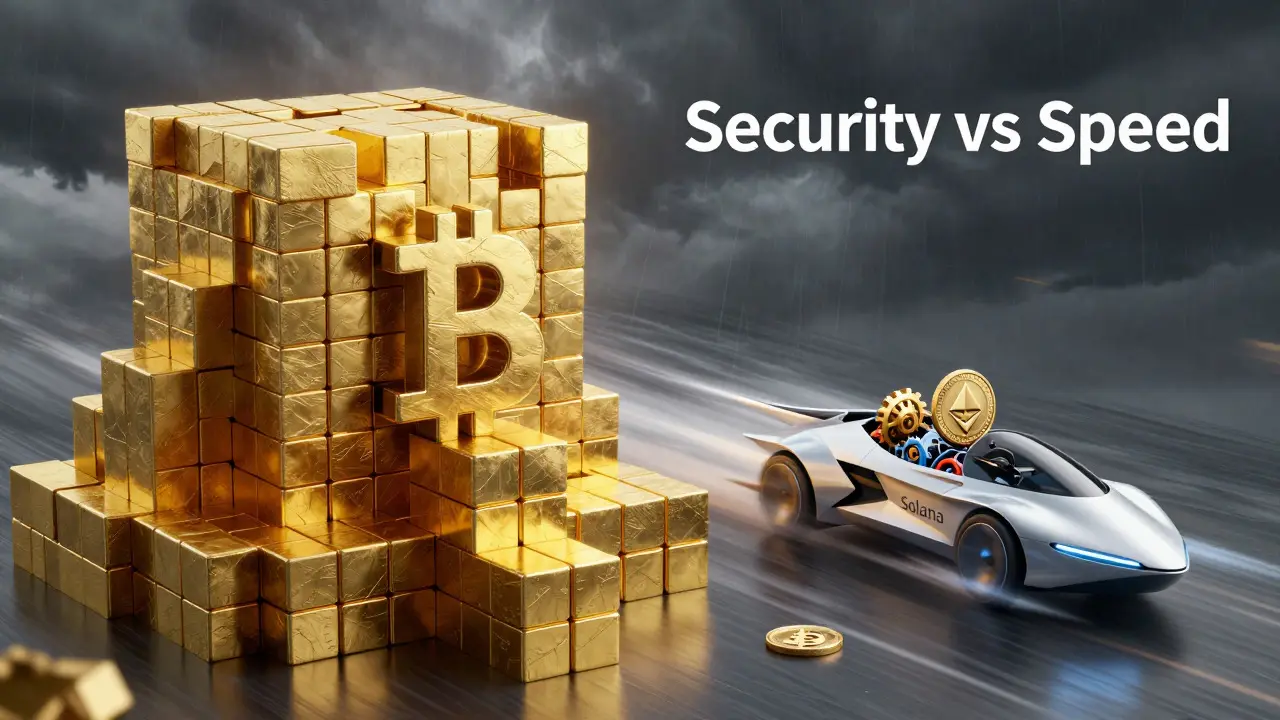
Security vs. Speed: The Trade-Off You Can't Ignore
If you ask a developer what makes a blockchain good, they might talk about transaction speed or low fees. If you ask an investor, they will likely talk about security and decentralization. Bitcoin chose the latter path early on, and that choice has paid off massively.
| Feature | Bitcoin | Ethereum | Solana |
|---|---|---|---|
| Consensus Mechanism | Proof of Work (PoW) | Proof of Stake (PoS) | Proof of History + PoS |
| Transactions Per Second (TPS) | ~7 TPS | 15-30 TPS (base layer) | 3,000-5,000+ TPS |
| Average Transaction Fee | ~$7.60 | ~$23.00 | <$0.005 |
| Network Finality Time | ~60 minutes | ~13 minutes | ~12.8 seconds |
| Primary Use Case | Store of Value / Settlement | Smart Contracts / DeFi | High-Speed Apps / Gaming |
Look at the table above. Solana is undeniably faster and cheaper. But speed comes with complexity. Complex systems have more points of failure. Since its launch, Solana has experienced several network outages due to congestion or software bugs. Ethereum has dealt with smart contract exploits and high gas fees that make small transactions impractical on its base layer.
Bitcoin, by contrast, has never suffered a protocol-level outage since its genesis block in 2009. Its simplicity is its strength. The Proof of Work consensus mechanism requires massive amounts of real-world energy and hardware to secure the network, making attacks economically unfeasible. For institutions holding billions in assets, this reliability is worth more than saving a few cents on transaction fees. They aren't buying Bitcoin to send micro-payments; they are buying it to park value securely.
Scarcity: The Digital Gold Standard
One of the most compelling arguments for Bitcoin is its monetary policy. There will only ever be 21 million Bitcoins. This hard cap is enforced by code, not by a central bank or a company board. Every four years, the "halving" event cuts the reward for mining new blocks in half, reducing the supply of new coins entering the market. The April 2024 halving further tightened this supply, reinforcing the scarcity narrative.
Most altcoins do not have such strict limits. Many have inflationary schedules designed to reward validators or developers, while others have uncapped supplies. Even Ethereum, which transitioned to a deflationary model during high usage periods, can revert to inflation depending on network activity. This flexibility makes altcoins attractive for building ecosystems but less appealing as a long-term store of value.
In a world where fiat currencies lose purchasing power due to inflation, Bitcoin's fixed supply acts as a hedge. Investors view it as "digital gold." When economic uncertainty rises, capital flows into Bitcoin. During the 2024 cycle, Bitcoin reached an all-time high of over $108,000, driving its market cap to nearly $3.9 trillion globally. At that peak, Bitcoin accounted for 53.6% of the entire crypto market. That kind of price action and market presence is driven by the belief that Bitcoin is a finite asset class, unlike many altcoins that can be diluted over time.
Volatility and Risk: Why Altcoins Are Still Speculative
Let's talk risk. If you want high returns, altcoins often deliver them-but they also bring higher volatility. Data from March 2025 showed that Solana's realized volatility was around 80% over a three-month period. That is nearly twice the volatility of Bitcoin and significantly higher than Ethereum's.
For a retail trader chasing quick gains, this volatility is exciting. For a corporation managing its treasury or a family office preserving wealth, it is terrifying. This difference in risk profile explains why portfolio advice consistently recommends keeping the majority of your crypto allocation in Bitcoin. A common rule of thumb suggests allocating 50-70% of a crypto portfolio to Bitcoin, treating it as the foundation. Altcoins then make up the remaining 30-50%, with smaller caps and meme coins limited to single-digit percentages.
This behavior reinforces Bitcoin's dominance. When markets get shaky, investors sell risky altcoins first and hold onto Bitcoin. This "flight to quality" within the crypto space keeps Bitcoin's market share stable even during downturns. Meanwhile, altcoins suffer from fragmentation. There are thousands of them, each competing for attention and liquidity. Bitcoin has none of that competition in its core niche as a global settlement layer.
The Future: Will Altcoins Ever Catch Up?
It is easy to look at Bitcoin's current dominance and assume it will last forever. But technology evolves. Ethereum is scaling through Layer 2 solutions like Arbitrum and Optimism, which offer lower fees and faster speeds while relying on Ethereum's security. Solana is working on upgrades like Firedancer, aiming for theoretical throughput of up to one million transactions per second later in 2026.
These innovations could drive significant usage metrics for altcoins. We might see more daily active users, higher total value locked (TVL) in decentralized finance, and more applications built on altcoin chains. However, usage does not always equal market cap dominance. People might use Ethereum for gaming or Solana for trading, but they may still choose to save their wealth in Bitcoin.
Regulatory clarity will also play a huge role. If regulators treat major altcoins as commodities rather than securities, we could see a surge in institutional adoption for those assets too. But until that happens, Bitcoin's head start in legal acceptance gives it a massive advantage. The U.S. Strategic Bitcoin Reserve and the approval of spot ETFs have created a moat around Bitcoin that is difficult for competitors to cross quickly.
So, while altcoins will continue to innovate and capture specific niches, displacing Bitcoin as the primary store of value seems unlikely in the near future. Bitcoin has become the standard against which all other cryptocurrencies are measured. It is the safest, most liquid, and most recognized digital asset in the world. For now, and probably for the foreseeable future, it remains the anchor of the crypto economy.
What is Bitcoin dominance and why does it matter?
Bitcoin dominance is the percentage of the total cryptocurrency market capitalization that belongs to Bitcoin. It matters because it indicates investor sentiment. High dominance suggests that investors are favoring safety and stability (Bitcoin), while low dominance often signals that traders are taking more risks on altcoins in search of higher returns.
Is Bitcoin better than Ethereum for long-term investment?
For pure store-of-value purposes, Bitcoin is generally considered safer due to its simpler code, higher decentralization, and status as a commodity. Ethereum offers more utility through smart contracts and decentralized apps, but it carries higher technical and regulatory risks. Many investors hold both, using Bitcoin as a foundation and Ethereum as a growth component.
Why did Bitcoin dominance rise after the 2024 ETF approvals?
The approval of spot Bitcoin ETFs allowed traditional financial institutions to invest in Bitcoin easily. These large players poured billions into Bitcoin products, significantly increasing its market cap relative to altcoins, which lacked similar regulated investment vehicles at the time.
Can altcoins ever surpass Bitcoin in market cap?
While individual altcoins can outperform Bitcoin in percentage gains during bull markets, surpassing Bitcoin in total market cap would require a massive shift in how institutions and governments view digital assets. Given Bitcoin's first-mover advantage, security record, and regulatory clarity, this is unlikely in the short to medium term.
What is the maximum supply of Bitcoin?
The maximum supply of Bitcoin is capped at 21 million coins. This limit is hardcoded into the Bitcoin protocol and is enforced by the network's miners. New bitcoins are created through mining rewards, which are halved approximately every four years, ensuring that the final bitcoin will not be mined until around the year 2140.
