

When you’re thinking about a bootcamp, the biggest question isn’t what language you’ll learn or how long it takes. It’s this: Will I actually get a job after? Too many bootcamps promise job placement like it’s guaranteed, but the truth is messier. Some students land roles within weeks. Others spend months applying, interviewing, and tweaking their portfolios. The difference isn’t just talent-it’s the quality of the support they get.
What Job Placement Assistance Actually Looks Like
Not all bootcamps offer the same kind of help. Some just send out a list of job boards and call it a day. Others have real, active programs built around connecting students with employers.
Good placement programs don’t wait until graduation. They start on day one. You’ll work with a career coach to build a resume that doesn’t sound like a textbook. You’ll do mock interviews with real hiring managers-people who’ve actually hired developers at companies like Monzo, Skyscanner, or Thoughtworks. You’ll get feedback on your GitHub profile, your LinkedIn, even your elevator pitch. One bootcamp in Edinburgh tracks how many students get invited to at least three technical interviews before they finish the course. That’s not luck-that’s structure.
The best programs also have direct partnerships. They don’t just post jobs-they send students directly to hiring managers who’ve agreed to interview bootcamp grads. These aren’t random companies. They’re firms that have hired from the same program before and know the quality level. Some even have pipelines: if a student completes the capstone project well, they’re automatically considered for an open role.
Graduate Outcomes: The Numbers Behind the Hype
Bootcamps publish stats. But not all stats are created equal. Look for these three things:
- What percentage of graduates who actively sought work got a job within six months?
- What’s the median salary for those hires?
- How many of those jobs are full-time, permanent roles-not freelance gigs or short-term contracts?
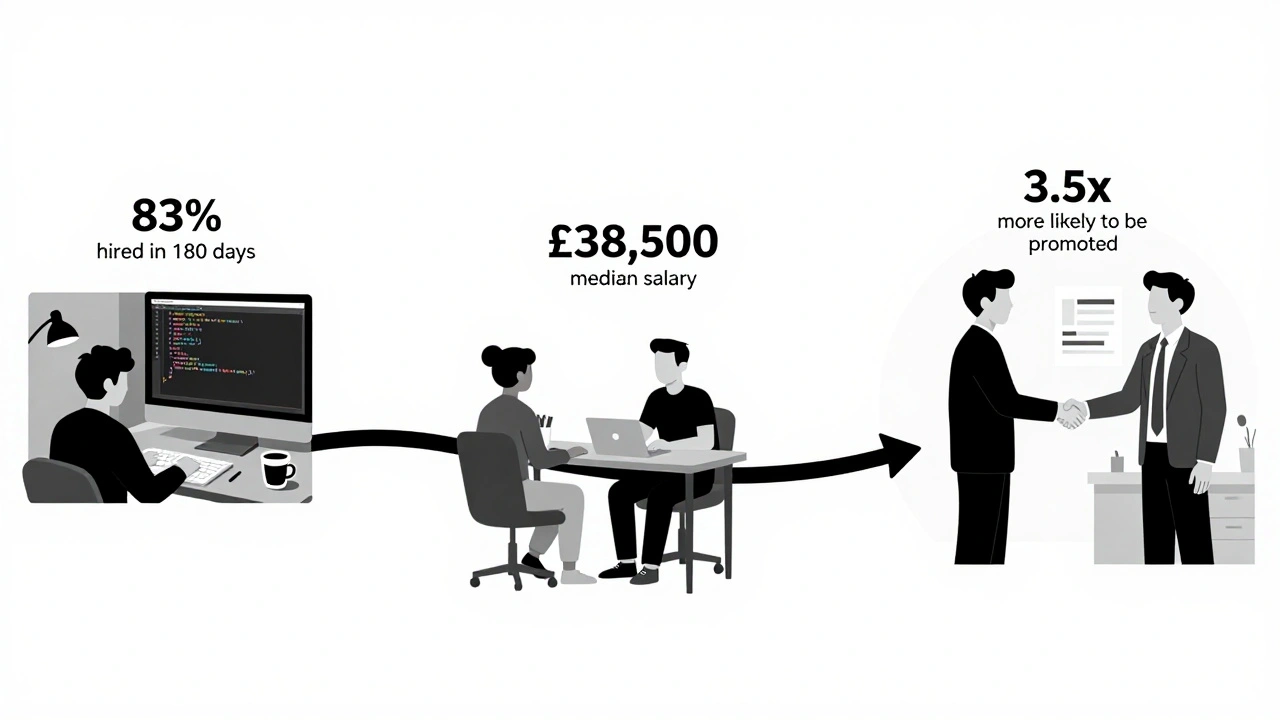
A 2024 survey of 1,200 UK bootcamp graduates found that 83% of those who completed career support services landed a tech role within 180 days. The median starting salary was £38,500. That’s higher than the average for new university graduates in non-STEM fields. But here’s the catch: only 57% of all bootcamp students reported using the career services. The rest tried to go it alone-and their job search took twice as long.
Some bootcamps only count graduates who got jobs as “successful,” ignoring those who left the program early or didn’t apply. The most transparent programs report outcomes for everyone who enrolled. If a school says 90% job placement but only 40 students finished, that’s not a strong track record. Look for programs that publish full cohort data.
What Kind of Jobs Do Graduates Actually Get?
Don’t assume every grad becomes a senior developer. Most start as junior developers, frontend engineers, QA testers, or technical support roles. Some go into DevOps, data analysis, or product management-especially if the bootcamp included exposure to those areas.
One graduate from a London-based bootcamp took a role as a junior frontend engineer at a fintech startup. She had no computer science degree. Her portfolio included three live projects built during the course, and she’d practiced explaining her code in interviews 17 times with her coach. She got hired in 11 days after finishing.
Another student, a former retail manager, switched into a junior backend role at a logistics company. He didn’t land his dream job right away-he took a contract role first, then moved to full-time after six months. That’s normal. Bootcamps prepare you for entry-level, not leadership.
The key is not the title. It’s the trajectory. Graduates who use career services are 3.5 times more likely to get promoted within 18 months than those who don’t.
Red Flags in Job Placement Claims
Watch out for these common tricks:
- “95% job placement!”-but they count anyone who got a job in any industry, even if it’s not tech. A grad working at a coffee shop doesn’t count.
- “Average salary £50k!”-but that’s based on five people who got high-paying roles at FAANG companies. The median is actually £34k.
- “We have partnerships with Google and Amazon!”-but those are just names on a website. No actual pipeline exists.
- “We guarantee a job or your money back!”-read the fine print. Most require you to apply to 50 jobs, attend every session, and complete every project. If you miss one, you’re out.
Ask for the raw data. Request a spreadsheet or PDF with graduate names (anonymized), job titles, companies, salaries, and start dates. If they won’t share it, that’s a warning sign.
How to Maximize Your Chances
Even the best program won’t do the work for you. Here’s what actually moves the needle:
- Start building your portfolio before the bootcamp ends. Don’t wait for the capstone. Build something you care about-maybe a tool for local charities or a data dashboard for a sports team.
- Practice explaining your code out loud. Record yourself. Watch it back. If you sound nervous or vague, fix it.
- Network early. Attend local tech meetups. Don’t just collect LinkedIn connections-ask for 15-minute chats. Most hiring managers will say yes.
- Apply to at least 10 jobs a week, even if you’re not “ready.” Feedback from real interviews is the fastest way to improve.
- Use your career coach like a teammate, not a lifeline. Go to them with specific questions: “I got rejected for this role-can you help me understand why?”
One student in Glasgow applied to 87 jobs before landing one. He didn’t get lucky-he got persistent. And he used every bit of support the bootcamp offered.
Alternatives to Bootcamp Career Services
Not every bootcamp has strong placement. If yours doesn’t, don’t panic. There are other paths:
- Join Codebar or TechMums for free mentoring and interview prep.
- Use TotalJobs or Reed to filter for “entry-level” or “junior” roles.
- Reach out to alumni from your bootcamp on LinkedIn. Ask how they got their first job.
- Consider contract roles through agencies like Hays or Randstad Digital. They often hire bootcamp grads.
The goal isn’t to rely on the bootcamp. It’s to use it as a launchpad. The real job search starts the day you enroll.
Final Reality Check
Bootcamps work-but only if you treat them like a sprint, not a shortcut. The training is intense. The support can be powerful. But your success depends on how much you put in.
Companies aren’t hiring bootcamp grads because they’re trendy. They’re hiring them because they’re ready. They can code. They can communicate. They’ve built things. They’ve failed, fixed, and tried again.
If you’re willing to put in the work, the job is there. The bootcamp just gives you the tools to find it.
Do bootcamp graduates really get hired at big tech companies?
Yes, but it’s not common. Most bootcamp grads start at startups, scale-ups, or mid-sized firms. A few land roles at companies like Barclays, TransferWise, or BBC. These usually happen when the grad has a standout portfolio, strong interview skills, and a referral from someone inside the company. Big tech hires bootcamp grads, but they also hire thousands of university grads-so competition is fierce. The key is to differentiate yourself with real projects and clear communication.
How long does it usually take to get a job after a bootcamp?
Most graduates who actively use career services land a job within 3 to 6 months. The median is around 11 weeks. But that varies by location, skill focus, and how much effort you put into applying. Someone who applies to 5 jobs a week and practices interviews daily will get hired faster than someone who waits until they feel “ready.” Don’t wait for perfection-start applying early.
Are bootcamp salaries lower than university degrees?
Not necessarily. In the UK, bootcamp graduates start at an average of £36,000-£40,000. University computer science grads start at £32,000-£38,000. The difference isn’t huge. What matters more is the role, company, and location. A junior dev in Edinburgh might earn £35k, while one in London earns £45k. Bootcamps often train you for practical, in-demand skills-which means you’re competitive from day one.
Can I switch careers with a bootcamp if I’m over 30?
Absolutely. The average age of UK bootcamp students is 31. Many are former teachers, nurses, retail managers, and even chefs. Employers care more about your ability to solve problems and learn quickly than your age. What you’ve done before can actually help-someone with customer service experience often makes a better UX developer. Bootcamps don’t discriminate based on background. Your past experience can be your advantage.
What if I don’t get a job after the bootcamp?
It happens. If you’ve done everything right-applied consistently, practiced interviews, built a strong portfolio-and still haven’t landed a role, reach out to your bootcamp. Many offer extended support for up to a year. You can also join free coding communities, volunteer for open-source projects, or take on freelance gigs to build your track record. The goal isn’t just to get any job-it’s to get your first real tech job. That first role opens the door to everything else.
If you’re serious about switching into tech, the bootcamp is just the beginning. The real work starts when you walk out the door.

Comments (14)
Gabby Love December 4 2025
Found this post super helpful. I went through a bootcamp last year and didn't use any career services-took me 7 months to land my first dev job. Wish I'd known then what I know now.
Jen Kay December 5 2025
Let me guess-the bootcamp that promised ‘guaranteed jobs’ also had a 90% dropout rate? Classic. The real metric isn’t how many they claim to place-it’s how many actually *stick* after the first year. And no, ‘freelance gigs’ don’t count.
Michael Thomas December 6 2025
Bootcamps are for people who don’t want to work. Go to college or shut up.
Abert Canada December 6 2025
I’m from Canada and did a bootcamp in Toronto. The career coach literally sat with me for 3 hours tweaking my GitHub README. I got hired in 42 days. Not because I’m genius-because they didn’t let me slack off. If your bootcamp doesn’t hold your hand like this, you’re wasting your time.
Xavier Lévesque December 7 2025
‘Apply to 10 jobs a week’-yeah right. I applied to 87. Got 3 interviews. One offer. Took 11 weeks. The coach said ‘you’re not ready’ until week 9. Then I got hired. Turns out ‘ready’ is a myth. Just keep showing up.
Sandi Johnson December 8 2025
One thing no one talks about: the emotional toll. You’re not just learning code-you’re rebuilding your identity. I was a barista. Now I’m a dev. Some days I still feel like an imposter. But the bootcamp’s peer support group? Saved me. Don’t underestimate the human stuff.
Eva Monhaut December 8 2025
I went from teaching high school biology to landing a junior frontend role at a health tech startup. My portfolio? A dashboard that tracked student attendance trends-because I was tired of paper forms. The bootcamp didn’t give me the job. But they gave me the courage to build something real-and then talk about it without sounding like a robot.
mark nine December 10 2025
Stop waiting to be ready. Start applying now. Even if you suck. You’ll get better by failing in public.
Tony Smith December 11 2025
It is imperative to note that the most successful graduates are not those who possess the highest technical aptitude, but rather those who demonstrate unwavering resilience, consistent communication, and an unrelenting commitment to iterative improvement. The bootcamp merely provides the framework; the individual must furnish the will.
Rakesh Kumar December 12 2025
Bro I did a bootcamp in Delhi and got hired by a startup in Bangalore in 3 weeks. My portfolio had 2 projects and I practiced interviews with my cousin who works at Flipkart. No fancy career services. Just hustle. If you're waiting for hand-holding, you're already behind.
Bill Castanier December 14 2025
Big tech hires bootcamp grads. But only if you can explain why your code works, not just that it does. I got rejected 12 times before I learned to talk like a human, not a documentation page.
Ronnie Kaye December 15 2025
Wait-so you’re telling me the bootcamp that charges $15k doesn’t even give you a LinkedIn profile review? That’s not a career service, that’s a scam with a syllabus. I’ve seen people pay more for yoga retreats and get better ROI.
Priyank Panchal December 15 2025
My bootcamp had 120 students. Only 22 finished. 18 got jobs. 4 left tech. The school reported 90% placement. They counted everyone who started. That’s not transparency. That’s lying. Don’t trust stats. Trust people who show you their pay stubs.
Ian Maggs December 17 2025
Is the bootcamp, then, merely a microcosm of the broader capitalist imperative to commodify human potential-transforming the existential quest for meaning into a transactional exchange of time, money, and credential? Or is it, more simply, a pragmatic vessel for those who, lacking the social capital of elite institutions, still seek to carve out a dignified space in the digital economy? The answer, perhaps, lies not in the curriculum-but in the silence of the job offer email.