

If you run a course - whether it’s a weekend workshop, a 12-week certification program, or an online training module - you’ve probably dealt with last-minute cancellations. Someone cancels the day before. Someone claims they didn’t get the email. Someone just ghosts you. Without a clear policy, you’re left guessing: Do you refund? Do you charge a fee? Do you let them reschedule? The answer shouldn’t be on the fly. It should be written down, agreed to upfront, and easy to enforce.
Why a written cancellation policy matters
A course cancellation policy isn’t just paperwork. It’s a shield. It protects your time, your revenue, and your ability to plan. Without one, you’re at the mercy of every participant’s changing schedule. One person cancels two weeks out and expects a full refund. Another drops out the night before and demands their money back anyway. You start feeling guilty for charging fees, even when you’ve already paid for materials, venue space, or instructor time.Studies show that 68% of course providers who use a clear, published cancellation policy report fewer disputes and higher payment compliance. That’s not magic. It’s clarity. When people know the rules before they sign up, they’re more likely to honor them.
Your policy also sets expectations. It tells participants: “This isn’t a free trial. This is a commitment.” That reduces no-shows. It reduces last-minute chaos. It makes your business feel professional - not reactive.
What belongs in a course cancellation policy
A strong policy answers these five questions clearly:- How far in advance must someone cancel to get a full refund?
- What happens if they cancel after that deadline?
- Can they transfer their spot to someone else?
- Do you offer credits for future courses instead of cash refunds?
- What if you cancel the course - do participants get a full refund automatically?
Don’t bury these in fine print. Put them where people see them: on your registration page, in the confirmation email, and in the welcome packet. If you’re running in-person classes, print a copy and hand it out on day one.
Here’s what a typical policy looks like in plain language:
- Full refund if canceled 14+ days before the start date.
- 50% refund if canceled 7-13 days before.
- No refund if canceled less than 7 days before or if no-show.
- Transfer to another participant allowed with 48 hours’ notice.
- If we cancel the course, you’ll receive a full refund or credit toward a future session.
That’s it. No jargon. No legalese. Just clear, fair, and enforceable terms.
Templates you can use right now
You don’t need to write this from scratch. Below are three ready-to-use templates based on common course types. Copy, paste, and tweak them for your needs.Template 1: Short-Term Workshop (1-3 days)
Course Cancellation & Refund Policy
- Full refund available if cancellation is received at least 14 calendar days before the event.
- 50% refund if canceled between 7 and 13 days before the event.
- No refunds issued for cancellations made less than 7 days before the event or for no-shows.
- Participants may transfer their registration to another person with at least 48 hours’ notice. The new participant must be approved by the course organizer.
- If the course is canceled by the organizer due to low enrollment, weather, or other unforeseen circumstances, all participants will receive a full refund or a credit toward a future session of equal value.
Template 2: Multi-Week Certification Program (4+ weeks)
Program Cancellation & Refund Policy
- Full refund available if cancellation is received at least 30 calendar days before the program start date.
- 75% refund if canceled between 15 and 29 days before the start date.
- 50% refund if canceled between 7 and 14 days before the start date.
- No refunds issued after 7 days before the start date or for withdrawals during the program.
- Participants may defer to the next cohort with written notice at least 7 days before the start date. Deferrals are allowed only once.
- If the program is canceled by the organizer, participants will receive a full refund or the option to transfer to an equivalent program within 6 months.
Template 3: Online Course with Lifetime Access
Online Course Cancellation & Refund Policy
- Full refund available within 14 days of purchase if no course modules have been accessed.
- No refunds issued after 14 days or if any course content has been viewed, downloaded, or completed.
- Refunds are processed within 5-7 business days to the original payment method.
- Once access is granted, the course is non-transferable.
- If the course is permanently discontinued by the provider, participants will receive a full refund or access to an equivalent replacement course.
Common mistakes to avoid
Even with a template, people mess this up. Here are the top three errors:- Being too vague. “Refunds considered on a case-by-case basis” sounds nice, but it invites conflict. It tells people they can argue their way out of paying. Stick to clear timeframes.
- Not enforcing the policy. If you make an exception for one person, you’ll get five more asking for the same. Consistency builds trust. If you bend the rules, document why - and make sure everyone knows it’s a one-time gesture.
- Forgetting to update it. Your policy should evolve. If you notice most cancellations happen at 10 days, maybe adjust your window to 14. If people keep asking for deferrals, build it into the policy. Review your policy every 6 months.
How to communicate your policy
A policy is useless if no one reads it. Here’s how to make sure it sticks:- On your registration page: Put the policy in a collapsible section titled “Important Terms.” Don’t hide it - but don’t overwhelm either.
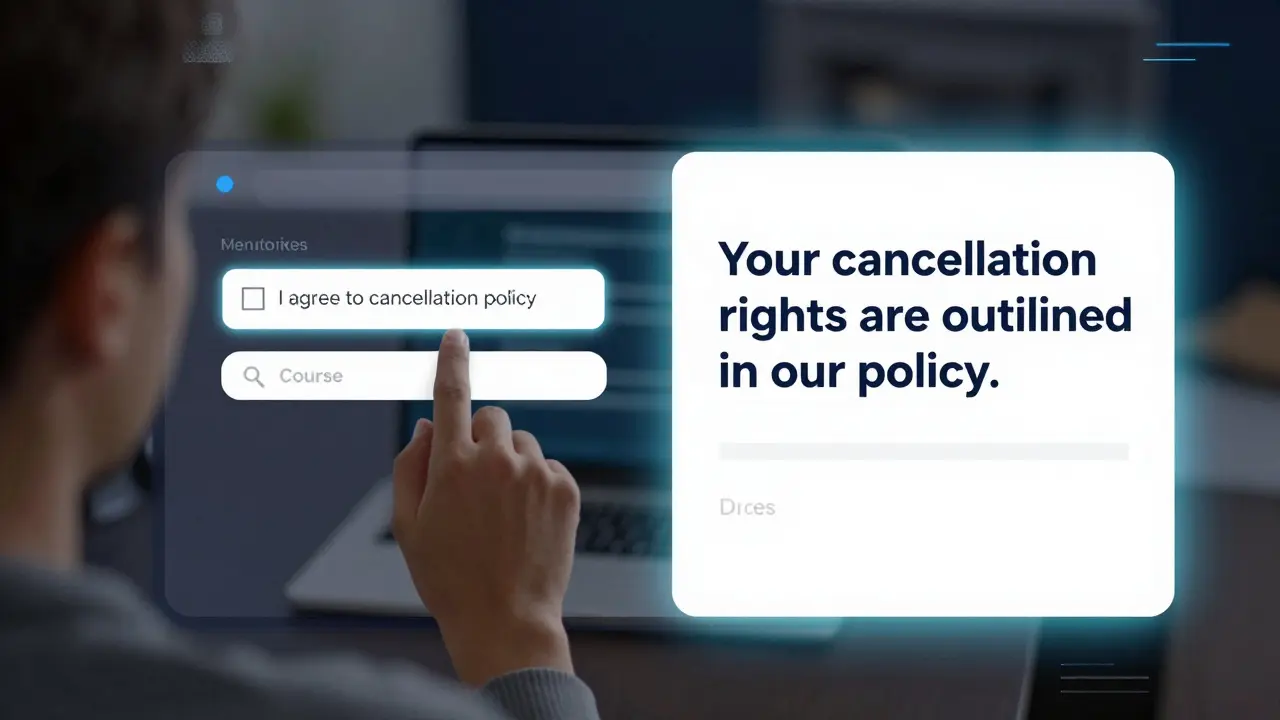
- In the confirmation email: Include a bold line: “Your cancellation rights are outlined in our policy: [link].”
- On your website: Add a page titled “Course Policies” and link to it in your footer.
- At registration: Require participants to check a box saying “I have read and agree to the cancellation policy.”
Some platforms like Teachable, Thinkific, or Kajabi let you add mandatory acceptance fields. Use them. It’s your legal protection.

What if someone disputes the policy?
Disputes happen. Someone claims they didn’t see the policy. Someone says they were “under stress” and didn’t mean to cancel. Your response should be calm, consistent, and documented.Here’s how to handle it:
- Politely remind them of the policy they agreed to.
- Provide a copy of the policy they accepted (email, signed form, checkbox record).
- Offer one alternative: a credit for a future course, or a partial refund if you’re feeling generous - but only once.
- If they continue to push, say: “I understand your frustration. Our policy is applied equally to all participants to ensure fairness. I’m happy to help you enroll in another course when you’re ready.”
Never argue. Never apologize for the policy. You’re not being harsh - you’re being professional.
What to do if you cancel the course
Sometimes, it’s not the participant who cancels - it’s you. Low enrollment. Instructor illness. Venue closure. Whatever the reason, you owe your participants a clear response.Here’s the right way to handle it:
- Notify them within 24 hours of the decision.
- Offer a full refund by default.
- Also offer a credit to a future session - many will choose this if the replacement is timely.
- Apologize sincerely. Don’t make excuses. Say: “We’re sorry this happened. We value your interest and want to make it right.”
Handling your own cancellation well builds loyalty. People remember how you treated them when things went wrong.
Final checklist: Does your policy pass the test?
Before you publish your policy, ask yourself:- Can a 16-year-old understand it?
- Is every refund rule tied to a specific number of days?
- Does it cover both participant and organizer cancellations?
- Is it easy to find on your website and in your emails?
- Have you tested it with at least three past participants?
If you answered yes to all five, you’re ready. You’ve turned a source of stress into a system that works for you - and for your participants.
Can I charge a cancellation fee instead of offering partial refunds?
Yes, but it’s riskier. Charging a flat fee (like $50) can feel arbitrary. Most people respond better to percentage-based refunds tied to timing. For example, “20% fee if canceled within 7 days” is clearer than “$50 fee.” If you do use a flat fee, make sure it’s reasonable - above 10% of the total cost can trigger chargebacks or complaints.
Do I need a lawyer to review my cancellation policy?
Not always, but it’s smart if you’re running high-value courses ($500+). In the UK, the Consumer Rights Act 2015 says you can’t charge for services already provided - but you can charge for costs incurred before cancellation. A lawyer can help you phrase your policy to stay compliant. For low-cost courses, a clear, fair policy written in plain English is usually enough.
What if someone cancels due to an emergency?
Emergencies are personal and real. Your policy doesn’t need to bend, but you can offer discretion. For example: “In cases of medical emergency or family loss, we may offer a full credit toward a future course with documentation.” This keeps your policy firm but human. Document every exception - don’t make it a habit.
Can I make my policy non-refundable?
For digital products like online courses, yes - if you clearly state that access is granted immediately upon purchase and no refunds are given after that. For in-person courses, full non-refundable policies are harder to enforce legally. Most consumer protection laws expect some flexibility. A 14-day cooling-off period is standard. Even if you say “no refunds,” you may still be required to offer a credit or partial refund if you can’t deliver the service.
How do I handle group bookings and team registrations?
Group bookings need their own rules. For example: “Group cancellations must be made 30 days in advance. If fewer than 80% of the group shows up, the team will be charged for the missing participants.” This prevents one person from canceling and dragging down the whole group. Always specify the group size minimum and cancellation window in writing.

Comments (15)
Patrick Sieber January 3 2026
Love this. Clear policies save so much drama. I used to wing it until a学员 ghosted me two days before a €2k workshop. Lost €800 in venue deposit. Now I use Template 2 with a 30-day refund window. Zero disputes since.
Kieran Danagher January 4 2026
Template 3 is the only one that makes sense for digital courses. If someone accesses content, they’ve already gotten value. Full refund after that is just encouraging abuse. People think ‘lifetime access’ means ‘free trial’ - it doesn’t.
OONAGH Ffrench January 4 2026
Clarity is kindness. Vague policies don’t protect you they just create resentment. People respect boundaries when they’re stated plainly. The real magic isn’t in the words it’s in the consistency
poonam upadhyay January 5 2026
Ugh I hate how people act like their ‘emergency’ overrides everything. My cousin canceled 3 days before her $1500 yoga retreat because her cat sneezed. And now she’s mad I didn’t refund? Like please. My policy says 7 days no exceptions. No one gets a pass because they’re ‘stressed’ - that’s just laziness with a sob story.
Shivam Mogha January 7 2026
Use the checkbox. Legal protection. Simple.
mani kandan January 7 2026
Template 1 works for my weekend art workshops. I used to feel guilty charging fees but now I see it’s not about money - it’s about respect. People who show up on time and pay attention are the ones who matter. The flakies? They’re not your audience anyway.
Rahul Borole January 8 2026
It is imperative that all course providers institutionalize standardized cancellation protocols. The absence of such systems constitutes a material operational vulnerability. I recommend integrating these templates into your CRM workflow with automated email triggers and timestamped acceptance logs. Compliance is not optional - it is foundational to sustainable pedagogical enterprise.
Sheetal Srivastava January 8 2026
Let’s be real - these templates are just corporate gaslighting. You’re not ‘protecting your time’ you’re weaponizing fine print to exploit learners. People cancel because life happens. Why should a single parent lose $500 because their kid got sick? This isn’t business - it’s cruelty dressed up as professionalism.
Bhavishya Kumar January 8 2026
Template 2 says ‘deferrals are allowed only once’ - missing Oxford comma. Also ‘within 6 months’ should be ‘within six months’ per formal style guides. And why is ‘participant’ capitalized mid-sentence? Inconsistent capitalization undermines credibility. Fix this before publishing.
ujjwal fouzdar January 10 2026
Every policy is a mirror. What does it say about who you are? Are you a gatekeeper or a guide? I used to be rigid - then I had a student show up crying because her mom was in the hospital. I refunded her. She came back six months later with three friends. That’s the real ROI. Rules are tools - not idols.
Anand Pandit January 11 2026
Big thank you for this. I was about to wing it again until I saw Template 3. I run a $97 digital course and I was terrified of chargebacks - now I know exactly how to handle it. Also the ‘check the box’ tip? Genius. I added it yesterday and already had zero refund requests. People respect clarity. You’re helping more than you know.
Reshma Jose January 11 2026
So many people think ‘no refund’ means ‘no heart’ - but it’s the opposite. It means you care enough to set boundaries so you can keep showing up for the people who actually show up. I used to cry when people canceled. Now I just send the policy link and move on. My business is healthier than ever.
rahul shrimali January 12 2026
Use the 14 day rule. Always. Works for everything.
sampa Karjee January 13 2026
These templates are laughably naive. You assume participants are rational actors with disposable income. Most of mine are from rural India - they don’t even have email access. You think they’ll read a ‘collapsible section’? They see a payment button. They pay. Then they disappear. Your policy is a luxury for the urban elite. Real world? You refund because you’re scared they’ll shame you on WhatsApp groups.
Eka Prabha January 13 2026
Notice how none of these templates mention GDPR or the EU’s right to withdraw under Article 14? Or how in India, the Consumer Protection Act 2019 mandates a 30-day cooling-off period for digital services? You’re giving people templates that could get them sued. This isn’t advice - it’s legal negligence dressed as helpful content.