
Imagine you're hiring for a critical role. You get a resume with a degree from a prestigious university. The transcript looks perfect. The seal is crisp. But what if it's fake? Credential fraud isn't just a minor issue-it’s a growing threat to education, hiring, and trust in digital systems. In 2025, over 12% of verified academic credentials submitted in job applications were flagged as fraudulent, according to data from the Global Credential Verification Network. That’s one in eight. And it’s not just diplomas. Certificates, licenses, training badges-all of it can be forged. The question isn’t whether fraud exists. It’s how we stop it.
Watermarks: The Invisible Signature
Watermarks aren’t just for PDFs or photos. In credential systems, digital watermarks are embedded data that don’t show up on screen but can be detected by software. Think of them like a hidden barcode inside a banknote. You can’t see it, but a scanner can verify it’s real.
Modern credential watermarks use cryptographic techniques to bind the holder’s identity, the issuing institution, and the date of issuance into a single, tamper-proof layer. If someone tries to edit the document-say, change the grade or the graduation date-the watermark breaks. The system knows instantly. Unlike simple logos or stamps, these aren’t just visual. They’re mathematically tied to a private key held only by the issuer.
Universities like MIT and the University of Toronto now issue digital diplomas with embedded watermarks. When an employer uses a verification tool, the system checks the watermark against the institution’s public key. No match? The credential is invalid. It’s fast, silent, and nearly impossible to fake without access to the issuer’s private key.
PKI: The Backbone of Trust
If watermarks are the invisible signature, PKI (Public Key Infrastructure) is the whole system that makes sure the signature means something. PKI is the same technology that secures your bank login and HTTPS websites. It uses pairs of keys: one public, one private.
Here’s how it works in credentialing:
- The university generates a unique private key and keeps it locked away.
- It uses that key to sign every credential it issues.
- The public key? Published openly on a trusted server.
- When someone checks a credential, the verifier uses the public key to confirm the signature is valid.
Why does this matter? Because if a fake credential lacks the correct digital signature, it’s instantly rejected. No manual review needed. No guesswork. PKI removes the middleman. You don’t need to call the school. You don’t need to wait for a response. The system tells you in seconds.
And it’s not theoretical. The U.S. Department of Education started requiring PKI-based credentials for all federally funded programs in 2024. Countries like Estonia and Singapore have gone even further-issuing all academic and professional credentials through PKI-secured digital wallets. If you can’t sign it with the right key, it’s not real.
Registries: The Central Ledger
Here’s the problem with PKI and watermarks alone: they verify authenticity, but not existence. What if someone creates a fake university? Or a fake credential system? That’s where registries come in.
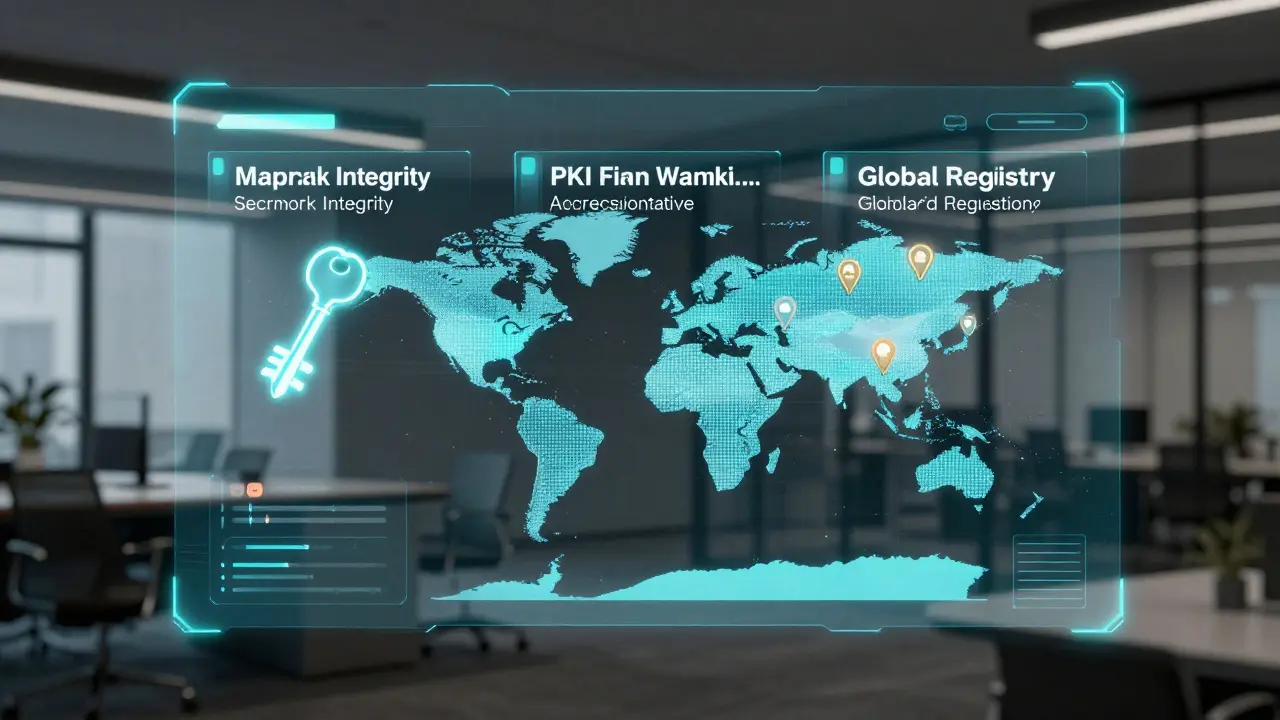
A credential registry is a trusted, publicly accessible list of authorized issuers. Think of it like a phone book for schools, certification bodies, and licensing agencies-but one that’s digitally signed and updated in real time.
When a credential is issued, it includes the issuer’s unique ID from the registry. The verifier doesn’t just check the signature. It checks: Is this issuer on the list? If the issuer isn’t registered-or was removed because they lost accreditation-the credential fails.
Platforms like Credly and Blockcerts integrate with global registries. In 2025, the International Credential Transparency Initiative launched a public registry that now includes over 3,200 accredited institutions across 47 countries. Each entry has:
- Legal name
- Official domain
- Public key fingerprint
- Issuance policy
- Revocation status
This stops fraud at the source. No more “Harvard Online Academy” that doesn’t exist. No more “Certified Blockchain Expert” from a domain bought for $5.99. The registry says: This issuer isn’t real. And the system blocks it automatically.
How It All Fits Together
Watermarks, PKI, and registries don’t work alone. They’re layers in a single defense system.
Let’s say someone submits a digital certificate:
- The system checks for a valid digital watermark. If it’s altered or missing, it’s rejected.
- If the watermark is intact, it checks the digital signature using PKI. If the signature doesn’t match the issuer’s public key, it’s rejected.
- If the signature is valid, it checks the issuer’s ID against the global registry. If the issuer isn’t listed-or was revoked-it’s rejected.
Only if all three checks pass is the credential accepted. This isn’t science fiction. It’s happening now. Companies like Parchment, VerifyEd, and IBM’s Blockchain Credentials are deploying this stack daily.
One hiring manager in London told us: “We used to spend 40 hours a week verifying degrees. Now? We get an instant green light or red flag. Fraud dropped 92% in six months.”
What About the Old Way?
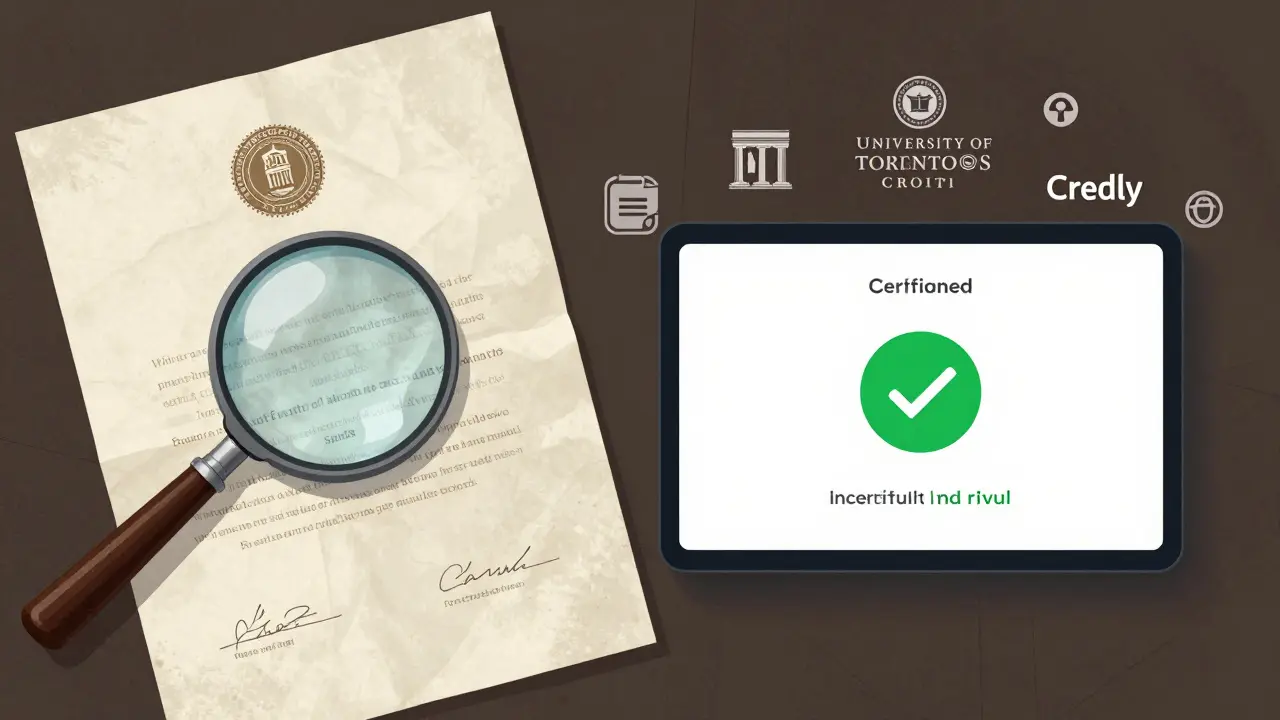
Remember calling the registrar’s office? Waiting for a fax? Sending a notarized copy? Those methods are slow, expensive, and easily fooled. A forged transcript can look real. A fake phone number can answer. A forged seal? Easy with Photoshop.
Manual checks rely on human judgment. Digital verification relies on math. And math doesn’t get tired. It doesn’t miss a detail. It doesn’t trust a pretty logo.
The shift from paper to digital isn’t just about convenience. It’s about security. And the three pillars-watermarks, PKI, and registries-make that shift possible.
What’s Next?
The next wave is blockchain-backed registries. Not because blockchain is flashy, but because it offers tamper-proof, time-stamped logs. Once a credential issuer is added to a blockchain registry, it can’t be deleted or altered without consensus. That’s powerful.
By 2027, over 60% of universities in North America and Western Europe are expected to issue credentials using this three-layer system. Employers will stop asking for transcripts. They’ll ask: “Can you share your digital credential?”
And if you can’t? You won’t get the job.
Can digital watermarks be removed from credentials?
Removing a cryptographic watermark without detection is virtually impossible. Modern watermarks are embedded using cryptographic hashing and digital signing. Any attempt to edit the document-whether cropping, resizing, or altering text-breaks the signature. Verification tools will flag the credential as invalid. Even advanced image editing software can’t restore the original cryptographic link without the issuer’s private key.
Do I need special software to verify these credentials?
No. Most verification happens through simple web tools. Employers or institutions can use free or low-cost platforms like VerifyEd, Credly, or the International Credential Transparency Initiative’s public checker. All you need is the credential’s unique URL or QR code. The system automatically checks the watermark, PKI signature, and registry status. No downloads or installations required.
What if my school doesn’t use PKI or registries yet?
If your institution hasn’t adopted digital credentialing, your credentials may still be vulnerable to fraud. You can request a digitally signed version from your registrar-many now offer it as an option. Alternatively, use third-party credential wallets like Blockcerts or MyCreds to create a verifiable version of your transcript or certificate. These services allow you to issue your own PKI-secured credentials using your school’s public key (if available).
Are credential registries government-run?
Some are, but most are public-private partnerships. The International Credential Transparency Initiative, for example, is governed by a coalition of universities, tech firms, and accreditation bodies-not any single government. Governments may regulate or endorse registries (like the U.S. Department of Education), but they rarely run them directly. The goal is open, transparent, and decentralized trust.
Can someone steal my digital credential and use it?
Not easily. Digital credentials are tied to your identity through cryptographic keys and often require a login to access. Even if someone downloads your credential file, they can’t use it unless they also have your private key or access to your verified account. Most systems also include time-limited sharing links or one-time verification codes. Plus, the registry tracks who originally issued it-so any attempt to reuse it will trigger alerts.

Comments (12)
Michael Thomas March 16 2026
Watermarks? PKI? Registries? This is just tech bro jargon for 'trust us.' Real verification is a phone call and a notary. All this digital crap just makes it harder for people who don't have fancy software. And don't get me started on 'blockchain-backed registries'-that's just buzzword bingo with extra steps.12% fraud? Yeah right. Probably 1% and they inflated it to sell more software.
Abert Canada March 17 2026
I work in HR in Toronto and we started using VerifyEd last year. The change was insane. Used to take 2-3 weeks to verify one international candidate. Now? Under 48 hours. And zero fraud since. The system doesn't lie. Watermarks + PKI + registry? It's not magic. It's just done right.Canada's been pushing this since 2023. We're not waiting for the US to catch up.
Xavier Lévesque March 19 2026
So let me get this straight. We're now trusting math more than human judgment?That’s cute. Until the math gets hacked. Or the registry gets corrupted. Or some intern at MIT accidentally leaks their private key. Then what? All the pretty graphs and green lights turn red. And suddenly you’ve got a thousand fake degrees flying around because no one checked if the system was actually secure.
It’s not a solution. It’s a fragile house of cards with a fancy name.
Thabo mangena March 19 2026
In South Africa, we have been struggling with credential fraud for decades. Many fake certificates are sold in townships as gateways to employment. The introduction of verifiable digital credentials through registries offers real hope. This is not merely technological advancement-it is social justice. When a young person from Soweto can prove their qualification without bribing officials, we all win.Let us not underestimate the dignity this system restores.
Karl Fisher March 21 2026
I mean, I went to Stanford and I have the digital credential. It’s gorgeous. Like a NFT but for my life achievements. I got a little teary-eyed when I saw the animated seal pop up. It’s like my diploma got a Netflix documentary.Also, I’m pretty sure my resume now comes with a Spotify playlist. Just kidding. Unless? Hmm.
Buddy Faith March 21 2026
This whole thing is a government corporate plot to track every credential you ever earnThey already know where you went to school
They already know what you studied
They already know if you lied
Next theyll track your sleep patterns and coffee intake
Its all connected
Scott Perlman March 22 2026
I used to work at a college registrar’s office. We got 30 fake transcripts a week. Paper ones. Handwritten. Looked real. We’d call the school. Sometimes they’d hang up. Sometimes they’d say ‘we don’t have that student.’ Now? We just scan the QR. Green light. Done. No stress. No fax machines. No drama.It’s just better.
Sandi Johnson March 23 2026
Oh wow. So now we’re going to automate trust? How quaint. Next they’ll install facial recognition in church to verify if you’re actually praying.Meanwhile, I’m over here still using a photocopy of my diploma from 2007 that I laminated with my mom’s hair dryer. Still works. Still looks legit. Still fools 90% of HR bots.
Eva Monhaut March 24 2026
What’s wild is how this system flips the power dynamic. Before, you had to beg institutions to verify you. Now, you hold the proof. You control the access. It’s not just about fraud prevention-it’s about agency. Especially for people from under-resourced schools, immigrants, self-taught professionals. This isn’t tech. It’s liberation.I’ve seen people cry when they first get their verified credential. Not because it’s fancy. Because it’s real. And finally, someone believes them.
mark nine March 25 2026
Just use Blockcerts. Free. Open source. Works with any school that has a public key. I issued my own credential from my community college using their tool. Took 10 minutes. Now I send it to employers. They’re impressed. Not because I went to a fancy school. Because I know how to prove I’m legit without begging.Tony Smith March 26 2026
One must consider the ethical implications of centralizing credential verification under a consortium of private entities and academic institutions. While the technical architecture is elegant, the governance model risks creating a new form of credential elitism. Those without access to digital infrastructure-or those whose institutions are not yet registered-may be systematically excluded.This is not merely a technical evolution. It is a sociopolitical transformation.
Rakesh Kumar March 26 2026
Bro I live in India and we have fake degrees everywhere. My cousin got a ‘Harvard MBA’ from a website that charges $200. He got hired. Got promoted. Now he’s running a team. I told him. He laughed. Said ‘if they can’t tell the difference, why should I care?’This system? It’s not for people like him. It’s for people like me who actually studied. Who want to be seen. Not judged by a logo. But by proof.
Finally. Something that works.