

Teaching can feel incredibly isolating. You close your classroom door, manage thirty unique personalities, and rarely get a moment to reflect on what actually worked-or didn’t-with anyone who truly understands the grind. But it doesn’t have to be that way. Building a Teaching Community of Practice is a structured group of educators who share a common concern or passion for teaching and learn how to improve their practice by interacting regularly online. This isn’t just another staff meeting or a generic social media group. It’s a deliberate space where teachers swap real strategies, troubleshoot specific challenges, and grow together.
When done right, an online CoP transforms individual struggle into collective wisdom. You stop reinventing the wheel for every lesson plan and start leveraging the tested ideas of your peers. The key is moving beyond casual chatter to focused, actionable collaboration.
What Exactly Is a Teaching Community of Practice?
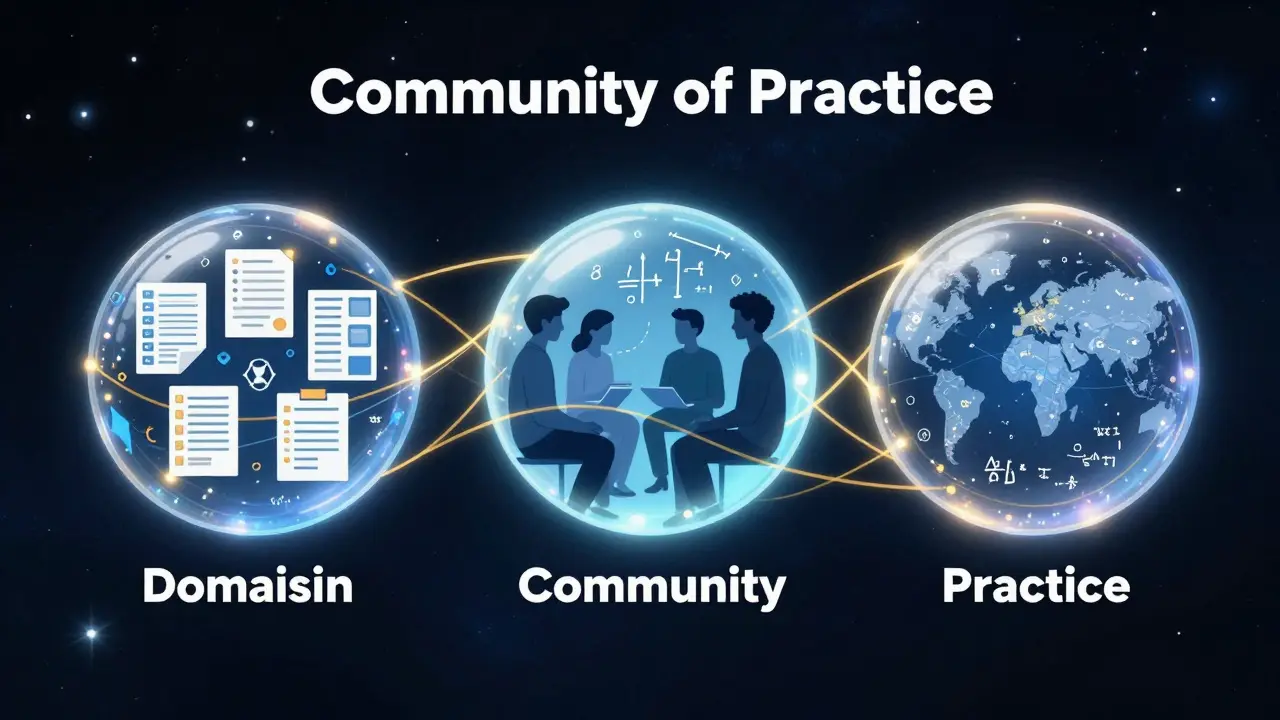
To build one, you first need to know what you’re building. A Community of Practice (CoP) is a framework originally defined by Etienne Wenger and Jean Lave in 1991, focusing on shared domains, communities, and practices. In education, this means three things must exist:
- The Domain: A shared area of interest. For example, "Teaching Critical Thinking in High School History" or "Managing Behavioral Issues in Early Years." If the topic is too broad, like "General Teaching," engagement will drop because there’s no specific hook.
- The Community: The people who interact around that domain. They develop relationships, trust, and mutual respect through regular interaction.
- The Practice: The resources, tools, stories, and experiences they share. This is the "stuff"-the lesson plans, the rubrics, the venting sessions, and the breakthroughs.
Unlike a Professional Learning Community (PLC) is often school-based, mandated by administration, and focused on student data outcomes, a CoP is usually voluntary, self-directed, and focused on the *teacher’s* craft and well-being. One drives compliance; the other drives connection.
Why Your Teachers Need an Online Space
You might wonder if Zoom calls and email chains aren’t enough. They aren’t. Traditional communication tools are transactional-they send information but don’t build culture. An online CoP provides a persistent home for professional growth.
Consider the burnout rates in education. Many educators leave the profession not because they hate teaching, but because they feel unsupported. An online CoP offers psychological safety. When a teacher posts, "I tried this new assessment method and it failed miserably," they aren’t judged. They receive constructive feedback from peers who have likely faced similar failures. This reduces isolation and accelerates problem-solving.
Furthermore, digital platforms allow for asynchronous participation. Not everyone can attend a Tuesday evening webinar. An online forum allows a teacher in Edinburgh to post a question at 7 PM, while a colleague in London replies at 8 AM. This flexibility respects the chaotic nature of teaching schedules.
Choosing the Right Platform for Collaboration
The tool you choose dictates the behavior of your community. If you want deep discussion, a chat app might be too fleeting. If you want quick updates, a forum might be too slow. Here is how different platforms stack up for teaching CoPs:
| Platform Type | Best For | Limitations | Examples |
|---|---|---|---|
| Discussion Forums | Deep, threaded conversations and resource archiving | Can feel static; requires active moderation | Discourse, phpBB |
| Social Networks | Rapid sharing, visibility, and casual connection | Noise can drown out valuable content; algorithmic feeds hide posts | Facebook Groups, LinkedIn |
| Closed Social Platforms | Structured channels, file sharing, and integrated video | Learning curve for non-tech-savvy users | Slack, Microsoft Teams |
| LMS Modules | If already using a system like Canvas or Moodle | Often feels like "school" rather than community | Canvas Discussions, Moodle Forums |
For most teaching CoPs, I recommend starting with a dedicated forum software like Discourse or a private Facebook Group. They offer the best balance of ease-of-use and depth. Avoid using general email lists; they fragment conversations and make it impossible to search for past solutions.
Steps to Launch Your First Teaching CoP
Building a community is not about flipping a switch. It’s about cultivating an ecosystem. Here is a practical roadmap to get started.
1. Define a Narrow, Compelling Niche
Don’t try to appeal to every teacher. "Teachers Who Care" is too vague. "Secondary Science Teachers Using Project-Based Learning" is specific. Specificity breeds relevance. When teachers see that the content applies directly to their daily reality, they engage.
2. Seed the Content Before Inviting Members
A blank page is intimidating. No one wants to be the first person posting in an empty room. Before you open the doors, populate the platform with five to ten high-quality discussions. Share a controversial opinion, post a challenging case study, or upload a useful template. This sets the tone and shows potential members what kind of value they can expect.
3. Invite the Right Founders
Don’t invite everyone at once. Start with five to ten "super-connectors." These are the teachers who are naturally collaborative, enthusiastic, and respected by their peers. Ask them to join privately. Their early activity will create the initial momentum that draws in others.
4. Establish Clear Norms
Write a simple code of conduct. Emphasize respect, confidentiality, and constructive feedback. Make it clear that this is a safe space for vulnerability. For example: "We assume positive intent. We critique ideas, not people."
Fostering Engagement Without Burnout
The biggest risk to any online CoP is silence. After the initial excitement fades, participation often drops. To keep the community alive, you need intentional facilitation.
Use Prompted Discussions: Don’t wait for organic topics. Every week, post a prompt. "What’s one thing that went wrong this week, and how did you fix it?" or "Share your favorite exit ticket strategy." Low-barrier questions encourage participation.
Celebrate Contributions: Publicly acknowledge members who share valuable insights. Tag them in posts. Highlight their resources. People crave recognition. When they see that their input matters, they return.
Rotate Leadership: Don’t carry the entire burden yourself. Identify active members and ask them to lead a monthly discussion or curate a resource thread. This distributes the workload and gives members ownership of the community.
Keep It Asynchronous: Respect time zones and busy schedules. Avoid mandating live meetings unless necessary. Let the conversation flow over days, not hours. This allows for thoughtful responses rather than reactive comments.
Measuring Success Beyond Numbers
It’s tempting to judge success by member count or daily active users. But these metrics can be misleading. A smaller, highly engaged community is more valuable than a large, silent one. Focus on qualitative indicators:
- Depth of Conversation: Are threads going beyond two replies? Are members asking follow-up questions?
- Resource Creation: Are members creating shared documents, templates, or guides based on discussions?
- Member Retention: Do teachers stay involved month after month?
- Impact Stories: Collect anecdotes from members about how the CoP changed their practice. Did they try a new strategy suggested by a peer? Did it work?
If you hear teachers saying, "I wouldn’t have figured that out without this group," you’ve built something meaningful.
Pitfalls to Avoid
Even well-intentioned CoPs can fail. Watch out for these common traps:
Too Much Administration: If the platform becomes a channel for top-down directives, teachers will disengage. Keep administrative announcements separate from community discussions.
Unequal Participation: A few voices dominating the conversation can silence others. Gently intervene to invite quieter members to share their perspectives. Use polls or small-group breakouts to ensure diverse input.
Lack of Direction: While CoPs should be organic, they still need structure. Without clear themes or goals, discussions can drift into irrelevant territory. Provide gentle guidance to keep the focus on the shared domain.
Building a teaching community of practice online is an investment in human capital. It takes time, patience, and consistent effort. But the payoff-a network of supported, empowered, and connected educators-is worth every minute.
How many members should a teaching Community of Practice have?
There is no perfect number, but research suggests that groups between 15 and 50 members tend to be most active. Smaller groups may lack diversity of thought, while larger groups can become unwieldy and require heavy moderation. Start small with 10-15 founding members and grow organically as capacity allows.
Is a Community of Practice the same as a Professional Learning Community (PLC)?
No. PLCs are typically school-based, mandatory, and focused on analyzing student data to improve achievement. CoPs are often voluntary, cross-institutional, and focused on developing personal teaching practice and professional identity. CoPs emphasize shared knowledge and mutual support rather than standardized outcomes.
How do I handle conflict in an online teaching CoP?
Address conflict quickly and privately. Move heated debates out of public threads to direct messages. Remind participants of the community norms, particularly regarding respect and assuming positive intent. Encourage members to focus on pedagogical differences rather than personal attacks. If necessary, mediate a resolution that reinforces the shared goal of improving teaching practice.
What if my CoP loses momentum after the first few months?
Momentum dips are normal. Re-engage by introducing new formats, such as guest speakers, book clubs, or challenge weeks. Solicit feedback from members to understand what they need more or less of. Consider rotating leadership roles to bring fresh energy. Remember that asynchronous communities often have seasonal rhythms aligned with the academic calendar.
Do I need a budget to start a teaching CoP?
Not necessarily. Many platforms offer free tiers for small communities (e.g., Facebook Groups, basic Discord servers). However, investing in dedicated forum software or a community management tool can significantly reduce administrative overhead and improve user experience. Even a modest budget for occasional guest experts or digital resources can boost engagement.
