

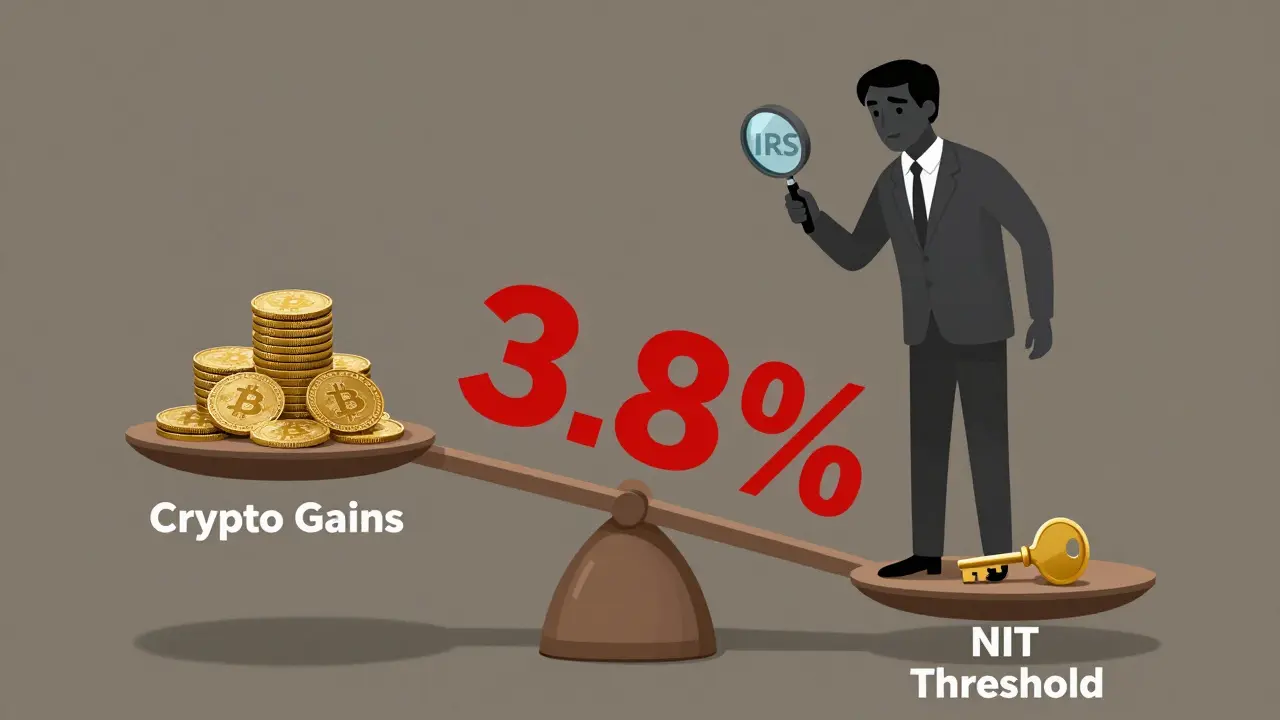
For high-income crypto investors, selling Bitcoin or Ethereum isn’t just about locking in profits-it’s about facing a hidden tax bill that can sneak up on you. The Net Investment Income Tax (NIIT), a 3.8% federal surtax, applies to crypto gains for those earning above certain income thresholds. And unlike regular capital gains tax, this one doesn’t show up on your brokerage statement. It shows up as a surprise when you file your return.
What Is the NIIT and Who Pays It?
The NIIT was created in 2013 as part of the Affordable Care Act. It’s not a new tax-it’s an extra 3.8% on top of your regular capital gains tax. You pay it if your Modified Adjusted Gross Income (MAGI) exceeds:
- $259,400 for married filing jointly (2025)
- $204,500 for single or head of household (2025)
- $129,700 for married filing separately (2025)
These numbers are adjusted for inflation each year. In 2024, the thresholds were lower. If you made a big crypto trade in 2023 and your income jumped above the limit, you’re likely paying NIIT now.
The tax doesn’t apply to your salary. It applies only to your net investment income. That includes interest, dividends, rental income, and-critically-capital gains from selling cryptocurrency. The IRS treats crypto as property, not currency. So every sale, trade, or exchange is a taxable event.
How the 3.8% Surtax Actually Works
The NIIT isn’t applied to your total crypto gains. It’s applied to the smaller of two numbers:
- Your net investment income (after losses)
- The amount your MAGI exceeds the threshold
Let’s say you’re single, made $190,000 in salary, and sold Ethereum for a $70,000 profit in 2025. Your MAGI is $260,000. You’re $55,500 over the $204,500 threshold. Your net investment income is $70,000. So the NIIT applies to $55,500-not the full $70,000. That’s $2,109 in extra tax ($55,500 × 0.038).
Now imagine you made $150,000 in salary and $100,000 in crypto gains. Your MAGI is $250,000. You’re $45,500 over the threshold. Your net investment income is $100,000. So NIIT applies to $45,500 again-$1,729 extra. The math changes depending on your income level, but the rule is always the same: apply the 3.8% to the smaller number.
Why Crypto Investors Get Hit Harder
Crypto investors face unique challenges with NIIT that traditional investors don’t. For starters, there’s no wash sale rule. If you sell Bitcoin at a loss and buy it back the next day, you can’t claim that loss to reduce your taxes. In stocks, you can. In crypto, you can’t. That means you’re more likely to realize gains-and trigger NIIT-without being able to offset them.
Also, crypto trading is often frequent. One person might do 50 trades in a year. Each one could add to your net investment income. Even if your salary is under $200,000, a single big sale-like cashing out from a 2021 bull market run-can push you over the edge.
And here’s the kicker: if you’re an active trader who makes crypto your primary income, you might avoid NIIT entirely. The IRS lets you classify as a “trader” if you trade regularly, frequently, and for profit. But proving that takes documentation, time, and often a CPA. Most people don’t meet the bar.
What Counts as Net Investment Income?
Not all crypto activity triggers NIIT. Here’s what does:
- Selling Bitcoin, Ethereum, or any crypto for a profit
- Trading one crypto for another (e.g., ETH for SOL)
- Receiving crypto from a hard fork or airdrop (if it has value at receipt)
- Earning interest or staking rewards (if not part of a business)
What doesn’t count? If you use crypto to buy a car or pay for services, that’s a taxable event-but it doesn’t count toward net investment income unless you’re holding the crypto as an investment. If you mine crypto as a business, that’s business income, not investment income. NIIT doesn’t apply.
But if you bought ETH in 2020 and sold it in 2024 for profit? That’s investment income. And if your MAGI is over the threshold? That’s NIIT territory.
How to Track and Calculate NIIT
You can’t calculate NIIT manually without detailed records. The IRS requires you to track:
- Acquisition date of each crypto asset
- Cost basis (what you paid)
- Sale date and proceeds
- Any losses from other crypto trades
Most people use crypto tax software. Tools like CoinTracker, Koinly, and TokenTax automatically flag NIIT exposure. In a 2024 survey, 68% of high-net-worth crypto users said NIIT calculation was the #1 feature they needed from tax software. The problem? Many tools still mess up cost basis calculations. One user reported a $12,000 NIIT bill because the software used FIFO instead of specific identification. That’s $456 in extra tax from a simple error.
You’ll need to file IRS Form 8960. It’s not part of your regular 1040. It’s a separate form that asks for your MAGI, your net investment income, and the lesser of the two. Then it applies the 3.8% rate. If you’ve never filed Form 8960 before, you’re not alone. The IRS saw a 27% jump in filings tied to crypto between 2022 and 2023.
What High-Income Crypto Investors Are Missing
A TaxBit survey of 500 high-net-worth crypto investors found that 42% didn’t know NIIT applied to crypto until they got their tax bill. The average unexpected tax hit? $8,240. That’s not a small number. It’s a surprise that can derail financial plans.
Reddit threads are full of stories:
- u/CryptoTrader87 sold $120,000 in Bitcoin bought in 2017. His salary was $180,000. He thought he owed $24,000 in capital gains. He owed $26,100-$2,100 more because of NIIT.
- u/DeFiInvestor got a token airdrop worth $40,000. He sold it the next week. He didn’t realize the airdrop itself was taxable income-and pushed him over the NIIT threshold.
These aren’t edge cases. They’re common. The IRS has been cracking down. The Inflation Reduction Act gave the agency $80 billion to improve enforcement, with crypto tax compliance as a top priority. By 2026, Deloitte predicts crypto-related NIIT revenue will hit $18.7 billion annually.

How to Reduce Your NIIT Exposure
You can’t avoid NIIT if you’re over the threshold and have investment income. But you can reduce it.
- Harvest losses: Sell losing positions before year-end. You can offset up to $3,000 of ordinary income per year with crypto losses. That lowers your MAGI and can keep you under the NIIT threshold.
- Time your sales: If you expect a big gain in 2025, consider spreading it over 2024 and 2026. Maybe sell half now, half next year.
- Use tax-advantaged accounts: If you hold crypto in a Roth IRA, gains aren’t taxable. But you can’t buy crypto directly in most IRAs. You need a self-directed IRA-complex and costly.
- Consult a CPA: A tax pro who understands crypto can help you structure trades, use cost basis methods, and avoid NIIT traps.
There’s no magic trick. But planning ahead saves money. One investor reduced his NIIT by $6,000 in 2024 by moving $150,000 in crypto gains into a 2025 sale-after his salary dropped due to a career change.
The Future of NIIT and Crypto
There’s talk in Congress about changing how NIIT applies to crypto. The 2025 Digital Asset Market Structure Act (H.R. 4763) proposes excluding active traders from NIIT. But the Congressional Budget Office says that would cost $1.2 billion in lost revenue over 10 years. Don’t count on it passing soon.
Meanwhile, the Treasury Department is tightening rules. Proposed regulations in late 2024 clarified that airdrops and hard forks are taxable events-and they can trigger NIIT if you’re over the income limit. The IRS is also pushing for better reporting. Exchanges may soon be required to issue 1099 forms for all crypto transactions, not just sales.
The bottom line? NIIT isn’t going away. It’s growing. In 2022, 3.8 million tax returns paid it. In 2024, over 1.2 million Americans with crypto held more than $10,000 met the MAGI threshold. That number will only rise.
If you’re a crypto investor with income over $200,000, NIIT is real. It’s not optional. It’s not a rumor. It’s a line item on Form 8960. Ignoring it costs money. Planning for it saves it.
Does the 3.8% NIIT apply to crypto losses?
No. NIIT applies only to net investment income-meaning your gains after losses. If you have $50,000 in crypto gains and $20,000 in losses, your net investment income is $30,000. NIIT applies to the smaller of that $30,000 or your MAGI over the threshold. Losses reduce your NIIT exposure, but they don’t eliminate it if you still have a net gain.
Do I pay NIIT on crypto staking rewards?
Yes-if you’re not running staking as a business. Staking rewards are treated as ordinary income when received. If your MAGI exceeds the NIIT threshold, those rewards count as part of your net investment income. If you’re actively staking as a trade or business, it’s business income, not investment income, so NIIT doesn’t apply.
Can I avoid NIIT by holding crypto long-term?
No. Holding crypto for over a year lowers your capital gains rate from 37% to 20%, but NIIT still applies if your MAGI is over the threshold. The 3.8% surtax is separate from the capital gains rate. Long-term holding reduces your base tax, but not the surtax.
What if I’m married and only one spouse earns crypto income?
The NIIT threshold for married filing jointly is $259,400 (2025). If one spouse earns $180,000 in salary and the other earns $90,000 in crypto gains, their combined MAGI is $270,000. That’s over the threshold. NIIT applies to the smaller of their net investment income ($90,000) or the excess over $259,400 ($10,600). So they pay 3.8% on $10,600-$403 in NIIT.
Do I need to file Form 8960 if I’m under the income threshold?
No. Form 8960 is only required if your MAGI exceeds the threshold and you have net investment income. If your income is under $204,500 (single) or $259,400 (married), and you’re not subject to NIIT, you don’t need to file the form-even if you sold crypto.
What to Do Next
If you sold crypto in 2024 and your income is close to or above the threshold, act now. Use crypto tax software to project your 2025 tax liability. Look at your MAGI and your net investment income side by side. If you’re over the limit, consider:
- Timing your next sale
- Using losses to offset gains
- Adjusting your withholding or estimated payments
Don’t wait until April. The IRS is watching. And the cost of being surprised is far higher than the cost of planning.

Comments (11)
Chris Atkins January 24 2026
I just sold some BTC last year and got blindsided by this 3.8% thing. Thought I knew taxes till this hit. No warning from Coinbase. No email. Just a surprise line item on Form 8960. Ouch.Jen Becker January 25 2026
This is why I don't cash out. Let it sit. Let the government chase ghosts.Ryan Toporowski January 26 2026
Yo if you're over the threshold and trading crypto you *need* to use Koinly or TokenTax. Seriously. I used CoinTracker and it messed up my cost basis and I paid $800 extra. Don't be me 😅Samuel Bennett January 27 2026
The IRS treating crypto as property is a scam. Money is money. If I buy a car with BTC and it appreciates, why am I taxed twice? This is fiat system oppression. They're coming for your digital wealth. Wake up.Rob D January 28 2026
You think this is bad? Wait till they start taxing your crypto staking rewards as ordinary income AND slap NIIT on top. That’s double taxation with a side of tyranny. America’s turning into a tax dystopia and you’re all just clicking ‘accept’ on 1099s like sheep.Franklin Hooper January 30 2026
The term 'net investment income' is technically accurate but misleading. Most people don't realize staking rewards count. And the MAGI calculation is a labyrinth. You need a CPA who speaks blockchain. Or you're doomed.Jess Ciro January 30 2026
This is all a distraction. The real tax trap is the 1099-DA form they're pushing. They want to track every single swap. Every tiny trade. They’re building a surveillance state under the guise of tax compliance.John Fox February 1 2026
I just use FIFO and hope for the best. It’s not perfect but it’s simple. And I’m not rich enough to care about the extra 3.8% anyway.Tasha Hernandez February 2 2026
Oh honey, you think $2k is bad? My friend paid $14k in NIIT last year because she got a $50k airdrop and didn't realize it counted as income. She cried for three days. Then she moved to Portugal.Anuj Kumar February 2 2026
Why do you let them tax you? Just move to India. No tax on crypto. No NIIT. No problem. America is broken.Christina Morgan February 4 2026
If you're over the threshold and haven't used tax-loss harvesting yet, you're leaving money on the table. I sold $30k in losing altcoins last December. Cut my NIIT by $1,140. It's not glamorous, but it's smart. And yes, you can do it too.