
Imagine trying to send a text message from an iPhone to an Android phone back in 2010. You couldn't just hit send and expect it to arrive instantly. The systems were walled gardens, designed to keep users inside their own ecosystems. Today, the blockchain world faces a similar problem, but with much higher stakes. We have over 200 distinct blockchain networks-Ethereum, Solana, Avalanche, Polygon, and countless others-each operating like its own isolated island.
This isolation is known as fragmentation, which prevents seamless interaction between different blockchain networks, forcing users to manage multiple wallets and bridges. For years, we relied on simple bridges to move tokens from one chain to another. But moving money is only half the battle. What if you want your smart contract on Ethereum to trigger an action on Solana? Or use NFTs from Polygon as collateral for a loan on Avalanche? That requires something more powerful than a bridge. It requires Cross-Chain Message Passing, specifically a protocol that allows arbitrary data and instructions to be transmitted securely between independent blockchains.
Arbitrary communication changes everything. It turns separate blockchains into a single, cohesive network where data flows as freely as capital. In this guide, we’ll break down how this technology works, why it’s safer (and riskier) than traditional bridges, and which protocols are leading the charge in 2026.
What Is Cross-Chain Message Passing?
At its core, cross-chain message passing is the connective tissue of the multi-chain web. While traditional bridges focus narrowly on asset transfers-locking tokens on Chain A and minting equivalent tokens on Chain B-message passing protocols handle any type of data. This includes smart contract function calls, governance votes, oracle updates, and complex multi-step operations.
Think of it like email versus postal mail. Postal mail (bridges) moves physical objects (tokens). Email (message passing) moves information. With email, you can attach files, schedule meetings, or trigger automated workflows. Similarly, arbitrary message passing allows a developer to write code on one chain that executes logic on another, creating truly omnichain applications.
The need for this technology emerged around 2019-2020 when Ethereum’s scaling limitations became apparent. As alternative Layer-1 chains gained traction, developers realized they needed a way to leverage the unique strengths of each network-Solana’s speed, Ethereum’s security, Polygon’s low fees-without siloing their users.
How the Technology Works Under the Hood
Understanding the mechanics doesn’t require a PhD in cryptography, but it does help explain why these systems are both powerful and fragile. The process generally follows five steps:
- Origin Event Generation: A smart contract on Chain A emits a message event. This payload includes the destination chain address, the target contract, the data itself, and a unique identifier called a nonce.
- Commitment: This event is recorded on Chain A as part of a block. The state of the chain is now cryptographically committed via a Merkle Root or similar proof structure.
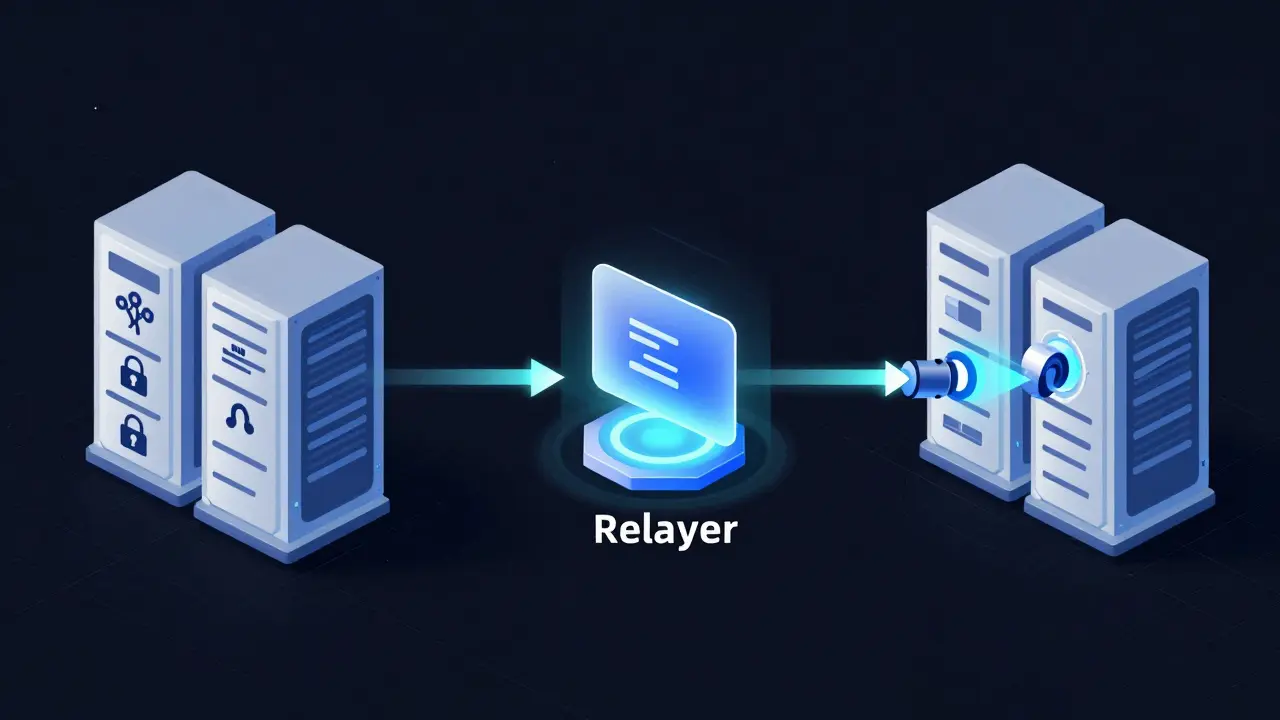
- Transport and Relaying: Specialized nodes, known as relayers, monitor Chain A. When they see the new event, they collect the cryptographic proof attesting to its validity and forward it to Chain B.
- Verification: On Chain B, a receiver contract validates the message. It checks the signature and ensures the message came from the correct source chain using the provided proof.
- Execution: Once verified, the destination contract processes the message and triggers the intended operation, such as releasing funds or updating a database.
The critical difference here is the verification step. In optimistic bridges, you assume the message is valid unless someone proves otherwise during a challenge period. In validium or zk-based approaches, the mathematical proof must be included upfront. This distinction heavily impacts speed and security.
Key Protocols Leading the Market
The landscape of cross-chain messaging is competitive, with three major players dominating developer adoption and transaction volume as of mid-2024.
| Protocol | Security Model | Market Share (Dev Adoption) | Key Strength |
|---|---|---|---|
| Chainlink CCIP | Decentralized Oracle Network (32+ node operators) | 47% | High security, enterprise-grade reliability |
| Axelar GMP | Dedicated Validator Network | 28% | General-purpose flexibility, strong enterprise partnerships |
| LayerZero | Lightweight Client / Ultra-Light Nodes | 15% | High throughput, lowest latency, highest transaction volume |
Chainlink CCIP was launched in October 2022 as a secure, scalable solution for cross-chain interoperability, leveraging Chainlink's decentralized oracle network to validate messages. Sergey Nazarov, co-founder of Chainlink, famously described CCIP as the "TCP/IP of Web3." Its strength lies in its robust security model, relying on independent node operators to sign off on messages. This makes it slower but significantly more resistant to collusion attacks.
Axelar General Message Passing (GMP) is a protocol that enables any smart contract on any connected chain to communicate with any other, supporting asynchronous messaging and complex multi-chain workflows. Axelar has focused heavily on enterprise adoption, partnering with Fortune 500 companies to build permissioned cross-chain solutions. Their recent launch of Asynchronous GMP allows messages to queue up during chain downtime, improving reliability.
LayerZero is an omnichain interoperability protocol that uses a lightweight client architecture to achieve sub-second finality and high throughput for cross-chain messages. LayerZero leads in raw transaction volume, processing billions of messages. It achieves this by requiring validators to run full nodes for both source and destination chains, reducing overhead. However, this model introduces different trust assumptions compared to CCIP.
Security Risks and the Interoperability Trilemma
If cross-chain messaging is so useful, why aren’t all dApps using it? Security. The shift from single-chain to multi-chain environments expands the attack surface dramatically. According to Trail of Bits’ September 2023 analysis, arbitrary messaging protocols contain 3.2 times more vulnerabilities than simple asset-only bridges.
The primary risks include:
- Validator Collusion: If enough validators in a network agree to lie about a message’s validity, they can drain funds. CCIP mitigates this with large, diverse validator sets.
- Message Replay Attacks: A malicious actor might try to submit the same message twice to exploit a bug. Proper implementation requires unique nonces and sequence counters.
- Sequencing Errors: Messages must arrive in the correct order. If Chain B processes Message 2 before Message 1, the application state can become corrupted.
- Smart Contract Bugs: Even if the messaging layer is secure, the receiving contract might have a flaw that allows exploitation upon message arrival.
Stanford’s Center for Blockchain Research introduced the concept of the "Interoperability Trilemma" in May 2023. They demonstrated mathematically that no protocol can simultaneously maximize decentralization, security, and composability. Developers must choose two. CCIP prioritizes security and decentralization, sacrificing some speed. LayerZero prioritizes speed and composability, accepting higher trust assumptions in its validator set.
Real-World Use Cases Beyond Token Swaps
While most users interact with cross-chain tech through token swaps, the real innovation happens in complex applications:
- Interoperable Lending: Users can lock ETH on Ethereum as collateral to borrow USDC on Avalanche. Synapse Protocol processed $4.2 billion in such transactions across seven chains using Axelar GMP between 2023 and 2024 without incident.
- Cross-Domain Governance: DAOs can allow members to vote using tokens held on different chains. This unifies community power regardless of where assets are stored.
- NFT Teleportation: Instead of bridging an NFT (which creates a wrapped version), true teleportation burns the original on Chain A and mints the authentic version on Chain B, maintaining unified ownership history.
- Omnichain Stablecoins: Stargate Finance maintains $1.3 billion in TVL across 14 chains, allowing users to move stablecoins seamlessly while preserving yield opportunities on each network.

Challenges for Developers
Building on cross-chain infrastructure is not for beginners. Consensys’ June 2023 survey found that 78% of developers need 3-6 months to become proficient. The learning curve involves mastering Merkle proofs, ECDSA/BLS signatures, and the consensus mechanisms of multiple chains.
Common pitfalls include:
- Ignoring Idempotency: Your contract must handle duplicate messages gracefully. If a relayer retries a message due to network congestion, your code shouldn’t execute the action twice.
- Underestimating Gas Costs: Sending a message costs gas on both the source and destination chains. During periods of high congestion, costs can spike from $0.02 to over $15 per message.
- Complex SDKs: Tools like Chainlink’s TypeScript SDK require advanced cryptography knowledge. Many developers report frustration with documentation gaps, though improvements have been made since late 2023.
To mitigate these issues, experts recommend starting with testnet tutorials, implementing exponential backoff for relayer retries, and conducting rigorous audits focusing on message sequencing and replay protection.
The Future of Arbitrary Communication
The market for cross-chain infrastructure grew 214% year-over-year in early 2024, reaching $1.2 billion. Arbitrary messaging protocols now represent 63% of this market, up from just 29% in 2023. This shift signals a maturation of the industry from simple asset movement to complex, composable applications.
Looking ahead, several trends are emerging:
- Standardization: The Interop Alliance announced a unified messaging standard in May 2024, backed by 14 major protocols. This could reduce fragmentation and improve user experience.
- Gas Abstraction: Axelar plans to introduce gas abstraction in Q4 2024, allowing users to pay fees in any token or even have sponsors cover costs, hiding the complexity of multi-chain payments.
- Regulatory Clarity: The SEC’s February 2024 guidance suggested that some messaging protocols could be classified as securities if they facilitate token transfers. Developers must stay vigilant about compliance.
- Consolidation: Blockchain Capital predicts that 60% of current protocols will merge or shut down by 2026. Only those with proven security records and strong developer communities will survive.
As Vitalik Buterin noted, cross-chain messaging is necessary for the multi-chain future, but it requires careful security modeling. The technology is no longer experimental; it’s foundational. Whether you’re a developer building the next big DeFi app or an investor evaluating infrastructure plays, understanding arbitrary communication is essential.
What is the difference between a bridge and cross-chain message passing?
A traditional bridge primarily facilitates the transfer of assets (tokens) between chains, often by locking and minting equivalents. Cross-chain message passing is a broader protocol that allows arbitrary data transmission, including smart contract calls, governance votes, and complex instructions, enabling true interoperability beyond just moving money.
Is cross-chain message passing safe?
Safety depends on the specific protocol and its security model. Protocols like Chainlink CCIP use decentralized oracle networks with many independent validators, offering high security. Others, like LayerZero, prioritize speed and may have different trust assumptions. All implementations carry risks, including validator collusion and smart contract bugs, so auditing and defense-in-depth strategies are critical.
Which protocol is best for developers: CCIP, Axelar, or LayerZero?
It depends on your priorities. Choose Chainlink CCIP for maximum security and enterprise-grade reliability. Choose Axelar GMP for flexible, general-purpose messaging with strong enterprise partnerships. Choose LayerZero for high throughput and low latency, especially if transaction volume is your main concern. Most professional developers start with CCIP testnets due to comprehensive documentation.
How long does it take to learn cross-chain development?
According to industry surveys, most developers need 3-6 months to become proficient. The steep learning curve involves understanding cryptography (Merkle proofs, signatures), multiple blockchain consensus mechanisms, and complex SDKs. Starting with testnet tutorials and focusing on idempotency and sequencing best practices can accelerate the process.
What is the "Interoperability Trilemma"?
Proposed by Stanford researchers, the Interoperability Trilemma states that no cross-chain messaging protocol can simultaneously achieve maximum decentralization, security, and composability. Developers must trade off between these factors. For example, a highly decentralized and secure protocol like CCIP may sacrifice some speed/composability, while a fast protocol like LayerZero may accept higher trust assumptions.

Comments (14)
Caitlin Donehue July 7 2026
I've been watching this space for a while and it's wild how fast things are moving. The comparison to email vs postal mail really clicked for me though. It makes the technical jargon feel less intimidating.
Jeanne Abrahams July 8 2026
Oh, look at us, trying to make blockchains talk to each other like they're not just glorified ledgers kept by people who haven't seen sunlight since 2017. We spent years building walled gardens and now we're desperately trying to build bridges between our own silos because we couldn't figure out interoperability from day one. Typical human ingenuity, really. First we isolate, then we panic, then we invent 'arbitrary message passing' to fix the mess we made. I suppose if you can't get your neighbors to say hello without a cryptographic proof, you might as well charge them gas fees for the privilege.
And don't even get me started on the 'security' aspect. Validator collusion? Please. As if a group of anonymous nodes running in someone's basement isn't going to collude when there's enough money on the table. It's not a trilemma, it's a tragedy. We're trading one set of centralized risks for another, more complex set of decentralized ones. But sure, let's call it 'Web3 maturity' and pretend we're solving fragmentation instead of just creating new points of failure. At least the iPhone and Android analogy is accurate-back then, at least, the walls were just bad design, not intentional financial traps.
Patrick Dorion July 9 2026
Jeanne has a point about the complexity, but dismissing the tech entirely misses the nuance. The real issue isn't the concept of cross-chain messaging, it's the implementation details that most developers gloss over. When you start talking about Merkle proofs and BLS signatures across different consensus mechanisms, you're entering a realm where a single off-by-one error in nonce handling can drain a protocol.
The Stanford trilemma mentioned in the post is actually quite profound. You literally cannot have decentralization, security, and speed all at once. Chainlink CCIP chooses security and decentralization, which means it's slower. LayerZero chooses speed and composability, which means you have to trust their validator set more. There is no free lunch here. If you're building an app that requires sub-second finality for high-frequency trading, LayerZero might be your only option despite the trust assumptions. If you're moving institutional capital, you need CCIP's heavy lifting.
What frustrates me is that most tutorials still treat these protocols as black boxes. Developers copy-paste SDKs without understanding what happens during the verification step. They don't realize that if the relayer network goes down, or if there's a sequencing error on the destination chain, their smart contract could end up in an inconsistent state. It's not just about sending data; it's about ensuring state consistency across heterogeneous systems. That's hard engineering. It's not magic, it's just very difficult distributed systems theory applied to cryptography.
Marissa Haque July 10 2026
Patrick! Oh my gosh, yes!! You hit the nail on the head with the developer experience part!!! I was reading through the Chainlink docs last week and I felt like I needed a PhD just to understand how to handle idempotency properly!!! It is so frustrating when the documentation assumes you already know everything about Merkle trees!!!
But honestly?? I love that we are finally getting somewhere with this stuff!!! The idea of using NFTs from Polygon as collateral on Avalanche sounds like absolute heaven for anyone tired of wrapping tokens endlessly!!! It feels like we are actually moving towards a cohesive web instead of this fragmented mess!!! Who else is excited about the gas abstraction coming from Axelar??? Paying fees in any token will change EVERYTHING for user adoption!!!
Bineesh Mathew July 10 2026
The moral decay of our society is laid bare in these 'bridges'. We seek to connect, yet we build walls of code that only the initiated may pass. Is it not ironic that in our quest for decentralization, we create central points of failure in the form of validator sets? The pseudo-philosophy of the blockchain is that code is law, yet the law is written by those who profit from its ambiguity. We are but ants crawling across a digital chasm, hoping the bridge does not collapse under the weight of our greed. The arbitrary nature of the message passing mirrors the arbitrary nature of value itself. What is a token but a shared hallucination? And what is a bridge but a collective agreement to ignore the abyss below? I find myself questioning not the technology, but the soul of those who wield it. Do they seek connection, or merely control disguised as interoperability? The drama unfolds not in the smart contracts, but in the hearts of the developers who sleepwalk into vulnerability after vulnerability.
Stephanie Frank July 12 2026
Bineesh, save the poetry for your diary. The reality is much simpler: these protocols are leaky buckets. The article mentions Trail of Bits found 3.2x more vulnerabilities in messaging protocols than simple bridges. That's not a philosophical dilemma, that's a math problem. Every time you add a cross-chain hop, you multiply the attack surface.
Look at the history. How many bridges got hacked? Hundreds. Billions lost. Now we're layering 'message passing' on top of that same fragile infrastructure and calling it innovation. It's not innovation, it's risk accumulation. The 'Interoperability Trilemma' is just a fancy way of saying 'you're gonna get rekt eventually.' Validators collude. Sequencers lie. Smart contracts have bugs. It's not a matter of if, but when. The only winning move is not to play, or at least, keep your funds on one chain until this whole circus burns itself out. Until then, enjoy your 'omnichain' dreams while the auditors sleep.
Lisa Puster July 13 2026
another american perspective here but honestly this tech is mostly driven by overseas devs who dont care about US regulations. the SEC guidance mentioned is barely a footnote in these articles. we need strict compliance before allowing arbitrary data flows that could facilitate sanctions evasion. the elitist view is that only those who understand the crypto should use it but that ignores the broader societal impact. i stay introverted because the noise is deafening and the pretension is unbearable. why do we need cross chain messaging when one secure chain would suffice? fragmentation is a choice not a necessity.
Joe Walters July 13 2026
Lisa you sound like a broken record. Yes regulations are important but you cant stop progress with fear. The fact that LayerZero processes billions of messages shows demand. People want to use their assets freely regardless of where they live. Its not about evading sanctions its about freedom of movement for capital. Also your grammar is terrible. Learn to punctuate before you lecture us on compliance. The future is multi-chain whether you like it or not. Get used to it or get left behind. Simple as that.
Michael Richards July 14 2026
Joe, calm down. Your aggression doesn't make your argument stronger. Lisa raises valid concerns about regulatory arbitrage. However, the technical reality is that standardization is happening faster than regulation. The Interop Alliance's unified standard is a game changer. If we can agree on a common language for messages, we reduce the friction significantly.
The key takeaway for developers is to prioritize idempotency. If your contract executes twice because of a retry, you're dead in the water. Use unique nonces. Always. And test on testnets extensively. The learning curve is steep, but the payoff for being able to build truly omnichain apps is worth it. Don't let the FUD stop you from building, but do respect the security implications. Audit early, audit often.
Laura Davis July 15 2026
Michael is right about the technical side, but let's talk about the human element. Building cross-chain apps is stressful. The pressure to get it right is immense. One mistake and you lose user trust forever. We need more support for developers navigating this complex landscape. Mentorship programs, better documentation, clearer guidelines. Let's lift each other up instead of tearing each other down. The community needs to be inclusive and supportive. If you're struggling with the SDKs, reach out. Someone has been there. We're all in this together. Let's build a safer, more accessible Web3 for everyone. No one should feel alone in this journey. Keep pushing forward, stay curious, and remember that every expert was once a beginner. You've got this!
Lisa Nally July 15 2026
Laura, while your enthusiasm is noted, it is misplaced. The 'human element' does not patch a reentrancy vulnerability. The technical precision required here is non-negotiable. To suggest that mentorship replaces rigorous auditing is dangerously naive. The jargon-heavy nature of this field exists for a reason: ambiguity leads to exploits. When we discuss 'idempotency,' we are not speaking in metaphors; we are defining mathematical guarantees. If a developer cannot grasp the difference between optimistic and zk-based verification models, they should not be deploying to mainnet. The drama surrounding failed bridges is not a social issue; it is a competence issue. We must elevate the discourse to match the complexity of the systems we are building. Emotional support does not prevent validator collusion. Cryptographic proofs do.
Keith Barker July 17 2026
the trilemma is real. you pick two. ccip picks security and decentralization. layerzero picks speed and composability. axelar tries to balance but leans enterprise. none are perfect. the market will decide. consolidation is inevitable. weak protocols die. strong ones survive. simple logic.
Robert Barakat July 18 2026
Keith captures the essence with minimal words. The philosophical underpinning of the interoperability trilemma suggests that perfection is an illusion. We must accept imperfection as a condition of existence in a multi-chain world. Each protocol represents a different path through the labyrinth of trade-offs. CCIP offers the fortress, impenetrable but slow. LayerZero offers the highway, swift but exposed. Axelar offers the marketplace, versatile but crowded. The wise developer chooses the path that aligns with their values and constraints. There is no universal truth, only contextual validity. In this sense, the technology reflects the human condition: we navigate uncertainty with imperfect tools, hoping for the best outcome. The reserved observer sees clearly. The drama fades. The code remains.
Oskar Falkenberg July 18 2026
hey guys just wanted to chime in and say that i think we are all missing the forest for the trees a bit here. the real win is that we are starting to see standardization efforts like the interop alliance. this is huge for collaboration. i know the tech is hard and the security risks are real but if we work together we can mitigate those risks. maybe we can start a study group or something to help devs learn the sdk better? i am happy to share notes from my recent deep dive into merkle proofs. lets keep the vibe positive and helpful. we are all learners here. no need to be toxic or overly dramatic. just good old fashioned collaboration. thanks for sharing your thoughts everyone.