

You’ve got the slides. You’ve got the script. But when you go live on Zoom or Teams, the energy drops. Why? Because passive listening doesn’t stick. People forget 70% of what they hear within 24 hours unless they do something with it. That’s where Virtual Instructor-Led Training (VILT) a synchronous online learning method where an instructor guides learners in real-time fails if you skip the active parts. The secret weapon? Labs and simulations.
These aren’t just fancy add-ons. They’re the difference between a webinar people endure and a workshop people remember. But designing them for a screen is tricky. You can’t just hand out a worksheet and hope for the best. You need structure, tech that works, and a facilitator who knows how to manage chaos. Here’s how to build labs that actually teach skills, not just concepts.
Why Passive VILT Fails and Active Learning Wins
Think about the last time you tried to learn Excel by watching someone else click buttons. Did you feel confident? Probably not. You felt like you were watching magic tricks without knowing the mechanics. Traditional VILT often falls into this trap. It’s lecture-heavy, low-interaction, and cognitively draining.
Active Learning an educational approach where students engage directly with materials through doing, discussing, and problem-solving flips this script. When learners manipulate variables in a simulation or troubleshoot a code snippet in a lab, their brains form stronger neural pathways. A study from the Journal of Applied Psychology found that trainees who engaged in active practice retained information 30-50% better than those who only observed.
In a virtual setting, this isn’t optional-it’s survival. Without physical presence, you lose non-verbal cues. If learners are bored, they don’t fidget; they just mute themselves and check email. Labs force engagement. They create stakes. If you don’t participate, your team loses the game or your server crashes. That immediate feedback loop is powerful.
Types of Virtual Labs: Choosing the Right Tool
Not all labs are created equal. The type you choose depends on the skill you’re teaching. Are you building muscle memory? Critical thinking? Or collaboration?
Here’s a breakdown of common formats:
- Software Sandboxes: Isolated environments where users can break things without consequences. Great for coding, CRM configuration, or financial modeling.
- Branching Scenarios: Interactive stories where choices lead to different outcomes. Ideal for soft skills like negotiation or customer service.
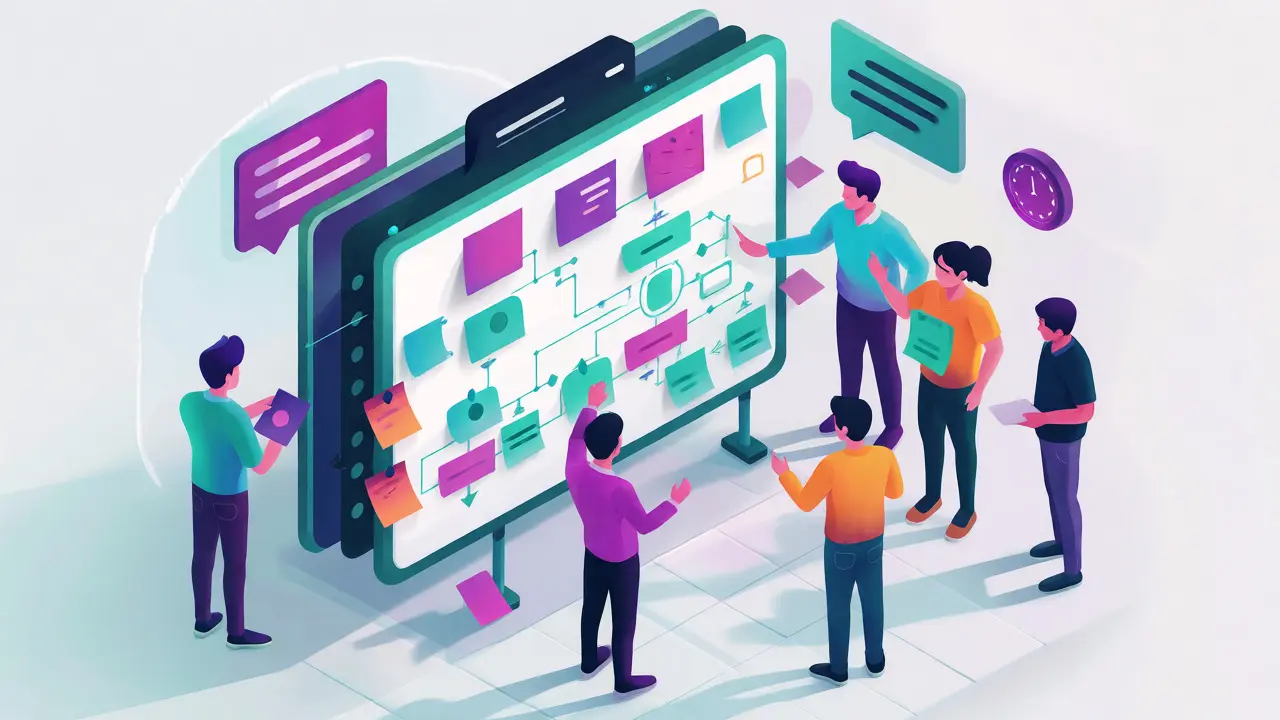
- Collaborative Whiteboards: Tools like Miro or Mural where teams map processes together. Best for design thinking or brainstorming sessions.
- Hardware Simulators: Digital twins of physical machines. Used in manufacturing, healthcare, or aviation training.
For example, if you’re training sales reps on handling objections, a branching scenario is better than a sandbox. Why? Because the skill is emotional and verbal, not technical. Conversely, if you’re teaching Python scripting, a sandbox is essential because syntax errors have specific, fixable causes.
| Lab Type | Best For | Tech Complexity | Facilitator Load |
|---|---|---|---|
| Software Sandbox | Technical skills (coding, IT, finance) | Medium-High | Low (self-paced checks) |
| Branching Scenario | Soft skills (sales, HR, leadership) | Low-Medium | High (debriefing heavy) |
| Collaborative Board | Process mapping, ideation | Low | Medium (moderation) |
| Hardware Simulator | Mechanical operations, safety | Very High | Low (automated feedback) |
The Design Blueprint: From Objective to Interaction
Don’t start with the tool. Start with the job-to-be-done. What should the learner be able to do after the session? If the answer is “explain the concept,” you don’t need a lab. If the answer is “configure the firewall” or “handle an angry client,” you do.
Use the ADDIE model, but tweak it for virtual constraints:
- Analyze: Identify the specific pain point. Is it knowledge gaps or skill gaps? Labs fix skill gaps.
- Design: Create a realistic scenario. Avoid abstract problems. Instead of “calculate ROI,” use “decide whether to approve this $50k marketing spend.”
- Develop: Build the asset. Keep it simple. A complex simulation that takes 20 minutes to load kills momentum.
- Implement: Run the session. Test audio/video sync. Ensure everyone has access before the call starts.
- Evaluate: Measure performance, not attendance. Did they solve the problem correctly? How long did it take?
A key rule: Keep the cognitive load low during the setup phase. If learners spend five minutes figuring out how to log into the lab, they’ve lost focus. Pre-load links, send credentials early, and run a tech check 10 minutes before the session.
Facilitation Techniques for Virtual Labs
Running a lab virtually is harder than in person. You can’t walk around the room. You can’t see who’s stuck unless they speak up. This requires a shift in facilitation style.
First, use breakout rooms strategically. Don’t keep everyone in one big group for problem-solving. Split them into pairs or trios. Smaller groups increase accountability. In a group of 20, one person can hide. In a group of three, hiding is obvious.
Second, set clear timeboxes. Ambiguity creates anxiety. Say, “You have 8 minutes to configure the dashboard. I’ll ping you at 6 minutes.” Then, stick to it. Use a visible timer on screen.
Third, monitor progress actively. Ask specific questions to random participants. “Sarah, what error message are you seeing?” “Mike, did you get past step 3?” This keeps everyone alert. Silence in a virtual lab usually means confusion, not deep thought.
Finally, debrief thoroughly. The learning happens in the reflection, not just the doing. Ask: “What worked? What didn’t? How would you apply this tomorrow?” Connect the simulation back to real-world tasks. If they solved a puzzle in the lab, show them exactly where that logic applies in their daily workflow.
Common Pitfalls and How to Avoid Them
Even well-designed labs fail if you ignore these traps.
The Tech Barrier: If the lab requires a plugin download or a specific browser version, half your class will miss the first 10 minutes. Solution: Use web-based tools that work on Chrome, Edge, and Safari without installs. Test on mobile too, though desktop is preferred for complex labs.
The ‘Click-Through’ Trap: Learners sometimes just click buttons until the green light turns on, without understanding why. Solution: Add checkpoints. Require them to explain their choice in the chat before proceeding. “Type ‘YES’ only if you understand why we chose option B.”
Lack of Context: A simulation feels fake if it doesn’t mirror reality. Solution: Use real data. If you’re training on Salesforce, use anonymized records from your actual database, not generic demo data. Authenticity boosts engagement.
Ignoring Accessibility: Color-blind learners might miss visual cues. Screen readers might skip interactive elements. Solution: Follow WCAG guidelines. Provide text alternatives for graphs. Ensure keyboard navigation works.

Tools of the Trade
You don’t need expensive software to start. Many effective labs can be built with existing platforms.
- Mentimeter or Slido: Great for quick polls and word clouds to gauge understanding during a lab.
- Miro or Mural: Infinite whiteboards for collaborative mapping. Easy to integrate with Zoom.
- Kahoot! or Quizizz: Gamified quizzes that can serve as mini-labs for knowledge checks.
- Twilio or CodePen: For lightweight coding exercises without full IDE setups.
- Articulate Storyline: For creating robust branching scenarios with rich media.
Start small. You don’t need a custom-built simulator for every topic. A well-crafted case study discussed in breakout rooms is a valid lab. A spreadsheet exercise shared via screen share is a valid lab. Focus on interaction, not technology.
Measuring Success Beyond Attendance
How do you know if your lab worked? Attendance is a vanity metric. Look at behavior change.
Track completion rates of post-session challenges. Send a follow-up task one week later. “Apply the negotiation tactic from our simulation to your next client call. Report back.” If 60% report success, your lab was effective.
Use pre- and post-assessments. Not multiple-choice trivia, but practical tests. Before the lab, ask them to draft an email response to a difficult customer. After the lab, ask them to do it again. Compare the quality. Did they use the techniques taught? Did they reduce tone errors?
Gather qualitative feedback. Ask: “What part of the simulation felt most realistic?” and “Where did you feel stuck?” This helps you refine the design for the next cohort.
How many learners can handle a virtual lab simultaneously?
It depends on the complexity and the number of facilitators. For self-paced sandboxes, you can have 50+ learners. For guided breakout activities, aim for 15-20 learners per facilitator. If you have one instructor, keep the total group under 25 to ensure meaningful interaction.
Do I need special software for every VILT lab?
No. Many effective labs use standard tools like Zoom breakout rooms, shared spreadsheets, or document co-editing in Google Docs. Specialized software is only needed for complex simulations requiring specific interfaces or data isolation.
How do I keep learners engaged during a long simulation?
Break it into chunks. Every 10-15 minutes, pause for a quick poll or a pair-share discussion. Introduce unexpected twists in the scenario to maintain tension. Use timers visibly on screen to create urgency.
What if a learner’s internet connection drops during a lab?
Have a backup plan. Save progress frequently if using web apps. Pair learners so they can assist each other. Have a static PDF version of the lab instructions available offline so they can catch up quickly upon reconnection.
Can simulations replace real-world practice entirely?
No. Simulations are safe spaces to make mistakes, but they lack the full emotional and environmental pressure of real life. Use them as a bridge between theory and fieldwork, not a replacement for on-the-job application.
