

Imagine buying Bitcoin at $90,000. Within hours, it drops to $85,000. Your heart races. Do you sell now and accept the loss? Or do you hold, hoping it bounces back, only to watch it fall to $70,000? This emotional tug-of-war is exactly why stop-loss and take-profit methods are pre-programmed exit rules that define a maximum loss level and a profit target for each position, allowing orders to execute automatically when price reaches those thresholds. These tools aren't just technical settings; they are the backbone of trading discipline in the chaotic world of cryptocurrency.
In crypto markets, where prices can swing 10% or more in a single day, relying on willpower alone is a recipe for disaster. Stop-loss and take-profit orders remove emotion from the equation by enforcing strict boundaries before you even enter a trade. Whether you are a beginner looking to protect your capital or an experienced trader refining your strategy, understanding these methods is essential for long-term survival.
The Core Mechanics: How Stops and Targets Work
At their simplest, these orders are instructions given to your exchange. A stop-loss order tells the system to sell your asset if the price falls to a specific point, limiting your downside. Conversely, a take-profit order sells your asset when the price rises to a desired level, locking in gains without you needing to stare at charts all day.
Consider a practical example from a 2025 TradingView tutorial. You buy Bitcoin at $90,000. You set a stop-loss at $85,500 (a 5% loss limit) and a take-profit at $94,500 (a 5% gain target). If the market crashes, your position closes automatically at $85,500. If it rallies, it sells at $94,500. You sleep soundly knowing your risk and reward are defined. This automation prevents the common mistake of holding onto losing positions in hopes of a miracle or selling winners too early out of fear.
Most major centralized exchanges like Kraken and Crypto.com support these order types natively. They often come in variations like stop-market (executes immediately at the next available price) and stop-limit (executes only at a specified price or better), giving you control over slippage during volatile moves.
Setting Levels: Percentage vs. Volatility-Based Methods
One of the biggest mistakes traders make is picking random numbers for their stops. Effective placement requires a logical basis. There are two primary approaches: percentage-based and volatility-based.
Percentage-Based Stops are straightforward. You decide you are willing to lose 5% or 10% of your entry price. For instance, if you buy Ether at $3,000 with a 10% stop, your exit is at $2,700. This method is easy to calculate but ignores market conditions. In a calm market, a 5% stop might be too tight, getting you shaken out by normal noise. In a wild market, it might be too wide, exposing you to excessive risk.
Volatility-Based Stops adapt to the market. Traders use indicators like the Average True Range (ATR) to measure recent price dispersion. ChartScout’s 2026 guide recommends identifying the "invalidation level"-the price where your trade thesis is proven wrong-and adding a buffer of 2x to 3x the ATR. This ensures your stop sits beyond ordinary fluctuations but still protects you if the trend reverses. For Bitcoin and large-cap tokens, stops are commonly placed 5-10% below entry, while volatile altcoins may require wider buffers of 8-15% to avoid premature exits.
| Method | Best For | Pros | Cons |
|---|---|---|---|
| Fixed Percentage | Beginners, stable coins | Simple to calculate, consistent risk | Does not account for market volatility |
| ATR-Based (Volatility) | Experienced traders, volatile assets | Adapts to market conditions, reduces false signals | Requires technical analysis skills |
| Support/Resistance | Trend followers | Aligns with market structure | Can be clustered with other traders' stops |

Advanced Techniques: Trailing Stops and Scaling Out
Static stops have a flaw: they cap your upside. If you set a take-profit at $94,500 and Bitcoin moons to $120,000, you miss out on massive gains. This is where advanced methods like trailing stops and scaling out shine.
A trailing stop is a dynamic order that moves with the price. For a long position, as the price rises, the stop-loss level rises behind it, maintaining a fixed distance or percentage. This locks in incremental profits while allowing the trend to continue. HyroTrader’s 2025 guide highlights this as a way to create a "staircase of realized gains." If the price reverses, the stop triggers, securing the profit accumulated up to that point.
Scaling Out involves closing portions of your position at different levels. Instead of selling all your Bitcoin at once, you might sell 50% at a key resistance level to bank some profit, then move the stop-loss on the remaining 50% to breakeven. This reduces psychological pressure and mitigates the risk of a sudden reversal wiping out all gains. It also helps manage slippage in illiquid markets, where large orders can impact the price.
Another nuanced technique is the closing-price stop, which triggers only if the daily candle closes beyond the stop level. This filters out intraday "wick hunts" common in low-cap altcoins, preventing premature exits caused by brief manipulative spikes.
The Psychology of Discipline: Why Rules Fail
Having a plan is one thing; sticking to it is another. The core challenge of stop-loss and take-profit methods is human psychology. Fear and greed are powerful forces that often override logic.
A common failure mode is moving your stop-loss further away when a trade goes against you. You tell yourself, "It’ll bounce back," turning a small, manageable loss into a catastrophic drawdown. Reddit discussions from 2024 and 2026 emphasize that high-earning traders maintain the strictest discipline, cutting losers quickly and never widening stops during drawdowns. The rule is simple: the stop-loss must be established immediately when you press buy and honored without exceptions.
Another pitfall is placing stops at obvious levels. If everyone puts their stop below $90,000, that zone becomes a liquidity pool. Market makers may push the price down to trigger these stops before reversing upward, leaving you stopped out just before the rally. To counter this, experts recommend placing stops slightly beyond obvious support/resistance zones, using irregular price levels to avoid clustering with the crowd.
Risk-Reward Ratios and Position Sizing
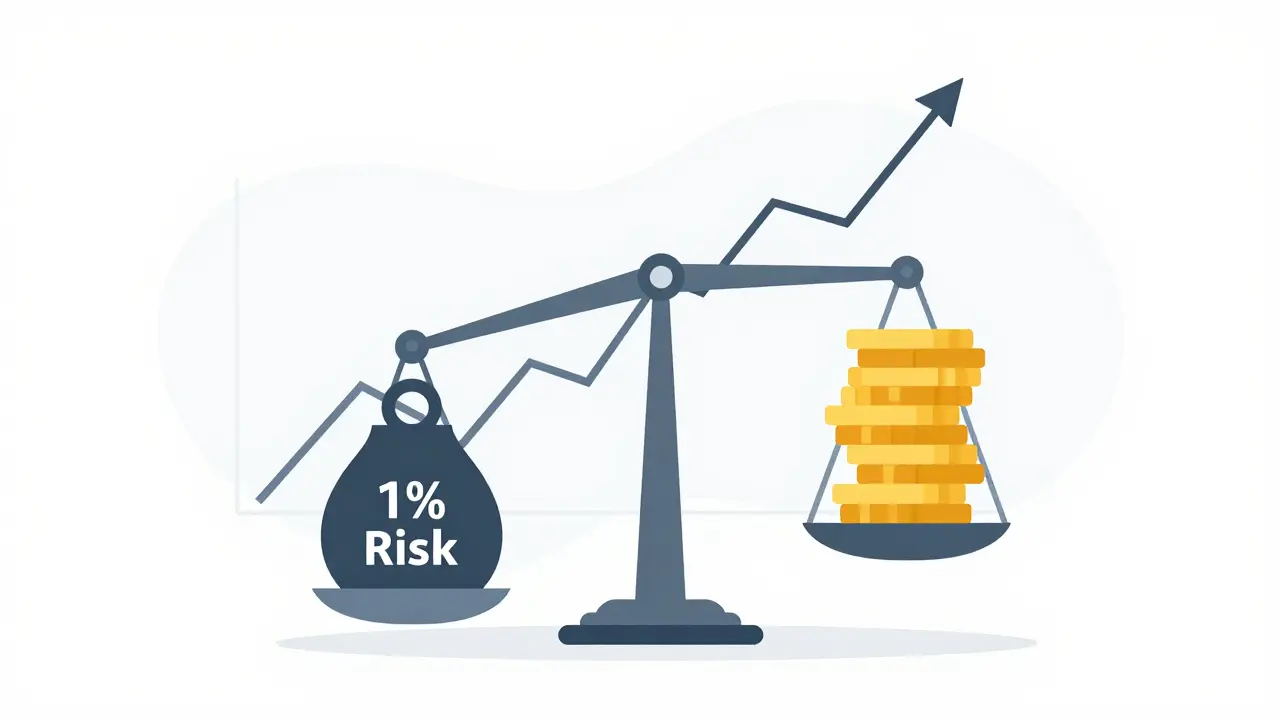
Discipline isn’t just about where you exit; it’s about how much you risk. A robust strategy ties stop-loss placement to position sizing. The "1% rule" suggests risking no more than 1% of your total account equity on any single trade. If your account is $10,000, you should not lose more than $100 per trade.
This dictates your position size. If your stop-loss is 5% away from your entry, you need to buy enough crypto so that a 5% drop equals $100. This mathematical approach ensures that even a string of losses won’t wipe out your capital. Combined with a risk-reward ratio of at least 1:2 (risking $100 to make $200), you can be profitable even if you win less than 50% of your trades.
Crypto.com’s 2025 resources stress defining both stop-loss and take-profit levels immediately after entering a trade. This pre-commitment removes the temptation to adjust targets based on emotions during market swings. When you know your max loss and potential profit upfront, you trade with clarity and confidence.
Implementation Tips for 2026
Implementing these methods today is easier than ever. Most platforms integrate stop-loss and take-profit options directly into the order entry interface. Here’s how to start:
- Start Small: Practice with small position sizes for several weeks. Use mental stops initially to build the habit, then switch to hard orders on the book.
- Use Technical Analysis: Don’t guess. Use support/resistance, moving averages (like the 50-day and 200-day lines), and chart patterns to determine logical exit points.
- Adjust for Volatility: Widen stops for altcoins and tighten them for stable pairs. Use ATR to quantify "normal" movement.
- Automate Where Possible: Set OCO (One-Cancels-the-Other) orders if your exchange supports them. This allows you to place both a stop-loss and take-profit simultaneously; if one triggers, the other is cancelled.
- Review and Refine: Keep a trading journal. Analyze whether your stops were hit due to genuine trend reversals or just market noise. Adjust your parameters accordingly.
Remember, the goal isn’t to predict the market perfectly. It’s to manage risk effectively. As academic studies show, portfolios with formal stop-loss rules experience significantly lower volatility, sacrificing some upside to preserve capital. In crypto, preserving capital is the first step to growing it.
What is the best stop-loss percentage for cryptocurrency?
There is no single "best" percentage. For Bitcoin and large-cap coins, 5-10% is common. For volatile altcoins, 8-15% may be necessary to avoid being stopped out by normal noise. Advanced traders use ATR (Average True Range) to set dynamic stops based on current market volatility rather than fixed percentages.
Should I use mental stops or hard stop-loss orders?
Hard stop-loss orders are generally recommended because they remove emotion and ensure execution even if you’re not watching the screen. Mental stops rely on willpower, which can fail during stressful market moves. However, some short-term scalpers prefer mental stops to avoid slippage in thin order books.
How does a trailing stop work in crypto trading?
A trailing stop moves up as the price rises, maintaining a fixed distance or percentage below the highest price reached. This locks in profits while allowing the trade to run during strong trends. If the price reverses by the trailing amount, the stop triggers and closes the position.
Why do my stop-loss orders keep getting hit before the price rebounds?
This often happens if your stops are placed at obvious support levels where many other traders have theirs. Market makers may push prices down to trigger these clusters (liquidity grabs) before reversing. Try placing stops slightly beyond obvious levels or using closing-price stops to filter out intraday wicks.
Is it better to scale out or exit all at once?
Scaling out (selling partial positions at different levels) is often superior in volatile markets. It allows you to bank some profits early, reducing psychological pressure, while keeping a portion of the position open to capture larger trends. It also helps mitigate slippage risks associated with large single orders.
