

You send an email. It arrives instantly. You transfer money. It clears in seconds. But what if you could write a rule that says, "If X happens, then Y must happen," and trust the computer to enforce it without asking a lawyer, a bank, or a manager for permission? That is the core promise of smart contracts. These are not magic wands; they are deterministic programs stored on a shared ledger that execute exactly as written when specific conditions are met.
The idea isn't new. In the mid-1990s, Nick Szabo described them as "computerized transaction protocols." But it wasn't until the launch of Ethereum in July 2015 that these concepts became practical infrastructure. Today, with over 15 million smart contracts deployed on Ethereum alone by Q2 2025, they form the backbone of decentralized finance (DeFi), gaming, and supply chain tracking. If you're trying to understand how this technology actually functions under the hood-beyond the buzzwords-you need to look at the code, the execution model, and the risks involved.
What Exactly Is a Smart Contract?
A smart contract is a self-executing agreement where the terms are written directly into lines of code. Unlike traditional contracts, which rely on human interpretation and legal enforcement, smart contracts run on a blockchain, ensuring that once the code is deployed, it cannot be changed, censored, or reversed by any single party.
Think of a vending machine. You don't need a clerk to watch you insert coins and press a button. The machine's internal logic ensures that if you pay $2, it dispenses a soda. If you don't pay, it doesn't. A smart contract works similarly but on a global scale. It holds assets (like cryptocurrency tokens) and releases them only when predefined rules are satisfied. For example, a contract might hold funds in escrow until a shipping provider confirms delivery via an oracle. Once confirmed, the funds automatically transfer to the seller.
This automation eliminates intermediaries like banks or clearinghouses, reducing costs and settlement times from days to minutes. However, it also shifts trust from institutions to mathematics and code quality. If the code has a bug, the error executes just as faithfully as the intended feature.
The Lifecycle: From Code to Execution
Understanding how a smart contract works requires following its journey from a developer's laptop to the blockchain network. This process involves three distinct phases: creation, deployment, and interaction.
- Creation: Developers write the contract using high-level languages. On Ethereum, the dominant language is Solidity. This language looks similar to JavaScript or C++ but includes specific features for handling blockchain data types and gas fees.
- Compilation: Human-readable Solidity code is compiled into bytecode-a low-level instruction set that the Ethereum Virtual Machine (EVM) can understand. This step optimizes the code and prepares it for storage.
- Deployment: The developer sends a special transaction containing the bytecode to the blockchain. Miners or validators process this transaction, and once included in a block, the contract receives a unique address. At this point, the code is immutable. Unless designed with upgrade patterns, the logic cannot be altered.
Once live, users interact with the contract by sending transactions to its address. These transactions include function calls and parameters. For instance, calling `transfer(address recipient, uint amount)` tells the contract to move tokens. The EVM processes this call, updates the contract's state (like balances), and records the result. All nodes in the network reach consensus on the outcome, ensuring everyone agrees on the new state.
Why Immutability Matters (and When It Doesn't)
Immutability is a double-edged sword. On one hand, it guarantees transparency. Anyone can inspect the source code on public explorers like Etherscan. This openness allows auditors to verify security before users deposit funds. On the other hand, it means mistakes are permanent. If a hacker finds a vulnerability in a deployed contract, they can exploit it repeatedly until the funds are drained.
To mitigate this risk, many modern projects use proxy contracts. Instead of storing logic directly, the main contract delegates calls to a separate "implementation" contract. This setup allows developers to update the logic by pointing the proxy to a new implementation address, effectively upgrading the contract without changing its address or losing stored data.
| Feature | Standard Immutable Contract | Upgradeable Proxy Contract |
|---|---|---|
| Code Changes | Impossible after deployment | Possible via proxy redirection |
| Trust Requirement | Low (code is fixed) | Medium (requires trusted admin) |
| Complexity | Simple structure | Higher complexity (storage layouts) |
| Risk Profile | Bugs are permanent | Upgrade mechanism can be exploited |
By 2025, roughly 35 to 40 percent of new deployments used these upgradeable patterns. While this flexibility is crucial for iterative development, it introduces new vulnerabilities. OWASP’s 2026 Smart Contract Top 10 highlights "Proxy and Upgradeability Vulnerabilities" as a critical category (SC10), noting that mismanaged upgrades can lead to total loss of control over user funds.
The Role of Oracles: Bridging Off-Chain Data
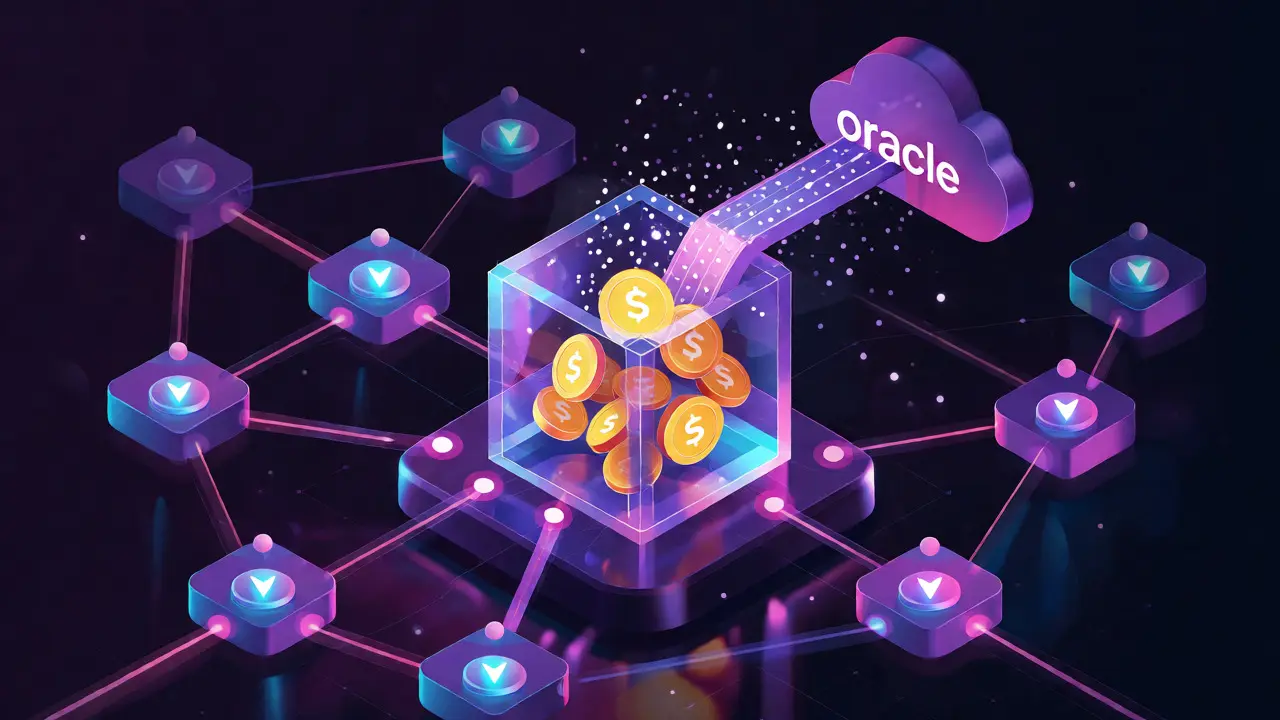
Smart contracts are isolated environments. They cannot natively access external data like stock prices, weather reports, or sports scores. If a contract needs to know the price of Bitcoin to trigger a loan liquidation, it needs help. Enter oracles, such as those provided by Chainlink.
An oracle is a service that fetches off-chain data and pushes it onto the blockchain. Without oracles, smart contracts would be limited to purely on-chain interactions. With them, they can power complex financial instruments. For example, a decentralized exchange might use an oracle to determine the fair market value of a token pair before executing a swap.
However, relying on oracles adds a layer of dependency. If the oracle provides incorrect data due to manipulation or technical failure, the smart contract will execute based on that bad input. Oracle manipulation attacks accounted for over $200 million in losses in 2025, representing about 6% of total smart contract-related exploits. Securing the oracle feed is just as important as securing the contract code itself.
Security Risks and Real-World Consequences
Code is law, but buggy code is expensive law. The stakes are high because smart contracts often hold billions of dollars in real-world value. According to Blockhertz, smart contract vulnerabilities and blockchain exploits resulted in approximately $3.4 billion in losses across 2025. Access control issues were the biggest culprit, accounting for $953.2 million (28%) of those losses.
Common vulnerabilities include:
- Reentrancy: An attacker calls back into the contract before the first execution finishes, draining funds multiple times. This caused major hacks in the past, though patterns like "Checks-Effects-Interactions" have reduced their frequency.
- Business Logic Errors: The code runs correctly, but the economic incentives are flawed. For example, a protocol might allow users to mint more tokens than intended due to a miscalculation in reward distribution. OWASP ranks business logic as the second most critical threat (SC02).
- Input Validation Failures: Approximately 18% of contracts deployed in early 2025 had issues with validating user inputs, leading to unexpected behavior or failed transactions.
It is worth noting that while headline-grabbing hacks dominate news cycles, academic research suggests that only about 1.98% of vulnerable contracts are actually exploited. Most contracts operate safely. However, the aggregate impact of successful exploits remains substantial, driving the industry toward rigorous auditing standards. Bug bounty platforms paid out nearly $78 million for smart contract issues in recent years, signaling that application-layer security is the primary focus for investors and developers alike.

Practical Applications Beyond Finance
While DeFi gets the spotlight, smart contracts are expanding into other sectors. In supply chains, they track goods from manufacture to delivery, automating payments upon receipt confirmation. In gaming, they manage asset ownership, allowing players to truly own in-game items and trade them freely on open markets.
Consider a simple rental agreement. Traditionally, this involves signing papers, paying deposits, and hoping the landlord returns the money. With a smart contract, the tenant locks crypto in the contract. The landlord verifies move-in. After the lease term ends, if no damages are claimed within a specified window, the contract automatically refunds the tenant. No disputes, no delays, no middlemen taking a cut.
Frequently Asked Questions
Can smart contracts be changed after deployment?
Generally, no. Standard smart contracts are immutable once deployed. However, developers can use proxy patterns to create upgradeable contracts. This allows the logic to be updated by redirecting the proxy to a new implementation contract, though the original address remains the same.
Are smart contracts legally binding?
This depends on jurisdiction. While the code enforces the technical execution, legal recognition varies. Some regions accept smart contracts as valid agreements, while others require a traditional legal wrapper. The code ensures automatic execution, but courts may still interpret intent in disputes.
What happens if there is a bug in a smart contract?
The contract executes the buggy code exactly as written. If a hacker exploits the bug, funds may be lost permanently. Unlike centralized apps, there is no central authority to reverse transactions. This is why thorough testing and third-party audits are critical before deployment.
Do I need to know coding to use smart contracts?
No. End-users interact with smart contracts through user-friendly interfaces like wallets and dApps (decentralized applications). The underlying code handles the logic, while the front-end translates actions into blockchain transactions.
How do smart contracts handle external data?
They use oracles. Since blockchains are closed systems, oracles act as bridges that fetch real-world data (like prices or weather) and submit it to the blockchain, allowing contracts to react to external events.
Next Steps for Understanding and Using Smart Contracts
If you are a developer looking to build, start by mastering Solidity and understanding the EVM's gas mechanics. Use tools like Hardhat or Foundry for local testing. Never deploy without writing unit tests for edge cases, especially around reentrancy and integer overflows.
For users and businesses, prioritize security. Check if the project has undergone audits by reputable firms like Trail of Bits or OpenZeppelin. Look for bug bounty programs, which indicate active community monitoring. Remember, the transparency of blockchain is your best friend-inspect the code or read audit reports before locking up significant capital.
Smart contracts are not just tech jargon; they are the plumbing of the next generation of the internet. By automating trust, they reduce friction in digital interactions. As security practices mature and regulatory frameworks clarify, their role in everyday commerce will likely expand beyond niche crypto circles into mainstream finance and logistics.

Comments (12)
Ian Mason-Laurence October 4 2026
The assertion that smart contracts eliminate intermediaries is technically imprecise. They do not remove the need for trust; they merely shift it from centralized institutions to cryptographic proofs and code correctness. Furthermore, the reliance on oracles introduces a significant attack surface, as noted in the text regarding the $200 million in losses. One must also consider that gas fees often render micro-transactions economically unviable, which contradicts the claim of universal cost reduction.
Ejike Ugwu October 4 2026
Bro, you really think this tech is safe? 🤨 The banks are just waiting to hijack the whole blockchain thing because they can't control it anymore. Look at how fast they move when their profits are threatened. I bet the SEC is already planning to classify every single token as a security just to kill DeFi before it gets too big. It's all rigged against us regular folks who don't have insider info. 📉💸
Lauren Martin October 6 2026
Typical crypto bro fluff. You gloss over the fact that 'code is law' only works until a whale buys the governance vote and changes the rules. Immutability is a marketing term, not a technical reality, especially with proxy patterns becoming standard. If your contract needs an admin key to fix bugs, you haven't decentralized anything; you've just moved the central point of failure from a bank vault to a GitHub repo. Most retail investors lose money here because they don't understand the economic incentives behind the code, not because of some magical 'trustless' execution. Go read up on MEV extraction if you want to know who actually wins these games.
Anthony . October 8 2026
I appreciate the balanced take! 🌟 It's cool to see the focus on both the potential and the risks like oracle manipulation. I think the rental example is super relatable for people getting into Web3 for the first time. We should definitely encourage more educational resources like this to help newcomers navigate the complexity without feeling overwhelmed. 🚀🤝
Mithilesh Singh October 8 2026
This is exactly what happens when technology outpaces morality. We create these complex systems where a single typo can drain millions, yet we refuse to regulate them properly. It is arrogant to assume that code alone can enforce justice. Where is the accountability? Who goes to jail when the 'smart' contract fails the poor? This lack of moral oversight is why society is crumbling. We need strict laws, not just better compilers. 🇮🇳
Tommy Cahyadi October 10 2026
Sure, let's pretend that 'immutable' means 'unchangeable' while developers quietly push updates through proxies. But hey, at least no one can change your transaction history unless they fork the chain. Good luck explaining that to your landlord though.
Shaina Silver-Baird October 10 2026
The mention of Chainlink as the primary oracle solution raises concerns about centralization vectors. If a majority of price feeds rely on a small set of node operators, aren't we just recreating the same dependency structures we sought to escape? Additionally, the legal ambiguity mentioned in the FAQ suggests that jurisdictions may retroactively invalidate smart contract executions, rendering the 'self-executing' nature moot in courtrooms.
evelyn starcher October 12 2026
It's about time someone explained this clearly!! 😤 Finally, a post that doesn't treat us like idiots. The vending machine analogy is spot on. I'm tired of people saying crypto is magic-it's just logic! And yeah, those hackers stealing billions are disgusting thieves. We need to protect our assets! 🔒💪 #SmartContracts #Truth
Kathleen Johnson October 13 2026
While the technical explanation is adequate, the article fails to address the environmental impact of proof-of-work chains that historically hosted these contracts, although Ethereum has shifted. Also, the comparison between immutable and upgradeable contracts is somewhat superficial given the storage layout complexities involved in EIP-1967 patterns. A deeper dive into the specific security audits cited would have been beneficial rather than just listing aggregate loss figures.
Kathy Mccoy October 15 2026
This is such a helpful breakdown! For anyone feeling intimidated by the jargon, remember that you don't need to be a coder to benefit from this tech. Start small, maybe try a simple dApp interaction, and build your confidence from there. You've got this! 💛
Marisa Marroquin October 16 2026
The narrative arc from Szabo's theoretical musings to the gritty reality of oracle exploits paints a vivid picture of technological maturation. However, one cannot ignore the aesthetic dissonance between the promise of frictionless automation and the very human chaos of governance disputes. It is a fascinating study in how digital determinism collides with social unpredictability.
Sabrina Silvani October 18 2026
We are witnessing the death of institutional trust and the birth of algorithmic faith. But is code truly neutral? Or does it encode the biases of its creators? When a smart contract executes a liquidation, it does not care about context, mercy, or error. It simply follows the rule. Is this efficiency, or is it a new form of cold tyranny where the developer becomes the legislator and the user becomes the subject? The immutability praised here is also a prison for the mistakes of the past.