
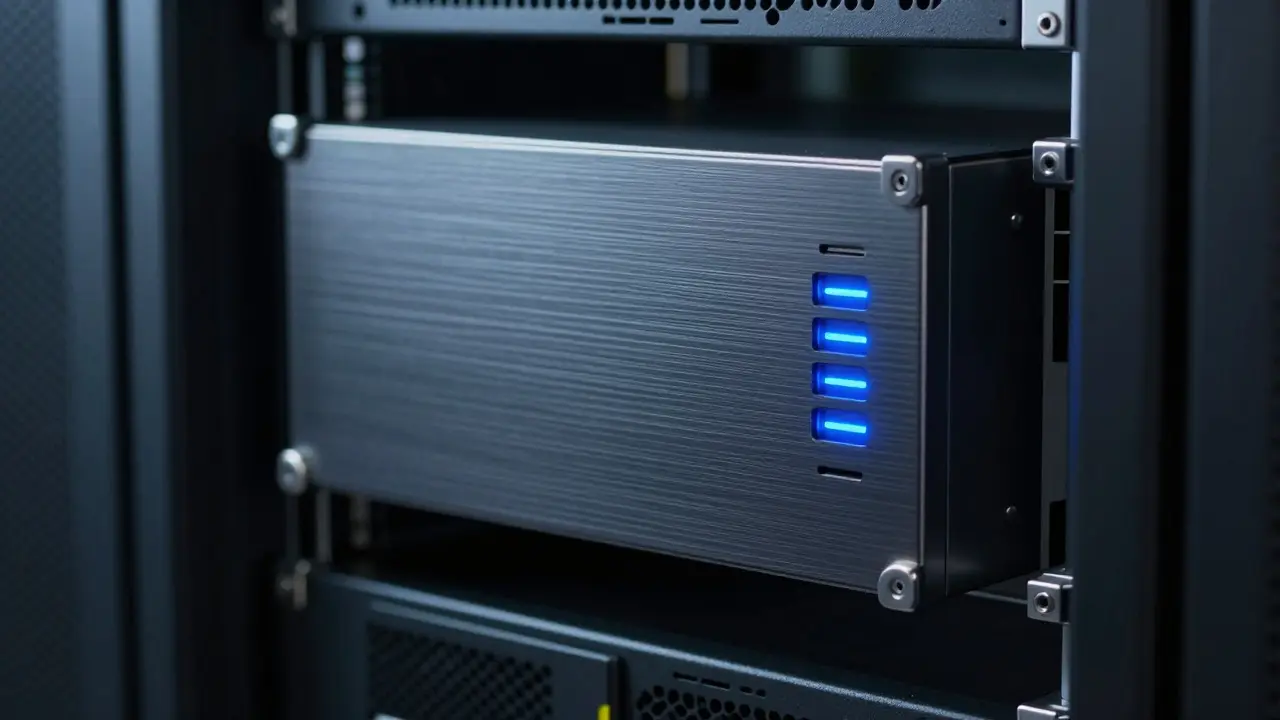
You hold the keys to your kingdom, or do you? In the world of digital assets, that question isn't philosophical-it's existential. For institutions managing millions in Bitcoin or Ethereum, relying on a simple password or a USB stick is negligence. This is where Hardware Security Modules enter the picture. They are the heavy-duty vaults of the cryptographic world, designed to ensure that private keys never leave a hardened boundary in plaintext.
By mid-2026, HSMs have evolved from niche banking tools into the backbone of institutional crypto custody. But they aren't the only game in town anymore. With Multi-Party Computation (MPC) rising in popularity, many wonder if the hardware box is becoming obsolete. The answer is more nuanced. HSMs remain the gold standard for regulatory compliance and high-volume signing, but they now often work alongside other technologies rather than standing alone.
What Exactly Is an HSM?
An Hardware Security Module is a dedicated physical computing device or specialized crypto processor that safeguards and manages digital keys for strong authentication and performs cryptographic operations inside a tamper-evident and intrusion-resistant boundary. Unlike a general-purpose server running software, an HSM is purpose-built for one thing: key management.
Think of it like this: if a software wallet is a house with a deadbolt, an HSM is a bank vault buried underground. When you generate a private key inside an HSM, that key stays there. It never exits the device in a readable format. Even if hackers compromise the server the HSM is attached to, they can’t steal the key because the key never left its secure home. All operations-signing transactions, encrypting data-happen internally. The outside world only sees the result, not the secret ingredient.
This concept isn't new to crypto. Traditional finance has used HSMs for decades to secure Visa and Mastercard payment networks, government systems, and certificate authorities. When Bitcoin launched in 2009, the industry adapted these existing, battle-tested devices to protect digital asset wallets. Companies like Thales Group and vendors providing infrastructure for Stripe and Ripple have long positioned HSMs as "trust anchors" for cryptographic infrastructure.
The Certification That Matters: FIPS 140-3
Not all hardware boxes are created equal. In institutional custody, trust is built on certifications, specifically those from the National Institute of Standards and Technology (NIST). The benchmark is FIPS 140-2 and its successor, FIPS 140-3. These standards define four security levels, with Level 3 being the practical minimum for serious financial services and cryptocurrency custody.
At FIPS Level 3, the requirements are strict. The device must detect physical intrusion attempts-like someone trying to pry open the casing-and immediately zeroize (wipe) all plaintext keys. Private keys may only enter or leave the device in an encrypted state. This means if a thief physically steals the HSM, they get a brick. If they try to crack it open, the keys vanish.
Spark’s 2026 glossary and Cregis’s institutional custody explainers emphasize that Level 3 validation is non-negotiable for most banks and exchanges. It mandates tamper detection, response mechanisms, and identity-based authentication for anyone accessing the module. Without this certification, auditors will likely flag your custody solution as insufficient for holding client funds.
HSM Architecture in Modern Custody
How does an HSM fit into your tech stack? Typically, you’ll find them deployed as network-attached appliances or PCIe cards installed directly into servers within secure data centers. They feature dedicated cryptographic engines optimized for algorithms like ECDSA and EdDSA, which power Bitcoin and Ethereum transactions.
Keys are generated using True Random Number Generators (TRNGs) inside the HSM. From there, integration happens via APIs, commonly using the PKCS#11 interface. This allows your trading platforms, wallet software, and back-office systems to request signatures without ever touching the raw key material.
Consider the architecture of OpenCustody, an open-source project updated in late 2025. Their design places HSMs at the core of exchanges and crypto-banks. Keys are born in the HSM, used for signing within the HSM, and managed through strict API calls. This setup ensures that even if the surrounding application code has vulnerabilities, the keys themselves remain isolated behind the hardware boundary.

HSM vs. MPC: The Great Debate
If you’ve been reading about crypto security in 2026, you’ve heard about Multi-Party Computation (MPC). MPC splits a private key into shares distributed across multiple parties or devices. No single party ever holds the full key. Transactions require a threshold of shares to come together cryptographically to sign.
Proponents of MPC, including firms like Zengo and Entropy, argue that it eliminates the single point of failure inherent in a physical HSM box. They claim the protocol itself is the root of trust, not the hardware. ChainScoreLabs, in a March 2025 analysis, went so far as to say MPC is replacing HSM-centric systems because it scales better across jurisdictions and avoids concentrating secrets in one location.
However, HSM advocates counter that hardware provides tangible, auditable security. Ripple notes in their 2023 guide that HSMs are simpler to understand and ideal for air-gapped wallets and long-term storage. For conservative banks and treasuries, a FIPS-certified metal box is easier to explain to regulators than a complex mathematical proof involving distributed shares.
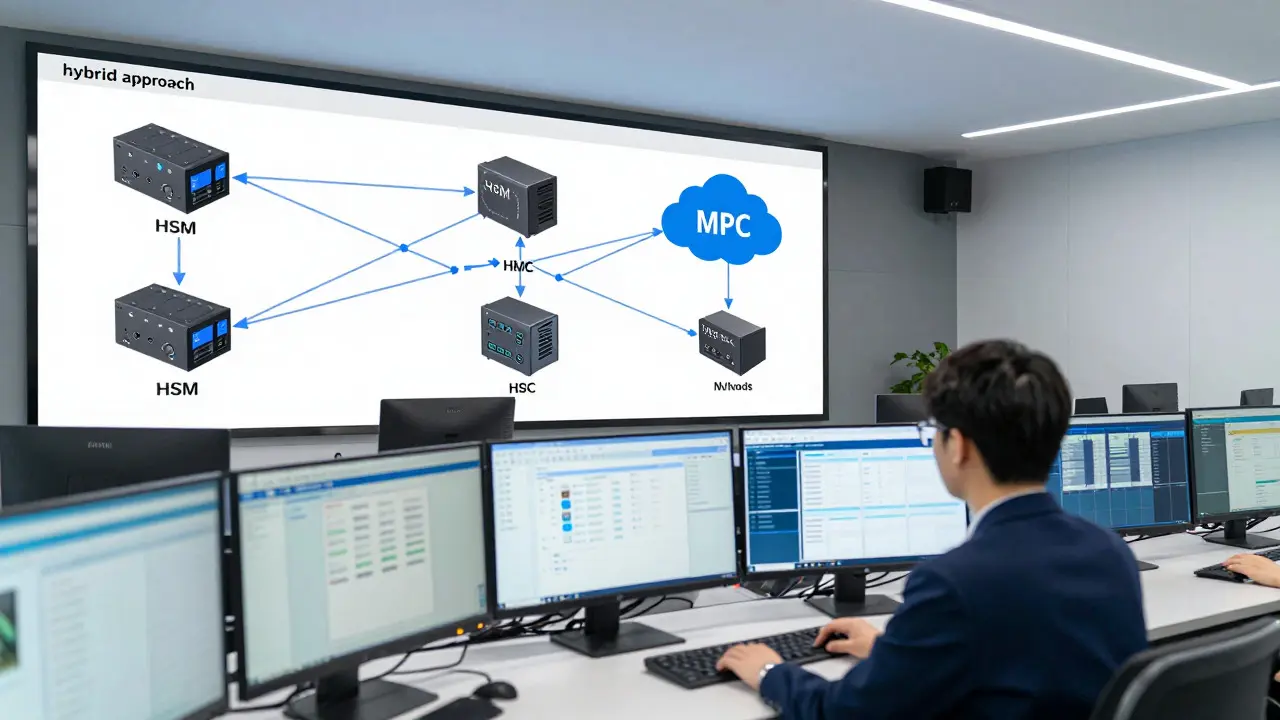
The reality in 2026 is often a hybrid approach. Tokenminds’ overview of best custody solutions highlights that leading platforms combine both. They use HSMs to store key material securely in tamper-evident devices while employing MPC protocols to ensure no single machine can unilaterally sign major transactions. This gives you the regulatory comfort of certified hardware with the flexibility and distribution benefits of MPC.
| Feature | Hardware Security Module (HSM) | Multi-Party Computation (MPC) | Multi-Signature (Multi-Sig) |
|---|---|---|---|
| Key Storage | Inside tamper-resistant hardware | Distributed as shares across devices/parties | Multiple distinct keys stored separately |
| Regulatory Acceptance | High (FIPS validated) | Moderate/Growing | High (On-chain transparency) |
| Single Point of Failure | Yes (Physical device) | No (Distributed) | No (Distributed keys) |
| Performance | High (Hardware accelerated) | Moderate (Computational overhead) | Low (Requires multiple on-chain txns) |
| Best Use Case | Cold storage, high-volume hot wallets | Distributed teams, cross-border ops | Treasury management, DAOs |
Operational Realities and Limitations
Implementing HSM-based custody isn't plug-and-play. It requires acquiring certified hardware or subscribing to cloud HSM services, integrating via APIs, and designing rigorous operational processes. You need to manage the full key lifecycle: generation, rotation, and destruction. This demands specialized skills in security engineering and DevOps.
One major limitation is centralization. As Eco’s 2026 support article points out, in an HSM model, customers never directly hold private keys. The custodian controls the hardware. Movement of assets requires authentication through the custodian’s operational process, which includes multi-factor authentication and human review for large transfers. This adds security but reduces immediacy compared to self-custody models.
Furthermore, HSMs alone are not enough. Cregis emphasizes that hardware enforces a boundary, but policy-level controls are still necessary. You need strong access controls, segregation of duties, and robust monitoring. CoinHubToday’s June 2026 data shows that while 100% of serious custodians use Tier 1 key management (HSM/MPC), only about 70% have implemented advanced Tier 3 transaction-layer controls like pre-signature simulation. Relying solely on the HSM without these layers leaves gaps in your security posture.
Who Uses HSMs Today?
The user base for HSMs in crypto is exclusively institutional. You won’t see retail investors buying Thales Luna or Utimaco modules for their personal savings. Instead, look at:
- Centralized Exchanges: Managing hot and cold wallet keys for millions of users.
- Custodial Service Providers: Offering regulated storage for hedge funds and pension schemes.
- Stablecoin Issuers: Protecting the reserves backing tokens like USDC or USDT.
- Payment Processors: Handling high-throughput crypto payments with the speed HSMs provide.
TradingStack notes that the earliest institutional solutions were built on HSMs, adapting devices from payment clearing systems. Today, these architectures continue to evolve, often housed in physically secure facilities with air-gapped configurations for cold storage.
Future Outlook: Hybrid is the Winner
Is the HSM dying? Not quite. While MPC gains ground for flexible, distributed signing, HSMs remain deeply embedded in institutional stacks for cold storage and high-value treasury operations. The trend in 2026 is toward hybrid architectures. Leading platforms use HSMs as trusted hardware roots-providing secure randomness and tamper-evident storage-while leveraging MPC for the actual signing workflows.
For regulated institutions, the FIPS validation of an HSM provides a clear audit trail that pure software solutions struggle to match. As long as regulators demand physical security proofs and hardware-enforced boundaries, HSMs will retain their place as a critical component of crypto custody. The smartest move isn't choosing between HSM and MPC, but understanding how to combine them effectively.
What is the difference between an HSM and a hardware wallet?
While both are hardware devices, an HSM is an enterprise-grade appliance designed for high throughput, regulatory compliance (like FIPS 140-3), and integration into server infrastructures. A consumer hardware wallet (like Ledger or Trezor) is a portable device for individual use, lacking the performance, certification levels, and API integrations required for institutional custody.
Do I need FIPS 140-3 Level 3 for my crypto business?
If you are an institutional custodian, exchange, or bank handling client funds, yes. Level 3 is the industry standard for financial services because it mandates tamper detection and immediate key zeroization upon physical intrusion. Lower levels may not satisfy auditor or regulator requirements for digital asset custody.
Can HSMs be hacked remotely?
Directly hacking the cryptographic engine of a modern, patched HSM is extremely difficult. However, the systems connected to the HSM can be compromised. If an attacker gains control of the server sending commands to the HSM, they might trick the HSM into signing malicious transactions. This is why operational controls, access policies, and monitoring are just as important as the hardware itself.
Is MPC replacing HSMs completely?
Not completely. While MPC is growing rapidly for its distributed nature, HSMs remain essential for regulatory compliance and as trusted sources of randomness. Most top-tier custody solutions in 2026 use a hybrid model, combining the hardware assurance of HSMs with the flexibility of MPC protocols.
What is PKCS#11 and why is it important for HSMs?
PKCS#11 is a standard API (Application Programming Interface) that allows software applications to interact with hardware security modules. It provides a common language for your custody platform to request key generation, encryption, and signing operations from the HSM, regardless of the specific vendor's hardware.
