
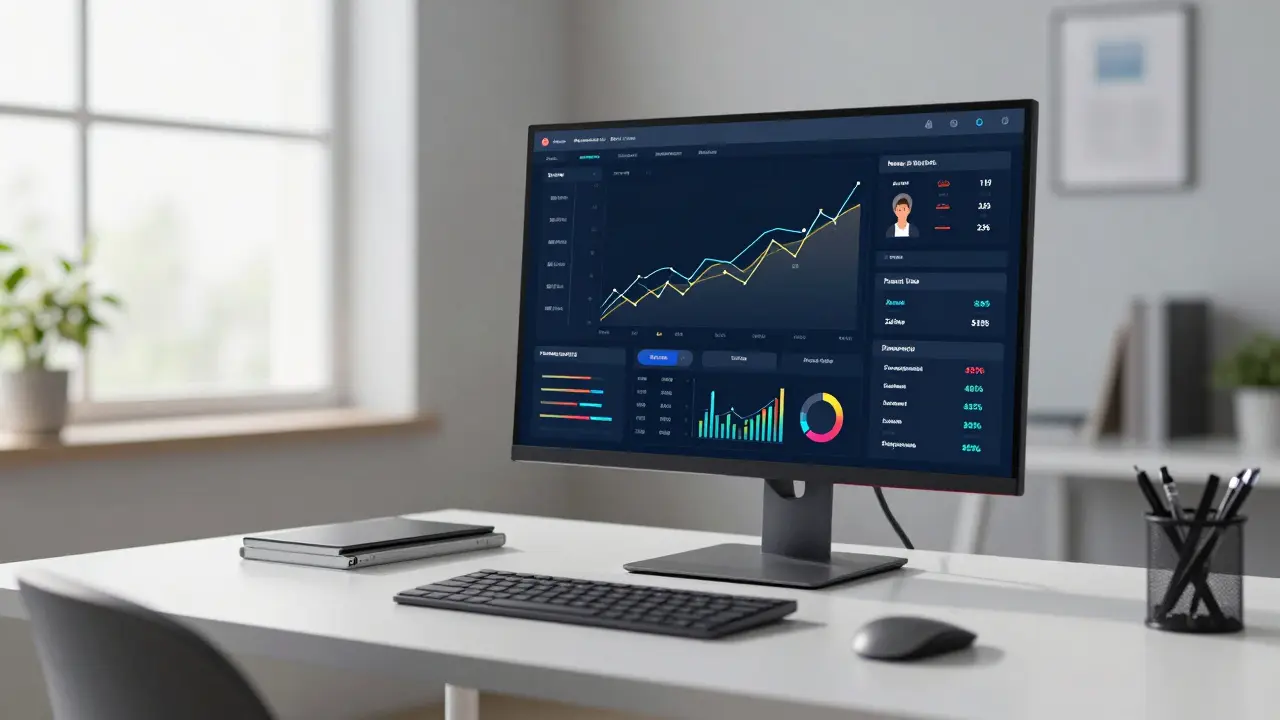
Imagine looking at a dashboard that tells you exactly which students are about to fail your course before they even miss the first deadline. That is the power of learning analytics. It moves education away from guesswork and toward evidence-based decisions. Instead of waiting for final grades to reveal problems, instructors can spot trends in real-time. This approach transforms how we design courses, support learners, and measure success.
In 2026, almost every digital learning environment generates massive amounts of data. From login times to video watch duration, every click leaves a trace. The challenge isn't collecting this data; it's making sense of it. Many educators feel overwhelmed by raw numbers. They see spreadsheets full of activity logs but don't know how to translate them into better teaching strategies. The goal here is simple: use data to help more students succeed.
Understanding the Core Metrics That Matter
To improve courses using data, you first need to know what to look at. Not all metrics are created equal. Some tell you about student behavior, while others reveal cognitive load or emotional engagement. Focusing on the wrong data points leads to wasted effort. For example, tracking total time spent in a Learning Management System (LMS) might seem useful, but it doesn't tell you if a student was actively studying or just leaving the tab open.
- Engagement Rate: The frequency and depth of interaction with course materials, such as forum posts, quiz attempts, and resource downloads.
- Completion Rates: The percentage of learners who finish specific modules or the entire course within a set timeframe.
- Time-on-Task: Active duration spent on specific assignments or readings, excluding idle periods.
- Assessment Correlation: How early performance metrics predict final grades or certification outcomes.
Start by defining what "success" looks like for your specific course. Is it high test scores? Practical skill application? Or simply consistent participation? Once you define the outcome, work backward to identify the leading indicators. If low forum participation correlates with lower exam scores, then engagement becomes a critical metric to monitor. This alignment ensures that your data collection serves a clear pedagogical purpose rather than just feeding a database.
Identifying At-Risk Students Early
One of the most impactful uses of learning analytics is early warning systems. These tools flag students who show patterns associated with dropout or failure. Traditional methods often wait until midterms to intervene, which is sometimes too late. Modern analytics platforms use algorithms to detect subtle signs of struggle much earlier.
Consider a scenario where a student usually logs in three times a week but suddenly drops to once. Or perhaps they are spending significantly more time on introductory videos than their peers, indicating confusion with basic concepts. When these anomalies occur, the system can alert the instructor. This allows for timely, personalized outreach. A simple email saying, "I noticed you're spending extra time on Module 2, do you have questions?" can change a student's trajectory. Studies in higher education show that early intervention increases retention rates by up to 15% in online programs.
However, accuracy matters. False positives can waste instructor time, while false negatives leave struggling students behind. To balance this, combine quantitative data with qualitative checks. Don't rely solely on automated flags. Use the data as a starting point for human judgment. Ask yourself: Does this student's pattern match known risk factors? Have there been recent technical issues? Context prevents misinterpretation of the numbers.
Optimizing Course Content Based on Usage
Data also reveals how students interact with your content. Are they skipping certain videos? Do they download PDFs but never read them? This information helps you refine your instructional design. If 80% of students skip a particular lecture, it might be too long, too dense, or redundant. Conversely, if everyone watches a specific tutorial twice, it might be confusing and need simplification.
| Metric Observation | Possible Issue | Actionable Strategy |
|---|---|---|
| High drop-off rate at minute 3 of a 10-minute video | Attention span limit or irrelevant intro | Chunk content into shorter segments; add interactive checkpoints |
| Low engagement with discussion forums | Lack of clear prompts or perceived value | Introduce peer grading; pose controversial or practical questions |
| High error rates on specific quiz questions | Conceptual misunderstanding or poor question wording | Review instructional material for clarity; revise question stems |
| Rapid completion of reading assignments | Skimming or lack of depth | Add comprehension quizzes; require annotated notes |
Use A/B testing for major changes. Create two versions of a module with different structures or media types. Randomly assign students to each group and compare their performance and satisfaction. This scientific approach removes bias from course design. You stop asking, "Do I think this works?" and start asking, "Does the data show this works?" Over time, this iterative process builds a highly effective curriculum tailored to your audience's actual needs.
Fostering Engagement Through Personalization
Personalized learning is no longer a buzzword; it's a necessity driven by data. One-size-fits-all instruction fails diverse learner populations. Analytics allow you to segment students based on their learning styles, pace, and preferences. Some learners thrive with visual aids, while others prefer text-heavy resources. Others need frequent feedback loops to stay motivated.
Adaptive learning platforms take this further by adjusting content difficulty in real-time. If a student answers multiple questions correctly, the system serves harder challenges. If they struggle, it provides remedial exercises. This keeps learners in the "zone of proximal development," where tasks are challenging but achievable. The result is reduced frustration and increased confidence.
You can implement personalization without expensive software. Use LMS features to create conditional releases. For instance, if a student scores below 70% on a diagnostic quiz, automatically unlock a supplementary review module. If they score above 90%, let them skip ahead to advanced topics. This respects individual pacing and prevents boredom among faster learners. Always communicate why certain paths are recommended. Transparency builds trust and encourages self-regulated learning.

Ethical Considerations and Privacy
With great data comes great responsibility. Collecting detailed information about students raises significant ethical questions. Who owns this data? How is it stored? Could it be used against students in hiring or future academic applications? In 2026, regulations like GDPR and FERPA still govern data privacy, but technology outpaces law. Institutions must establish clear policies.
Be transparent with learners. Tell them what data you collect and why. Explain how it will help them succeed. Avoid surveillance-style monitoring that creates anxiety. Focus on supportive analytics rather than punitive tracking. For example, frame alerts as opportunities for help, not warnings of punishment. Anonymize data when sharing insights with broader teams or publishing research. Protecting student privacy maintains trust, which is essential for any educational relationship.
Also, watch for algorithmic bias. Historical data may reflect past inequalities. If previous cohorts of a certain demographic performed poorly due to external factors, an algorithm might incorrectly predict future failure for similar students. Regularly audit your models for fairness. Involve diverse stakeholders in interpreting results. Human oversight remains crucial to ensure data serves justice, not just efficiency.
Implementing a Sustainable Analytics Workflow
Setting up learning analytics isn't a one-time project. It requires a sustainable workflow integrated into your daily teaching routine. Start small. Pick one or two key metrics to track initially. Master interpreting those before adding complexity. Use existing tools in your LMS before investing in new software. Most platforms offer basic reports on attendance, grades, and activity.
- Define Goals: Align analytics with specific learning outcomes.
- Select Tools: Choose user-friendly dashboards that visualize data clearly.
- Train Staff: Ensure instructors understand how to read and act on data.
- Collect Data: Run courses normally while gathering baseline metrics.
- Analyze Trends: Look for patterns across weeks and semesters.
- Iterate Design: Adjust content and support based on findings.
- Evaluate Impact: Measure whether changes improved student success.
Collaborate with instructional designers and IT specialists. They can help automate reports and troubleshoot technical issues. Share best practices among faculty. Create a community of practice where teachers discuss what worked and what didn't. Continuous improvement relies on collective wisdom, not isolated efforts. By embedding analytics into your culture, you make data-driven decision-making a natural part of teaching.
What is the difference between learning analytics and educational data mining?
Learning analytics focuses on measuring and analyzing data to support and optimize learning and the environments in which it occurs. It is action-oriented and aims to improve educational outcomes. Educational data mining involves discovering new knowledge about learning processes through computational methods. It is more research-focused and seeks to uncover underlying patterns and theories. While related, learning analytics is applied directly by educators, whereas data mining is often conducted by researchers.
How can small institutions afford learning analytics tools?
Many Learning Management Systems (LMS) like Moodle, Canvas, or Blackboard include built-in analytics features at no extra cost. Start by utilizing these native reports. Open-source tools like OLAT or Mahara also offer robust analytics capabilities. Additionally, cloud-based services often provide tiered pricing suitable for smaller budgets. Prioritize functionality over brand name. Focus on solving specific problems rather than buying comprehensive suites you won't fully use.
Can learning analytics replace traditional assessment methods?
No, learning analytics should complement, not replace, traditional assessments. Quizzes and exams measure specific knowledge acquisition at a point in time. Analytics provide a continuous view of learning behaviors and engagement. Combining both gives a holistic picture of student progress. Relying solely on behavioral data misses nuances of deep understanding, while relying only on tests ignores the learning process itself. Use analytics to inform how you assess, not to eliminate assessment.
What are common pitfalls in implementing learning analytics?
Common pitfalls include data overload, lack of instructor training, and ignoring context. Educators may collect vast amounts of data but fail to act on it due to complexity. Without proper training, they cannot interpret dashboards effectively. Another mistake is treating data as absolute truth without considering external factors affecting students. Finally, failing to communicate with students about data usage breeds distrust. Address these by starting small, providing support, and maintaining transparency.
How does AI enhance learning analytics in 2026?
AI enhances learning analytics by automating pattern recognition and prediction. Machine learning algorithms can process large datasets quickly to identify at-risk students or recommend personalized resources. Natural language processing analyzes discussion forums for sentiment and understanding. AI reduces manual workload for instructors, allowing them to focus on intervention. However, AI models require careful validation to avoid bias and ensure accuracy. Human oversight remains essential for ethical and effective implementation.

Comments (9)
michael rome June 5 2026
It is absolutely imperative that we recognize the profound shift from anecdotal evidence to empirical validation in modern pedagogy. The notion of waiting for final grades to ascertain student comprehension is archaic and fundamentally flawed in a digital ecosystem. We must embrace the granularity of data points such as login frequency and video engagement metrics to construct a holistic view of learner behavior. This transition requires a significant cultural shift within academic institutions, moving away from intuition-based teaching toward a rigorous, data-informed methodology. By leveraging these insights, educators can proactively identify at-risk individuals before they disengage entirely, thereby fostering an environment conducive to sustained academic success.
Andrea Alonzo June 6 2026
I have spent considerable time reflecting on the implications of this approach, particularly regarding the ethical dimensions of surveillance versus support, and it is quite fascinating how the line blurs when we begin tracking every single click a student makes within a learning management system because while the intention is undoubtedly to help those who are struggling, one cannot ignore the potential for creating an atmosphere of constant scrutiny that might inadvertently increase anxiety rather than alleviate it, especially for students who already feel marginalized or overwhelmed by the sheer volume of expectations placed upon them in higher education today.
Saranya M.L. June 7 2026
The pedagogical efficacy of Learning Analytics (LA) is contingent upon the precise calibration of Key Performance Indicators (KPIs) to align with specific cognitive load theories and instructional design frameworks. It is incumbent upon educational practitioners to distinguish between superficial engagement metrics, such as mere presence in a virtual classroom, and deep cognitive engagement, which necessitates a more nuanced analysis of interaction patterns and assessment correlation coefficients. Furthermore, the implementation of algorithmic bias mitigation strategies is non-negotiable to ensure equitable outcomes across diverse demographic cohorts, thereby upholding the integrity of the educational data mining process.
om gman June 8 2026
oh look another article telling us to trust the machine gods to save our failing education systems its always so dramatic when numbers tell you what to do isnt it i mean sure lets just ignore the fact that half these dashboards are garbage and the other half are spying on kids like some dystopian nightmare but hey if you want to play god with algorithms be my guest just dont cry when the false positives drive your students insane
Jeanne Abrahams June 8 2026
How utterly charming that we believe a spreadsheet can replace human intuition. In South Africa, we often deal with infrastructure challenges that make 'real-time analytics' a luxury few can afford, yet here we are discussing A/B testing lecture videos as if bandwidth issues don't exist. It's a bit rich, isn't it? But I suppose if you're sitting in a climate-controlled office with unlimited data, the world really does look like a series of manageable metrics rather than a chaotic mess of human struggle.
Bineesh Mathew June 9 2026
The soul of education is being dissected by cold, unfeeling algorithms that reduce the vibrant tapestry of human curiosity into binary data points of success and failure. We are witnessing the commodification of learning, where the sacred act of seeking knowledge is transformed into a transactional metric of efficiency. This pseudo-intellectual reliance on data strips away the mystery and beauty of the unknown, leaving us with a sterile landscape where only the measurable matters, and the immeasurable spirit of inquiry is left to wither in the shadows of statistical significance.
Oskar Falkenberg June 9 2026
i think thats a fair point about the soul of things but honestly ive seen too many students drop out because no one noticed they were struggling until it was way too late so maybe losing a bit of mystery is worth saving a few degrees im not saying the data is perfect or anything cause let me tell you the typos in some of these reports are hilarious but still if we can catch someone early that seems better than letting them fail silently right?
Caitlin Donehue June 11 2026
I wonder if anyone has actually looked at the long-term effects of this constant monitoring on student creativity.
Francis Laquerre June 11 2026
The integration of learning analytics represents a pivotal moment in global educational discourse, bridging cultural gaps through universal data standards while respecting local pedagogical nuances. It is essential that we approach this technological evolution with a spirit of collaboration, ensuring that diverse voices from various international contexts contribute to the development of inclusive and effective analytical frameworks. By sharing best practices across borders, we can create a more equitable and responsive educational landscape that truly serves all learners regardless of their geographical location.