

Every student deserves a fair shot at learning. But for millions of students with disabilities, that’s not always the case-unless schools and institutions follow the law. In the United States, two major laws shape how education must be accessible: the ADA and key parts of education law like IDEA and Section 504. These aren’t suggestions. They’re legal obligations. Ignoring them can lead to lawsuits, loss of federal funding, and, most importantly, harm to students who need support.
What the ADA Really Means for Schools
The Americans with Disabilities Act (ADA), passed in 1990, is often thought of as a law about ramps and parking spots. But it goes far deeper. Title II of the ADA applies to public entities-including public schools, community colleges, and universities. It says these institutions can’t exclude people with disabilities from any program, service, or activity. That includes online learning platforms, textbooks, exams, field trips, and even school websites.
For example, if a school uses a learning management system like Canvas or Blackboard but doesn’t make it compatible with screen readers, it’s violating the ADA. If a video lecture has no captions, or a PDF syllabus isn’t readable by assistive tech, that’s also a violation. It doesn’t matter if the teacher didn’t mean to exclude anyone. The law doesn’t care about intent. It cares about outcome.
The ADA doesn’t just cover physical spaces. It covers digital ones too. In 2023, the Department of Justice made it clear: websites and digital content must be accessible under Title II. Schools that rely on third-party tools-like Zoom, Google Classroom, or Quizlet-must ensure those tools meet accessibility standards. If they don’t, the school is still responsible.
Section 504 and IDEA: The Education Law Side
While the ADA sets broad civil rights standards, two other laws drill down into education specifically: Section 504 of the Rehabilitation Act and the Individuals with Disabilities Education Act (IDEA).
Section 504 applies to any program that receives federal funding-which includes nearly every public school and most private colleges. It requires schools to provide reasonable accommodations so students with disabilities can access education on an equal basis. A student with dyslexia might get extra time on tests. A student with mobility challenges might get a note-taker or priority seating. These aren’t special privileges. They’re legal rights.
IDEA, on the other hand, goes further. It applies only to K-12 public schools and mandates individualized education programs (IEPs) for eligible students. An IEP isn’t just a plan. It’s a legally binding document that outlines exactly what services the student will receive, how often, and who will deliver them. If a school fails to follow an IEP, parents can file a due process complaint-and win. In 2024, the U.S. Department of Education reported over 12,000 IDEA-related complaints were resolved, with schools required to pay for private placements, tutoring, or compensatory services in more than 60% of cases.
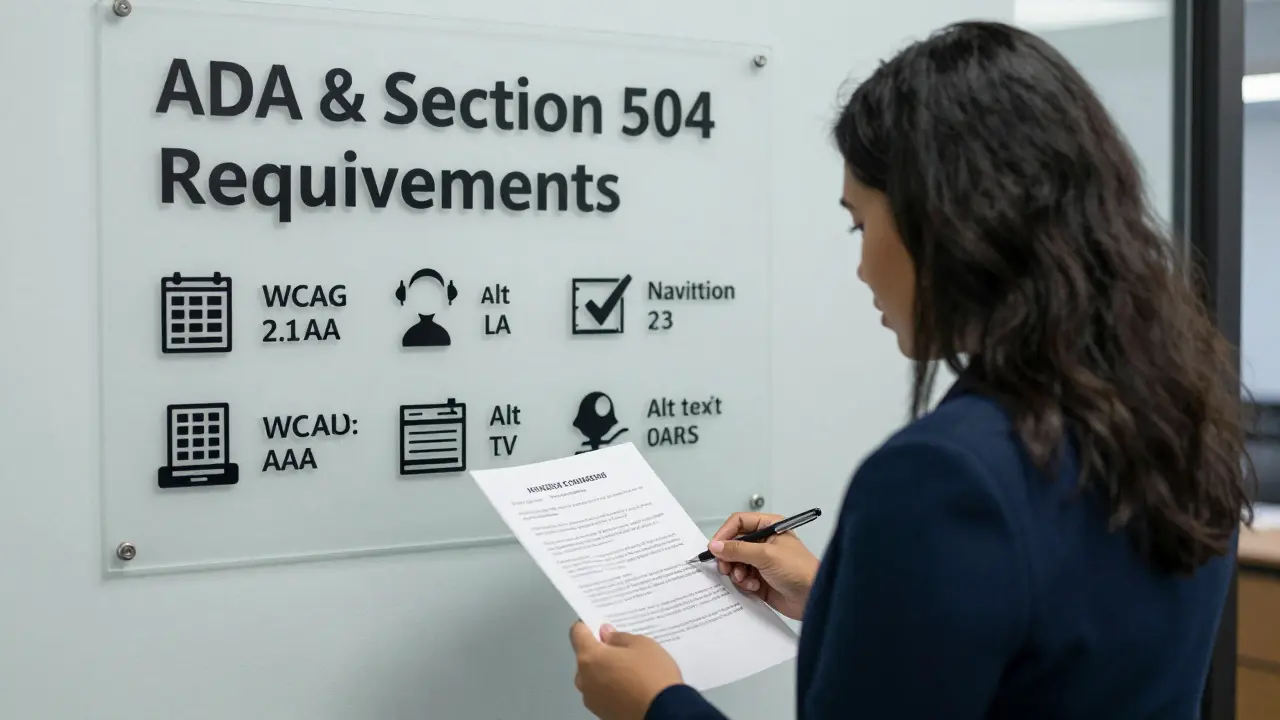
Where ADA and Education Law Overlap-and Clash
ADA and IDEA often work together, but they’re not the same. IDEA is more detailed and specific to K-12. ADA and Section 504 apply to all levels, including colleges. A student who outgrows IDEA at age 22 still has rights under ADA and Section 504 in college.
Here’s a common scenario: A high school senior with ADHD gets extended time on SATs under IDEA. When they get to college, the university doesn’t automatically give them the same accommodations. That’s legal. But the college must still evaluate the student’s needs under Section 504 and provide reasonable accommodations-not necessarily the same ones, but ones that give equal access.
That’s where confusion creeps in. Schools sometimes think, “We followed IDEA, so we’re done.” But college is a different system. And the ADA still applies. Colleges can’t say, “We don’t have funding for that.” The law doesn’t allow cost as a reason to deny access.
What Schools Must Do: Practical Steps
Compliance isn’t optional. And it’s not just about lawyers and lawsuits. It’s about making sure every student can learn. Here’s what schools actually need to do:
- Train staff on accessibility basics-teachers, IT, and administrators. Many don’t know how to make a PowerPoint accessible or check if a PDF is screen-reader friendly.
- Test all digital content before rollout. Use free tools like WAVE or Axe to scan websites and documents. If a video is uploaded, captions must be added within 48 hours.
- Build accessibility into procurement. When buying software, ask vendors: “Is this WCAG 2.1 AA compliant?” Don’t accept “It’s accessible enough.” Demand documentation.
- Design for flexibility. Not all disabilities are visible. A student might need quiet space for exams, or a different font size, or voice-to-text tools. Offer options, not one-size-fits-all.
- Have a clear process for students to request accommodations. No one should have to fight to get what the law already gives them.
Some schools hire accessibility coordinators. Others use district-wide teams. Either way, someone needs to own this. And that person needs authority-not just a title.

What Happens When Schools Don’t Comply
The consequences aren’t theoretical. In 2025, a university in Texas paid $1.8 million in damages after a blind student sued over inaccessible course materials. The school had ignored repeated requests for accessible PDFs and videos. The court ruled the university violated both ADA and Section 504.
Another case in California involved a high school that refused to caption YouTube videos used in class. A parent filed a complaint with the Office for Civil Rights. The school lost federal funding for two years and was forced to retrain all staff.
These aren’t rare. The U.S. Department of Education’s Office for Civil Rights received 2,100 accessibility complaints in 2024 alone-up 40% from 2022. Most involved digital access: websites, online assignments, learning platforms.
It’s Not Just About Law-It’s About Learning
When a student with a visual impairment can finally read their textbook through a screen reader, they’re not just getting a legal accommodation. They’re getting a chance to learn. When a student with anxiety can take a test in a quiet room, they’re not being coddled. They’re being given a fair shot.
Accessibility isn’t about charity. It’s about justice. And the law is clear: education must be open to everyone. Schools that treat accessibility as an afterthought aren’t just breaking the law-they’re failing their students.
The tools exist. The standards are well-known. The cost of compliance is far less than the cost of a lawsuit. The real question isn’t whether schools can afford to be accessible. It’s whether they can afford not to be.
Does the ADA apply to private schools?
Yes, but differently. Private schools that don’t receive federal funding aren’t covered by Section 504 or IDEA. But they still must comply with Title III of the ADA, which requires places of public accommodation-including private schools-to make reasonable modifications to ensure accessibility. This means accessible websites, physical spaces, and accommodations like extended test time if requested.
What is WCAG 2.1 AA and why does it matter?
WCAG 2.1 AA stands for Web Content Accessibility Guidelines, version 2.1, Level AA. It’s the global standard for making websites and digital content accessible. Most legal cases and federal guidance now use WCAG 2.1 AA as the benchmark. If a school’s website or learning platform meets this standard, it’s far less likely to face legal trouble. Key requirements include text alternatives for images, keyboard navigation, captioned videos, and color contrast that’s easy to read.
Can a student be denied accommodations if they don’t have a formal diagnosis?
No. Under Section 504 and the ADA, schools must evaluate students if there’s reason to believe they have a disability that limits a major life activity-like learning, seeing, or concentrating. A formal diagnosis isn’t required. If a student shows signs of difficulty, the school must initiate an evaluation. Waiting for paperwork is a violation.
Do colleges have to provide personal aides like note-takers or interpreters?
Yes, if they’re necessary for equal access. Colleges must provide reasonable accommodations, which can include sign language interpreters, real-time captioning, note-takers, or assistive listening devices. They don’t have to provide personal devices like wheelchairs or hearing aids, but they must ensure the learning environment is accessible. If a student needs a note-taker because they’re blind or have a learning disability affecting writing speed, the college must arrange it.
What if a teacher refuses to make materials accessible?
The school is still legally responsible. Even if a teacher ignores accessibility rules, the institution must step in. Schools need policies that hold staff accountable. That includes training, clear guidelines, and consequences for non-compliance. If a teacher consistently ignores accessibility, the school’s leadership must intervene-because the law doesn’t excuse ignorance.
