
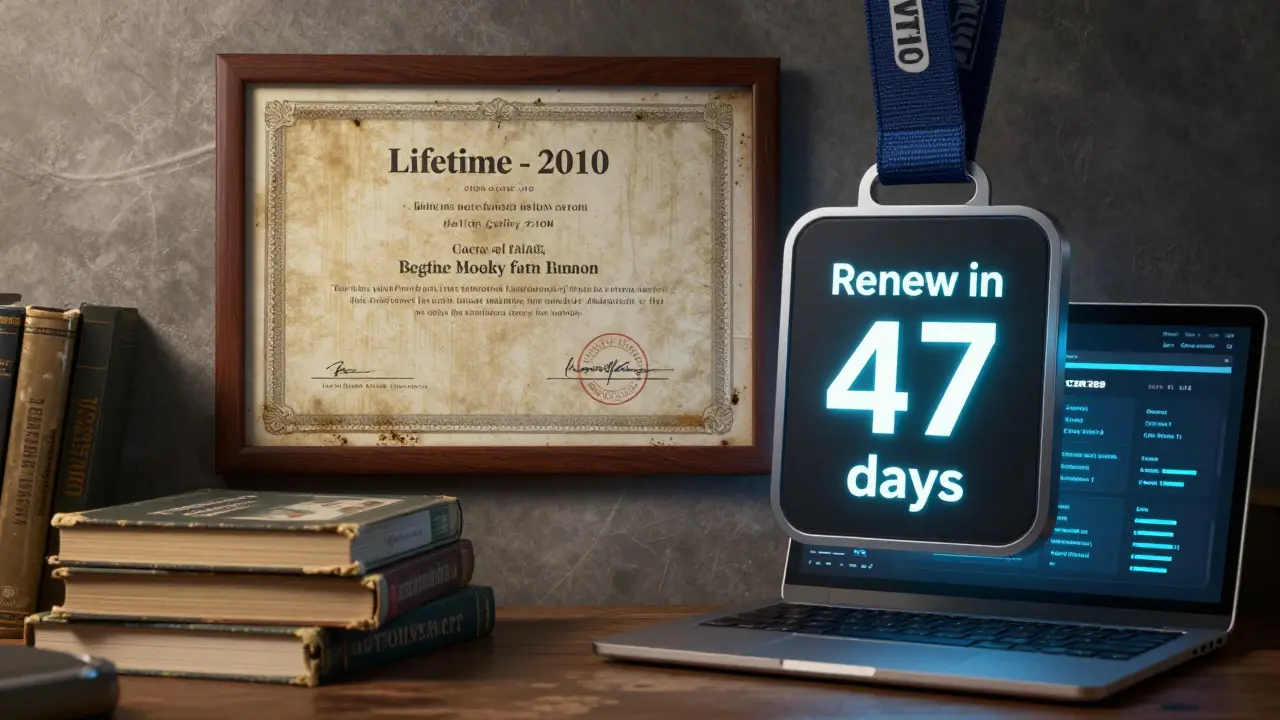
When you earn a professional certificate, do you expect it to last forever? Or should it expire? This isn’t just a technical question-it’s a policy decision that affects trust, safety, and how seriously people take your credentials. Too many organizations treat certification like a one-time trophy. But in fast-moving fields like cybersecurity, healthcare, or financial compliance, a certificate that never expires can be more dangerous than no certificate at all.
Why Lifetime Certificates Sound Good-But Often Aren’t
The idea of a lifetime certificate feels rewarding. You worked hard. You passed the test. You earned it. Why take it away? Some industries still offer them: project management (PMP), certain IT vendor certs, even some teaching licenses. But here’s the problem: skills decay.A 2023 study from the UK’s National Institute for Health and Care Excellence found that 62% of healthcare professionals who held lifetime certifications in infection control practices were no longer following updated protocols after five years. Why? Because they stopped updating their knowledge. The certificate became a badge, not a guarantee.
Lifetime certificates create a false sense of security. Employers assume you’re still current. Clients assume you know the latest standards. Regulators assume you’re compliant. But without renewal, you’re not just outdated-you’re potentially risky.
Expiring Certificates: The Real Safety Net
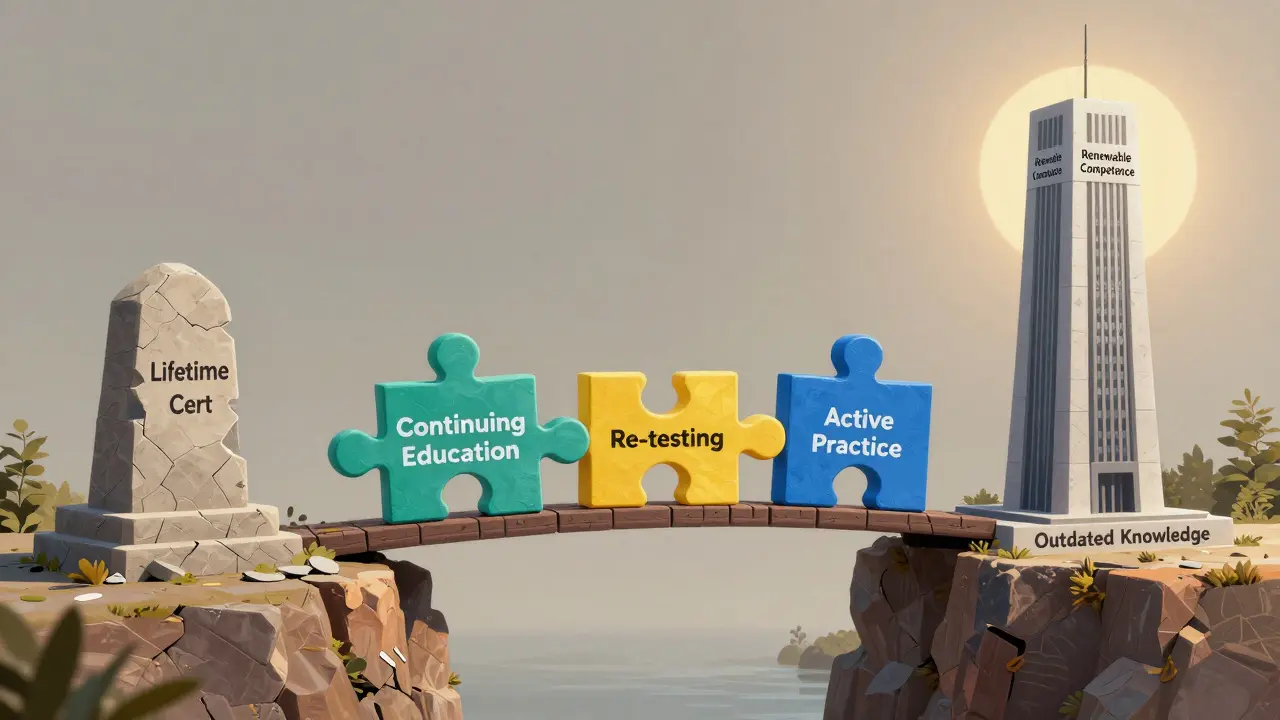
Expiring certificates force renewal. That’s not punishment-it’s protection. Think of it like a driver’s license. You don’t get to keep yours forever because road rules change, new technologies emerge, and human reaction times decline with age. The same logic applies to professional competence.Organizations that use expiring credentials typically require one of three things:
- Continuing education hours
- Re-testing
- Proof of active practice
For example, the UK’s Health and Safety Executive requires all certified asbestos assessors to renew every three years with documented training and case logs. That’s not bureaucracy-it’s public safety. If someone’s certifying a building as safe to occupy, you want them to know the latest regulations, not the ones from 2015.
Expiring certificates also help identify who’s truly engaged. Someone who renews consistently shows they care. Someone who lets theirs lapse? That’s a red flag-even if they once knew the material.
When Lifetime Certificates Might Make Sense
Not all fields change fast. Some foundational knowledge stays stable for decades. Think legal ethics, basic accounting principles, or core engineering standards. In those cases, lifetime certification can work-if it’s paired with mandatory updates.For example, the Institution of Engineering and Technology (IET) in the UK offers lifetime membership to certified engineers, but requires annual participation in technical briefings or webinars. It’s not about re-testing-it’s about staying connected. That’s the key: lifetime doesn’t mean static.
Another example: teaching certifications in Scotland. While the teaching license itself doesn’t expire, educators must complete 30 hours of professional development every five years to remain on the General Teaching Council register. The credential lasts, but the obligation to learn doesn’t.

Policy Design: What Actually Works
Designing a certification policy isn’t about picking one model over the other. It’s about matching the renewal cycle to the pace of change in your field.Here’s a simple framework:
- How fast does knowledge become outdated? If it’s less than two years, annual renewal. If it’s five to ten, go with triennial (every three years). If it’s more than ten, consider lifetime with mandatory updates.
- What’s the risk if someone gets it wrong? High-risk fields (medical, aviation, finance) need strict expiration. Low-risk fields (basic office software, some design tools) can afford flexibility.
- Can you verify ongoing competence? Can you require peer reviews, case studies, or log submissions? If yes, lifetime + updates works. If not, expiration is safer.
Many organizations fail because they pick a model based on tradition, not data. They keep lifetime certs because “that’s how it’s always been.” But in 2026, that’s not good enough.
Real-World Examples That Got It Right
Take the UK’s Certified Information Systems Security Professional (CISSP) credential. It expires every three years. To renew, you need 120 Continuing Professional Education (CPE) credits or retake the exam. That’s not easy. But because cybersecurity threats evolve daily, this system works. A 2025 survey by the UK Cyber Security Council showed that CISSP holders who renewed were 78% more likely to correctly identify a zero-day attack than those who didn’t.
Contrast that with a certificate in basic first aid. Some providers offer it for life. But the Red Cross updated its guidelines in 2024-changing compression depth, AED protocols, and pediatric response. If your cert says “lifetime,” but you haven’t trained since 2019, you’re not helping-you’re hurting.
Even in education, the trend is shifting. The Scottish Qualifications Authority stopped issuing lifetime teaching certificates in 2022. Now, all educators must renew every five years with evidence of active teaching and professional development. Why? Because curriculum changes. Student needs change. Teaching methods change.
The Hidden Cost of Not Expiring
There’s a cost to letting certificates sit forever. It’s not just about skill decay. It’s about credibility.When a company accepts a lifetime certificate from someone who hasn’t updated their knowledge in a decade, they’re not just trusting that person-they’re trusting the whole certification system. If that system becomes unreliable, employers start ignoring all certs. That’s how valuable credentials lose their meaning.
And when a certification body refuses to update its standards, it becomes irrelevant. We’ve seen it happen. A once-respected IT certification from 2010 is now a punchline because it doesn’t reflect cloud infrastructure, AI security, or DevOps practices. The organization that issued it? It’s gone.
Expiring certificates aren’t about control. They’re about keeping the system honest. They signal that competence isn’t a one-time achievement-it’s an ongoing commitment.
What Should You Do?
If you’re designing a certification program:- Don’t default to lifetime. Ask: How often does this knowledge change?
- Don’t make renewal a chore. Make it useful. Offer free webinars, discounted courses, or access to industry networks as part of renewal.
- Don’t ignore the human factor. People will let things lapse if it feels punitive. Make renewal feel like an opportunity, not an obligation.
- Track outcomes. Measure whether renewing leads to better performance, fewer errors, or higher client satisfaction.
If you’re holding a certificate:
- Check its expiration date. Even if it says “lifetime,” look for mandatory updates.
- Don’t assume your knowledge is still current. Compare your practices to the latest guidelines from your certifying body.
- If it’s expired, don’t panic. Renew it. It’s not a failure-it’s professionalism.
Certifications aren’t trophies. They’re tools. And tools need maintenance.
Do lifetime certificates have any value today?
Yes-but only if they’re paired with ongoing requirements. A lifetime certificate without mandatory updates is meaningless. The real value comes from proof that the holder stays current. Some organizations combine lifetime status with annual training or peer review to keep the credential credible.
How often should professional certificates expire?
It depends on the field. In fast-moving areas like cybersecurity, finance, or healthcare, renew every 1-3 years. In more stable fields like law or engineering fundamentals, 3-5 years works. For very static knowledge, lifetime with mandatory updates (like annual briefings) is acceptable. The key is matching renewal frequency to how fast the field changes.
Can I still use a certificate after it expires?
Technically, maybe-but you shouldn’t. Once a certificate expires, it no longer meets the standards of the issuing body. Using it to claim expertise or secure contracts is misleading. Most employers and regulators will treat it as invalid. Renewing is not optional if you want to stay compliant and credible.
What’s the biggest mistake organizations make with certification policies?
They design policies based on convenience, not risk. Choosing lifetime certificates because they’re cheaper to manage, or skipping renewal because “people don’t like it,” ignores the real cost: damaged trust, compliance failures, and safety risks. The easiest path isn’t the right one.
Are expiring certificates more expensive to manage?
Upfront, yes. Tracking renewals, sending reminders, and verifying training takes work. But the long-term cost of not doing it is far higher. A single incident caused by outdated knowledge-like a misdiagnosis, data breach, or safety violation-can wipe out years of savings and destroy reputation. Renewal systems are an investment, not an expense.

Comments (9)
Liam Hesmondhalgh March 25 2026
I'm sick of these so-called 'lifetime certs' in Ireland. My mate got his PMP in 2012 and still brags about it like he's some tech wizard. Meanwhile, he's still using PowerPoint to manage Agile sprints. If your cert doesn't expire, it's just a plastic plaque collecting dust. Time to scrap the whole 'lifetime' nonsense.Patrick Tiernan March 25 2026
Honestly I dont even get why people care so much about certs anymore. I mean like yeah sure if you're doing brain surgery maybe but most of this stuff is just corporate theater. My cousin works in IT and he got some 'cybersecurity' cert five years ago and now he just copies paste from stackoverflow. The system is broken.Patrick Bass March 27 2026
I think the key is balance. A lifetime certificate isn't inherently bad - it's the lack of mandatory engagement that makes it dangerous. If you're going to give someone a lifetime credential, you need to require annual micro-learning, peer review, or participation. Otherwise, it's just a trophy.Tyler Springall March 28 2026
The notion that a certification should expire is a Marxist construct designed to keep the working class dependent on institutional gatekeepers. True mastery is not measured by bureaucratic renewal cycles but by the quiet confidence of someone who has internalized their craft. I've been practicing network architecture since 1999 and I haven't renewed a single cert - and yet I've led five successful enterprise migrations. Who's really the expert here?Amy P March 30 2026
I work in healthcare compliance and I can't tell you how many people I've seen with 'lifetime' certs who clearly haven't opened a guideline since 2018. One guy tried to use a 2012 protocol for a sepsis case last month. We had to pull him off the floor. Certs aren't trophies - they're live wires. Let them expire and make renewal easy. Seriously, a 10-minute refresher webinar? That's not a burden. It's basic professionalism.Ashley Kuehnel March 31 2026
I'm a nurse educator and we just switched from lifetime to 3-year renewals last year. The best part? People started asking for free training sessions. They actually wanted to learn again. We now have a Slack group with 800+ nurses sharing tips, case studies, and even memes about AEDs. Renewal didn't kill engagement - it reignited it. Make it fun, make it useful, and people show up.adam smith April 1 2026
I have been in IT for over 20 years. I do not need a certificate to prove I know how to configure a firewall. The market rewards results, not plastic cards. If your company still requires expired certs for hiring, you're doing it wrong. Focus on skills, not stamps.Mongezi Mkhwanazi April 3 2026
Let me be very clear: the entire certification industry is a pyramid scheme built on the anxiety of the working class. Organizations profit from renewal fees while the individual is left scrambling to pay for webinars, exams, and mandatory 'professional development' that often has zero relevance to their actual job. The real solution? Decentralize expertise. Let GitHub, open-source contributions, and peer-reviewed project logs replace the corporate certification cartel. If you can demonstrate your competence through action - not paperwork - you shouldn't need a badge at all. The fact that we still live in a world where a 15-year-old certificate is considered 'valid' is a moral failure of the entire credentialing apparatus.Mark Nitka April 3 2026
I think we're all missing the point. The question isn't lifetime vs expiring - it's about trust. Expiring certs create accountability. Lifetime certs create complacency. But the real issue is how we verify competence. If we're going to require renewal, let's make it meaningful: peer-reviewed project logs, recorded code reviews, patient outcomes, or client feedback. Not just another quiz. The goal isn't to gatekeep - it's to ensure that the person holding the credential is actually, currently, doing good work. That's what matters.