
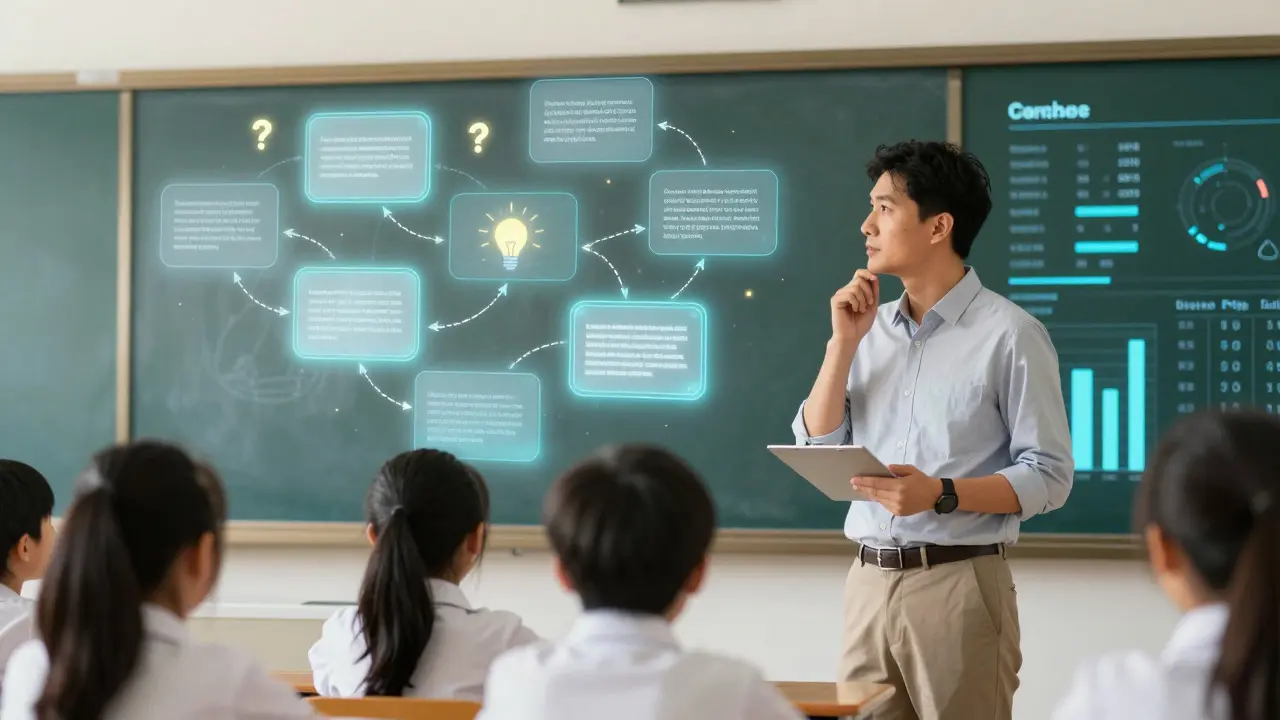
Imagine a system that reads your student’s essay not just to check for grammar, but to understand how deeply they’re thinking about climate change-or how confused they are about quadratic equations. That’s not science fiction. It’s natural language processing in action inside modern learning analytics.
What Is Natural Language Processing in Learning Analytics?
Natural language processing, or NLP, is a branch of artificial intelligence that lets computers understand, interpret, and generate human language. When you type a question into a chatbot or ask your phone to send a text, you’re using NLP. In education, it’s being used to turn messy, unstructured text-like discussion posts, essays, feedback, and even spoken responses-into usable data.
Learning analytics is about collecting and analyzing data from learning environments to improve outcomes. But before NLP, most of that data came from clicks, quiz scores, or time spent on a page. Now, it’s also coming from what students write and say. NLP bridges the gap between human expression and machine understanding.
For example, a student writes: "I get how photosynthesis works, but I don’t see how it connects to the carbon cycle." An older system might just count the words. NLP detects the uncertainty, flags the conceptual gap, and suggests a targeted video or reading. That’s the power of it.
How NLP Turns Text Into Actionable Insights
Here’s how it works in practice:
- Text is cleaned: punctuation, spelling errors, and irrelevant filler words are filtered out.
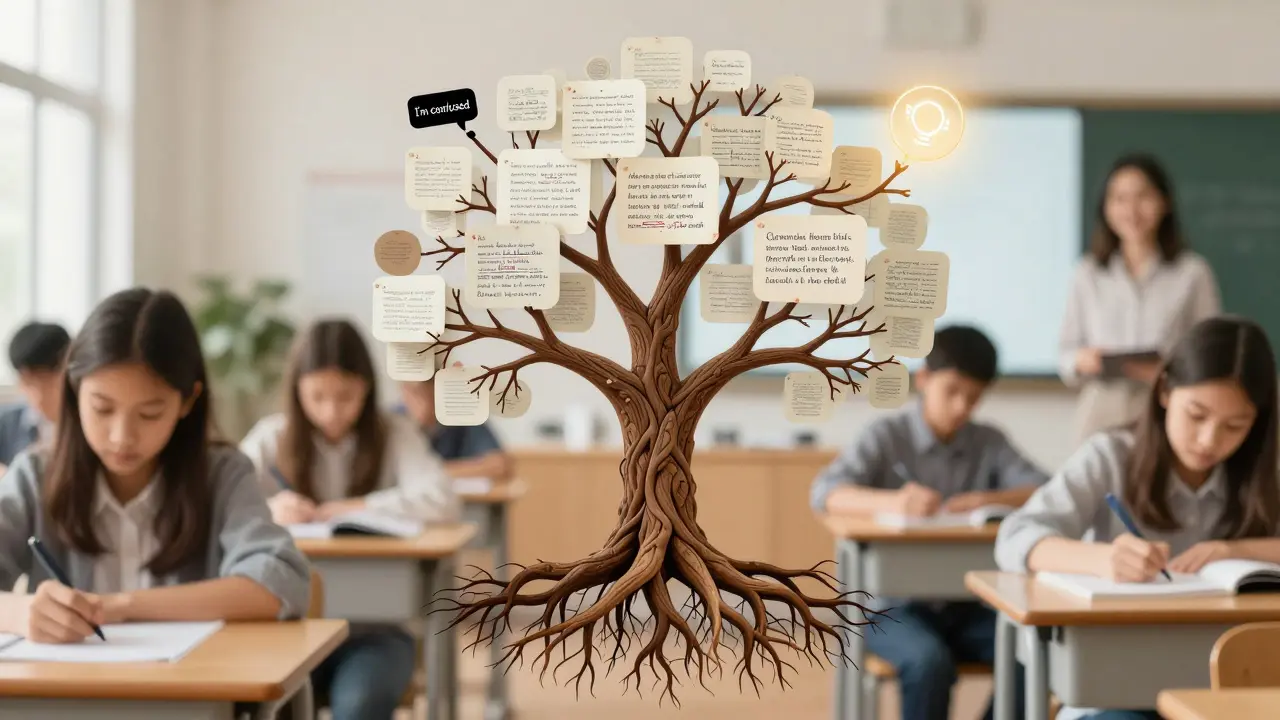
- Key phrases are identified: terms like "I think," "I’m confused," or "this makes sense" are tagged for emotional or cognitive signals.
- Sentiment and tone are analyzed: Is the student frustrated? Confident? Disengaged?
- Concept mapping happens: NLP links student statements to curriculum topics. If ten students mention "mitochondria" but none connect it to ATP production, the system flags a teaching gap.
- Responses are grouped: Similar answers cluster together, helping instructors spot common misconceptions without reading every single submission.
At the University of Michigan, a pilot program using NLP on discussion board posts reduced instructor grading time by 40% while increasing feedback accuracy. The system didn’t replace teachers-it gave them superpowers.
Real-World Examples of NLP in Action
Let’s look at three concrete uses:
1. Automated Essay Scoring
Systems like ETS’s e-rater and Turnitin’s Revision Assistant use NLP to evaluate writing not just for grammar, but for structure, argument strength, and use of evidence. They don’t give grades-they give feedback. One study showed students who received NLP-driven feedback improved their next essay score by 18% on average.
2. Intelligent Tutoring Systems
Tools like Carnegie Learning’s MATHia use NLP to understand student responses in natural language. Instead of forcing students into multiple-choice boxes, they can type: "I tried subtracting first, but I kept getting a negative number." The system recognizes the error pattern and responds with a tailored hint.
3. Student Wellbeing Monitoring
At Arizona State University, NLP scans anonymous journal entries from first-year students. Phrases like "I can’t keep up," "no one understands me," or "I want to quit" trigger alerts to academic advisors. The system doesn’t diagnose depression-it flags risk patterns so humans can step in early.
What NLP Can’t Do (And Why That Matters)
NLP isn’t magic. It has limits:
- It struggles with sarcasm, cultural context, and idioms. A student saying "Oh great, another group project" might be sarcastic-but the system reads it as positive.
- It can’t understand emotion the way a human can. Tone, pauses, eye contact-these are lost in text.
- It can reinforce bias. If training data mostly came from native English speakers, non-native writers might be flagged as "low quality" even when their ideas are strong.
That’s why NLP in learning analytics isn’t about automation. It’s about augmentation. The best systems combine machine insights with human judgment. A teacher sees a flagged student and asks: "What’s really going on?" That’s where real change happens.
Why This Matters for Educators and Institutions
Higher education is under pressure to scale without sacrificing quality. Large classes, limited staff, and diverse learners make personalized feedback impossible without tech.
NLP helps:
- Scale one-on-one support to thousands of students.
- Identify at-risk learners before they drop out.
- Improve curriculum by showing what concepts students consistently struggle with.
- Reduce grading burnout for instructors.
A 2025 report from the Learning Analytics Society found schools using NLP-driven analytics saw a 22% drop in first-year attrition and a 15% increase in student satisfaction scores.

The Future: Where NLP in Learning Analytics Is Headed
By 2027, we’ll see:
- Real-time NLP feedback during live lectures-students type questions, and AI surfaces related resources instantly.
- Multimodal systems that combine text, voice, and even facial expressions (via optional webcam use) to gauge engagement.
- Personalized learning paths built from NLP analysis of student writing over time.
- Ethical guardrails: institutions will require transparency-students will know when NLP is analyzing their work and why.
The goal isn’t to replace teachers. It’s to free them from repetitive tasks so they can do what machines never will: build relationships, inspire curiosity, and challenge thinking.
Getting Started with NLP in Your Learning Environment
If you’re an educator or administrator wondering where to begin:
- Start small: Use NLP tools for one assignment type-like discussion posts or short reflections.
- Choose transparent tools: Ask vendors how their models are trained and whether bias testing was done.
- Involve students: Explain how the system works. Transparency builds trust.
- Pair tech with human review: Never act on NLP flags alone. Always follow up.
- Measure impact: Track changes in student performance, engagement, and instructor workload.
You don’t need a PhD in AI to use this. You just need curiosity and a willingness to let data guide your teaching-not replace it.
Can NLP really understand student writing better than a human?
No-NLP doesn’t understand writing the way a human does. It finds patterns. A teacher knows context, tone, and intent. NLP can spot that ten students used the same flawed logic in their essays, or that a student’s language shifted from confident to hesitant. It highlights what’s happening. Humans decide what to do about it.
Is NLP in learning analytics only for universities?
No. K-12 schools, corporate training programs, and even online course platforms like Coursera and Khan Academy use NLP to analyze student responses. Smaller tools like Grammarly for Education and Turnitin’s Revision Assistant are already helping high school teachers give better feedback faster.
Does NLP invade student privacy?
It can-if used poorly. Reputable platforms anonymize data, store it securely, and let institutions control access. The key is policy: students should know what’s being analyzed, why, and how their data is protected. Many universities now require opt-in consent for NLP analysis of personal writing.
Can NLP detect cheating or plagiarism?
It can flag similarities, but not intent. Tools like Turnitin compare text to databases of published work, but NLP goes further: it can detect if a student’s writing style suddenly changes, which might signal outsourced work. Still, human review is required-context matters. A sudden shift could mean illness, stress, or a new tutor-not cheating.
What’s the difference between learning analytics and NLP?
Learning analytics is the big picture: using data to improve learning. NLP is one tool in that toolbox. Think of learning analytics as the doctor, and NLP as the stethoscope. The doctor listens to many things-quiz scores, attendance, participation. NLP listens to what students write and say. Together, they give a fuller view.
Natural language processing isn’t replacing teachers. It’s giving them better tools to see what students are really thinking-before they fall through the cracks. The future of education isn’t about robots grading papers. It’s about humans using smart technology to do what they do best: care, connect, and teach.

Comments (9)
Amanda Harkins February 23 2026
I think the real magic isn't in the algorithm detecting 'I'm confused'-it's in the fact that now, for the first time, we're forced to look at student writing as data instead of just grading it. That shift changes everything. Not because machines get it better, but because they make us stop pretending we ever really saw what was going on underneath.Used to be, if a kid wrote something vague, you'd just mark it 'needs more detail' and move on. Now? You see patterns. Ten kids saying the same half-truth. That's not laziness. That's a broken lesson. And that's worth fixing.
Jeanie Watson February 24 2026
lol i just want my essays to be graded faster tbhTom Mikota February 25 2026
Let’s be real-NLP can’t tell sarcasm? That’s like saying a microwave can’t toast bread. Of course it can’t. But that doesn’t mean we shouldn’t use it. I’ve seen students write 'Oh great' in all caps, followed by 12 pages of detailed analysis. The system flags it as positive? Fine. The teacher sees it and laughs. That’s the combo. Machine finds the anomaly. Human adds context. Done.Also-grammar police? I’m here. Someone said 'I get how photosynthesis works'-should be 'I understand how.' Minor? Yes. But it’s the little things that make writing matter.
Mark Tipton February 26 2026
Let me cut through the hype. This isn't 'augmentation.' This is surveillance dressed up as pedagogy. You think NLP is just flagging 'I can't keep up'? No. It's logging every word, every hesitation, every emotional shift-and feeding it into a proprietary algorithm owned by a corporation with no accountability. The University of Michigan pilot? They didn't release the model. They didn't disclose the training data. And now? Every student's private reflection is being turned into a behavioral profile. This isn't helping teachers. It's building a student scorecard. And the next step? Insurance premiums based on your 'engagement metrics.'Wake up. If you're okay with AI reading your journal entries to 'flag risk,' you're already part of the problem. Transparency? Ha. The system doesn't tell students *how* it's analyzing them. Just that it is. That's not ethical. That's dystopian. And no, I'm not being paranoid. I read the ETS white papers. They're terrified of non-native speakers. They're optimizing for fluency, not insight.
Adithya M February 27 2026
I work in a rural school in India and we just rolled out a simple NLP tool for short answer responses. It's not perfect-but for the first time, I can see that 70% of my class thinks 'gravity' is a force that pulls things 'down' instead of toward mass. I used to think they were just bad at physics. Turns out, I never explained it right. This tool didn't replace me. It made me a better teacher. No hype. Just results.Jessica McGirt February 28 2026
I appreciate how the post emphasizes human oversight. Too many ed-tech tools treat NLP as a black box that 'solves' teaching. But real education is relational. A flagged student might be grieving, homeless, or caring for siblings. The system sees 'low engagement.' A teacher sees a person. That’s why I always follow up with a note: 'I noticed your last post-want to chat?' Not because the AI said so. Because I care. Technology doesn’t replace that. It just gives us more time to do it.Donald Sullivan March 1 2026
NLP? Sounds like another way for schools to cut staff. They’ll say 'Oh, the AI handles feedback!' then fire half the TAs. I’ve seen it happen. First they automate grading, then they automate advising. Next thing you know, a kid says 'I’m thinking about dropping out' and gets a canned response from a bot. No one calls. No one checks in. This isn’t innovation. It’s cost-cutting with a fancy name.Tina van Schelt March 3 2026
I love this. Not because it’s perfect, but because it’s messy and human. NLP doesn’t need to 'understand'-it just needs to *notice*. Like when a student writes 'I don’t know why I’m even here' and the system tags it as 'emotional distress.' That’s not diagnosis. That’s a red flag. A teacher walks over, sits down, and says, 'Hey. You okay?' And suddenly, the whole class changes. That’s the moment tech matters. Not when it grades. When it whispers: 'Look here.'Ronak Khandelwal March 4 2026
This is beautiful 🌱 I’ve seen students in my online course who never spoke up in forums-but when they wrote journal entries, they poured out their hearts. NLP didn’t fix their problems. But it gave me a window into their world. One kid wrote 'I feel like my voice doesn’t matter.' The system flagged it. I reached out. We talked. Now he leads our study group. Tech didn’t save him. But it gave me the chance to try. That’s all we need. 💛