

When students feel disconnected from a course, grades drop. Participation fades. Many drop out before finishing. The problem isn’t the material-it’s the lack of human connection. That’s where live Q&A sessions and office hours come in. They’re not just nice-to-have add-ons. They’re the bridge between passive learning and real understanding.
Why Live Interaction Beats Pre-Recorded Lectures
Watching a 45-minute video lecture is easy. Asking a question in the comments section? Not so much. Most students don’t. They wait. They assume someone else will ask. Or they give up. By the time they email the instructor, it’s too late. The next module has already started.
Live Q&A changes that. When students see their instructor typing out answers in real time, they feel seen. They realize their confusion isn’t weird or stupid-it’s normal. In one 2024 study of 1,200 online learners, students who attended weekly live sessions were 68% more likely to complete their course than those who didn’t. The reason? Real-time interaction builds trust. And trust keeps people engaged.
It’s not about perfection. It’s about presence. You don’t need a studio. You don’t need fancy gear. Just a webcam, a quiet room, and the willingness to say, “I don’t know-but let’s find out together.”
How to Structure Effective Office Hours
Office hours aren’t just extended help desks. They’re mini-community hubs. The best ones follow a simple pattern: structure, flexibility, and follow-up.
Start with a weekly schedule. Post it in the course calendar. Make it consistent. Thursday at 4 PM? Stick to it. Students plan around it. If you change it every week, they’ll stop showing up.
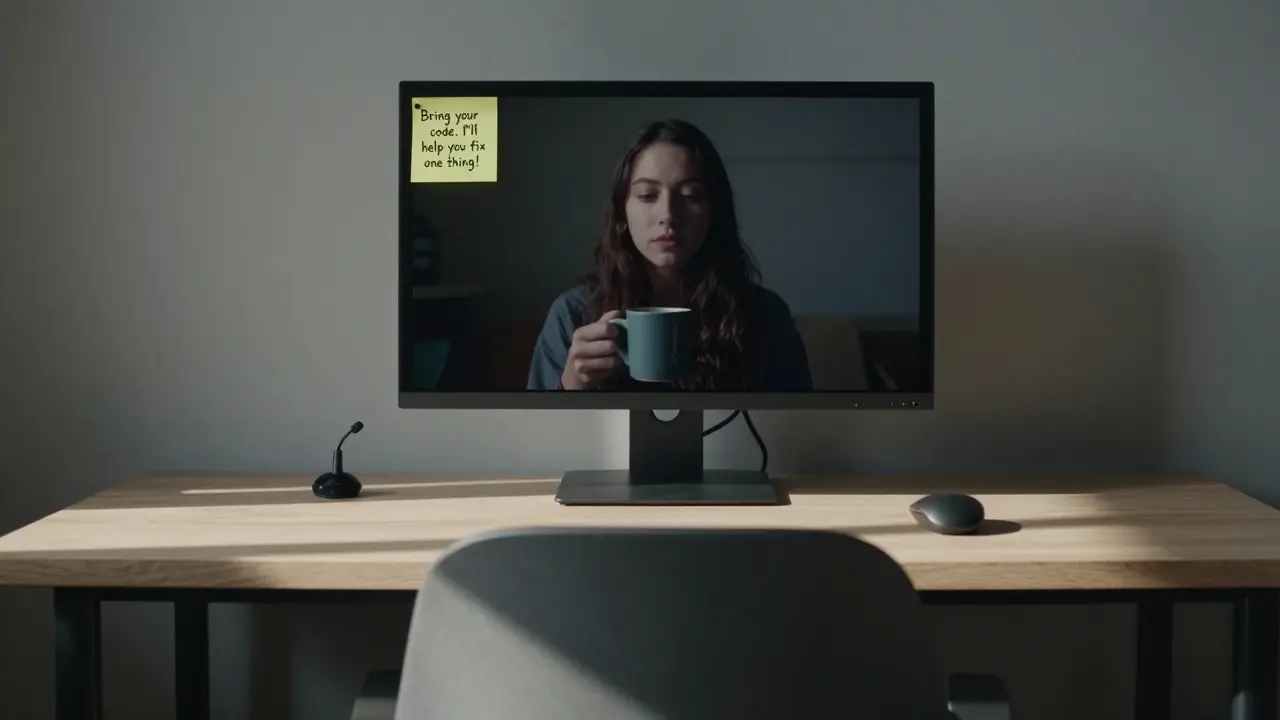
Set a clear purpose. Don’t say, “Come if you have questions.” Say, “Bring your draft essay. We’ll walk through one example together.” Or, “Bring your code snippet. We’ll debug it live.” Specificity lowers the barrier. People show up when they know exactly what to expect.
Use breakout rooms. If you have 15 students, split them into three groups of five. Let each group tackle one problem. Then rotate. This keeps energy high and gives quieter students a chance to speak. One instructor at the University of Edinburgh found that after switching to small-group office hours, participation from international students jumped by 40%.
Record the session-but only for those who miss it. Don’t make the recording the main event. The magic happens in the live chat, the raised hands, the “Oh, so THAT’S what you meant!” moments.
Turning Q&A Into a Learning Tool, Not a Q&A
Most instructors treat Q&A like a question-and-answer game: student asks, teacher answers, done. That’s not learning. That’s broadcasting.
Here’s how to flip it:
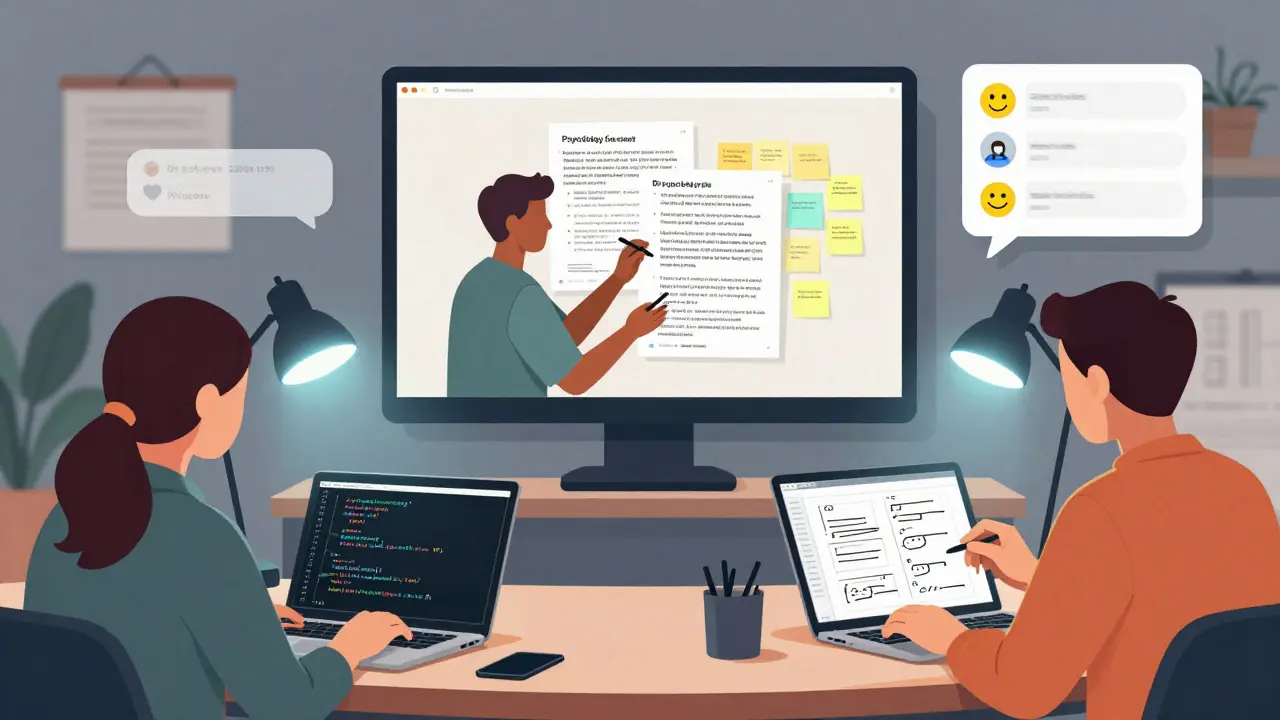
- Ask students to submit questions ahead of time. Use a shared doc or form. This gives you time to group similar ones and prepare examples.
- Don’t answer the first question right away. Say, “Who else is struggling with this?” Then invite others to explain what they tried. Often, a peer’s explanation clicks better than yours.
- Use the “think-pair-share” method. Pose a problem. Give students 30 seconds to think. Then pair them up. Let them discuss. Then bring it back to the group.
- End each session with one action item: “Try this tomorrow. Come back next week with your results.”
This turns passive listeners into active participants. It’s not about giving answers. It’s about teaching people how to think.
What Happens When You Skip Live Sessions
Some instructors skip live Q&A because they’re busy. Others think it’s inefficient. But the cost is higher than it looks.
Without live interaction:
- Students feel isolated. Loneliness is the #1 reason students drop out of online courses.
- Misunderstandings pile up. A small confusion in Week 2 becomes a wall in Week 6.
- Feedback loops break. You don’t know what they’re struggling with until it’s too late.
- Grades suffer. Studies show students who never attend live sessions score 18% lower on average.
It’s not about time. It’s about momentum. Live sessions create rhythm. They give students a reason to log in, not just check in.
Real Examples That Work
At a coding bootcamp in Glasgow, instructors started hosting 20-minute “Code Clinics” every Tuesday. No prep. No slides. Just: “Show me your code. I’ll help you fix one thing.” Within three weeks, completion rates rose from 61% to 89%.
A psychology course at Edinburgh Napier replaced one weekly lecture with a live case study discussion. Students brought personal stories (anonymized). The instructor didn’t lecture. She asked: “What do you think happened here?” The engagement spike was immediate. Discussion threads after the session tripled.
One business course in Manchester started with a simple rule: “If you ask a question in the live session, you get 5% extra credit on your next quiz.” Not because they wanted to bribe students. But because they wanted to lower the cost of asking. The result? Questions went from 3 per session to 22.
Common Mistakes (And How to Fix Them)
Here’s what goes wrong-and how to fix it:
- Mistake: You talk too much. Fix: Set a 2-minute limit per answer. Use silence as a tool. Let students fill it.
- Mistake: Only the loudest students speak. Fix: Use anonymous polling tools. Ask, “Raise your hand if this confused you.” Then call on someone who didn’t speak.
- Mistake: You skip sessions when busy. Fix: Assign a rotating student moderator. Let them lead the Q&A while you watch. It builds leadership-and keeps the rhythm alive.
- Mistake: You don’t follow up. Fix: Send a 100-word summary after each session: “Here’s what we covered. Here’s what to try next.”
What You Need to Start
You don’t need a budget. You don’t need permission. Just three things:
- A consistent time slot (even 30 minutes once a week).
- A simple platform (Zoom, Google Meet, or even Discord).
- A promise: “I’ll be here. Bring your questions.”
Start small. Try one session. See what happens. The first time a student says, “I finally get it,” you’ll know why this matters.
Do live Q&A sessions really improve grades?
Yes. A 2024 analysis of 17 online courses found that students who attended live Q&A sessions scored 15-22% higher on final assessments than those who didn’t. The biggest gains came in courses with open-ended assignments-essays, projects, coding tasks-where understanding mattered more than memorization.
What if no one shows up to my office hours?
It happens. Don’t take it personally. Start by asking for feedback: “What’s stopping you from joining?” Often, it’s timing, fear of sounding dumb, or not knowing what to bring. Adjust based on their answers. Offer a 5-minute “drop-in” option. Or start with a low-pressure prompt: “Bring one thing you’re stuck on. We’ll fix it together.”
Can I do live Q&A without video?
Absolutely. Audio-only or text-based sessions (via chat or forum) work well, especially for students with poor internet or those who prefer typing. The key is responsiveness. Reply within 60 seconds. Use emojis or short affirmations (“Got it,” “Good question”) to show you’re listening. A 2025 survey found 63% of students in low-bandwidth regions preferred text-based Q&A over video.
How often should I hold live sessions?
Once a week is the sweet spot. Too often, and it becomes a chore. Too rarely, and momentum fades. If your course is fast-paced (like a 6-week bootcamp), try twice a week for the first three weeks, then scale back. If it’s a 12-week semester, once a week with a mid-term bonus session works best.
Should I require attendance?
No. Forcing attendance kills the vibe. Instead, make it worth showing up. Offer a small bonus point. Share a resource only available during the session. Or just be genuinely helpful. When students feel seen, they’ll come on their own.

Comments (11)
Emmanuel Sadi February 26 2026
Lol so you're telling me the secret to student retention is... actually showing up? Who knew. My 3am Zoom call with 2 students and a cat walking on my keyboard is now a 'community hub'. Next you'll say water is wet.Nicholas Carpenter February 28 2026
This is spot on. I’ve seen students light up during live sessions - not because they got the right answer, but because they felt like they belonged. It’s not about the tech. It’s about showing up as a human.Chuck Doland March 1 2026
The empirical evidence presented here is both statistically significant and pedagogically coherent. The constructivist underpinnings of live interaction align with Vygotskyan social learning theory, wherein cognitive development is mediated through dialogic engagement. Furthermore, the temporal consistency of scheduled sessions fosters metacognitive predictability, which reduces cognitive load and enhances retention. One must therefore conclude that the pedagogical efficacy of synchronous interaction is not merely anecdotal but theoretically grounded.Madeline VanHorn March 2 2026
I mean, if you’re still struggling to get students to show up, maybe your course isn’t worth their time. Not everyone needs a hand-holding session. Some people just need to figure it out themselves.Glenn Celaya March 2 2026
Live sessions are overrated. I’ve seen instructors go off on tangents for 20 mins about their dog. Students don’t care. They want answers. Not vibes. And don’t get me started on breakout rooms - that’s just chaos with extra stepsWilda Mcgee March 3 2026
I tried the ‘bring one thing you’re stuck on’ thing last semester and holy heck it changed everything. One kid brought a half-finished poem and we turned it into a group critique. Another had a bug in their code that turned into a 10-minute debugging party. By the end, people were texting each other outside class. That’s the magic. Not the tech. The connection.Chris Atkins March 3 2026
I teach in Kenya and we do text Q&A over WhatsApp. No video. No mic. Just replies within a minute and a few 👍 and 💯 emojis. Students say it feels like talking to a friend who actually gets it. Low bandwidth doesn’t mean low connection.Jen Becker March 5 2026
I tried this. No one came. I cried. Then I posted a TikTok. Got 12k views. Now I’m a ‘professor influencer’. My students call me ‘Queen of the Q&A’. I don’t know if it helped them learn. But they definitely learned my morning coffee order.Ryan Toporowski March 6 2026
Just started doing 15-min ‘Quick Wins’ sessions before exams. One student said ‘I finally stopped panicking’ 🥹 I cried. I’m a mess. But I’m a happy mess. 🤗Samuel Bennett March 8 2026
You say ‘studies show’ but did you even check the methodology? 2024 study? Who funded it? Probably some edtech startup trying to sell you Zoom licenses. Also grammar error in the post - ‘they’re’ not ‘their’. Fix it.Rob D March 8 2026
America invented online education. You think some guy in Glasgow with a webcam is gonna out-teach us? We have 47% of the world’s PhDs. This ‘community hub’ nonsense is just woke pedagogy wrapped in a Zoom link. Bring back lectures. Silent. Serious. Solved.