
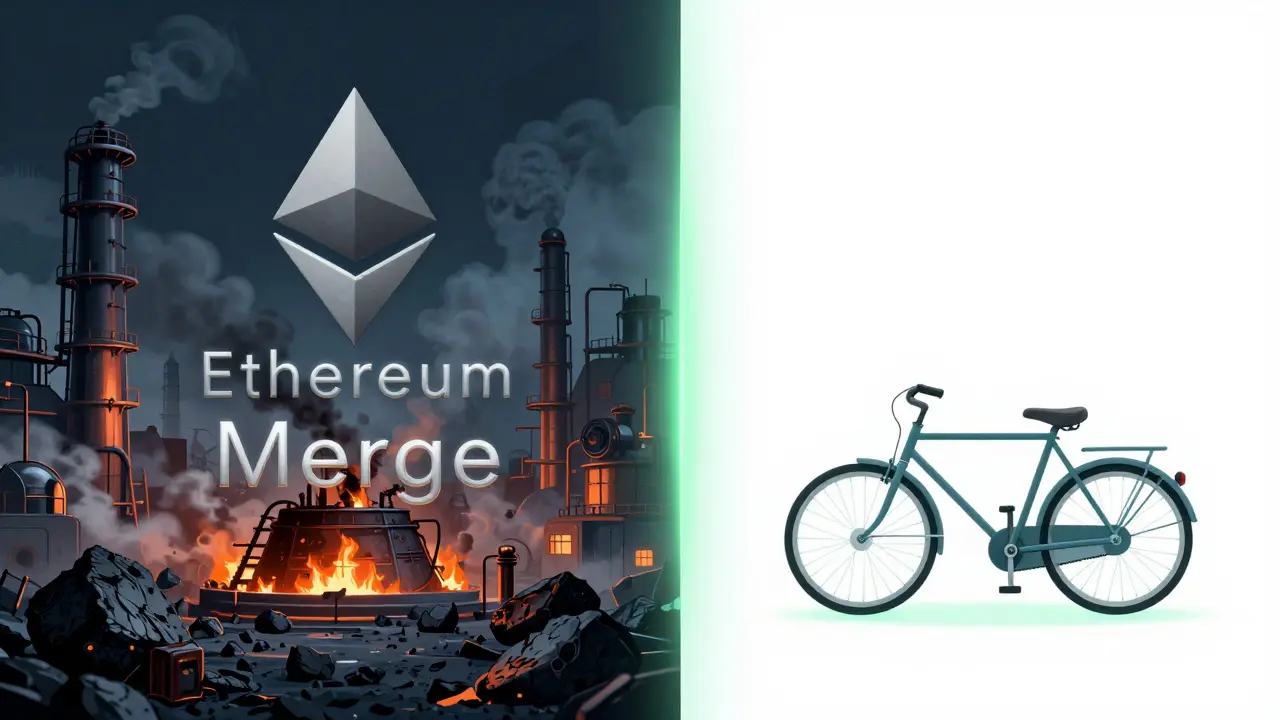
Remember when buying an NFT felt like you were personally contributing to a climate crisis? For years, the narrative was simple and scary: one mint equaled months of household electricity. If you’ve been away from the space since 2021, that story feels ancient history now. The landscape has shifted dramatically. Today, the environmental footprint of digital ownership is a fraction of what it used to be, thanks to fundamental changes in how blockchains operate.
The core issue isn't whether NFTs are 'green' or not-it's about understanding where the energy actually goes. It’s no longer just about the blockchain consensus mechanism; it’s also about where your files live. To make informed decisions as a collector, creator, or investor in 2026, you need to look past the hype and understand the mechanics of Proof-of-Stake networks and the hidden costs of off-chain data storage.
The Great Shift: From Mining to Staking
To understand why things changed, we have to look at what came before. Before September 2022, the dominant platform for NFTs, Ethereum, relied on Proof-of-Work (PoW). This system required powerful computers to solve complex mathematical puzzles to validate transactions. It was an energy-intensive arms race. A single transaction could consume around 50 kWh of electricity-roughly what a typical home uses in three days.
Then came The Merge. On September 15, 2022, Ethereum switched to Proof-of-Stake (PoS). Instead of miners burning electricity to compete, validators stake their own cryptocurrency to secure the network. The result? An instantaneous drop in energy consumption by approximately 99.9%. According to data from the Crypto Carbon Ratings Institute (CCRI), this shift made Ethereum roughly 2,000 times more energy-efficient overnight.
Think of it like switching from driving a gas-guzzling truck to riding a bicycle. The destination (validating a transaction) is the same, but the fuel required is negligible. Today, running a validator node requires hardware comparable to a standard laptop-often just 8 GB of RAM. There are no massive server farms humming with ASIC chips anymore. This architectural change is the single biggest factor in modern NFT sustainability.
Beyond Ethereum: Native PoS Chains
Ethereum wasn’t alone in this transition, though it was the most impactful due to its market share. Several other blockchains launched with Proof-of-Stake from day one, avoiding the high-energy phase entirely. These networks offer alternative ecosystems for NFT creators who prioritize low energy use above all else.
| Blockchain | Consensus Type | Energy Profile | Key Characteristic |
|---|---|---|---|
| Bitcoin | Proof-of-Work | Very High | High security, slow transactions, ~830 kWh per tx |
| Ethereum (Post-Merge) | Proof-of-Stake | Low | Largest NFT ecosystem, 99.9% reduction post-2022 |
| Solana | Proof-of-Stake | Very Low | High throughput, native low-cost minting |
| Tezos | Proof-of-Stake | Very Low | Self-amending protocol, energy-efficient design |
| Polygon | PoS / Layer 2 | Ultra-Low | Batch processing, scales Ethereum efficiency |
Networks like Solana, Tezos, and Polkadot maintain relatively small carbon footprints because they never engaged in the energy-intensive mining competition seen in Bitcoin or early Ethereum. For projects starting fresh in 2026, choosing a native PoS chain ensures minimal environmental impact from the outset. However, the sheer volume of activity on Ethereum means its absolute improvement matters most globally.

The Layer 2 Multiplier Effect
Even on a sustainable Proof-of-Stake network, every transaction still consumes some energy. This is where Layer 2 scaling solutions come into play. Networks like Arbitrum, Optimism, and Polygon sit on top of Ethereum. They bundle hundreds or thousands of individual transactions into a single batch before submitting them to the main Ethereum chain.
Imagine sending 1,000 letters. In a traditional model, you pay postage for each one. With Layer 2, you put all 1,000 letters into one big box and pay for shipping once. This batching process drastically reduces the computational load on the main network. For NFT collections, this means minting thousands of items can cost a fraction of the energy compared to minting them individually on the mainnet.
This technology, combined with standards like ERC-1155 (which allows batch minting within a single smart contract call), creates a compounding effect on sustainability. While ERC-1155 helped modestly during the PoW era, its synergy with PoS and Layer 2 networks makes it a powerhouse for eco-friendly digital asset creation today.
The Hidden Cost: Off-Chain Storage
Here is where many people get confused. When you buy an NFT, the token itself lives on the blockchain. But the image, video, or audio file usually does not. Blockchains are terrible at storing large files; they are designed for data integrity, not capacity. So, the actual media is stored off-chain.
This introduces a new variable: the energy cost of hosting. Where does your JPEG live?
- Centralized Servers: Many early NFTs pointed to AWS or similar cloud providers. These data centers consume significant electricity, often powered by fossil fuels depending on the region. If the company shuts down, the link breaks (a problem known as "link rot"), and the energy spent was wasted.
- InterPlanetary File System (IPFS): This is a decentralized protocol. Files are split and distributed across many nodes worldwide. While this improves durability, it doesn't necessarily reduce energy use-it spreads it out. Some argue it’s more efficient than redundant centralized backups; others say it’s harder to measure.
- Arweave: A permanent storage solution that charges a one-time fee. It aims to optimize for long-term preservation, potentially reducing the need for continuous re-hosting.
The sustainability of your NFT depends heavily on this layer. An NFT on a green PoS chain pointing to a coal-powered server farm is less sustainable than one on a slightly less efficient chain pointing to renewable-powered decentralized storage. As of 2026, best practices involve using decentralized storage protocols backed by renewable energy sources whenever possible.
Future Outlook: Renewables and Efficiency
Looking ahead to 2030, projections suggest that even with exponential growth in NFT adoption, energy consumption will remain well below pre-Merge peaks. Modeling indicates that if validator networks increasingly rely on renewable energy-specifically curtailed wind and solar power-the carbon footprint could drop further. Breakeven gas fees for green transactions are estimated between $1 and $7, depending on the level of renewable integration.
Organizations like the Gallery Climate Coalition have updated their guidance, now recommending Ethereum and other PoS networks for art practices. The focus has shifted from avoiding NFTs altogether to optimizing the stack: choose PoS, utilize Layer 2s, and ensure your metadata points to sustainable storage solutions.
The narrative has flipped. NFTs are no longer the villain in the climate conversation. With the right technical choices, they can be part of a low-carbon digital economy. The key is awareness. Don’t just click "mint." Look at the chain, check the storage, and understand the full lifecycle of the digital asset you’re supporting.
Did the Ethereum Merge really reduce energy usage by 99.9%?
Yes. Reports from the Crypto Carbon Ratings Institute and tests by the Ethereum Foundation confirmed that the transition from Proof-of-Work to Proof-of-Stake reduced energy consumption by approximately 99.9%, making it roughly 2,000 times more efficient.
What is the difference between on-chain and off-chain storage for NFTs?
On-chain storage refers to the token ID and metadata reference recorded on the blockchain. Off-chain storage holds the actual media file (image/video). Most NFTs use off-chain storage like IPFS or centralized servers because blockchains are too expensive and slow for large files.
Are Layer 2 networks more sustainable than the Ethereum mainnet?
Yes. Layer 2 networks like Polygon and Arbitrum batch multiple transactions together before posting them to Ethereum. This significantly reduces the total number of computations required, leading to lower overall energy consumption per transaction.
How does IPFS affect the environmental impact of an NFT?
IPFS distributes file storage across many nodes rather than relying on a single data center. While this enhances durability, its energy impact varies based on how those nodes are powered. It is generally considered more resilient but requires careful consideration of the underlying infrastructure's energy source.
Which blockchain is the most eco-friendly for NFTs in 2026?
Native Proof-of-Stake chains like Solana, Tezos, and Cardano are highly efficient. However, Ethereum Post-Merge, especially when used with Layer 2 solutions, offers a balance of massive liquidity, security, and very low energy consumption, making it a top choice for sustainable NFT projects.

Comments (14)
Andrea Alonzo July 13 2026
I really appreciate how this article breaks down the technical shifts without getting bogged down in jargon, because it is so easy to feel overwhelmed when trying to understand where your digital assets are actually stored and what that means for the planet. It is fascinating to see how the industry has moved away from the energy-intensive mining models of the past, which were genuinely concerning for anyone who cared about climate change, toward these more efficient Proof-of-Stake mechanisms that require a fraction of the power. I think many people still hold onto the old narrative that NFTs are inherently destructive, but the data clearly shows that the Merge was a pivotal moment that changed the entire landscape overnight, reducing energy consumption by nearly 99.9%. What strikes me most is the emphasis on off-chain storage, because even if the blockchain itself is green, pointing to a coal-powered server farm kind of defeats the purpose of all those other improvements. We need to keep pushing for decentralized storage solutions like IPFS or Arweave that are powered by renewables, otherwise we are just shifting the problem rather than solving it. It is encouraging to see organizations updating their guidance to reflect these changes, as it helps legitimize the space for artists and collectors who want to make ethical choices. The comparison between Layer 2 batching and sending letters in a single box is such a perfect analogy for explaining why these scaling solutions matter so much for sustainability. I hope more creators start prioritizing these eco-friendly stacks, not just for the environmental benefits but because it makes economic sense to reduce costs through efficiency. Ultimately, awareness is key, and posts like this help demystify the process so we can all make informed decisions about what we support in the digital economy.
om gman July 14 2026
oh look another take on how nfts are suddenly the saviors of the environment lol
you guys really believe that switching to pos magically fixed everything? its just marketing spin for people who dont understand that the actual art files are sitting on aws servers burning coal while you pat yourselves on the back for using ethereum
the whole thing is a scam wrapped in greenwashing
Saranya M.L. July 16 2026
Your assertion that the entire ecosystem is merely 'marketing spin' demonstrates a profound lack of understanding regarding cryptographic consensus mechanisms and their thermodynamic implications. While it is true that centralized cloud providers like AWS have significant carbon footprints, the distinction between on-chain validation and off-chain metadata storage is critical and often misunderstood by laypeople. The transition to Proof-of-Stake did not just 'magically fix' anything; it fundamentally altered the computational requirements for securing the network, reducing energy usage by approximately 99.9% as verified by independent audits from the Crypto Carbon Ratings Institute. To dismiss this empirical data as mere 'spin' is intellectually dishonest and ignores the rigorous engineering behind modern blockchain infrastructure. Furthermore, the adoption of Layer 2 solutions further optimizes transaction batching, thereby reducing the marginal energy cost per mint event to negligible levels. One must also consider that decentralized storage protocols are evolving rapidly, with many nodes now utilizing renewable energy sources, unlike the opaque energy mixes of traditional data centers. Therefore, labeling the entire medium as a 'scam' based on a superficial critique of current storage practices is both reductive and factually incorrect. We should instead focus on optimizing the stack, as suggested by the Gallery Climate Coalition, to ensure that digital ownership aligns with sustainable practices. Ignoring these advancements does not make them less real, nor does it address the genuine progress made in reducing the carbon footprint of digital transactions.
Jeanne Abrahams July 17 2026
Oh please, spare me the lecture on thermodynamics.
In South Africa, we deal with load shedding daily, so we know exactly what happens when your precious servers lose power. Your 'decentralized' nodes are probably running on diesel generators half the time anyway. Don't pretend your tech is cleaner than reality.
Bineesh Mathew July 18 2026
The tragedy of our times is that we measure salvation in kilowatt-hours while ignoring the spiritual void of digital ownership. You speak of efficiency as if it were a moral virtue, yet the soul of the artwork remains trapped in a cold, unfeeling database. Is it truly sustainable to trade one form of exploitation for another? The energy saved is merely a distraction from the deeper existential crisis of commodifying existence itself. We are building cathedrals in the sky while the earth burns beneath our feet, convinced that our ledgers absolve us of guilt. This is not progress; it is a sophisticated delusion. The true cost is not measured in carbon, but in the erosion of human connection and the tangible world. We are becoming ghosts in the machine, haunting our own creations.
Patrick Dorion July 18 2026
Look, I get the philosophical angst, but let's stick to the facts here. The energy reduction is real and measurable. Whether you like the concept of NFTs or not, the technology has become vastly more efficient. The issue isn't the philosophy of ownership; it's the physics of computation. PoS uses less electricity. Period. If you're worried about the environment, supporting networks that use 99.9% less energy is objectively better than supporting those that don't. Let's not conflate metaphysical concerns with environmental impact assessments. They are two different conversations.
Lisa Puster July 18 2026
typical naive optimism
you think switching to pos saves the planet? laughable
the real issue is the greed driving the market not the electrons flowing through wires
until we stop hoarding digital junk nothing matters
Marissa Haque July 19 2026
Wow! That is such a harsh perspective!!!
I mean, sure, greed is part of every market, but dismissing the technological advancements entirely seems counterproductive!! The fact that we can now mint art with a tiny fraction of the energy used before is huge!! Why can't we celebrate progress while still critiquing the culture?? It doesn't have to be black and white!! We can want both sustainability AND accountability!!
Stephanie Frank July 19 2026
Exactly. People love to play devil's advocate without doing any homework. The data is right there in the post. Ethereum is 2000x more efficient. If you can't wrap your head around basic arithmetic and environmental science, maybe stay out of the conversation. It's not complicated. Less energy = better for the planet. Stop making it about feelings.
Caitlin Donehue July 21 2026
I guess I'm just curious about the long-term viability of IPFS though. If nodes drop out, does the file disappear? Or is it really permanent?
Keith Barker July 22 2026
it depends on incentives
ipfs is not magic
if no one pays to store the data eventually it might vanish unless pinned somewhere else
arweave is better for permanence but costs more upfront
michael rome July 23 2026
It is important to respect the boundaries of what technology can promise versus what it delivers. While the shift to PoS is undeniably positive, we must remain vigilant about the claims made by projects regarding their storage solutions. Just because a platform says they use IPFS doesn't mean the files are permanently secured. Users need to verify this themselves. It is empowering to have this knowledge, but it requires responsibility. We should encourage creators to be transparent about their infrastructure choices.
Joe Walters July 24 2026
lol yeah right
most creators dont even know what ipfs is
they just copy paste code from github and pray
its all chaos man
Oskar Falkenberg July 25 2026
i totally agree with the sentiment here but i think we are missing the bigger picture about layer 2s
like arbitrum and optimism are game changers because they batch transactions so you are basically paying for one big tx instead of thousands of small ones
it makes the whole thing way cheaper and greener at the same time
plus the gas fees are lower so more people can participate which is great for inclusivity
we should really be focusing on educating people about these l2 options because they are the future of scalable and sustainable web3 applications
and honestly the user experience is getting so much better too
so its not just about saving trees its about making the tech accessible to everyone
which is pretty cool if you ask me