
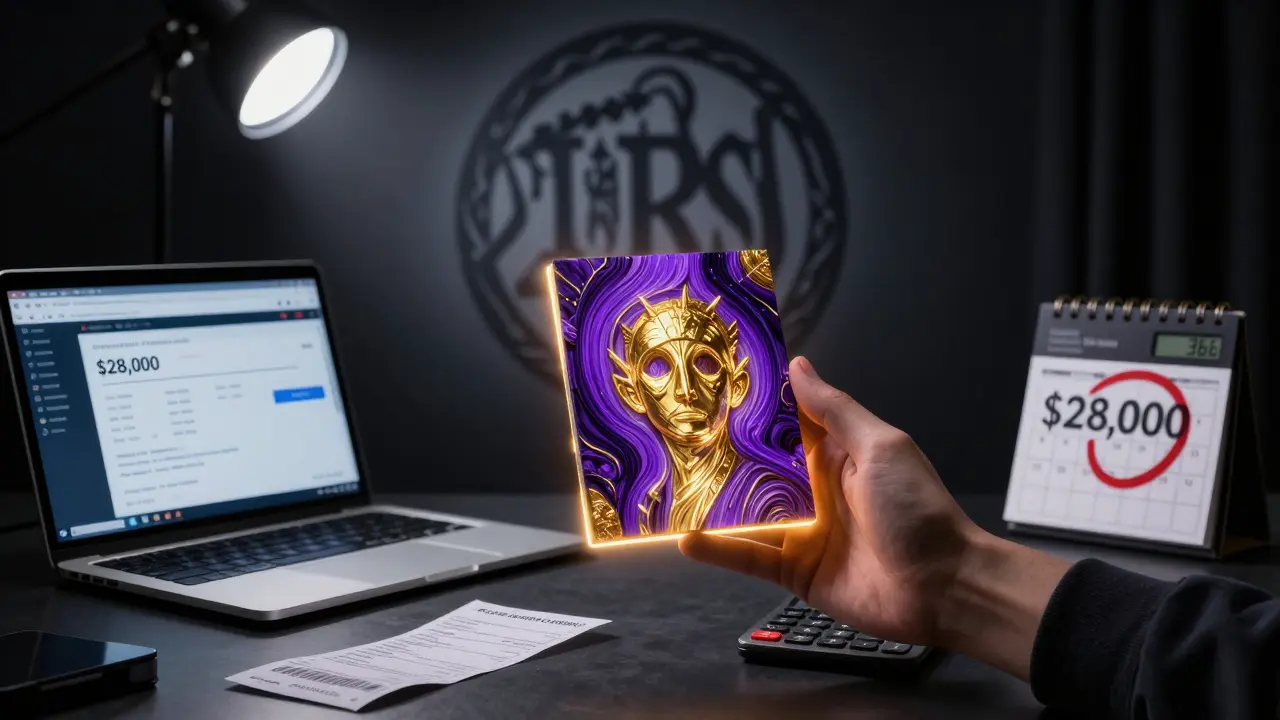
When you sell an NFT, you don’t just hand over a digital image-you trigger a tax event. The IRS treats NFTs as property, not currency, which means every sale, trade, or even gift can owe taxes. In 2025, this isn’t just a technical footnote-it’s a full-blown compliance issue with real money at stake. If you bought an NFT for $500 and sold it for $15,000, you didn’t just make a profit. You created a taxable gain. And how much you pay depends on one critical question: Is your NFT a collectible?
Is Your NFT a Collectible? The 28% Tax Trap
The biggest surprise for most NFT owners isn’t that they owe taxes-it’s how much they might owe. The IRS has a special rule for collectibles. If your NFT is classified as one, long-term capital gains (sales after holding more than a year) are taxed at up to 28%, not the standard 15% or 20%. That’s a massive jump. A $100,000 profit could mean $28,000 in taxes instead of $15,000.So what makes an NFT a collectible? The IRS uses a “look-through analysis.” That means they don’t care about the file format or blockchain. They look at what the NFT represents. If it’s digital art, music, or virtual real estate, it’s likely a collectible. If it’s a utility token-like a membership pass or game item-it might not be. But the line is blurry. A Bored Ape is clearly art. A token that unlocks a VIP Discord channel? That’s less clear. And the IRS hasn’t given clear rules yet.
That uncertainty is dangerous. In 2024, nearly half of NFT traders didn’t even know the collectible rate existed. Many assumed their NFTs were taxed like stocks. They weren’t. And now, with brokers required to report sales on Form 1099-DA, the IRS has a full list of who sold what. If you didn’t report correctly, you’re on their radar.
Short-Term vs Long-Term: The One-Year Rule
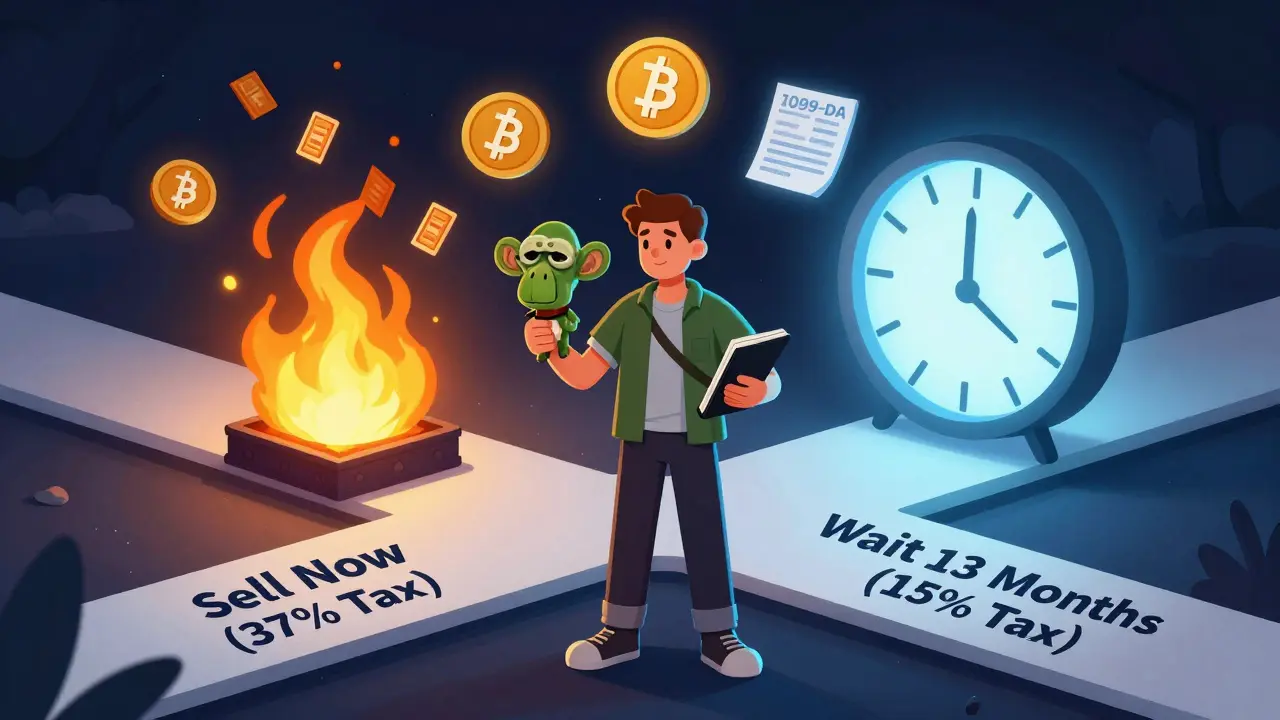
Holding period matters more than you think. If you sell an NFT within a year of buying it, you pay your regular income tax rate. For most people, that’s 22% to 37%. That’s brutal. A $20,000 gain could mean $7,400 in taxes if you’re in the 37% bracket.But if you wait longer than 12 months? You drop into long-term capital gains. That’s 0%, 15%, or 20%-depending on your income. For a single filer earning under $47,025, you pay nothing. For someone making $150,000, it’s 15%. That’s a huge difference.
Here’s the catch: The 28% collectible rate overrides the 20% cap. Even if you’re in the 15% bracket, if your NFT is a collectible, you pay 28%. So timing alone isn’t enough. You need to know what you’re selling.
One trader in Ohio held a digital painting for 11 months and 29 days. He sold it just before the one-year mark. He paid 32% in taxes. He later realized he could’ve waited two more days and paid 15%. He lost $18,000 in taxes because of a 48-hour delay. That’s not a mistake you make twice.
Creators Pay Ordinary Income-Plus Self-Employment Tax
If you mint and sell your own NFTs, you’re not an investor. You’re a business. The money you make is ordinary income, not capital gains. That means it’s taxed at your full income rate-up to 37%. And if you’re doing this regularly, you owe self-employment tax too. That’s 15.3% on top.Let’s say you’re a digital artist. You mint 10 NFTs and sell them for $5,000 each. That’s $50,000 in income. You’re in the 24% tax bracket. So $12,000 goes to income tax. Then you add 15.3% self-employment tax on $50,000-that’s $7,650. Total tax: $19,650. You keep $30,350. That’s less than 61% of your revenue.
Some creators try to defer sales to January to push income into the next tax year. That helps if you expect to be in a lower bracket next year. Others deduct expenses-software, gas fees, even a home office-if they can prove it’s a business. But you need records. The IRS doesn’t accept “I made art” as proof. You need invoices, wallet logs, and timestamps.
Record-Keeping: The Only Way to Avoid Disaster
The IRS doesn’t care if you used MetaMask, Coinbase, or a private wallet. They care about two things: when you bought it and how much you paid. That’s your cost basis. It includes the purchase price plus gas fees. If you bought an NFT for $1,200 and paid $85 in gas, your cost basis is $1,285.But here’s the problem: Most people don’t track gas fees. Or they buy NFTs in batches. Or they swap ETH for an NFT and don’t record the ETH’s cost basis. That’s a nightmare for tax season.
By 2026, brokers will start reporting cost basis on Form 1099-DA. But right now? You’re on your own. You need to save every transaction. Wallet address. Date. Amount paid. Gas fee. What you received. Even if you traded an NFT for another NFT-that’s a taxable event. No exceptions.
One user on Reddit tracked 47 NFT transactions in 2024. He used a spreadsheet. He printed every transaction receipt. He kept screenshots of marketplace listings. When the IRS asked for proof, he had it. He paid $2,300 in taxes. Someone else with the same portfolio used an app that didn’t track gas fees. He got audited. He owed $14,000.
Timing Strategies That Actually Work
The best tax strategy isn’t hiding. It’s planning. Here’s what works:- Hold for 13+ months. Don’t just hit one year. Go past it. The IRS looks at exact dates. A day early can cost you thousands.
- Sell in December if you bought in January. That gives you the full year. If you bought on January 15, 2024, sell on January 16, 2025. Don’t wait until January 17. You might forget.
- Offset gains with losses. If you lost money on another NFT, sell it before year-end. You can deduct up to $3,000 in capital losses against ordinary income. Any extra carries forward.
- For creators: Defer sales to Q1. If you minted in late 2024, wait until January to sell. That pushes income to next year. Use the time to gather deductible expenses.
One digital artist sold her entire collection in December 2024. She’d held each piece for over 18 months. She paid 15% on $122,000 in gains. That’s $18,300 in taxes. If she’d sold in 2023, she’d have paid 32%-$39,040. She saved $20,740 by waiting.

What’s Coming in 2025 and Beyond
The IRS is ramping up. In 2024, they conducted over 17,000 crypto audits-a 214% jump from 2023. They’ve budgeted $315 million just for NFT and crypto enforcement in 2025. Brokers are now legally required to report every sale. You can’t hide.Some lawmakers want to fix this mess. Senator Elizabeth Warren’s Digital Asset Tax Fairness Act proposes a flat 25% tax on all NFT sales, no matter the holding period or type. It’s still in committee, but it’s a sign the system is broken. Right now, you’re stuck with a patchwork of rules that change every year.
By 2027, NFT tax revenue could hit $2.8 billion a year. That’s not because people are making more money. It’s because the IRS is finally catching up.
What to Do Now
If you own NFTs, here’s your checklist:- Track every purchase: date, price, gas fee, wallet address.
- Identify what each NFT represents. Art? Music? Utility? That determines if it’s a collectible.
- Calculate your cost basis for every NFT you plan to sell.
- Wait at least 13 months before selling to qualify for long-term gains.
- Use tax software that supports NFTs and collectible classification. Most free tools don’t.
- Consult a tax pro who’s handled NFTs before. Don’t trust a general CPA.
You don’t need to be a tax expert. But you do need to know the rules. The difference between paying 15% and 28% isn’t luck. It’s preparation.
Are NFTs taxed as collectibles or capital assets?
NFTs are treated as capital assets by default, but the IRS can classify them as collectibles under Section 408(m) if the underlying asset is art, music, or other tangible-like digital property. This triggers a 28% long-term capital gains rate. The determination depends on the NFT’s nature, not its blockchain format. A digital painting is likely a collectible. A game item with utility may not be.
Do I owe taxes if I trade one NFT for another?
Yes. Swapping NFTs is a taxable event. The IRS treats it as a sale of the first NFT and a purchase of the second. You must calculate the gain or loss based on the fair market value of the NFT you received at the time of trade. Even if you didn’t convert to fiat, you still owe tax on the profit.
What if I bought an NFT with cryptocurrency?
Buying an NFT with ETH or another crypto creates two taxable events: the sale of your crypto (which may have its own gain/loss) and the purchase of the NFT. You must track the cost basis of the crypto you spent. For example, if you bought ETH for $2,000 and used it to buy an NFT when ETH was worth $3,000, you have a $1,000 capital gain on the ETH, plus the NFT’s cost basis is $3,000.
Do I need to report NFTs even if I didn’t make a profit?
Yes. The IRS requires you to answer “yes” to the digital asset question on Form 1040 if you received, sold, exchanged, or otherwise disposed of any digital asset-including NFTs-even if you broke even or lost money. Failing to report can trigger an audit, even if no tax is owed.
What happens if I don’t report my NFT sales?
The IRS now receives transaction data directly from exchanges and brokers via Form 1099-DA. If your sale isn’t reported on your tax return, you’ll likely receive a CP2000 notice asking why. Penalties include 25% of the underpaid tax, plus interest. In cases of intentional non-reporting, penalties can reach 75%. Audits are rising fast-over 17,000 in 2024 alone.
Can I deduct NFT-related expenses?
If you’re a creator or trader operating as a business, you can deduct expenses like gas fees, software subscriptions, legal advice, and home office costs. But if you’re a passive investor, you can’t deduct anything. The IRS doesn’t allow personal hobby losses to offset gains. Keep detailed records to prove business activity.
If you’re holding NFTs, the clock is ticking. Every day you wait could change your tax bill. The rules are complex, but the path forward isn’t. Track everything. Wait longer. Know what you own. And when in doubt, get help. The cost of a bad decision isn’t just money-it’s time, stress, and maybe an audit you didn’t see coming.

Comments (10)
Sheetal Srivastava January 8 2026
The IRS treating NFTs as collectibles is such a catastrophic overreach-28%? That’s not taxation, that’s confiscation. The very notion that a JPEG’s aesthetic value should trigger a higher rate than a stock is economically incoherent. We’re living in a post-modern tax regime where semantics override substance. The IRS doesn’t understand digital ownership, and yet they’re auditing people like they’re hiding gold bars in their attic. This isn’t policy-it’s digital feudalism.
Bhavishya Kumar January 9 2026
It is imperative to note that the Internal Revenue Code Section 408(m) explicitly classifies certain tangible personal property as collectibles, and by extension, digital assets with intrinsic artistic value fall under this purview. The term 'collectible' is not arbitrary; it is codified. Failure to distinguish between utility tokens and digital art constitutes a fundamental misunderstanding of tax law. Proper documentation of cost basis, including gas fees, is not optional-it is statutory.
ujjwal fouzdar January 10 2026
Think about it-what is art? Is it the pixels? The blockchain hash? The community that breathes meaning into it? The IRS sees a file. A trader sees profit. A creator sees soul. But the machine? The machine just sees numbers. And it doesn’t care if you cried when you bought that Bored Ape. It doesn’t care if you spent three years building your collection. It just wants its 28%. We’re not fighting taxes-we’re fighting the dehumanization of value. The algorithm doesn’t know that your NFT is your child’s first digital painting. But you do. And that’s the only tax code that matters.
Bhagyashri Zokarkar January 12 2026
i mean like… i just bought a buncha nfts last year cause i thought theyd go up and now im like oh wait i have to pay taxes on them?? and i didnt even track the gas fees and i think i paid in eth and now im just like… why does this feel like being robbed by a robot?? i just wanted to own cool pictures lol
Rakesh Dorwal January 12 2026
Of course the IRS is targeting NFTs. Who do you think controls the global financial system? The same banks that hate decentralized tech. This is a power grab. They know crypto threatens their monopoly. So they make the rules so confusing, so punishing, that normal people give up and go back to their savings accounts. Don’t be fooled-this isn’t about fairness. It’s about control. And if you’re smart, you’ll hold your NFTs until the system collapses.
Vishal Gaur January 14 2026
man i read this whole thing and i still dont know if my weird monkey nft is a collectible or not. i bought it for 0.5 eth cause it had a hat and now i think i might owe like 10k in taxes? i didnt even know you could get audited for this. i just thought it was like trading pokemon cards. why is everything so complicated now? i just wanna chill
Nikhil Gavhane January 14 2026
This is actually one of the clearest breakdowns of NFT taxation I’ve seen. The point about holding 13+ months instead of just 12 is critical-so many people miss that. And the reminder that even breaking even requires reporting? That’s something most overlook. If you’re holding NFTs, treat this like your finances, not your hobbies. Track everything. Even the small stuff. It’s not scary if you’re prepared. You’ve got this.
Raji viji January 15 2026
Bro, the 28% thing is a goddamn trap. You think you’re a savvy investor? Nah. You’re a sucker who fell for the ‘digital art’ fairy tale. The IRS isn’t coming after the whales-they’re coming after the guys who bought a $500 NFT hoping to flip it for $5k. You didn’t create value. You just gambled. And now you’re gonna pay for it in blood, sweat, and IRS forms. Stop pretending you’re an artist. You’re a day trader with delusions.
Rajashree Iyer January 17 2026
There’s a quiet tragedy in every NFT sale. Not the money lost-but the soul sold. We used to collect art because it moved us. Now we collect it because it appreciates. We turned wonder into a spreadsheet. The IRS doesn’t see beauty. They see taxable gain. And we let them. We gave them the keys to our digital cathedrals. Every time we sell, we whisper: ‘Yes, you’re right. This is just a commodity.’ But it’s not. It’s memory. It’s identity. It’s the last place where creativity still dares to be unquantifiable. And they’re trying to tax that away.
Parth Haz January 17 2026
Thank you for this comprehensive overview. I would like to emphasize the importance of consulting a tax professional with specific experience in digital assets. General CPAs may lack the nuanced understanding required to properly classify NFTs under Section 408(m). Additionally, maintaining a chronological ledger of all transactions-including wallet addresses, timestamps, and gas fees-is not merely advisable; it is the cornerstone of audit defense. Proactive documentation is the most reliable tax strategy available.