

Imagine holding a digital dollar that you trust to be worth exactly one real dollar. Now imagine the company behind it won’t let anyone check their bank account properly. That’s the core tension in the world of stablecoins, which are cryptocurrencies designed to maintain a fixed value, typically pegged 1:1 to fiat currencies like the US Dollar. As we move through late 2026, the conversation has shifted from "which coin is fastest" to "who actually holds the money." The answer lies in Real-World Assets (RWA)-off-chain financial instruments like cash, Treasury bills, and commercial paper that back these digital tokens.
If you’re using stablecoins for trading, savings, or business payments, understanding what backs them isn't just academic-it's your safety net. Recent regulatory shifts, particularly the GENIUS Act of 2025, have forced issuers to get serious about transparency. But there’s still a massive gap between a quick "attestation" and a full-blown audit. Let’s break down what’s actually sitting under the hood of your favorite stablecoin, why it matters, and how to spot the risks before they hit your wallet.
The Shift to High-Quality Liquid Assets
Gone are the days when stablecoin issuers could park billions in risky corporate debt and call it a day. The industry has pivoted hard toward High-Quality Liquid Assets (HQLA). Think of this as the financial equivalent of keeping your emergency fund in a mattress versus investing it in a startup. Regulators now demand that the majority of reserves sit in Tier-1 assets: cash held at central banks like the Federal Reserve, short-term U.S. Treasury bills with maturities under three months, and overnight reverse repurchase agreements.
Why the obsession with Treasuries? Because they’re liquid. If everyone rushes to redeem their stablecoins for cash during a market panic, the issuer needs to sell those assets instantly without taking a huge loss. Backing by long-term bonds or illiquid loans creates a mismatch-you can’t pay out cash today if your money is locked up for five years. The GENIUS Act explicitly prohibits commercial paper and corporate bonds for regulated payment stablecoins, aiming to eliminate the credit risk that plagued traditional finance during past crises.
| Stablecoin | Primary Backing | Audit Frequency | Regulatory Status |
|---|---|---|---|
| USDC | Cash, U.S. Treasuries, Repos | Monthly Attestation | New York Trust Charter |
| USDT | Treasuries, Cash, Other | Quarterly Procedures | Offshore / Mixed |
| PYUSD | Cash, Short-term Treasuries | Monthly Attestation | New York Trust Charter |
| DAI | Crypto Collateral, RWA Vaults | On-Chain Verification | Decentralized Protocol |
Attestations Are Not Audits: A Critical Distinction
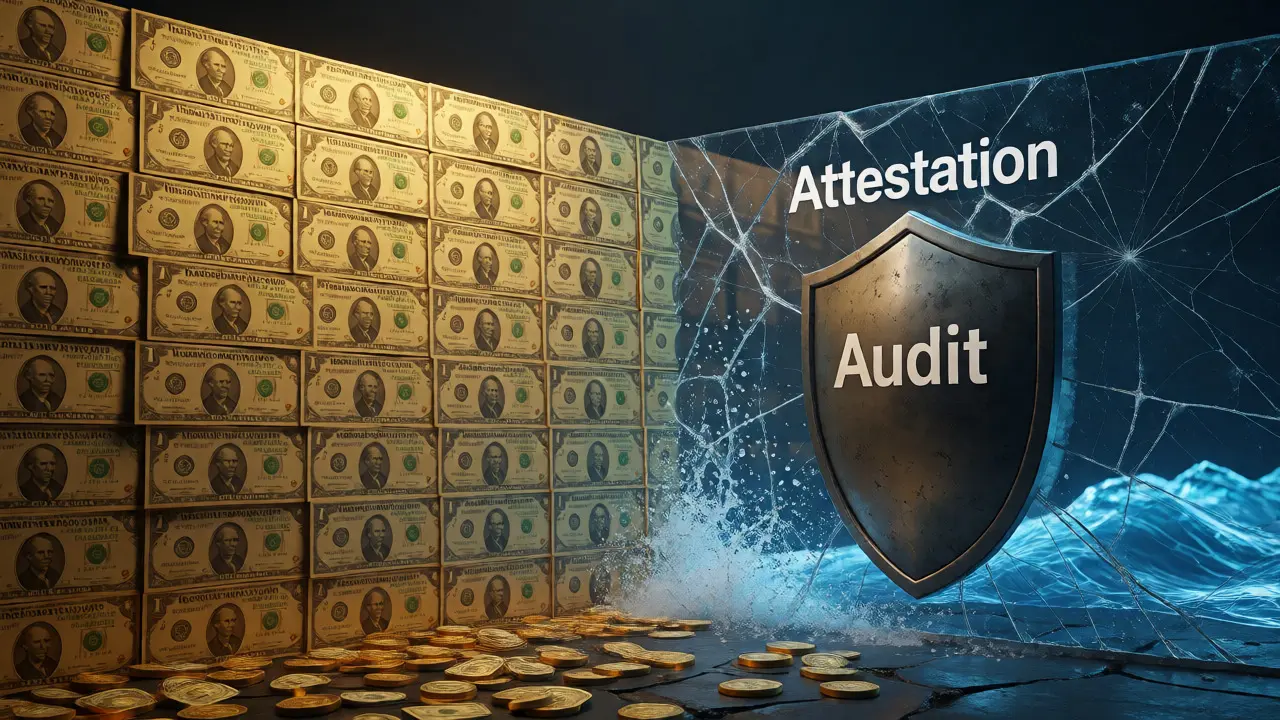
This is where most people get tripped up. When an issuer says they are "audited," they often mean they received an attestation. An attestation is a point-in-time snapshot. It’s like a doctor checking your blood pressure once a year and saying, "You were healthy on January 1st." It doesn’t tell you if you had a heart attack on February 15th.
A full financial audit goes deeper. It tests internal controls, verifies asset segregation, and reviews transactions over a period. Under current best practices, major players like Circle (USDC) and Paxos (PYUSD) provide monthly attestations from Big Four firms like Deloitte or KPMG. Tether (USDT), however, has historically relied on quarterly agreed-upon procedures reports from BDO Italia. These reports confirm that specific accounts contained certain amounts on a specific date but don’t necessarily verify the entire history or the effectiveness of the issuer’s control systems.
Consumer advocacy groups have slammed this approach, arguing that a one-day snapshot allows issuers to temporarily boost reserves right before the reporting date. While Tether argues its surplus assets prove solvency, the lack of a continuous, comprehensive GAAP audit remains a sticking point for institutional investors who need absolute certainty.
The Risk Landscape: What Could Go Wrong?
Even with conservative reserves, risks remain. The biggest threat is liquidity risk. Imagine a scenario where the price of U.S. Treasuries drops sharply due to rising interest rates. If the issuer holds these assets to maturity, they might not lose money. But if they need to sell immediately to meet redemptions, they might have to sell at a discount. This mark-to-market loss can erode the reserve buffer, potentially breaking the peg.
Then there’s counterparty risk. Who holds the actual cash? Often, it’s a third-party bank or trust company. If that bank fails, or if legal disputes freeze the accounts, your stablecoin becomes unbacked. The GENIUS Act attempts to mitigate this by requiring bankruptcy-remote structures, ensuring that issuer operating funds are separate from customer reserves. But legal frameworks vary by jurisdiction, creating a patchwork of protections.
Operational errors are another silent killer. Smart contracts governing minting and burning must be flawless. A bug in the code that allows free minting without corresponding collateral deposits can dilute the value of every token in circulation. Technical audits by firms like Cyfrin focus heavily on these logic flows, testing edge cases like oracle failures or admin key compromises.

How to Verify Your Stablecoin’s Health
You don’t need to be an accountant to do basic due diligence. Start by checking the issuer’s website for their latest reserve report. Look for two things: frequency and detail. Monthly reports are better than quarterly. Detailed breakdowns showing exact percentages of cash vs. Treasuries are better than vague statements like "high-quality assets."
- Check the Auditor: Is it a reputable firm like Deloitte, PwC, EY, or KPMG? Or is it a lesser-known entity?
- Read the Scope: Does the document say "agreed-upon procedures" or "full audit"? Know the difference.
- Look for Segregation: Confirm that reserves are held in accounts distinct from the issuer’s operational funds.
- Monitor News: Regulatory actions or lawsuits against the issuer’s banking partners can signal trouble ahead.
For decentralized options like DAI, use on-chain analytics tools. You can see collateral ratios in real-time. However, remember that even decentralized stablecoins rely on off-chain RWAs now. If DAI uses tokenized Treasuries, you’re still exposed to the same custodial and legal risks as centralized coins, just wrapped in smart contract code.
The Future: Convergence of TradFi and DeFi
We are watching a merger of traditional finance (TradFi) and decentralized finance (DeFi). Newer projects are experimenting with proof-of-reserves mechanisms that update automatically via blockchain oracles. Instead of waiting for a monthly PDF report, users might soon see live data feeds confirming that every token issued matches a verified asset in custody.
However, technology alone doesn’t solve trust. Legal clarity does. As regulations mature globally, expect a shakeout. Issuers who fail to adapt to strict Tier-1/Tier-2 asset rules will either shrink or disappear. For you, the user, this means fewer choices but higher quality. Stick to issuers who welcome scrutiny, publish transparent data, and operate within clear legal frameworks. In the end, the best stablecoin isn’t the one with the highest yield; it’s the one you never have to worry about.
What is the difference between an attestation and an audit?
An attestation is a limited-scope verification of specific data points at a single moment in time, based on information provided by the issuer. A full audit is a comprehensive examination of financial statements, internal controls, and compliance over a period, resulting in a formal opinion on fairness and accuracy. Attestations are faster and cheaper but offer less assurance.
Why are U.S. Treasuries preferred for stablecoin backing?
U.S. Treasuries are considered risk-free assets with high liquidity. They allow issuers to quickly convert reserves into cash to meet redemption demands without significant price impact. Unlike corporate bonds or commercial paper, Treasuries carry minimal default risk, making them ideal for maintaining a stable 1:1 peg.
Can a stablecoin lose its peg even with good reserves?
Yes. Peg breaks can occur due to technical glitches in smart contracts, sudden mass redemptions causing liquidity crunches, or regulatory freezes on custodian accounts. Even if reserves exist, if they cannot be accessed or sold quickly enough, the market price may deviate from $1.00.
Is Tether safer now than it was in previous years?
Tether has significantly improved its reserve composition by eliminating commercial paper and increasing holdings in short-term Treasuries. However, it still relies on quarterly agreed-upon procedures rather than full GAAP audits, which some critics argue leaves room for opacity compared to fully audited competitors like USDC.
What happens if a stablecoin issuer goes bankrupt?
If reserves are properly segregated in bankruptcy-remote accounts, holders should theoretically recover their funds ahead of other creditors. However, legal proceedings can be slow and complex. If reserves were mixed with operating funds or improperly managed, recovery might be partial or delayed.

Comments (11)
jyotshna Senapati October 28 2026
Oh, please. This entire discussion is just noise for people who don't understand how money actually works. You're all obsessing over 'audits' like it's some holy grail when in reality, the only thing that matters is liquidity and trust. If Tether or Circle says they have the money, they have the money. Period. The rest of you are just scaredy-cats hiding behind spreadsheets because you lack the courage to hold real assets without a government babysitter watching your every move. It’s pathetic, really.
Prayagraj Medicose October 30 2026
The banks are lying to us. Always have been.
Think about it. Why do they push Treasuries? Because they need buyers for their debt. If everyone stopped buying stablecoins backed by US debt, the whole system collapses. I bet the 'attestations' are just rubber stamps from firms that owe favors to the Fed. Don't believe the hype. Hold physical gold or go fully decentralized with no off-chain exposure at all. Anything else is a trap set by the elite to keep us dependent on their failing currency. Wake up sheeple.
Howard Hurd October 31 2026
Finally someone mentions the GENIUS Act. About damn time! :D
We shouldn't be relying on offshore entities anyway. American dollars should be backed by American assets held in American banks under American law. That's common sense. If you want safety, stick to USDC or PYUSD. Anything else is gambling with your hard-earned cash. Let Europe figure out their own mess; we don't need their 'mixed regulatory status' nonsense here. 🇺🇸
SHANNON GRUBER October 31 2026
Tether still hasn't provided a full GAAP audit. End of story.
Stop pretending quarterly procedures are equivalent to an audit. They aren't. It's lazy reporting for lazy investors. If you can't handle the truth, don't use crypto.
Brad Walker November 2 2026
We are witnessing the death of traditional finance, but not in the way the economists predict. It is a slow suffocation. The stablecoin is not a coin; it is a mirror reflecting our collective anxiety about value itself. When you look into the ledger, you do not see numbers; you see the fragility of human agreement. We build these digital temples of certainty upon foundations of sand, hoping the tide does not come in too quickly. Is it risk? Or is it simply the nature of existence in a post-truth economy? The peg holds until it doesn't, much like hope itself.
Hemali Jaiswal November 3 2026
This is such a vibrant and necessary conversation! 🌟 It’s wonderful to see the industry maturing towards transparency. However, let’s not forget the beauty of decentralization. While centralized issuers like Circle offer peace of mind through legal frameworks, protocols like MakerDAO (DAI) offer something far more poetic: algorithmic harmony. Yes, they rely on RWAs now, but the governance is democratic! It’s like choosing between a well-managed garden and a wild forest-both have their unique charm. Let’s appreciate the diversity of solutions rather than dismissing one for the other. Every user deserves to choose their level of involvement and trust. 💖
Manoj Kumar November 4 2026
The distinction between attestation and audit is trivialized by the masses, yet it remains the primary vector for systemic failure. One must consider the geopolitical implications of concentrating reserve backing in short-term U.S. Treasuries. Should the Federal Reserve alter its monetary policy abruptly, the mark-to-market losses could trigger a cascade effect across all major stablecoins simultaneously. Furthermore, the reliance on third-party custodians introduces counterparty risk that is often obscured by the veneer of 'bankruptcy-remote' structures, which may not hold up in cross-border litigation. We are merely delaying the inevitable correction.
Kieran Mitchell November 6 2026
THIS IS THE MOST IMPORTANT TOPIC RIGHT NOW!!!
Do you realize what happens if the peg breaks?! Chaos!!! Absolute chaos!!! People will lose everything!!! The media won't care about the nuances of Tier-1 assets; they will scream 'CRYPTO CRASH' and sell everything!!! We need stricter laws!!! We need more audits!!! We need to protect the little guy from the sharks!!! Why isn't this on the front page of every news site?! It should be!!! Stop sleeping on this!!!
Sean Eagen November 8 2026
If you cant prove it, dont buy it. Simple as that. Moral obligation to know where ur money is. No excuses.
Charles Reah November 9 2026
Hey everyone, great points raised here. Just wanted to add a bit of context for those new to the space.
It helps to think of stablecoins like different types of savings accounts. Some are FDIC insured (or similar), some are backed by government bonds, and others are collateralized by other crypto assets. The key takeaway from this article is that 'transparency' comes in different flavors. Attestations are good, but full audits are better. And yes, Tether has improved, but there is still a gap compared to USDC.
If you are holding large amounts, maybe diversify across a few reputable issuers. Don't put all your eggs in one basket, even if the basket looks sturdy. Happy to answer any questions if folks are confused about the difference between RWA-backed coins and purely crypto-collateralized ones!
Kathleen Johnson November 9 2026
Let’s cut through the emotional clutter and address the fundamental misunderstanding prevalent in these comments. The assertion that 'trust' is the primary metric is analytically flawed. Trust is subjective; solvency is objective.
When we discuss High-Quality Liquid Assets (HQLA), we are discussing the mathematical probability of meeting redemption obligations under stress scenarios. The shift toward Tier-1 assets is not merely a regulatory compliance checkbox; it is a direct response to the duration mismatch risks that plagued earlier iterations of stablecoins. Critics who dismiss attestations as meaningless fail to recognize that monthly snapshots, while imperfect, provide a significantly higher signal-to-noise ratio than the quarterly reports historically offered by offshore competitors.
Furthermore, the argument regarding 'off-chain' exposure ignores the fact that even decentralized stablecoins like DAI have integrated Real-World Assets to stabilize volatility. This creates a hybrid risk profile that requires sophisticated analysis, not simplistic moralizing about centralization versus decentralization. The market is pricing in credit risk, liquidity risk, and operational risk. Those who ignore these factors are not being contrarian; they are being negligent. The GENIUS Act is not perfect, but it establishes a baseline of accountability that was previously nonexistent. To suggest otherwise is to ignore the empirical data of the last five years. We must prioritize rigorous financial due diligence over narrative-driven investment strategies. The era of 'trust me, bro' is over. Now, we verify.