

Ever felt like you’re grading a black box? You assign the work, collect the grades, and move on. But do you actually know if your students mastered the specific skills you taught them? Or are they just good at guessing what you want? Student Learning Outcomes (SLOs) is the process of measuring whether learners achieved specific goals. It’s not about who got an A or F; it’s about whether they can write code, analyze data, or speak French. If you aren’t tracking this, you’re flying blind.
Most educators confuse assessment with evaluation. Assessment checks student performance. Evaluation checks the effectiveness of your teaching. SLO tracking sits right in the middle. It gives you hard data to prove your curriculum works-or needs a tweak. In 2026, with AI tutors and adaptive platforms everywhere, relying on gut feeling isn’t enough. You need concrete methods and reliable tools to close the loop between teaching and learning.
Why Traditional Grading Fails SLO Tracking
Let’s be honest: a grade book is terrible at telling you *why* a student struggled. Did they fail the exam because they didn’t understand the core concept, or because they ran out of time? Did they get the essay wrong because their grammar was poor, or because their argument lacked logic?
Traditional grading aggregates everything into one number. This masks the nuance. If a student scores 75% on a history paper, that number tells you nothing about their ability to cite sources versus their ability to construct a thesis. Course Analytics fixes this by breaking down performance into granular metrics. Instead of one grade, you get five or six data points per assignment, each mapped to a specific outcome.
This shift matters for accreditation bodies too. They don’t just want to see pass rates anymore. They want evidence of continuous improvement. When you track outcomes, you can show exactly how you adjusted your teaching based on previous cohorts’ struggles. That’s powerful stuff.
Core Methods for Defining and Measuring Outcomes
You can’t track what you haven’t defined. Vague outcomes like “understand biology” are useless. You need actionable verbs. This is where Bloom’s Taxonomy comes in handy. It helps you categorize cognitive levels from basic recall to complex creation.
Here’s a quick way to structure your outcomes:
- Recall: Can the student list the steps of mitosis?
- Apply: Can the student predict the outcome of a genetic cross?
- Analyze: Can the student compare two different economic models?
- Create: Can the student design a sustainable urban plan?
Once you have these clear definitions, you need a method to measure them. Rubrics are the gold standard here. But not the old-school, vague rubrics. We’re talking about analytic rubrics that separate criteria. For example, in a coding class, you might score syntax correctness separately from algorithm efficiency. This separation allows you to see that while everyone understands syntax, half the class struggles with optimization. That’s an insight you can act on immediately.
| Method | Best For | Data Granularity | Effort Level |
|---|---|---|---|
| Analytic Rubrics | Complex projects, essays, presentations | High (separate scores per criterion) | Medium-High |
| Item Analysis | Multiple-choice exams, quizzes | Very High (per question) | Low (automated) |
| Portfolios | Creative arts, long-term skill development | Medium (qualitative + quantitative) | High |
| Peer Review | Collaborative skills, critical thinking | Medium (subjective but scalable) | Low-Medium |
The Role of Course Analytics Platforms
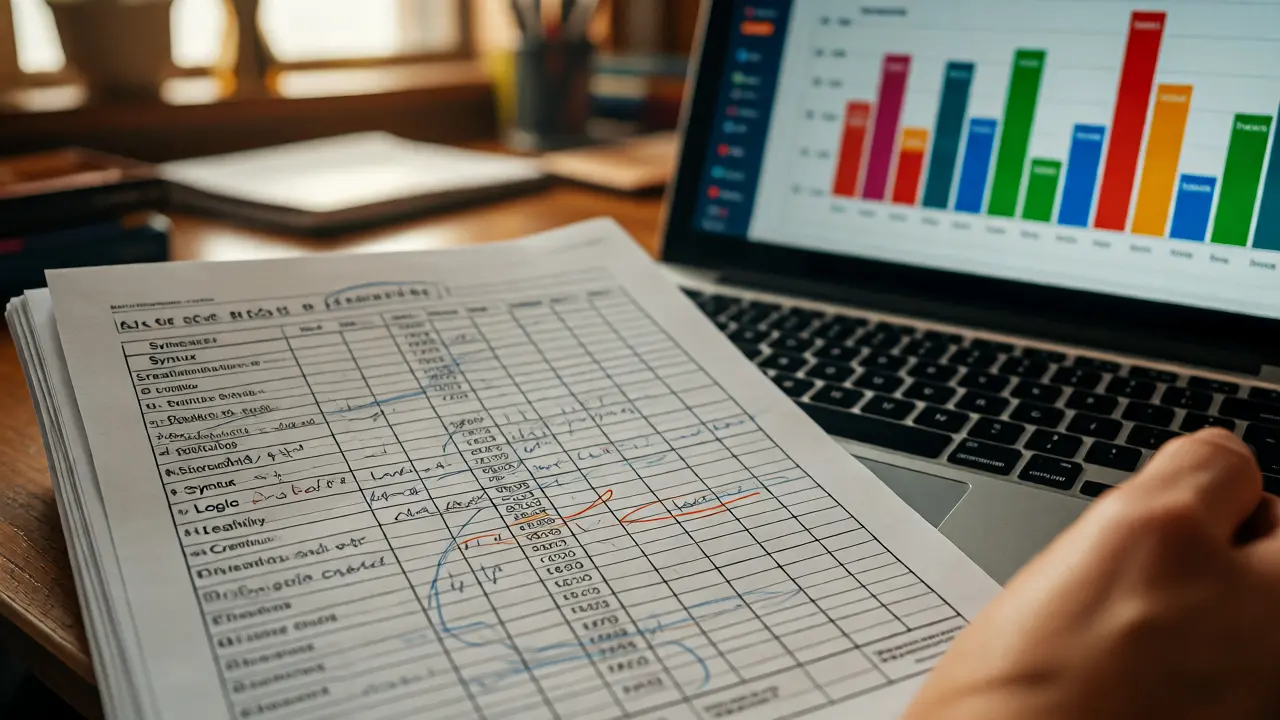
Doing this manually for 100 students is a nightmare. Imagine trying to calculate the average score for “Critical Thinking” across three assignments for every single student in Excel. You’ll lose your mind. This is where Learning Management Systems (LMS) with built-in analytics save the day.
Modern LMS platforms like Canvas, Blackboard, or Moodle have evolved beyond simple file repositories. They now offer detailed dashboards. You can tag every quiz question with a specific SLO. The system then automatically generates reports showing which outcomes were met and which weren’t. If 80% of your class failed the questions tagged “Statistical Significance,” you know exactly where to focus next week’s lecture.
But don’t stop at the LMS. Specialized tools exist for deeper analysis. Tools like Turnitin Feedback Studio allow you to create custom rubrics that integrate directly with plagiarism checking. Meanwhile, coding platforms like Replit or GitHub Education provide real-time feedback on code quality, mapping commits and pull requests to specific competency standards.
Implementing a Tracking System Without Burning Out
The biggest barrier to SLO tracking isn’t technology-it’s workload. Teachers are already drowning. If your new system adds ten hours of paperwork a week, it will fail. Keep it simple.
Start small. Pick one course. Define three key outcomes. Tag your existing assessments to those outcomes. Don’t try to overhaul your entire curriculum overnight. Use existing data first. Most schools have years of grade data sitting dormant in servers. Analyzing past trends can reveal persistent gaps before you even change a lesson plan.
Another pro tip: involve students in the tracking process. When students see their own progress bars against specific outcomes, motivation spikes. It shifts the narrative from “I got a B” to “I’m still working on mastering citation formats.” This transparency builds self-regulated learners, which is a huge win for retention rates.
Common Pitfalls and How to Avoid Them
Even with the best tools, things go wrong. Here are the traps I’ve seen repeatedly in UK universities and colleges.
Outcome Misalignment: Your exam tests memory, but your outcome says “critical thinking.” Students ace the test but fail to apply concepts in real-world scenarios. Always align assessment types with outcome verbs. If the verb is “create,” the assessment must require creation, not selection.
Data Paralysis: Collecting too much data leads to ignoring all of it. Focus on the top three outcomes that matter most for accreditation or student success. Ignore the rest until you have capacity.
Lack of Action Loop: Tracking without acting is just record-keeping. Schedule regular review meetings-monthly or termly-to discuss the data. Decide on one specific intervention based on the numbers. Then check if it worked next term.
Future Trends: AI and Adaptive Learning
We are moving toward hyper-personalized tracking. In 2026, AI-driven platforms can detect when a student is struggling with a specific sub-skill before they even submit an assignment. By analyzing click patterns, time-on-task, and error types, these systems predict failure risk with surprising accuracy.
Adaptive learning engines adjust content in real-time. If a student fails a quiz on “Photosynthesis,” the system doesn’t just give a lower score; it serves up a micro-lesson on light-dependent reactions. This creates a dynamic feedback loop where tracking drives immediate remediation. It’s efficient, scalable, and increasingly affordable for institutions of all sizes.
What is the difference between learning objectives and learning outcomes?
Objectives describe what the instructor intends to teach (e.g., "The instructor will cover cell division"). Outcomes describe what the student will be able to do after instruction (e.g., "The student will model the phases of mitosis"). Tracking focuses on outcomes because they are measurable behaviors.
Do I need expensive software to track student learning outcomes?
Not necessarily. While dedicated analytics platforms offer advanced features, you can start effectively using spreadsheets and rubric templates within your current LMS. Many free tools like Google Forms combined with Sheets can handle basic tagging and aggregation for smaller classes.
How often should I review SLO data?
Ideally, review data mid-semester to make timely adjustments. Waiting until the end of the term is often too late to help the current cohort. Mid-term reviews allow you to intervene with extra resources or revised explanations for struggling groups.
Can peer assessment accurately track learning outcomes?
Yes, if structured correctly. Peer assessment works well for outcomes related to collaboration, communication, and critical evaluation. However, it requires clear rubrics and training for students to ensure consistency. It complements, rather than replaces, expert assessment.
How does SLO tracking impact accreditation?
Accreditation bodies require evidence of continuous improvement. SLO tracking provides this by showing trends over multiple cohorts. Demonstrating that you identified a gap, implemented a change, and measured its effect satisfies rigorous accreditation standards.
