
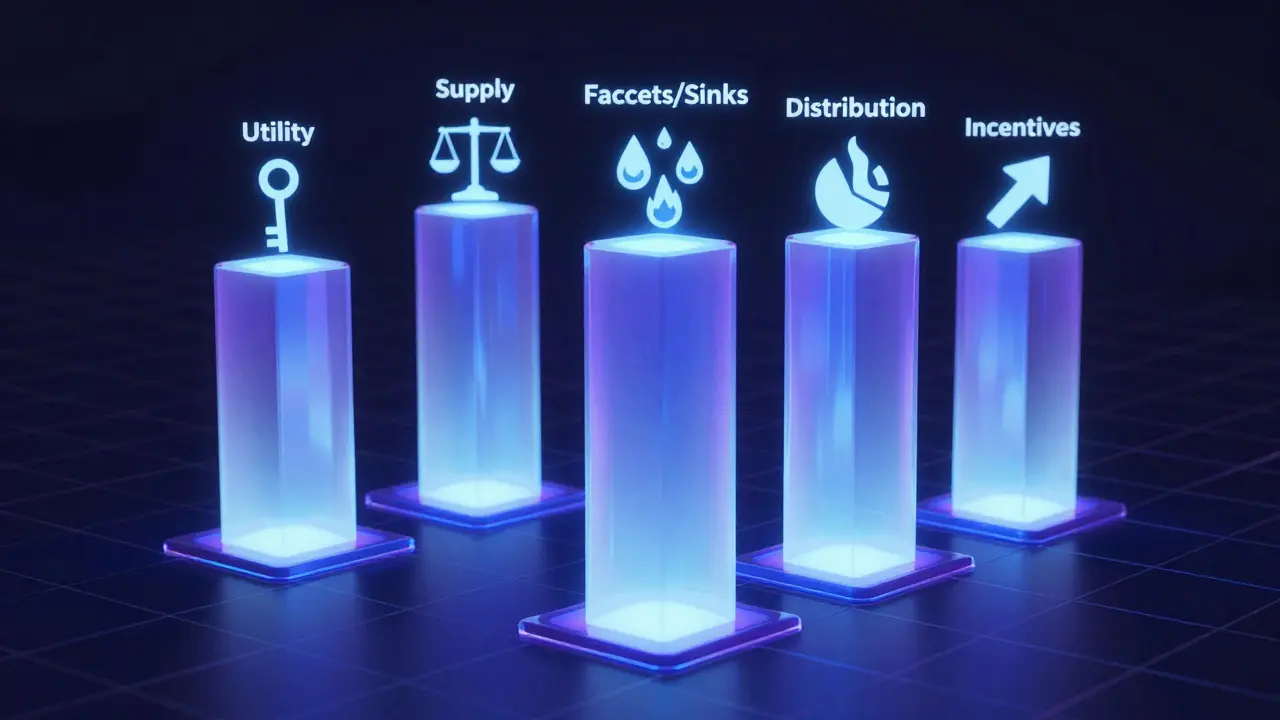
You’ve probably seen it happen. A new crypto project launches with a lot of hype. The price spikes. Then, six months later, the chart looks like a cliff face. Why? Usually, it’s not because the technology was bad. It’s because the tokenomics is the economic blueprint that defines how a digital token is created, distributed, used, and valued over time were broken from day one.
Tokenomics isn’t just about setting a price or picking a total supply number. It’s the entire operating system for your project’s economy. If you get it wrong, you end up with a system where everyone wants to sell, no one wants to hold, and the network dies. If you get it right, you build a self-sustaining ecosystem where users, developers, and investors all win.
The Five Pillars of Token Design
Think of tokenomics as building a small country. You need laws (governance), currency (supply), jobs (utility), taxes and benefits (incentives), and a fair way to distribute wealth (distribution). Most failed projects ignore at least one of these pillars. Here is how to nail each one.
1. Define Real Utility First
Before you write a single line of code, ask yourself: What does this token actually do? If the answer is "nothing, it just goes up in value," you’re building a casino, not a protocol. Token utility is the practical function a token serves within its ecosystem, such as paying fees, granting governance rights, or providing access to services.
Strip away the speculation. What needs the token?
- Payments: Does it pay for gas fees or transaction costs on the network?
- Governance: Does holding it give you a vote on future upgrades?
- Access: Does it unlock premium features or exclusive content?
- Collateral: Can it be locked to borrow other assets?
If your token has multiple utilities, great. But make sure at least one of them is essential. If users can use your platform without ever touching the token, why would they buy it? The token must be the key that unlocks the door.
2. Master the Supply Dynamics
Supply is the most misunderstood part of tokenomics. People obsess over whether a token has a fixed cap (like Bitcoin) or an infinite supply (like Ethereum). The truth? Neither is inherently better. It depends on your goals.
| Model Type | How It Works | Best For | Risk Factor |
|---|---|---|---|
| Fixed Supply | Total tokens are minted at launch; no new ones are created. | Store of value, digital commodities. | No revenue generation mechanism; relies purely on scarcity. |
| Inflationary | New tokens are issued regularly to reward validators/stakers. | Security-heavy networks, staking protocols. | Dilutes holder value if demand doesn't grow faster than inflation. |
| Hybrid / Deflationary | Tokens are issued but also burned (destroyed) via fees or buybacks. | Platforms with high transaction volume. | Complex to balance; requires consistent usage to work. |
The key metric here isn’t just total supply-it’s circulating supply. If you have 1 billion tokens but 90% are locked up for five years, the market only sees 100 million. This creates artificial scarcity. Be transparent about your vesting schedules. Hidden unlocks are the fastest way to lose trust.
3. Balance Faucets and Sinks
This is the engine room of your economy. You need to manage the flow of tokens in and out of circulation.
Faucets emit new tokens. Think staking rewards, liquidity mining bonuses, or team allocations being unlocked. Faucets increase supply. If you have too many faucets open, you flood the market, and the price crashes.
Sinks remove tokens. These are mechanisms like burning transaction fees, buying back tokens with protocol revenue, or locking tokens permanently for governance stakes. Sinks create deflationary pressure.
A simple rule of thumb: Your sinks must eventually match or exceed your faucets as the network matures. If you’re constantly printing money to pay users but never taking any back, you’re heading for hyperinflation. Look at models that burn a percentage of every transaction fee. That ties token value directly to network activity. More usage = more burns = higher potential value.
4. Distribute Fairly to Avoid Crashes
Who gets the tokens at launch? This decision dictates your community’s health for years. A common mistake is giving too much to insiders (team and early investors) and too little to the community.
Here is a healthy benchmark for initial allocation:
- Community & Liquidity: 40-60%. This ensures there’s enough token in the wild to trade and use.
- Team & Advisors: 10-20%. Enough to stay motivated, but not enough to dump on retail.
- Investors: 10-30%. Capital is needed, but don’t let VCs control the network.
- Treasury: 5-15%. Reserved for future development and emergencies.
Critical tip: Use long vesting periods. If the team holds 15% of the supply, lock it up for two years with a six-month cliff. This shows you believe in the long term. If the team can sell everything on day one, why should anyone else hold?
5. Align Incentives with Behavior
Incentives drive action. But bad incentives drive the wrong action. If you offer 100% APY in staking rewards funded by new token issuance, you attract mercenaries, not missionaries. They’ll farm the yield and dump the token the second the rate drops.
Design incentives that reward real contribution:
- Staking for Security: Reward users who lock tokens to secure the network, but penalize them (slashing) if they act maliciously.
- Governance Rights: Give voting power to long-term holders. Make short-term trading less attractive by tying significant influence to time-locked stakes.
- Fee Discounts: Offer lower transaction fees for users who hold or stake the native token. This creates a direct financial reason to keep the token rather than sell it.
Ask yourself: Does this incentive encourage behavior that makes the network stronger, or does it just move money around?

Common Pitfalls to Avoid
Even experienced builders fall into these traps. Watch out for them.
The "Speculative Utility" Trap: Creating a token just so people can trade it. Without real-world use cases, the token becomes a zero-sum game. One person’s gain is another’s loss. Sustainable economies require positive-sum games where value is created through usage.
Ignoring Regulatory Risk: In 2026, regulators are watching closely. If your token promises passive income based on the efforts of others, it might be classified as a security. Build compliance into your design. Decentralized governance and clear utility help mitigate this risk.
Static Design: Economies change. Your tokenomics shouldn’t be set in stone forever. Build adaptive governance mechanisms that allow the community to adjust parameters like emission rates or fee structures as the network evolves. Hard-coded rules often break under unexpected market conditions.

Testing Before You Launch
Never launch without stress-testing. Use simulations to model different scenarios. What happens if the price drops 50%? Do stakers panic-sell? What if adoption grows ten times faster than expected? Do you run out of liquidity?
Run these numbers. Adjust your faucets and sinks. Test your distribution schedule. The cost of fixing a bug in a spreadsheet is nothing compared to the cost of fixing a broken economy after mainnet launch.
Tokenomics is the bridge between technology and human behavior. Get the tech right, and you have a product. Get the tokenomics right, and you have a movement.
What is the difference between tokenomics and economics?
Economics is the broad study of how societies produce, distribute, and consume resources. Tokenomics is a specialized subset focused specifically on digital tokens. It deals with the unique mechanics of blockchain assets, such as smart contract-enforced supply caps, algorithmic issuance, and decentralized governance, which don't exist in traditional fiat systems.
Why is circulating supply more important than total supply?
Total supply includes all tokens that will ever exist, including those locked up or not yet minted. Circulating supply represents the tokens actually available for trading and use in the market. Market capitalization is calculated using circulating supply. A low circulating supply with a high total supply can indicate future inflationary pressure when locked tokens are released, potentially crashing the price.
How do I calculate if my token's inflation is sustainable?
Compare your annual token emission rate (faucet output) against the projected growth in network demand and sink mechanisms (burns/fees). If emissions consistently outpace the removal of tokens and organic demand growth, inflation will dilute holder value. Aim for a model where sinks begin to offset faucets as user activity scales, leading to neutral or deflationary pressure over time.
What is a vesting schedule and why does it matter?
A vesting schedule dictates when tokens allocated to teams, investors, or advisors become tradable. It matters because large, sudden releases of tokens (unlocks) can flood the market with sell pressure. Long vesting periods with gradual cliffs align insider interests with long-term project success and protect retail investors from immediate dilution.
Can a token have both fixed supply and staking rewards?
Yes, but the rewards must come from existing circulating supply, not newly minted tokens. For example, a portion of transaction fees collected by the protocol can be redistributed to stakers. This maintains the fixed total supply while still providing incentives. Alternatively, some projects use a hybrid model where a small percentage is minted for security, balanced by aggressive burning mechanisms.

Comments (12)
Patrick Dorion June 16 2026
It is fascinating to observe how the abstract concepts of game theory manifest so brutally in these digital economies. The distinction between a protocol and a casino often hinges on whether the utility is intrinsic or merely speculative. When we examine the faucet and sink dynamics, we are essentially looking at the metabolic rate of the network itself. If the metabolism is too fast without sufficient nutrient intake from sinks, the organism collapses. I have seen many projects fail not because the code was flawed, but because the economic incentives rewarded short-term extraction over long-term stewardship. The vesting schedules mentioned here are critical for aligning the temporal horizons of insiders with the community. Without that alignment, you have a principal-agent problem on a massive scale.
Michael Richards June 18 2026
This article reads like it was written by someone who has never actually launched a token. You talk about 'fair distribution' as if it is a moral imperative rather than a mathematical necessity for liquidity. Most founders know that giving 40-60% to the community means you will be diluted into irrelevance before you even ship version one. VCs do not put money into projects where they do not have control. If your team cannot dump on retail, you are weak. The market respects strength, not hand-holding. Stop trying to build Utopia and start building a product that makes money.
Laura Davis June 19 2026
Wow, Michael, that is some serious negativity right there!
I completely disagree with the idea that control equals strength. In fact, true strength comes from having a community that believes in the vision enough to hold through volatility. When you lock up tokens for two years, you are showing confidence, not weakness. It builds trust. Trust is the currency of crypto, more so than any coin. If you treat your users like ATMs, they will leave the second the yield drops. We need to focus on sustainable ecosystems, not just quick exits. Let's keep the conversation constructive, okay?
Michael Richards June 19 2026
Laura, please save the therapy speak for your diary. The market does not care about your feelings or your 'trust'. It cares about supply and demand. If the team locks their bags, the price stagnates because there is no insider buying pressure signaling conviction. Retail buys when insiders buy. Simple economics. Your 'constructive' approach is exactly why half of these projects die in winter. Cut the fluff.
Lisa Nally June 21 2026
Oh my goodness, can we all just take a deep breath?
The issue here is clearly a lack of understanding regarding token velocity and equilibrium states. Michael is being aggressively reductive, while Laura is overly sentimental. The reality lies in the sophisticated interplay of emission schedules and burn mechanisms. As the post correctly identifies, sinks must eventually exceed faucets. This is not opinion; it is basic macroeconomic theory applied to closed-loop systems. Those who ignore this are simply gambling, not investing. Please educate yourselves before commenting.
Oskar Falkenberg June 22 2026
i think what everyone is missing here is the human element of all this technical jargon. its easy to talk about faucets and sinks but hard to remember that real people are losing their savings when these models fail. i have been following crypto since the early days and i have seen so many good ideas ruined by bad incentives. the author is right about vesting though. if the team can sell day one nobody trusts them. we need more transparency and less hype. also the table in the post was really helpful for visualising the different supply models. thanks for sharing this.
Stephanie Frank June 23 2026
Another generic guide written by someone who probably bought in at the top. The 'five pillars' are obvious to anyone who has read a whitepaper. What this misses is the regulatory hammer coming down in 2026. You can have perfect tokenomics, but if the SEC decides your governance token is a security, none of it matters. Burn mechanisms don't protect you from lawsuits. Vesting schedules don't stop delistings. This entire industry is built on sand and you are all arguing about the color of the castles.
Lisa Puster June 23 2026
the american obsession with regulating every aspect of life is suffocating innovation. europe is already behind and now you want to stifle growth further. tokenomics is a tool for freedom not a target for bureaucrats. if your project is solid it will survive regardless of what washington says. stop whining about regulations and start building better tech. the global south is moving forward while you argue about compliance
Caitlin Donehue June 23 2026
I wonder if the author has considered how AI-driven trading bots might disrupt these traditional faucet and sink models. With algorithms reacting in milliseconds, human-designed incentives might become obsolete almost instantly. It seems like we are playing chess against supercomputers while still using wooden pieces.
Keith Barker June 23 2026
utility is a myth. price is the only utility. everything else is noise. people buy because they want to get rich not because they want to vote on upgrades. admit it.
Robert Barakat June 25 2026
To say price is the only utility is to misunderstand the nature of value itself. Value is derived from consensus and utility is the anchor of that consensus. Without utility, price is purely speculative and therefore unstable. The question is not whether people want to get rich, but whether the system allows them to do so sustainably. A casino pays out winners until it goes bankrupt. A protocol generates revenue. The distinction is vital for the longevity of the asset class.
Marissa Haque June 26 2026
OMG!! This discussion is getting so intense!!!
I love how everyone has such strong opinions! But seriously, the part about testing before launch is SO important!! How many times have we seen a project launch and then immediately rug pull or crash because they didn't test the liquidity pools?! We need more simulation tools for everyday developers!! It’s crazy how complex this stuff is but also how necessary it is!! Let’s keep learning together!!!