
Imagine building a custom sword in a video game. In most titles, that sword exists only on the developer's server. If they shut down the servers or change the rules, your creation vanishes. User-Generated Content (UGC) in blockchain games promises something different: true ownership, portability, and the ability to monetize your creativity directly. But does it actually work? As of late 2026, the landscape is fragmented, experimental, and often confusing for newcomers. This guide cuts through the hype to explain how modding and UGC actually function in Web3 environments, what you can realistically build, and where the pitfalls lie.
The Core Promise vs. The Reality
Traditional modding has been around for decades. Think of Roblox, a centralized platform where creators earned over $1.5 billion in 2025. It’s massive, but it’s controlled by one company. You don’t own your code; you rent space on their infrastructure. Blockchain games aim to shift this power dynamic. By recording assets on a public ledger, these games claim to give players verifiable proof of ownership and the potential to move items between different games.
However, "ownership" in blockchain gaming is nuanced. Owning an NFT (non-fungible token representing digital uniqueness) usually means you own a receipt, not necessarily the copyright or the underlying art file. Most blockchain games still rely on centralized servers for gameplay logic. If the team behind the game disappears, your NFT might still exist on the chain, but the game world that gives it meaning could be gone. The real value proposition isn't just holding a token; it's about provenance (the history of ownership and creation) and interoperability (the ability to use assets across different platforms).
Four Ways Players Create Content
Not all UGC is created equal. There are four distinct models currently operating in the blockchain space, ranging from simple asset creation to complex code modification.
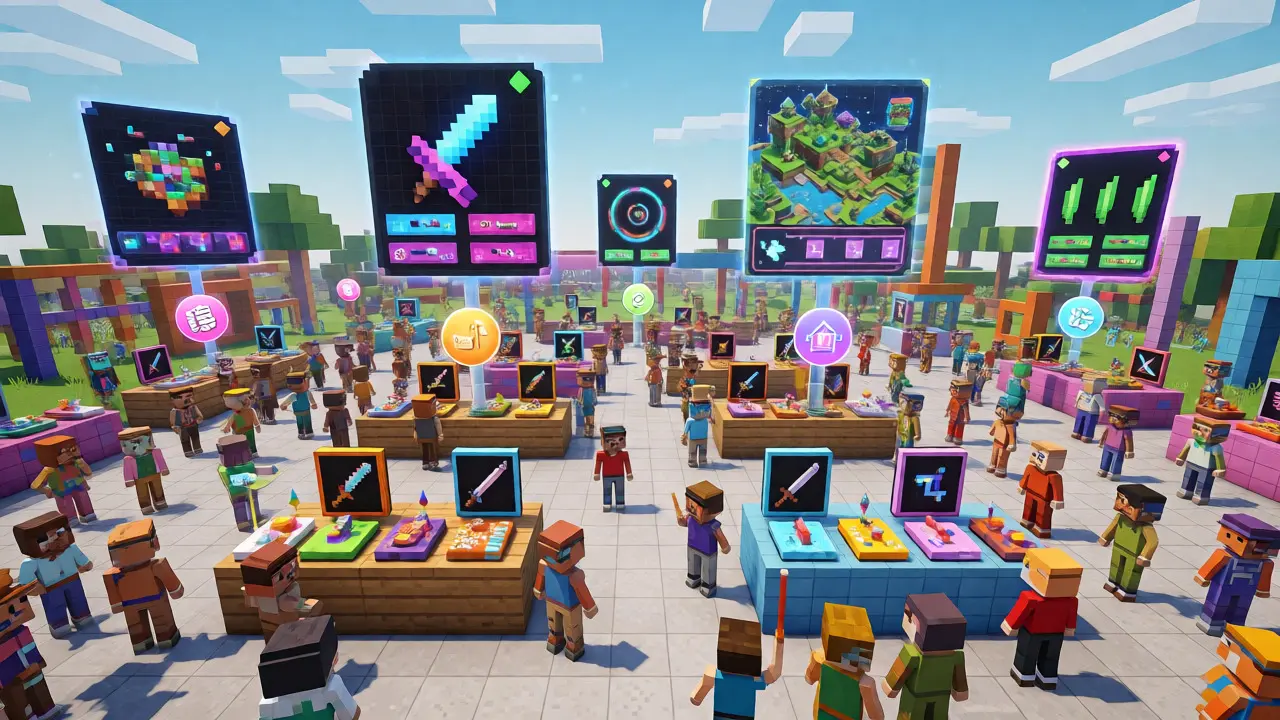
- On-Chain Asset Registration: This is the most common model. Players create skins, weapons, or land parcels. The visual data lives off-chain (on servers like IPFS or AWS), but the ownership record is on the blockchain. Platforms like The Sandbox (a voxel-based virtual world) use this heavily. You can mint your creation as an NFT and sell it, but the game engine controls how it looks and behaves.
- No-Code Creator Platforms: Tools like Decentraland’s Editor allow users to build scenes without writing code. These are great for designers who want to create experiences but lack programming skills. The output is a scene file published to a marketplace.
- SDK-Based Development: For those with technical skills, Software Development Kits (SDKs) offer more control. Decentraland SDK 7 (the current development framework for the platform) allows developers to write TypeScript scripts that interact with smart contracts. This enables complex mechanics, like token-gating doors or dynamic lighting based on wallet balances.
- Runtime Game-Rule Modification: This is the frontier. Games like EVE Frontier (an MMO utilizing blockchain for state verification) allow players to write code that affects the shared game world. These "Smart Assemblies" aren't just cosmetic; they change how the game plays for everyone connected to them.
Case Study: EVE Frontier and True Modding
If you want to see what actual blockchain modding looks like, look at EVE Frontier. Unlike The Sandbox, which is largely a creative sandbox for static assets, EVE Frontier integrates player code into its core loop. In 2026, a mod contest saw winners like CradleOS receive $25,000 for creating civilization-management tools. Other winners built bounty systems and territory control mechanics.
This approach uses a hybrid architecture. Heavy lifting-like physics calculations and rendering-happens on traditional servers to keep latency low. However, critical state changes are verified on the blockchain. This means if a player creates a new rule via a Smart Assembly, other players can verify its legitimacy independently. It’s powerful, but it introduces complexity. Writing code that affects thousands of other players requires rigorous testing. A bug in a player-made mod can crash the local shard or break the economy.
The Economics of Creation
Can you make money? Yes, but the numbers vary wildly. Centralized platforms like Roblox offer massive reach but take significant fees. In contrast, blockchain platforms often offer higher revenue shares but smaller audiences.
| Platform Type | Creator Revenue Share | Audience Size | Technical Barrier |
|---|---|---|---|
| Roblox (Centralized) | ~30-70% (varies by context) | Massive (Millions daily) | Low to Medium |
| The Sandbox (Hybrid) | Dependent on LAND/NFT sales | Niche (Hundreds of thousands) | Medium (VoxEdit/Game Maker) |
| Decentraland (Hybrid) | 97.5% Primary / 2.5% Secondary | Niche (Tens of thousands) | Medium to High (SDK 7) |
| EVE Frontier (Programmable) | Contest prizes & market sales | Very Niche (Thousands) | High (Coding required) |
Notice the trade-off. Decentraland offers a generous 97.5% cut on primary sales, but the total volume is a fraction of Roblox’s billions. Blockchain gaming funding dropped significantly in 2025, falling from $857 million to $544 million according to Chainplay. This suggests that while the technology works, the speculative bubble has burst, leaving room for serious creators rather than quick flippers.
Pitfalls: Ownership, Interoperability, and Security
Before you start coding, understand the risks. The biggest myth is seamless interoperability. Just because you have an NFT sword doesn't mean you can equip it in a racing game. Different games use different art pipelines, physics engines, and schemas. A portable NFT is often technically transferable but practically unusable outside its original ecosystem.
Security is another major concern. Smart contracts can have exploits. Wallet phishing remains the number one way players lose assets. When you interact with a new dApp or mod, you’re granting permissions to a piece of code. If that code is malicious, it can drain your funds. Always check the reputation of the creator and audit the contract if possible.
Governance is also tricky. Who moderates bad content? In centralized games, the dev team bans toxic players. In decentralized worlds, governance is often handled by DAOs (Decentralized Autonomous Organizations). This process is slow and prone to voter apathy. Malicious mods or spammy assets can clutter the marketplace until the community votes to remove them.
Getting Started: A Roadmap for Creators
Ready to dive in? Here is a practical path forward based on your skill set.
- Choose Your Layer: Are you an artist, a designer, or a coder? Artists should look at The Sandbox’s VoxEdit. Designers might prefer Decentraland’s no-code editor. Coders should explore EVE Frontier’s SDK or Ethereum-compatible chains like Polygon or Sui.
- Learn the Toolset: Download the editors. For Decentraland, install Creator Hub. For The Sandbox, get VoxEdit. Spend two weeks just making small objects. Don’t try to build a full MMORPG on day one.
- Understand the Wallet: Set up a secure hardware wallet. Learn how to sign transactions. Understand gas fees-even on low-cost chains like Polygon, fees add up during development iterations.
- Start Small: Create a single wearable item or a simple interactive prop. Mint it as an NFT. List it on the secondary market. See if anyone buys it. This validates demand before you invest months of work.
- Join the Community: Discord is the town square for blockchain games. Ask questions. Participate in hackathons. EVE Frontier’s recent contests showed that active participation leads to both recognition and rewards.
The Future: Programmable Worlds
We are moving away from static collectibles toward programmable worlds. The next generation of blockchain games won't just let you buy a skin; they’ll let you rewrite the rules of gravity or introduce new economic policies via smart contracts. This requires better tooling. Current SDKs are still clunky compared to Unity or Unreal Engine. But as standards emerge, the barrier to entry will drop.
For now, treat blockchain UGC as an experiment. It offers unique benefits in provenance and settlement, but it lacks the polish and audience size of traditional platforms. If you enjoy tinkering with code and believe in open economies, the payoff can be substantial. If you just want to play a fun game, stick to centralized platforms for now.
Does owning an NFT mean I own the copyright?
Usually, no. Owning an NFT typically grants you a license to display or use the asset within specific contexts defined by the project. Commercial rights vary widely by project terms and conditions. Always read the specific license agreement associated with the collection.
Is interoperability guaranteed between blockchain games?
No. While the token standard (like ERC-721) allows the same ID to exist on multiple chains or games, the actual utility depends on whether each game supports that specific asset type. Art formats, animations, and physics properties rarely translate seamlessly between different game engines.
How much does it cost to publish UGC in blockchain games?
Costs vary by network. On Ethereum mainnet, minting can cost several dollars in gas fees. On Layer 2 solutions like Polygon or Arbitrum, costs are cents. Some platforms, like The Sandbox, cover initial minting costs for certain programs, while others require you to pay for storage and transaction fees upfront.
What happens if a blockchain game shuts down?
Your NFT remains on the blockchain, so you retain the token itself. However, the game client may stop working, meaning you can no longer view or use the asset in its intended environment. Metadata hosted on centralized servers might also become inaccessible if the hosting provider drops support.
Do I need to know how to code to create content?
Not necessarily. Many platforms offer no-code editors for creating scenes and basic interactions. However, advanced features, custom mechanics, and deep integration with smart contracts generally require knowledge of languages like TypeScript, Solidity, or Rust.
